
Poll: Bryce Harper, Manny Machado And The Phillies
On several occasions over the past decade, the Phillies have shown a willingness to spend among the league’s elite. However, because the Phillies were recently amid a full-fledged rebuild, the big-market club took major steps backward in the spending department. Last year, with Philadelphia aiming to make a sizable leap in the standings, the team began with a modest $95MM-plus in commitments. Two expensive signings from last offseason – right-hander Jake Arrieta (three years, $75MM) and first baseman Carlos Santana (three years, $60MM) – easily served as the Phillies’ priciest players in 2018, and the duo did help the team make legitimate progress. The Phillies notched their best record since 2012 (80-82), totaling 14 more wins than they amassed in 2017, but they finished under .500 for the sixth consecutive season and extended their playoff drought to seven years.
Santana is now on the block, though his potential exit isn’t a sign that the Phillies are looking to cut costs. Quite the contrary, actually, as owner John Middleton has publicly declared that the Phillies won’t be bashful when it comes to doling out money. In fact, while discussing the Phillies’ offseason plans on Friday, Middleton proclaimed that “we’re going into this expecting to spend money. And maybe even be a little bit stupid about it. We just prefer not to be completely stupid.”
Even before Middleton made it known that Philadelphia’s looking to go big-game hunting, expectations were that the franchise would spend aggressively this winter. After all, the open market now features two of the most enticing free agents ever in outfielder Bryce Harper and infielder Manny Machado. Combining the Phillies’ spending capabilities with the lack of guaranteed money on their books beyond 2020, pursuits of both Harper and Machado have seemed like foregone conclusions. Both players stand a strong chance of surpassing the richest contract in baseball history – the 13-year, $325MM extension outfielder Giancarlo Stanton signed with the Marlins in 2014 – and the Phillies are among the teams truly capable of spending that type of cash. What’s more, if any one organization is going to sign both Harper and Machado, the Phillies are on a very short list of realistic possibilities.
The need for Harper, Machado or both in Philadelphia is obvious, as either player would clearly boost a position player group which ranked 22nd in runs and 23rd in fWAR in 2018. The Phillies’ 48 hitters accounted for 12.4 fWAR, while Machado (6.2) and Harper (3.5) combined for 9.7 by themselves. The two 26-year-olds have been among the game’s most feared hitters throughout their decorated careers, though Machado has also provided plenty of value as a third baseman. The former Oriole and Dodger would do the same in Philadelphia, which got so-so production at the hot corner from Maikel Franco, current free agent Asdrubal Cabrera and J.P. Crawford, among others, in 2018. Franco’s now penciled in as the Phillies’ 2019 starter at third, but that spot’s ripe for an upgrade.
Philadelphia is seemingly even worse off at shortstop, Machado’s preferred position and where he spent the majority of last season. Machado didn’t have a banner year defensively, but he did place first among shortstops in wRC+ (141) and second in both home runs (38) and fWAR. The Phillies, on the other hand, received a microscopic 0.7 fWAR from shortstops Scott Kingery, Crawford, Cabrera and Pedro Florimon, and their combined wRC+ (74) was barely more than half of Machado’s.
Fortunately for the Phillies, their 2018 outfield wasn’t as toothless as the left side of their infield. That doesn’t mean it’s an area of strength, however. Aside from slugger Rhys Hoskins, who overcame horrific defense to log a respectable fWAR (2.9), the Phillies got mediocre or worse overall production from outfield regulars Odubel Herrera, Nick Williams, Roman Quinn and Aaron Altherr. Going forward, Hoskins may shift to first base, which explains the team’s willingness to trade Santana and could increase the need for Harper or another high-end outfielder. Harper, like Hoskins, had a year to forget in the field. Defensive ineptitude has hardly been the norm for Harper since he debuted in 2012, though, and he made up for it to an extent by notching another quality year at the plate.
Signing Harper would improve the Phillies’ near-term chances of returning to contention, and there’s an added bonus: Landing him would be a blow to the division-rival Nationals, Harper’s only team to date. The Nats, the reigning NL East champion Braves and the Mets will each push for supremacy in the division next season, but the Phillies could wind up as the favorites if general manager Matt Klentak uses Middleton’s money effectively this winter. While there are plenty of avenues Klentak could explore that don’t involve Harper or Machado, speculation about those two heading to Philadelphia will persist until they officially come off the market.
Will the Phillies land Harper, Machado or both?
-
They won't sign either player 31% (4,791)
-
They'll sign Harper 29% (4,513)
-
They'll sign Machado 23% (3,489)
-
They'll sign both 17% (2,588)
Total votes: 15,381
Poll: Which Team Will Sign Patrick Corbin?
Free agent lefty Patrick Corbin is arguably the top hurler on the market this offseason. The former Diamondback timed his ascension to dominance perfectly last season, posting career bests in strikeout rate (11.07 K/9), HR/9 (0.68), FIP (2.47), xFIP (2.61), ERA (3.15), fWAR (6.3) and games started (33) in a pivotal walk year for the 29-year-old. If not for the staggering wire-to-wire performance of Mets righty Jacob deGrom, Corbin’s defense-independent pitching marks would have paced the Senior Circuit, besting even the perennial virtuosity of two-time defending Cy Young Award winner Max Scherzer of the Nationals. In a free agent class replete with everything but top-end arms, Corbin has positioned himself squarely at the top: as our own Tim Dierkes, Steve Adams, and Jeff Todd see it, the hurler is the premier available starting pitcher, set perhaps to command a deal in excess of $125MM over multiple seasons.
Signs of caution, however, do mark the landscape. Though Corbin has fewer innings under his belt than most starters his age, the limited output came with a price – a Tommy John surgery following a breakout 2013 campaign knocked out all of the following season, plus half of the next, and a hopeful rebound in 2016 was derailed by shaky command and a dangerous propensity for giving up the gopher ball. Corbin also relies heavily on a wipeout slider that ranked as the league’s very best in 2018: after a lessened reliance on the pitch in the two-year aftermath of the surgery, the lefty has again ramped up its use, throwing it a shocking 41.3% of the time in 2018, the second-highest among all starting pitchers in baseball last year. The pitch, of course, is renowned for the stress it places on the thrower’s elbow, and has long been circumstantially linked to the UCL tear that precipitates Tommy John.
There’s also the body of work. Never a top prospect, Corbin seemed, after nearly 750 IP at the major-league level following the 2017 season, to have settled comfortably in a place quite near his long-ago projected role: Baseball America reports in 2010 and 2011 pegged him as a “number 3 or four” and “number four” starter, respectively, and the lefty’s minor league performance did little to discredit that view. Acquired from the Angels in a 2010 deadline deal that sent Dan Haren to Los Angeles, Corbin was a secondary piece in the return headlined by former top prospect Tyler Skaggs. The slider-slinging lefty did offer a quality 2013 season, posting an ERA/FIP/xFIP all between 3.40 and 3.50, but the performance coincided with a near all-time offensive low across the league – his park- and league-adjusted xFIP that year, after all, was just eight percent better than league average.
There were more stumbles to follow. A partial-year renaissance in 2015 was followed, in the middle of the next season, by a demotion to the bullpen; despite a career-high 53% ground-ball rate, Corbin’s walk rate ballooned to near four per nine, and he was too often bit by the long ball. Heavier slider use ushered in another rebound in 2017, but shades of last year’s dominance were still scarce: at the conclusion of that season, Patrick Corbin had, in 745 innings pitched, vindicated the scouts’ reports, offering up a perfectly harmonious 97 ERA-/97 FIP-, three percent better than the league average. ZiPS projected to hurler to be slightly better in the 2018 season, pegging him for a 94 ERA-/95 FIP- in the newly-humidor-scarred Chase Field.
So what, then, will teams make of the innings-eater-turned-ace in the new-look pitching environment? Will heavier bullpen dependence suppress the value of starting pitchers across the board? Will teams hold his mostly-middling ways against him, dismissing the recent ascension as outlier? Will the slider-heavy profile give them pause? Or will they double down, certain they’re acquiring a staff-leading ace far into the next decade? And, most notably for this piece, which teams seem mostly likely to fall into the category of the latter?
The Yankees, unsurprisingly, may be his top suitor. Corbin, who was raised outside Syracuse, NY, grew up a Yankee fan: “It would definitely be great to play there,’’ he told Bob Nightengale of the USA Today earlier this year. “I grew up a Yankee fan. My whole family are Yankee fans. My mom, my dad, my grandpa, everybody. Really, every generation of my family has been Yankee fans. Living up in Syracuse, everybody’s a Yankee fan. Not too many Mets fans up there.’’ The Bombers, who recently re-signed C.C. Sabathia for one final year, still face questions in the rotation’s back half, where a disappointing 2018 performance from Sonny Gray has left him squarely on the the block. The fit between the storied franchise and New York native seems an ideal one, especially in a park that rewards left-handed power like few others – Corbin, for his career, has been death on lefties, striking out nearly 31% of them and allowing just 20 total HR, good for a minuscule 2.54 xFIP against. The Yanks, who last year failed to eclipse the luxury-tax threshold for the first time in 15 seasons, seem primed and ready to make their periodic splash, but whether or not a free agent hurler is foremost in their efforts remains to be seen.
Next in line may be the Phillies, whose team ownership has made no attempt to hide its fervent pursuit of the market’s top assets, with principal owner John Middleton noting that the club could be “a little bit stupid about it.” After a systematic payroll reduction over the last few seasons, the Phillies finally re-announced their presence as a major offseason player with last year’s signing of Jake Arrieta, and again seem ready to pounce in the more bountiful class of 2018-’19. The rotation, which in ’18 had one of the league’s widest ERA-FIP gaps, likely due in large measure to the shoddy left-side defense of Rhys Hoskins, Maikel Franco, and Scott Kingery, is chock-full of controllable arms with significant upside, and posted sterling peripherals as a whole last season. Still, uncertainty hovers around the burgeoning careers of righties Nick Pivetta and Vince Velasquez, each of whom turned a second straight season of poor performance on the back of encouraging secondary stats, and Zach Eflin, who was downright dreadful in limited big-league action before 2018. With the club’s top pitching prospects at least a couple years away, and money to burn across the diamond, the Fightins may elect to prop up an area of strength as they enter a pivotal 2019.
The Braves could also be a major player here, what with the windfall they’ve received from increased attendance at their new Smyrna, GA, home, and question marks all across the rotation. After Mike Foltynewicz, the organization has little on which it can count next season – Kevin Gausman and Julio Teheran sprinted to the big leagues oozing promise, but have been mostly uneven since, and heralded rookie Sean Newcomb again battled the command issues that had so often plagued him in the minors. Touki Toussaint was a nice surprise, but he walked nearly seven men per nine in a brief MLB stint last season, and Calgary-born Mike Soroka spent much of the season’s second half on the shelf. The farm is brimming with starting pitching talent of all types, but none have asserted themselves as MLB-ready for 2019. There’s been little indication from GM Alex Anthopolous that the club is looking to make a major splash, but the up-and-coming Braves seem as good a fit as any for the 29-year-old Corbin, should the team decide to move in that direction.
The Astros, perhaps set to lose Dallas Keuchel and Charlie Morton to free agency, could also be a factor. Both Justin Verlander and Gerrit Cole are free-agents-to-be following the 2019 season, Lance McCullers Jr. just underwent Tommy John surgery and will miss the ’19 season, and the club’s glut of upper-level starting pitching depth has dwindled in recent years. With GM Jeff Luhnow announcing that the club will move Collin McHugh back to the rotation, two spots are still in flux. Luhnow seemed cryptic when asked about a possible increase in the 2019 payroll, but with so many rotation question marks in the years to come, a top-level arm would seem an ideal fit for the 2017 champions.
The Nationals, who’ve seen a once-historic rotation dwindle to just Max Scherzer, Stephen Strasburg, and possible non-tender candidate Tanner Roark, plus a series of who-knows and could-bes, also have the money and the need, should the club decide to pivot away from Bryce Harper. Still, with a whopping $245MM combined owed to Scherzer and Strasburg over the life of their deals, signing another high-priced starter would seem exceedingly unlikely.
Other teams, like the Dodgers, Twins, Giants, and Angels could be in play, to a lesser degree. Los Angeles has the money, of course, but has been loath to shell it out to a high-priced free agent from outside the organization under GM Andrew Friedman’s watch, and the club is already stocked with quality left-handed arms. The Twins have stripped their payroll to nearly nothing in recent years, but still have a bevy of intriguing rotation options and numerous holes on the offensive side. The Giants, of course, had the league’s highest payroll last season, but still owe over $120MM combined to Jeff Samardzija and Johnny Cueto, and don’t figure to be players in the offseason starting pitching market. The Angels, devoid now of anything resembling a top-end arm after Shohei Ohtani‘s Tommy John surgery, could be a background lurker, though the club is still saddled with Albert Pujols‘ albatross for another three seasons and may find other needs more urgent.
Which team will be the one to pull the trigger?
Which Team Will Sign Patrick Corbin?
-
New York Yankees 55% (11,212)
-
Other 15% (3,048)
-
Philadelphia Phillies 12% (2,385)
-
Atlanta Braves 8% (1,639)
-
Houston Astros 6% (1,143)
-
Washington Nationals 4% (905)
Total votes: 20,332
Offseason Outlook: San Diego Padres
MLBTR is publishing Offseason Outlooks for all 30 teams. Click here to read the other entries in this series.
The Padres’ were in full rebuild mode by mid-2016, having dealt away any veteran players with value by that year’s trade deadline. Immediate help was not on the way. In fact, it was nowhere close if it even existed. General manager A.J. Preller was going to have his opportunity to build his team from the ground up. Two-and-a-half years later, the Padres have, arguably, the best farm system in baseball and are looking to become legitimate playoff contenders in the next year or two.
Preller is now tasked with putting together a Major League roster that can at least break .500 in 2019 while staying in contention past July 31st. That would be a major step forward for a franchise that has not had a winning season since 2010. The 2018 Philadelphia Phillies, who improved by 14 games from the previous season and didn’t fall out of the pennant race until mid-September, would be a good comparison for what success would look like at the minimum. Matching what the Atlanta Braves did—an 18-game improvement and division championship—would be quite a bit more challenging and represents something like the best-case scenario. Preller’s offseason, which should be very eventful, will have a major effect on whether the team can become a perennial playoff contender and how quickly they can get there.
Guaranteed Contracts
- Eric Hosmer, 1B: $119MM through 2025 (can opt out after 2022)
- Wil Myers, INF/OF: $64MM through 2022 (includes $1MM buyout of $20MM club option for 2023)
- Clayton Richard, LHP: $3MM through 2019
- Craig Stammen, RHP: $2.25MM through 2019
- Kazuhisa Makita, RHP: $1.9MM through 2019
Arbitration-Eligible Players (projected salary via MLBTR contributor Matt Swartz)
- Kirby Yates (4.021) – $3.0MM
- Cory Spangenberg (4.004) – $2.3MM
- Austin Hedges (2.166) – $1.8MM
- Travis Jankowski (2.169) – $1.4MM
- Bryan Mitchell (3.049) – $1.2MM
- Robbie Erlin (4.078) – $1.1MM
- Greg Garcia (3.083) – $900K
- Non-tender candidates: Spangenberg, Mitchell, Garcia
Free Agents
[San Diego Padres depth chart | San Diego Padres payroll outlook]
With the waves of young and inexpensive talent expected to arrive in San Diego over the next few seasons, the Padres should have the ability to add multiple impact players with high price tags in preparation for their next playoff run. Eric Hosmer, signed last offseason, was the first significant piece. Adding a frontline starting pitcher and either a third baseman or shortstop prior to the 2020 season would appear to be the next big priorities. It’s possible that they will check one or both off of the list as early as the current offseason.
Preller’s first line of business, however, could be to determine how to best sort out the crowded outfield situation. With only Wil Myers guaranteed a spot on the 25-man roster — barring a trade, at least — and everyone else having Minor League options, it doesn’t have to be that complicated. But, assuming that Myers’ third base experiment is over, the Padres have six outfielders and not one of them belongs in Triple-A.
It could take some creativity on Preller’s part, but Myers is certainly a trade candidate. Although he’s due to make just $3MM in 2019, he’ll make $20MM annually over the next three seasons. That normally wouldn’t be a lot for a former Rookie of the Year who averaged 29 homers and 24 stolen bases in his ages 25-26 seasons, can play multiple positions and is still only 27 years old. But he’s been injury-plagued throughout his career and his overall numbers have been underwhelming for a player who fits best at a corner outfield spot.
Hunter Renfroe (.805 OPS, 15.5 AB/HR) and Franmil Reyes (.838 OPS, 16.3 AB/HR) were each particularly impressive in 2018, making them attractive trade targets for a team hoping to add some legitimate right-handed power to their lineup. Travis Jankowski could be a useful reserve and should draw some interest. Manuel Margot and Franchy Cordero, on the other hand, are much less likely to be traded. Margot’s value is down after he struggled in 2018 and he’s too talented for the Padres to sell low on him. The left-handed hitting Cordero missed most of last season due to an elbow injury, keeping him somewhat of an unknown commodity. But, in any case, the Padres will want to hold on to a 24-year-old with 30 home run and 30 stolen base potential.
Hosmer was a disappointment in his first season with the club, but maybe it shouldn’t have been all that unexpected. After a solid rookie season in 2011, he had his worst season as a pro in 2012. He bounced back in 2013 before struggling again in 2014. He had a very good 2015 season, which ended with a World Series championship. His numbers dipped slightly in 2016 and then he was at his best in 2017 (.882 OPS, 25 HR). Not that the Padres were expecting eight years of the 2017 version, but it’s safe to say that he wasn’t nearly as productive as they had hoped in his debut. It’s probable that he’ll continue to be up and down as he was with the Royals while delivering a couple of higher-output seasons somewhere in between.
Other than Hosmer at first base, catcher Austin Hedges is the only other position player who is all but assured to be in the Padres’ Opening Day starting lineup. Acquiring the best catching prospect in baseball, Francisco Mejia, last July has done nothing to change that. Hedges’ defense and leadership ability are much too valuable for a team that will continue to rely so much on young pitching. If the Padres believe that the 23-year-old Mejia is ready for the Majors in 2019, it could make sense to pair him with Hedges, who could be a strong mentor despite his age (26) and lack of MLB experience (2.166 days). Both players have a long ways to go to prove themselves offensively at the MLB level, but it wouldn’t be a stretch to think that the duo could combine for over 25 homers per season. Of course, Mejia could also be a valuable trade chip and could headline a major deal this offseason. He could also spend some more time in Triple-A. In either of those cases, the Padres would have to bring in a veteran backup to give Hedges an occasional day off. Free agent A.J. Ellis was terrific in that role last season.
While Reyes made plenty of noise during his rookie season, his contributions were somewhat of a surprise. Luis Urias‘ debut in late August, however, marked the arrival of one of the organization’s highest-profile prospects. The 21-year-old had a handful of big games, but didn’t have much time to establish himself before a season-ending hamstring injury. Expected to be the team’s second baseman for years to come once he arrived in the Majors, Urias could temporarily slide over to shortstop depending on how things go this offseason.
With top prospect Fernando Tatis Jr. closing in on the Majors, the expectation is that the Padres will either add a stop-gap or long-term solution at shortstop or third base. If shortstop is not addressed, Urias could play there until Tatis is ready to step in. If the Padres add a long-term solution at the position, Urias would stay at second base and Tatis would prepare to be the team’s third baseman of the near future. Other players who could figure into the mix in some way or another are Christian Villanueva, who crushed left-handed pitching in 2018 (1.118 OPS, 14 HR) but was awful versus right-handers, Carlos Asuaje, Jose Pirela and Cory Spangenberg. The latter trio is on the bubble to remain on the 40-man roster.
Free agent targets at third base could include another former Royals star, Mike Moustakas, or veterans Asdrubal Cabrera, Josh Donaldson, Josh Harrison and Jed Lowrie. Only the 30-year-old Moustakas would appear to fit the team as a potential long-term solution if the Padres were willing to offer him a contract for at least three or four years. A run at Donaldson, whether on a pillow contract or multi-year deal, could be an interesting high-upside possibility if the Padres decide to make a push.
With multiple big-market teams expected to be involved in the bidding, Manny Machado is probably a long shot. But if last offseason was any indication, it wouldn’t be a huge surprise if the Padres got involved on some level. As was the case with Hosmer, they could make a competitive offer early on and then wait for him to circle back if he doesn’t receive a better one. Unless Machado’s stock has dropped dramatically, though, that is not likely to happen.
Of the free agent shortstops, none other than Machado would be expected to sign for more than one or two seasons. Freddy Galvis, who the team raved about during his lone season in San Diego, could return on an affordable multi-year deal with the expectation that he’d move into a utility role once Tatis reached the Majors. Alcides Escobar, Adeiny Hechavarria, Jose Iglesias and Jordy Mercer are stop-gap options who would likely cost much less than the $6.8MM that Galvis earned in 2018.
If the Padres are to make a splash this offseason, it would most likely come via trade. Their farm system is good enough to get most any player that is available. Would Cleveland trade Jose Ramirez? Probably not this offseason. Even if they end up trading one of their best pitchers, the Indians are still the class of the AL Central. Eugenio Suarez would be a great fit at the hot corner, but the Reds are also looking to take the next step forward in their rebuild and wouldn’t want to trade one of their best hitters unless the return was not only compelling, but including some quality MLB assets. A three-team scenario involving Miguel Andujar of the Yankees is perhaps not unimaginable. (It’d be complicated, but so was the swap that brought Myers to San Diego.)
One very controversial option would be a buy-low acquisition of Cubs shortstop Addison Russell, who will miss the first month of the season while serving out a 40-game suspension under Major League Baseball’s domestic violence policy. Last month’s release of lefty reliever Jose Torres, however, could be an indication that the Padres aren’t interested in a player with that kind of baggage. After a strong rookie season in 2017 (4.21 ERA, 8.3 K/9 in 62 appearances), Torres spent 2018 on the Restricted list while serving a 100-game suspension under the MLB/MLBPA joint domestic violence, sexual assault, and child abuse policy. Instead of reinstating him after the season, he was designated for assignment and subsequently released.
Mariners shortstop Jean Segura and third baseman Kyle Seager could be available and either would seem to fit the Padres’ need on the left side of the diamond. Segura’s price tag would be high—not a problem if the Padres like him enough to take on his almost $15MM per year salary for his ages 29-32 seasons—and Seager is still owed around $60MM through 2021 and coming off of a bad season. Using the Myers contract to facilitate a deal is at least an interesting possibility to contemplate. J.P. Crawford, Maikel Franco, and Jurickson Profar probably aren’t the huge difference-makers that the Padres are looking for, but they might be likelier to be available in a trade.
Stay tuned. Things could get very interesting if Preller is focused on the trade market to upgrade his lineup.
Despite having a wealth of pitching prospects who are set to reach the Majors sometime in the next year or two, the starting rotation is clearly the weakest link on this roster. Adding a frontline starter to pair with veteran workhorse Clayton Richard would take a great deal of weight off of the young pitchers who are still getting their feet wet or who will be debuting in 2019. Joey Lucchesi was impressive as a rookie, posting a 4.08 ERA, 3.0 BB/9 and 10.0 K/9 in 26 starts. After a rough stretch to begin his MLB career, Eric Lauer had a 3.16 ERA over his last 16 starts. That lefty duo should have a leg up on the competition, while Robbie Erlin, Bryan Mitchell, Jacob Nix and Luis Perdomo are among the arms who could compete for one of the last rotation spots. Brett Kennedy, Walker Lockett and Colin Rea will also be in the mix if they’re still on the 40-man roster when Spring Training begins.
Mitchell pitched so poorly in 2018 that he was demoted to the bullpen after seven starts before spending three months on the disabled list. He probably saved his roster spot in September with a 2.19 ERA in four starts, including 8.2 shutout innings in his final appearance. That type of performance was likely closer to what Preller had in mind when he took on Chase Headley‘s $13MM salary in order to acquire Mitchell from the Yankees last offseason. It’s unlikely that Preller would want to give up on him so soon after making such a big investment.
A wildcard for the rotation will be Matt Strahm, who now has two very good seasons under his belt as a relief pitcher. With the growing importance of the multi-inning setup man role, the 27-year-old might have already found his niche. But it would be worth stretching him out this spring and giving him a decent chance to prove that he can be an effective starting pitcher.
The next wave of prospects, while unlikely to make an impact in April or May, could make things interesting at some point during the season. After sitting out the 2017 season while recovering from Tommy John surgery, Chris Paddack returned to health and quickly proved to be one of the best pitching prospects in baseball. He only has seven Double-A starts under his belt, but he’s not that far away. In 177.2 career innings in the Minors, the 22-year-old has a 1.82 ERA with an unfathomable 20 walks and 230 strikeouts. Logan Allen, the Texas League Pitcher of the Year, and former 1st Round pick Cal Quantrill should also reach San Diego in 2019. They won’t be the only potential reinforcements during the season. Dinelson Lamet, one of the few bright spots from the 2017 season, is currently recovering from Tommy John surgery and could be back in the second half.
While there are several free agent starting pitchers who could help in the short-term, including former Padres Trevor Cahill and Tyson Ross, and a few others who could make sense on a multi-year deal — Gio Gonzalez, for instance — the expectation is that the Padres will set their sights very high in their pursuit of a frontline starter who can anchor their rotation for several years. Noah Syndergaard would be quite a catch, but he’s also the kind of superstar acquisition that would take multiple elite prospects to get (if the Mets are even interested in that kind of package). Would giving up Paddack, Tatis and more in a deal for three years of Syndergaard be worth it? With how often pitchers get hurt, that could turn out to be a disaster. Corey Kluber, a 4th Round pick of the Padres back in 2007, and Danny Duffy could also be on their wish list. A Zack Greinke acquisition wouldn’t cost much in terms of prospect talent if there were willing to take on a big chunk of the $95.5MM that he’s still owed through 2021.
There are also quite a few pitchers with two years of control who might be had via trade, including Trevor Bauer, Carlos Carrasco, James Paxton and a rebound candidate in Julio Teheran. Preller would surely be somewhat more hesitant to give big pieces for that length of control, though of course less years also means a lower price tag (though each of these hurlers also earns at a manageable rate of pay). A pitcher of that ilk could help carry the team until another crop of pitching prospects — Michel Baez, Anderson Espinoza, MacKenzie Gore and Adrian Morejon are a big reason why their farm system is so widely-respected — is ready to step in.
Regardless of how much they can upgrade their rotation, they can always opt to lean a bit more on their bullpen if necessary. Teams like the A’s and Brewers proved in 2018 that you don’t need starting pitchers who can consistently work deep into games if the bullpen can consistently pick up the slack. It’s no surprise that the Padres’ bullpen was very good in 2018. Despite having ten sub-.500 seasons since the move to Petco Park in 2004, they’ve never cracked the 100-loss barrier. And that’s mostly due to a solid bullpen that keeps things from going completely off of the rails. Even without Brad Hand, who was traded to Cleveland in July, they are still in decent shape with closer Kirby Yates, Craig Stammen, Strahm (if he isn’t in the rotation), and a long list of hard-throwing pitchers with late-inning potential.
Strahm isn’t as dominant as Brewers’ bullpen star Josh Hader, but the left-hander proved that he can be very good in a similar high-leverage, multi-inning role. Jose Castillo and Robert Stock both passed their rookie auditions with flying colors, as did Trey Wingenter, though in a much smaller sample size. Stock and Wingenter each hit 100 MPH on multiple occasions and they aren’t the the only Padres’ pitchers who can bring that kind of heat. Former Rule 5 pick Miguel Diaz, 19-year-old Andres Munoz and Gerardo Reyes, all capable of hitting triple digits, could spend time in the Majors during the upcoming season.
There appears to be plenty of good relief options, but they’ve had so much success resurrecting careers that it would be a surprise if they didn’t add at least one veteran bounce-back candidate with late-inning experience. Former Nationals closer Drew Storen, who is returning from Tommy John surgery, is one of several relievers who will be looking for a chance to rebuild value in a pitcher-friendly atmosphere.
Offseason Outlook: New York Yankees
It’s rare that a 100-win season can feel like a let-down, but when one’s chief division rival wins 108 games and captures a World Series title, the sentiment is more understandable. That’s the situation in which the Yankees find themselves, and they’ll likely act aggressively in an effort to close that gap this winter.
Guaranteed Contracts
- Giancarlo Stanton, OF/DH: $270MM through 2027 (Stanton may opt out after 2020; if he does not, Marlins will pay $30MM of his remaining salary over the life of the contract)
- Jacoby Ellsbury, OF: $48.7MM through 2020
- Masahiro Tanaka, RHP: $45MM through 2020
- Aroldis Chapman, LHP: $45MM through 2021 (Chapman may opt out after 2019)
- CC Sabathia, LHP: $8MM through 2019
- Brett Gardner, OF: $7.5MM through 2019
Arbitration-Eligible Players (service time in parentheses; salary projections via MLBTR contributor Matt Swartz)
- Didi Gregorius (5.159) – $12.4MM
- Sonny Gray (5.061) – $9.1MM
- Dellin Betances (5.078) – $6.4MM
- Aaron Hicks (5.041) – $6.2MM
- Luis Severino (2.170) – $5.1MM
- Austin Romine (5.045) – $2.0MM
- Tommy Kahnle (3.131) – $1.5MM
- Greg Bird (3.053) – $1.5MM
- Ronald Torreyes (2.139) – $900K
- Non-tender candidates: Gray, Romine, Torreyes
Free Agents
- CC Sabathia (already re-signed; salary noted in “Guaranteed Contracts” section above), Andrew McCutchen, J.A. Happ, David Robertson, Zach Britton, Neil Walker, Adeiny Hechavarria, Lance Lynn
[New York Yankees depth chart | New York Yankees payroll outlook]
Last offseason, much was made of the efforts by the Yankees (and several other big-market organizations) to dip below the $197MM luxury tax barrier (which rises to $206MM for the upcoming season). With mega-stars Bryce Harper and Manny Machado looming on the horizon, there was a belief in many instances that teams were preparing to make a run at one or both 26-year-old MVP-caliber talents. That may not have genuinely been true of all teams that endeavored to reset their tax penalty, but it does seem that there was some truth to that belief as pertains to the Yankees. They’ve already been connected to both and likely will continue to be until the pair has signed (be it in the Bronx or elsewhere).
Harper is a clumsier fit for the Yankees, who already are set to deploy an outfield mix including Aaron Judge, Giancarlo Stanton, Aaron Hicks, Brett Gardner and, if he’s healthy and still with the organization, Jacoby Ellsbury. Long-lauded prospect Clint Frazier, too, remains a consideration after an injury-marred 2018 campaign. Given that mix of outfielders, there’s no clear “need” for Harper, though as is always the case with this type of player, there will be multiple teams without an immediately clear “need” that are in the mix. In fact, that same perception applied to an extent last year when the Yankees acquired Giancarlo Stanton from the Marlins.
If the Yankees were to embark on a serious pursuit of Harper, there’d be multiple avenues to making the arrangement work. Harper could rotate through the corner outfield/DH spots with Stanton and Judge, with each seeing occasional time at DH in order to best remain healthy and fresh throughout the year. Agent Scott Boras has already pitched the idea that Harper could be a quality option at first base, though it doesn’t seem likely that the Yankees (or any other club) would simply plug him in as the everyday option there; perhaps he could get an occasional start at the position against tough righties to spell Luke Voit. The specifics behind a theoretical Harper-to-Yankees scenario are probably not all that worth dwelling on, as they seem likely to remain just that — theoretical. The fit is a bit messy, and while the Yankees won’t be entirely ruled out so long as he’s a free agent, they’re also unlikely to be portrayed as a significant favorite.
That’s less the case for Machado, whose fit in the Bronx became even clearer with the revelation that Didi Gregorius would require Tommy John surgery that’ll keep him out for much of the 2019 season. Depending on when medical experts project Gregorius to be able to return, it’s even possible that he’ll be non-tendered or signed to a different contract that lessens the burden of next season’s projected $12.4MM salary. His future is likely being debated among Yankees officials extensively, and without any specific insight into his exact recovery timeline, it’s tough to forecast exactly how (or if) he factors into the organizational plans. Gregorius is, after all, slated to become a free agent next winter.
Regardless of the return date for Gregorius, his injury opens a clear spot to play Machado at shortstop for the first few months of the 2019 season — and possibly beyond. Machado would give the Yankees a middle-of-the-order presence at a premium position, and while signing him would all but assure a return to luxury tax territory, the Yankees would be in the lowest penalty bracket thanks to last year’s financial machinations.
Concerns regarding Machado’s makeup abound following his October comments about his habitual lack of hustle and his likely deliberate clipping of Jesus Aguilar‘s foot on a play at first base in the NLCS. Yankees managing partner Hal Steinbrenner has already declared that such antics “ain’t going to sell where we play baseball,” and emphasized the importance of the organization having a heart-to-heart discussion with Machado regarding his attitude. To be fair to Machado, while his “Johnny Hustle” and “not my cup of tea” comments reflect poorly, the latter half of his sentiments — the ones in which he said his lack of hustle “looks terrible” and is something he’s worked to change — have been largely ignored in favor of the more sordid portion of his interview. He clearly should have taken a more apologetic tone in the first place, but he’ll surely point to the second half of his comments when meeting with teams in an effort to curb the sting of his jarring comments. As for his actions against Aguilar, it’s unclear exactly how he could justify that behavior.
Looking strictly at the on-field fit, adding Machado would create some problems for the Yankees — at least on the defensive side of the equation. For all of rookie third baseman Miguel Andujar‘s accolades at the plate, he rated as the worst defensive third baseman in the Majors this past season by measure of Defensive Runs Saved (-25), Ultimate Zone Rating (-16.0) and Revised Zone Rating (.634). Machado’s glovework at shortstop also checked in well below average, and while he made some improvements as the season wore on, the defensive pairing of Andujar and Machado on the left side of the infield would be lacking.
That dovetails, to an extent, with the Yankees’ need for rotation improvements. Andujar’s bat makes him a fan favorite in the Bronx, but there’s been plenty of speculation that he could also be used as a trade chip in order to acquire some rotation help. Machado could slide over to third base in that instance, with Gleyber Torres assuming his natural position at shortstop. That’d free the Yankees to peruse a deep slate of options at second base, where free-agent options would include Brian Dozier, DJ LeMahieu and Jed Lowrie, among others.
Including Andujar in a trade for rotation help is far from a given and is but one of many possibilities that Cashman and his staff figure to explore when looking to add to a group that is still unsettled even after re-signing CC Sabathia almost immediately after free agency began. Trade possibilities will be plentiful, with James Paxton, Zack Greinke, Robbie Ray and even Indians stars Corey Kluber, Carlos Carrasco and Trevor Bauer seeing their names surface in early offseason rumors. Free agency will have its options, too; Patrick Corbin heads up the free-agent market and has been connected to the Yankees for the better part of a season. Dallas Keuchel, J.A. Happ, Charlie Morton and Nathan Eovaldi are among the next tier of names that could be considered.
Of course, the Yankees have a trade candidate of their own on the roster at present. Sonny Gray’s time in Yankee pinstripes is all but finished, as Cashman as taken the somewhat uncommon approach of publicly declaring that a change of scenery is likely best for Gray. At least five clubs already have interest in Gray, who was generally excellent away from Yankee Stadium in 2018, so the Yankees should find a trade partner — perhaps even one willing to send something of modest 2019 value in return.
However things shake out with Gray, the Yankees seem likely to add multiple starting options this winter. Luis Severino, Masahiro Tanaka and Sabathia are currently penciled into the rotation, and while fans are anxiously anticipating the day when Justus Sheffield receives an earnest look as a starter, the team would be better served if Sheffield were able to be eased into the mix rather than thrown into the fire and counted on as a contributor from day one. Beyond Sheffield, names like Jonathan Loaisiga, Domingo German and Chance Adams can be viewed as depth options or possible bullpen pieces, depending on organizational preference.
On the subject of the bullpen, the Yankees already have an imposing group of relievers that could withstand the losses of both David Robertson and Zach Britton. Currently, the relief corps is anchored by Aroldis Chapman, Dellin Betances and Chad Green. Jonathan Holder made strong strides in 2018, as well, while Tommy Kahnle remains with the club as a high-upside option coming off a disastrous 2018 campaign. That’s a nice foundation to a strong ‘pen, but there’s clearly room for the Yankees to add to the mix — with a possible emphasis on looking at options who throw from the left side. A reunion with either Robertson or Britton would certainly make sense, but there should be quality options at more affordable rates in free agency. The trade market, too, will feature myriad options as it does every offseason (as explored in MLBTR’s Market Snapshots for righty and lefty relievers).
As far as the Yankees’ lineup is concerned, there’s arguably only a true need for one significant upgrade — be it at shortstop to replace Gregorius for half the season or at second base in the event that Torres slides over to short in Sir Didi’s absence. Beyond the bevy of corner outfield options noted above, Aaron Hicks delivered a terrific all-around season in center and should be counted on as the primary option there. Voit’s Herculean showing in September may have earned him a legitimate look at first base, leaving Greg Bird behind as a leapfrogged depth option. Perhaps relying on a pair of players who are still largely unproven would be leaving too much to chance for the Yankees, however. If that’s the case, then there’s no reason they couldn’t make a legitimate run at perennial NL MVP candidate Paul Goldschmidt, for whom the D-backs are reportedly open to exploring trades. Goldschmidt is only a season away from reaching free agency, but would be a massive addition to the lineup and the rental scenario has its advantages as well. (He wouldn’t tie the organization’s hands in the long run and the club could anticipate recouping draft compensation through the qualifying offer system at season’s end.)
Gary Sanchez struggled through a miserable season at the plate, but he’s since undergone left shoulder surgery to address an issue that could certainly have impacted his swing. He’s expected to be ready for the start of Spring Training. I’d argue that the Yankees could be well-served to add a backup option with more offensive upside than Romine — particularly with Sanchez now recovering from surgery — but Cashman suggested last season that non-tendering Romine was never really a consideration. Romine, to his credit, showed more power than ever in 2018 and seemed to take a legitimate step forward with the bat — all while delivering solid defensive contributions.
Perhaps for the Yankees, then, the rest of the bench will be the primary area of focus once the middle-infield situation is sorted. Tyler Wade, Ronald Torreyes and recent waiver claim Hanser Alberto are among the top options for a utility infield role, but none brings much in the way of offense to the table. There’s arguably no great need for a player of Marwin Gonzalez‘s caliber, but there’s also little denying that he’d strengthen the bench and give the Yankees the type of versatility that teams increasingly covet. While he’ll be substantially move expensive than Neil Walker was last winter, Gonzalez would fill the role Walker occupied much more capably for years to come. In theory, he could even be the Yankees’ primary infield addition if Machado lands elsewhere, as he’d be more than capable of starting at second base while Gregorius mends.
That’s likely too great a focus on one individual option, however — particularly one who’d fit on virtually any team in the league. Any of Lowrie, Asdrubal Cabrera or Josh Harrison could be fits in a semi-regular role before shifting to a utility capacity when the Yankees are at full strength. If the organizational preference is to simply find a strong defender to replace Gregorius in the early going, either Jose Iglesias or Freddy Galvis could fit that bill before moving into a utility role later on, though neither brings much offensive excitement to the table.
Generally speaking, the Yankees have the ability to spend at levels that far outpace their financial behavior in recent offseasons. New York has $156MM on the books in 2019 (including arbitration projections and pre-arb players) and would see that number dip to $147MM if and when Gray is traded. That’s a relative pittance for a club that has opened the season with a $200MM+ payroll eight times dating back to the 2008 season. And, taking a long-term look, the Yankees have just two contracts on the books as soon as 2021 — those of Stanton and Chapman, either of whom could technically opt out of their contracts before that point.
Viewed through that lens, the Yankees have the resources to be as bold as they like this offseason. The most straightforward approach could include something like signing Machado and Corbin while also trading for Paxton, and they’d have the financial means to not only do so with ease but to do so with the knowledge that such an aggressive slate of moves could come with just a single year of luxury tax penalties. That’s but one example of the manner in which the Yankees could operate this winter — and, likely, one that is too simplistic — but serves to underscore one bottom-line point: if they wish to do so, the Yankees are better-positioned than at any point in the past half decade to emulate the “Evil Empire” era with a hyper-aggressive series of offseason expenditures.
Arbitration Breakdown: Jacob deGrom
Over the next couple weeks, I will be discussing some of the higher profile upcoming arbitration cases. I rely partly on my arbitration model developed exclusively for MLB Trade Rumors, but will also break out some interesting comparables and determine where the model might be wrong. 2019 projections are available right here.
The most interesting arbitration case of 2019 is probably Jacob deGrom. The arbitration system is an antiquated method of player compensation. While teams on the free agent market bid based on innovative stats, other numbers that reflect more accurate player valuations, and detailed scouting assessments, the arbitration system still uses stats like wins, saves, and RBI that teams have since discarded in their player evaluation. The stats remain important because a couple hundred players become eligible for arbitration every year, and everyone knows what criteria the system uses.
But arbitration also rewards hardware. An MVP or Cy Young Award can weigh heavily on the ultimate salary a player will take home, and until recently those awards were often based on antiquated statistics like wins. The press was a few steps behind front offices in innovation—after all, that’s probably how it should be.
All these differing forces crash into each other in 2019, as deGrom enters his third year of arbitration eligibility with a mere 10-9 record, but a Cy Young Award. And it was not just a squeaker he won without real competition —he got all but one first place vote in a year where Max Scherzer won 18 games, had a 2.53 ERA, and struck out 300 hitters. Aaron Nola won 17 games this year with a 2.37 ERA too. There were clearly other contenders, but deGrom won thanks to a more knowledgeable press base that eschewed wins and focused on his sensational overall performance.
Arbitration still uses wins, however. And that could easily downgrade deGrom. In fact, my model—which is backward looking by design, asking what raises players have gotten historically with similar statistics—sees deGrom earning a mere $5.5 million raise, which would bring him up to a $12.9 million salary. Back in 2014, Scherzer himself won a Cy Young with a 21-3 record and a 2.90 ERA, striking out 240 in 214.1 innings. That got him an $8.8 million raise, a record for third time eligible starting pitchers which still stands today. The eleven fewer wins are the main reason the model is more skeptical of deGrom. After all, the strikeouts and innings are similar and deGrom’s ERA was a full point lower.
The model could easily miss here. If a panel decides to ignore wins like the Cy Young voters did, it could easily give deGrom a $9 or $10 million raise (and somewhere around a $17 million salary), possibly setting off a new wave of arbitration cases that could simultaneously give arbitration-eligible pitchers salaries more in line with their relative value, all while forcing the unfortunate arbitration salary modelers of this world to retool their models!
Of course, maybe the model is just right. Maybe the Mets will be able to persuade a panel — or, more likely, persuade CAA Sports (the agency that only recently employed new Mets GM Brodie Van Wagenen) that a panel would be persuaded — that wins will be valued as they have in the past, substantially harming deGrom’s argument. In that case, we would need to look for pitchers with very low win totals and very low ERAs. Only a few names surface.
By far the most interesting is Jeff Samardzija. In 2015, Samardzija went 7-13 with a 2.99 ERA in 219.2 innings, and earned a $4.34 million raise. That seems like an absolute floor for deGrom, who clearly bested Samardzija on every major statistic—even wins. Plus, that was four years ago and is probably a little stale.
There are not even that many very low ERA seasons to look at. Cole Hamels got a $5.5 million raise seven years ago with a 14-9 record and a 2.79 ERA. The model is essentially predicting that deGrom gets Hamels’ raise despite the staleness of that case, and despite the fact that deGrom topped Hamels in every category but wins.
Perhaps another interesting comparable could be David Price, who went 15-12 with a 3.26 ERA in 2015. The most notable aspect of his case though, is the fact that his tally of 271 strikeouts is quite similar to deGrom’s 269. Probably the most compelling aspect of Price’s case, however, was his accumulation of 248.1 innings. That tops deGrom by over thirty frames. Price’s $5.75 million raise could be argued as a ceiling on that front as well. There is a key difference cutting in the other direction, of course, in the form of the extra 1.5 earned runs Price allowed per nine innings.
Whatever deGrom gets, he is sure to set an interesting precedent going forward. Will arbitration panels stop paying as much attention to wins? How will they consider extremely low ERAs? How will Cy Young Awards come into play? The most interesting case of 2019 probably has some light to shine on these questions.
Examining Draft Pick Compensation For The 5 Teams That Could Lose Qualified Free Agents
Five different teams made qualifying offers to free agents this winter. Six of the seven players turned down the one-year, $17.9MM offer. Here’s what each of those teams stands to gain in draft pick compensation.
Astros
The Astros made a qualifying offer to Dallas Keuchel. The Astros were neither a revenue sharing recipient nor a competitive balance tax payor. Therefore, regardless of the size of the contract Keuchel signs, the Astros will receive draft pick compensation after Competitive Balance Round B, which takes place after the second round.
Diamondbacks
The Diamondbacks made qualifying offers to Patrick Corbin and A.J. Pollock. The D’Backs were a revenue sharing recipient. If Corbin or Pollock signs for a guarantee of $50MM or more, the D’Backs get draft pick compensation after the first round. If one of the players signs for less than $50MM, the Diamondbacks get draft pick compensation after Comp Round B. Corbin is a near-lock to sign for more than $50MM, while Pollock is a borderline case. Of the six qualified free agents, the $50MM contract size threshold only matters in the cases of Corbin and Pollock.
Dodgers
The Dodgers made a qualifying offer to catcher Yasmani Grandal (Hyun-Jin Ryu already accepted his). Like the Astros, they were neither a revenue sharing recipient nor a competitive balance tax payor. Regardless of the amount Grandal signs for, the Dodgers will receive draft pick compensation after Competitive Balance Round B.
Nationals
The Nationals made a qualifying offer to Bryce Harper, and the Nats were a competitive balance tax payor. Therefore, the Nationals will receive draft pick compensation after the fourth round regardless of the size of contract Harper signs.
Red Sox
The Red Sox made a qualifying offer to Craig Kimbrel, and the Sox were a competitive balance tax payor. Therefore, the Red Sox will receive draft pick compensation after the fourth round regardless of the size of contract Kimbrel signs.
The Nationals and Red Sox stand to gain fairly unimpressive draft picks, likely somewhere in the 140s. The Astros and Dodgers should get picks in the 80s. The D’Backs should get a pick in the 30s for Corbin. Pollock could land them a pick in the 30s or the 80s depending on whether he gets $50MM.
Which Draft Picks Each Team Would Lose By Signing A Qualified Free Agent
Bryce Harper, Patrick Corbin, Dallas Keuchel, Craig Kimbrel, Yasmani Grandal, and A.J. Pollock were the six free agents this year to receive and turn down a one-year, $17.9MM qualifying offer from their teams this month. If those players sign elsewhere, here’s a look at the draft picks the signing team would lose.
Competitive Balance Tax Payors: Red Sox, Nationals
If either of these teams signs a qualified free agent from another team, it must forfeit its second-highest and fifth-highest pick in the 2019 draft. The team will also have its international signing bonus pool reduced by $1MM. Both teams could plausibly sign a qualified free agent, though it’s probably more likely for the Nationals.
Revenue Sharing Recipients: Diamondbacks, Braves, Orioles, Reds, Indians, Rockies, Tigers, Royals, Marlins, Brewers, Twins, Athletics, Pirates, Padres, Mariners, Rays
These 16 teams received revenue sharing and did not exceed the competitive balance tax. If one of these teams signs a qualified free agent, it forfeits its third-highest pick. These teams face the smallest draft pick penalty.
All Other Clubs: Cubs, White Sox, Astros, Dodgers, Angels, Mets, Yankees, Phillies, Giants, Cardinals, Rangers, Blue Jays
These 12 remaining teams would forfeit their second-highest pick and and have their international signing bonus pool reduced by $500K. The penalty is something of a middle ground, but it would sting for a team like the White Sox to sacrifice a pick in the 40s.
What happens if a team signs two of these six free agents? The CBA calls for forfeiture of the next highest available draft pick. For example, if a team has already lost its second and fifth-highest picks and it signs a second qualified free agent, it would lose its third and sixth-highest picks. So as in the past, if you’ve already signed one qualified free agent, the draft pick cost to sign another is reduced.
Looking For A Match In A Carlos Santana Trade
Earlier this week, Ken Rosenthal of The Athletic reported via a rival executive that the Phillies are “shopping the hell” out of first baseman Carlos Santana. The Rhys Hoskins left field experiment went poorly this year, so it’s logical for GM Matt Klentak to attempt to trade the veteran Santana to allow Hoskins to move back to first base in 2019.
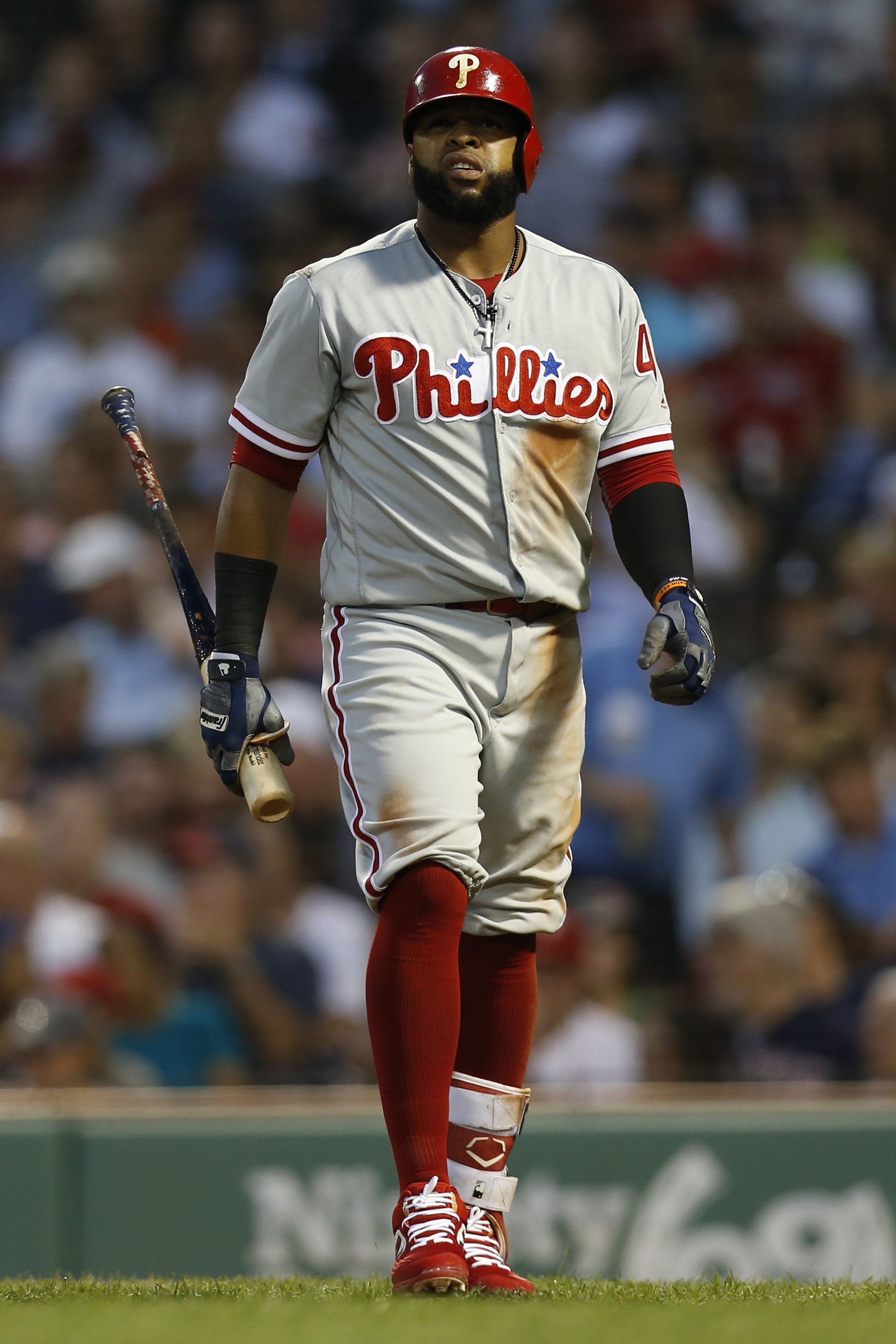
First, let’s take a look at what Santana is in this stage of his career. He’s a switch-hitting walk machine with modest power. He put up a 109 wRC+ for the Phillies this year, and 119 from May onward. Steamer projects a 119 mark on the whole for Santana next year. That’s a level he’s reached only once in the last four seasons, so it would be fair to question such optimism.
Though it’s an unscientific and more conservative guess, I’d expect 110-115. Certainly if you’re a rival GM and Santana is being shopped to you, you’d take my position on his expected offense. Santana has spent most of his time as a first baseman in recent years with the Phillies and Indians, and of course he’s an option at designated hitter as well.
Santana’s contract is a major factor in any potential trade. He’s owed $35MM over the next two years. Given Santana’s strong projection for next year, a case can be made that the Phillies shouldn’t need to pay his contract down significantly. However, I think in reality there are enough cheaper alternatives on the market that the Phillies will have to kick in at least $10MM, or else take back a contract or attach a prospect.
For a look at the other first basemen available this winter, check out Jeff Todd’s market snapshot from last month. The free agent market doesn’t offer any first baseman who qualifies as a definite regular, but the trade market could be robust. Paul Goldschmidt is obviously superior to Santana, while Justin Smoak is a fairly similar hitter who is earning only $8MM in 2019. Though better suited at DH, the Cardinals’ Jose Martinez is also in Santana’s class as a hitter. Martinez has yet to reach arbitration and can be controlled for four more years. I’m not convinced Jose Abreu and Brandon Belt will be on the move this winter. The trade market at first base could also feature a variety of more flawed options, such as Justin Bour (now on waivers), Eric Thames, or Wil Myers. The bottom line: the presence of Goldschmidt, Smoak, and perhaps Martinez could clog Santana’s market, as Goldy is an impact hitter and the others have more desirable contract situations.
There’s also the idea that a team with an established first baseman could acquire Santana to serve primarily as its designated hitter. The DH trade market could include Kendrys Morales, Mark Trumbo, Shin-Soo Choo, C.J. Cron, Matt Davidson, and Miguel Cabrera. As a hitter, only Cabrera is on Santana’s level, and he’s basically immovable due to his hefty contract. The free agent market does offer one option that is superior to Santana as a DH: Nelson Cruz. Cruz projects at a 132 wRC+ next year, and we expect him to sign for less than the $35MM owed to Santana. So if you’re looking to fill a DH spot, you would talk to Cruz’s agent before you’d worry about trading for Santana – unless the Phillies offer to pay down Santana’s contract significantly. You might also look at a player like Daniel Murphy, who carries a similar projection to Santana and should sign for less than $30MM.
If the Phillies are viewing Santana as mainly a contract dump, they might need to kick in $15MM to get him down to the equivalent of a two year, $20MM deal. If the commitment was reduced that far, Santana might start to rise up on teams’ lists above someone like Murphy. Here’s a look at the teams that could be a match for Santana this winter:
- Twins: With Joe Mauer retiring and Logan Morrison reaching free agency, the Twins have an opening at first base and the need for a bat like Santana. They also have room in the payroll for most of his contract. It’s a reasonable match.
- Astros: The Astros make a lot of sense for Santana. He’s a better hitter than their incumbent first baseman, Yuli Gurriel, and they’re open at DH with Evan Gattis reaching free agency. Still, it would be easier for the Astros or Twins to just sign Cruz, so the Phillies would have to make it worth their while.
- Rays: Earlier this month, Marc Topkin of the Tampa Bay Times wrote that the Rays “seek more of a feared overall hitter” than the arbitration eligible C.J. Cron. The Rays also have more payroll space than they’ve had in recent years, making Santana a pretty good fit. The Rays also have Jake Bauers at first base. 27-year-old Ji-Man Choi pitched in at DH this year and should have a job against right-handed pitching. The Rays are a sleeper pick for Santana, though like the Astros and Twins they’d need to be convinced he’s a better option than Cruz.
- Rockies: After giving the bulk of first base time to Ian Desmond this year and getting replacement level production, the Rockies could seek an upgrade. GM Jeff Bridich spoke earlier this month of being “a little bit more focused on our offense this offseason as compared to last season,” and Santana could give a boost compared to Desmond or Ryan McMahon. However, the team’s payroll appears fairly tight and they may also address deficiencies at catcher and in a corner outfield spot.
- Cardinals: The Cardinals deployed the aforementioned Jose Martinez as well as Matt Carpenter at first base this year. Carpenter could move to third base to accommodate a first base acquisition like Santana. However, replacing Martinez with Santana would upgrade the defense more than anything, since they are hitters of similar ability. I could see the Cards taking a look at Santana, but not as their first choice.
- White Sox: The Sox appear likely to stick with Jose Abreu at first base, and could run out a Daniel Palka-Matt Davidson DH platoon. Palka is an option at an outfield corner, so the White Sox could feasibly add Santana as a primary DH who also chips in at first base. They’ve got plenty of payroll space as well.
- Angels: The presence of both Shohei Ohtani and Albert Pujols make the Angels an unlikely match for Santana. Still, the Halos should have some at-bats available at first base and DH, as Ohtani and Pujols are hardly locks for 150 games apiece. And theoretically, Santana could try to fake it at third base as he did in 119 innings for the Phillies this year.
- Rangers: With Shin-Soo Choo locked in at DH, the Rangers could acquire Santana as a replacement for first baseman Ronald Guzman. It might be too early to give up on the 24-year-old Guzman, and the Rangers have stronger needs on the pitching staff and at catcher. Still, if they’re simply looking to get better next year in any way possible, replacing Guzman with Santana should at least be on the table.
- Marlins: This is an outside the box option, since most of the focus with the Marlins is on which veteran pieces they’ll sell off as their rebuild continues. The team does have a few internal options at first base for next year such as Peter O’Brien and Garrett Cooper. Marlins president of baseball operations Michael Hill said a month ago, “We’re going to look at internal candidates, and we’re going to look at external candidates.” Why not Santana? For one thing, a trade can work well for a rebuilding club seeking a veteran boost, since free agents are typically reluctant to sign unless such a team overbids. Plus, the Marlins arguably have the payroll space to take on Santana’s entire contract, especially if they unload players like J.T. Realmuto, Dan Straily, and Derek Dietrich. In taking on all $35MM, the Marlins could demand that the Phillies throw in a quality prospect. It’s still a long shot scenario for the division-mates to match up on a Santana deal, however.
- Orioles: The Orioles are stuck with Chris Davis through 2022, unless they’re willing to release him. They’ve also got Trumbo under contract for one more year. Adding Santana only makes sense in the same vein as the Marlins: take the entire contract, and get a quality veteran hitter plus a prospect.
- Tigers: The Tigers could slot Miguel Cabrera in at DH and acquire Santana for first base. They’ve got the payroll space for Santana, at least compared to historical spending. But a bargain option makes more sense here unless the Phillies offer something enticing, putting the Tigers in the same group as fellow rebuilders like the Marlins and Orioles.
- Red Sox: The Red Sox have first baseman Mitch Moreland under contract for $6.5MM for 2019 and J.D. Martinez locked in at DH. The most likely path is just bringing back Steve Pearce as Moreland’s right-handed hitting complement, but the Sox could theoretically acquire Santana and plug him in as the everyday first baseman. Doing so would likely make the team better, though a first base switch doesn’t appear to be an offseason priority. Plus, acquiring Santana would worsen Boston’s luxury tax penalty.
- Yankees: The Yankees have Luke Voit and Greg Bird as first base options, and Giancarlo Stanton spending at least some of his time at DH. There’s no real point to replacing Voit with Santana, and the Yankees have bigger needs, so this match appears unlikely.
- Royals: The Royals don’t have anyone at first base or DH that would preclude an acquisition of Santana. But with the team looking to cut payroll, trading for Santana hardly makes sense.
Offseason Outlook: Washington Nationals
The Nationals will again look to bounce back from a bitterly disappointing season, but they’ll again do so with significant resources and reason for optimism.
Guaranteed Contracts
- Max Scherzer, SP: $105MM through 2021 (with assorted deferments)
- Stephen Strasburg, SP: $135MM through 2023 (with assorted deferments; includes opt-outs after 2019, 2020)
- Ryan Zimmerman, 1B: $20MM through 2019 (includes buyout of 2020 option)
- Adam Eaton, OF: $11.4MM through 2019 (includes buyouts of 2020, 2021 options)
- Trevor Rosenthal, RP: $7MM (includes buyout of 2020 vesting option)
- Howie Kendrick, UTIL: $4MM through 2019
Arbitration-Eligible Players (projections via MLBTR contributor Matt Swartz)
- Anthony Rendon (5.130) – $17.6MM
- Tanner Roark (5.055) – $9.8MM
- Trea Turner (2.135) – $5.3MM
- Michael Taylor (4.010) – $3.2MM
- Kyle Barraclough (3.059) – $1.9MM
- Joe Ross (3.067) – $1.5MM
- Sammy Solis (3.061) – $900K
- Non-tender candidates: Roark, Solis
Option Decisions
- Sean Doolittle, RP: Exercised $6MM club option (deal includes $6.5MM club option for 2020, with $500K buyout)
Free Agents
- Joaquin Benoit, Tim Collins, Bryce Harper, Jeremy Hellickson, Kelvin Herrera, Greg Holland, Mark Reynolds, Matt Wieters
[Washington Nationals Depth Chart | Washington Nationals Payroll Outlook]
Despite their overall sustained excellence, the Mike Rizzo-era Nationals have yet to end a season in a pleasing manner. Unlike the 2016 and 2017 clubs, which washed out of divisional series in thrilling fashion, the 2018 Nats ground to a halt in something of a slow-motion breakdown.
In years past, Nats disappointments — of all their varying flavors — have not really changed the organization’s trajectory. And for good reason: there have been seven consecutive winning seasons. Sure, it’s possible to interpret a few moves as direct responses to the developments of the season prior (Rafael Soriano, anyone?), but that’s only natural for any team.
Broadly, the march has continued, with Rizzo and co. rather notably managing to transition quite seamlessly from one high-end core to another. It seems foolish to expect anything but the same this winter, with the Nats once again poised to add finishing pieces to a quality existing roster, all while hoping that this time it’ll come together when it matters most.
It’s quite remarkable that this feels in large part like any other offseason for the Nationals. After all, one of the team’s true constants — superstar outfielder Bryce Harper — was due to disembark as the train limped into the station at season’s end. Yet his free agency came as a creeping inevitability — not just because it always seemed a fait accompli that he’d test the open market, but because the Washington organization improbably found a new version of Harper himself in the form of phenom Juan Soto, a 19-year-old, left-handed-hitting corner outfielder who somehow exceeded Harper’s own preternatural blend of pitch recognition, patience, and the ability to drive the ball all over the field.
It remains to be seen (and may never be fully known) whether Soto’s rise will play a significant role in Harper’s ultimate destination. The Nats, no doubt, have signaled they have serious interest in retaining Harper. They held onto him (at the trade deadline and in August) even while conceding more generally and then made a big offer late in the season. It’s obvious that the club did not expect that bid to lead to a deal, but it did set down a marker: the D.C. club will be a factor in Harper’s market, and any other clubs with interest will need to beat that not-insignificant $300MM starting point.
At the same time, the presence of Soto lessens the urgency to retain a player of Harper’s ilk. Every team would love to have that bat, but it’s possible the ultimate victor of the free-agent auction will be one that stands to gain more over its existing in-house alternatives. The Nats can plausibly line up an affordable, controllable, and potentially quite excellent outfield of Soto, Adam Eaton, and Victor Robles — with support from Michael Taylor, Howie Kendrick, and perhaps others — while wishing Harper the best and collecting some draft compensation on his way out the door.
Indeed, a departure is arguably the simpler outcome. Signing Harper would almost certainly require further movement. He and Soto would presumably be penciled in for nearly all of the plate appearances at two of the outfield spots. Robles and Eaton could share time, to be sure, but that’d be a questionable allocation of resources. The former needs to be playing every day at his stage of development, particularly after missing significant time due to injury in 2018. And the latter is too good a player (at least when at full health) to be left picking up playing time scraps.
Resolving that tension is possible, though it isn’t particularly straightforward. It’d be possible to make space with a trade, but parting with Robles would mean giving up a player who many believe is ready to be a core contributor. Selling Eaton, who still hasn’t shown he’s fully recovered from a series of leg injuries, would mean moving him at an inopportune moment. It’s theoretically possible that Harper or Soto could be considered a candidate to share time at first base with Ryan Zimmerman — if not even help replace him after the ’19 campaign — but that is a speculative and perhaps somewhat risky scenario. Were Robles to be made available in trade following a successful pursuit of Harper he’d almost certainly be the biggest prospect available this winter, perhaps giving the Nats the inside track to land another key piece. But it’s also fair to note that Robles is still eligible to be optioned, which isn’t an entirely unlikely scenario at all to open the season.
Whether or not Harper is retained is a massive question for the Nats. Somewhat incongruously, though, it doesn’t really change what the club’s key needs are so much as their means of addressing them. If Harper leaves, it seems much likelier that Robles stays; if Harper goes, then Robles is more expendable and the purse strings will surely be tighter.
In years past, the Nationals have proven willing both to send out prospects and plunk down cash to get their targets for the MLB roster. So — how much cash could the team spend? Some big salaries have come clear of the books, it’s true, but there are also raises to consider. With their current projected roster, the Nats are slated to have roughly $165MM on the books in 2019. That said, this year’s nominal balance sheet includes balloon payments for Max Scherzer and Stephen Strasburg, when in actuality much of the money is owed on a deferred schedule. Moreover, the average annual values of those deals are significantly lower. In calculating the luxury tax — which smooths out any annual changes in long-term deals but does include other costs — the Nats are still something like $50MM shy of the $207MM threshold.
In other words, even if the organization decides to keep Roark, it could in theory add upwards of $50MM in 2019 salary while still remaining south of the tax barrier, a reputed goal of the organization. A forthcoming arbitration hearing regarding the seemingly never-ending MASN TV rights fees dispute could also have an impact, both by settling expectations for a major income source and potentially opening the door to some real cash flow in the relative near future. Really, it’s anyone’s guess just how much money the Lerner family will green-light to spend, but the means are likely there if the club feels it needs to inflate the payroll to add necessary pieces.
Regardless of what blend of assets — prospects and cold hard cash — is utilized, the organization will set out with a fairly obvious set of priorities. First and foremost, the Nats need to acquire a primary catcher and at least one quality starting pitcher. They’ll surely also look to boost their pitching depth while perhaps remaining open to acting opportunistically if a quality player can be had at a value. Finally, the organization will also no doubt consider the acquisition of a second baseman — even if it’s not a top priority — while exploring bench upgrades.
Rizzo has made clear his desire not just to get another piece behind the dish, but to make it a significant one. The position has been a black hole for the past two years, making an upgrade over the departing Matt Wieters a top priority. It’s already known that the Nats have tried for some time to pry J.T. Realmuto loose from the Marlins, but they haven’t been able to do so this point (despite reportedly dangling Robles). Perhaps the Pirates will show some willingness to discuss Francisco Cervelli, though that doesn’t seem particularly likely to result in a deal. Otherwise, the Nationals may need to go onto the open market to find a player worthy of regular action. Yasmani Grandal seems to be a good fit, with old friend Wilson Ramos also representing a possibility. If they succeed in adding one of those pieces, the Nats could go open the reserve job for competition among Spencer Kieboom, Pedro Severino, Raudy Read, and perhaps some minor-league veteran signee(s). If the organization can’t figure a way to a top-end catcher, it’d arguably be preferable to add two new players who could deliver good production in a timeshare.
There are quite a few more possibilities on the pitching market. With the steady Gio Gonzalez traded away and now a free agent, the Nats will likely push to land a hurler who’s capable of joining Max Scherzer and Stephen Strasburg at the top of the staff. Trade possibilities are somewhat murky, but it is certainly possible to imagine some matches — and it’s worth recalling that Rizzo has made use of this route for a fair number of quality complementary pieces in the past.
The Nats have had previous interest in Zack Greinke and might be willing to take over some salary, while seeing some appeal in the fact that his contract is only three years in length. Lefties James Paxton and Robbie Ray (the latter a Rizzo draftee) could be of interest. And there’s little doubt that the team would be in on the Indians’ excellent trio of tantalizing potential rotation trade pieces. (It’s fair to note, too, that Robles would be a perfect fit in Cleveland.) Free agency offers some possibilities, too. Patrick Corbin figures to be the top prize on the market, but there’s no reason the Nats wouldn’t at least check in. Fellow southpaw Dallas Keuchel is somewhat older, but that will also mean he likely won’t require so lengthy a commitment. That goes all the more for veteran J.A. Happ. Nathan Eovaldi, meanwhile, is going to draw a close look from all pitching-needy contenders.
Boosting the pitching depth beyond that will also be necessary, especially if the Nationals decide to move on from Roark. There has been no clear indication of that as of yet, but he has not been in top form and could either be traded (it’s possible a deal could involve another relatively expensive MLB asset coming back) or non-tendered so that his salary can be utilized in another manner. He’d otherwise round out a back-of-the-rotation mix that includes quite a lot of uncertainty. Joe Ross only just returned from Tommy John surgery while former first-rounder Erick Fedde has not yet established himself in the majors. Austin Voth, Jefry Rodriguez, and Kyle McGowin are also available for depth but hardly seem like clear options to take a rotation job out of camp. Last year, the Nats made a late move to add Jeremy Hellickson, then carefully avoided over-exposing him to opposing lineups. That worked out rather well and could be tried again with Hellickson or some other veteran hurler. Possibilities abound.
The bullpen has already been the recipient of two live new arms, as the Nationals dealt for Kyle Barraclough and inked an incentive-laden contract with Trevor Rosenthal. At their best, both are hard-to-hit flamethrowers who could combine to form a potent late-inning trio with excellent (albeit oft-injured) closer Sean Doolittle. A pessimist would add that both of these recently acquired hurlers also have trouble staying in the strike zone at times. Needless to say, neither is a sure thing.
Justin Miller, Koda Glover, and Wander Suero lead the remaining relief options from the right side, with the aforementioned back-of-the-rotation candidates also representing long relief candidates. There are several other righties on the 40-man, any of whom could conceivably make the Opening Day roster with a big spring — or be jettisoned beforehand if there’s a need for a 40-man spot. On the left side, Matt Grace is coming off of a strong season; Sammy Solis is not and is a non-tender candidate. If the Nats chase a higher-end reliever, it could make sense for it to be a lefty, though the team may also just wait and see whether an appealing opportunity presents itself. There certainly seems to be room for one or two more arms here, though it’s not a priority to the same extent as adding at catcher and in the rotation.
If there is another area to address, it’s at second base. The Nats say they’re happy to roll with a combination of Kendrick and Wilmer Difo, but that seems suboptimal and largely unnecessary given the glut of players available at the position in both trade and free agency. It’s at least theoretically possible the Nats could pursue Whit Merrifield of the Royals, who’s perhaps the most valuable potential trade target. Otherwise, there are a variety of veteran options. Roark and Taylor both represent MLB assets that could be moved to the right club in a deal for a second bagger (or, for that matter, a pitcher). It’s also plausible that the Nats could take on a bigger salary (e.g. Jason Kipnis, Dee Gordon) in a deal primarily targeted at acquiring a pitcher. Otherwise, free agents include Jed Lowrie, Brian Dozier, DJ LeMahieu, Josh Harrison, and old friends Asdrubal Cabrera and Daniel Murphy.
It’s possible the Nationals will look to add a regular at second. But the team could also prioritize a player who’d work in the mix there and elsewhere, with Kendrick spending time at second and in a corner outfield spot while Difo (or Adrian Sanchez or some outside acquisition) works as a true utility infielder. It’s interesting to consider whether the team could pursue a reunion with Murphy, who could also share time with Zimmerman at first. Switch-hitting Neil Walker is coming off of a rough season but could function in a similar capacity. Or poor-defending, sweet-swinging Marlins utilityman Derek Dietrich could make some sense. Otherwise, the club may again go searching for some big lefty pop to function in a bench role. Rizzo has employed numerous players of this ilk over the years, most recently Matt Adams. He’ll again be a possibility, with Justin Bour (recently waived by the Phillies), Lucas Duda, and Logan Morrison also looking to be options. Whether a roster spot is again utilized on such a piece may depend upon the more important machinations covered above.
Photo courtesy of USA Today Sports Images.
Projecting Payrolls: Philadelphia Phillies
I’m ecstatic to join the MLBTR team to offer insight on an essential topic in the baseball world, especially this time of year: team payrolls. We’ll be combing through the league this winter, focusing first on the teams that figure to be the biggest players in the free agent marketplace.
There’s no better place to start than Philadelphia.
Team Leadership
The Phillies have one of the more complicated ownership structures in the league. Current managing partner John Middleton first purchased an ownership stake in the team in 1994, acquiring additional interests in the club over time until finally reaching a plurality 48% interest, becoming manager partner in 2015. The Buck family owns the other plurality 48% interest via their Tri-Play group. Despite the fact that Middleton has been managing partner for only four years, his longtime involvement with the club as well as that of the Buck family provides solid continuity.
The front office is headed by longtime baseball man and team president, Andy MacPhail, the prior president of the Orioles and former general manager for the Cubs and Twins. Current general manager Matt Klentak enters his fourth season at the helm, still searching for his first winning season and Philadelphia’s first winning season since the 2011 club blitzed its way to 102 regular season victories. While Klentak appears to have strong support from ownership, the fourth year of a rebuild is traditionally moving time: if it’s going to work, the wins need to show up and in a big way.
Historical Payrolls
Before digging into Phillies specifics, here are a few general notes when looking at historical data:
- Generally speaking, we’ll be using the data from Cot’s Baseball Contracts, maintained by Baseball Prospectus, for our historical data.
- Because the data comes from Cot’s and not from a meticulously detailed historical record of internal, proprietary information maintained by individual teams, the figures cited here will tend to be annual salaries plus prorated bonus amounts for each year. This is not how most Major League free agency contracts pay out: the various bonuses paid to players are often paid at specified times and not ratably over the course of deals. Nevertheless, using the data from Cot’s will help provide a strong estimate.
- Deferrals are difficult to capture. For example, the Nationals owe Max Scherzer a $35 million salary in 2019…but they won’t pay him a penny of his base salary for 2019 until 2022 (he does receive a $15 million portion of his signing bonus next year). Because of the difficulty in capturing deferrals, I’ll use something of an arbitrary cutoff, only factoring them into the numbers when they figure to have a significant impact on team spending, as is the case with the Nationals and Orioles, for example, given a bevy of deferred obligations, but as is likely not the case with the Rockies who owe only a relatively small amount to Todd Helton into the future.
- There are two primary considerations in examining historical payrolls: they show us either what type of payroll a team’s market can support or how significantly a given ownership group is willing to spend. In the most useful cases, they show us both.
With those housekeeping items out of the way, let’s dig in on what the Phillies have actually done in recent years.
Defining “recent” can be tricky. Changes in ownership, competitive windows, and market forces can yield wildly different payrolls over time. As a result, we’ll focus on a 15-year span in this series, covering 2005-18 for historical data as a means to understanding year 15: 2019. We’ll also use Opening Day payrolls as those better approximate expected spending by ownership. Here is what the Phillies have spent in the prior 14 seasons:
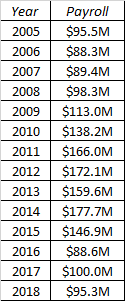
The Phillies payroll history tells a compelling and clean history of the club over the past decade and a half. They emerged in the mid-2000s as a young team supplemented by some expensive veterans, got extraordinarily expensive at the end of the 2000s and beginning of the 2010s as the core reached its peak earning years, endured some bloated payrolls despite meager win totals as the 2010s went on, and kept payroll to a minimum as a rebuild began. The Phillies carried a top-six leaguewide payroll each year from 2009-14 before tumbling to be among the 10 lowest payrolls in each of the past three seasons, a truly remarkable swing.
Philadelphia has not been a franchise to push the boundaries in the amateur market either, eschewing the big-bonus deals given to the likes of Latino amateurs Yoan Moncada (Red Sox) and Yadier Alvarez (Dodgers), among many others, by other big-market ball clubs. As such, the Major League payroll is a strong indication of true spending capacity for the team.
Future Liabilities
Some teams are loaded up with future guaranteed money, significantly hampering their ability to commit significant dollars to free agent targets. We’ll address teams like the Cubs and Rockies later in this series.
Other teams find themselves with barren future guarantees. We’ll spend time discussing the Twins and White Sox later as well.
The Phillies find themselves largely in the middle space of teams with regard to future commitments. Here is a look at their future guarantees with the powder blue highlight indicative of a player option whereas the peach indicates a club option. Note that the numbers shown on here are cash payments by year, not the salary plus the prorated amount of any bonus.
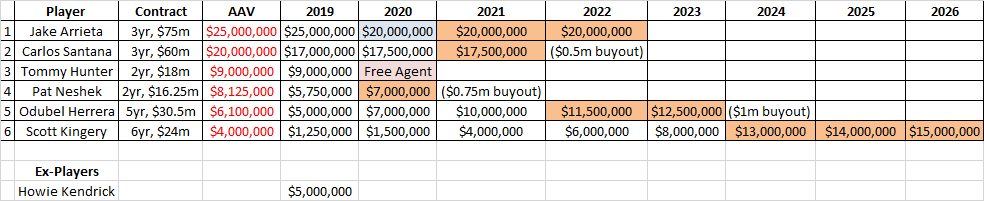
The future commitments are not exactly staggering. We’ll start at the bottom of the list. Kendrick’s $5 million in 2019 is the only deferral on Philadelphia’s chart, and it obviously shouldn’t impact future spending. Kingery’s extension basically guarantees him salaries commensurate with that of an above-average regular throughout what would have been his arbitration years with the 2024-26 options reflecting discounts over free agent salaries for a similarly effective player. If he turns out to be dead weight going forward (unlikely), the commitment remains relatively meager: $21.75 million through 2023, including the $1 million buyout of his 2024 option. That’s not breaking the bank and could provide strong value. Herrera is quite similar, just a few years further along the way; Herrera also figures to bounce back from poor BABIP luck in 2018, a year in which his defense also failed the metrics for the first time. Hunter and Neshek provide short-term guarantees with Neshek’s option in 2020 serving solely as a value play with minimal downside.
Instead, the big numbers to focus on here are Santana and Arrieta. Because Santana’s contract featured a significant signing bonus ($10 million), his future guarantee is both closer to approximating his actual value than it otherwise would be and easier to fit into a ballooning payroll, should that be the case. Nevertheless, Ken Rosenthal of The Athletic recently reported that the Phillies are aggressively shopping Santana, hoping to move his salary while opening up a defensive home for young (and cheap) slugger Rhys Hoskins.
Arrieta, on the other hand, has a contract structure that functions as a real wild card thanks to its unique language and Arrieta’s recent production. Arrieta earned $30 million in 2018, he gets $25 million in 2019, and then the chaos begins. Arrieta may opt out of his contract following the 2019 season, forfeiting a $20 million guarantee in the process. However, the Phillies may preempt the opt-out clause by exercising their club option on a two-year, $40 million extension covering 2021-22, Arrieta’s age-35 and age-36 seasons. The club option years may increase to a total of $50 million based on Arrieta hitting an unknown innings pitched threshold over 2018-19*, but that number is likely to be quite high meaning that Arrieta’s 172 2/3 innings from 2018 likely foreclosed the possibility of hitting that escalator.
*=Editor’s Note: MLBTR has since learned that the escalators are based on games started as opposed to innings pitched. By starting 31 games in 2018, Arrieta has boosted the base salary in both club option seasons by $2.5MM apiece, making the combined value of those seasons $45MM. He’d boost each by $1MM with 28 starts in 2019, plus another $500K each for starts 29, 30 and 31.
The Arrieta decision appears fascinating for both player and club. Arrieta is projected for another season of being a roughly league-average starting pitcher who throws about 180 innings. If he performs at such a rate, he has a strong incentive to opt out of his contract as the market will likely yield something in the neighborhood of $40-50 million on a multi-year guarantee for that production. On the other hand, the Phillies have an incentive to keep him around for that production but it isn’t so strong as to risk buying Arrieta’s mid-30s at the rate of $60 million over three years. Unless Arrieta erupts for another Cy Young-caliber season or melts down due to injury or ineffectiveness in 2019, the parties appear headed for a November 2019 staredown regarding their respective decisions.
Nevertheless, among the names listed above, the Phillies won’t be hamstrung due to their future guarantees.
Moving to arbitration, the Phillies feature some significant likely expenditures, particularly as ace Aaron Nola and slugging third baseman Maikel Franco age through raises. Franco may represent a tough non-tender decision in future years if he continues to struggle getting on base, but for now, he has age, power, and pedigree on his side, justifying his $5.1 million figure.
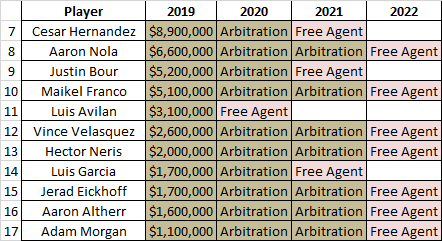
It is overwhelmingly likely that Bour is non-tendered or traded given the presence of Santana and Hoskins. Altherr and Garcia could also be non-tendered, though taking them out of the salary table results in relatively little change to spending from a team-wide perspective.
What Does Team Leadership Have to Say?
This will likely come as little surprise: despite clamoring for continued financial flexibility into the future, Klentak admitted that the Phillies have the wherewithal to make a significant addition to payroll in 2019. Addressing the media at the general manager meetings in early November, Klentak stated, “It’s a pretty bad feeling to go into an offseason knowing that you have things you need to address and not having the financial resources to do it because your money is tied up in players. I don’t think we ever want to put ourselves in that position. But some players are going to demand more than three-year contracts, and we have to be open to that. If it makes sense, we can do it. This is a franchise that carried big payrolls for a long, long time. We will likely get back to that again.”
Middleton provided a similar directive from ownership last offseason, offering that, , “[y]eah, I think we’re close. They [the front office] came to us with a budget, and we said, ‘Guys, if you want to put that number in for the budget, that’s fine, but don’t live with that. If something comes up, and it breaks the bank relative to the budget, and you don’t pursue it, we’re going to be upset.’ And they know that.” In an era where ownership frequently addresses the need to cut costs and operate efficiently, such an admission from Middleton is startling, even if it occurred nearly a year ago.
There is one final consideration that requires mention here: attendance. The Phillies regularly sported attendance figures just shy of two millions visitors each year until they opened Citizens Bank Park in 2004. Attendance figures ballooned to 3.25 million that year, dipping to about 2.7 million in each of 2005 and 2006 before climbing over the three million threshold again in 2007 and staying there through 2013, peaking at 3.777 million in 2010. From 2014 onward, however, attendance has tumbled back to the 1.8 million to 2.4 million territory.
Are the Phillies a Player for Bryce Harper or Manny Machado?
For some teams, this will be a really interesting examination. For the Phillies, it isn’t: they’re definitely players for Harper and Machado, and from a purely financial perspective, it’s within the realm of possibility that they could be contenders to sign both young stars. That said, there has been no indication to date that ownership or management is mulling such an unprecedented dual pursuit of both talents.
What Will the 2019 Payroll Be?
It’s worth providing what is likely an obvious disclaimer: ownership and management knows the actual budget whereas we’re focusing on historical data and other relevant factors to project future spending in the immediate and more distant years to come.
Nevertheless, there are numerous reasons to expect the Phillies to spend and to spend big this winter. Between Nola, Nick Pivetta, Vince Velasquez, Zach Eflin, and Arrieta, the Phillies already have a cheap, controllable playoff rotation in-house before considering possible contributions from bounce-back candidate Jerad Eickhoff and the late-season prospect arrivals of the much-hyped Sixto Sanchez and Adonis Medina.
The position player talent, however, is another story. Philadelphia’s team-wide wRC+ of 91 last year ranked 21st in baseball, narrowly ahead of the lowly Rangers and Royals. For a team looking to make the jump to postseason contention, the Phillies are in desperate need of an offensive jolt and it isn’t coming from the farm unless 2017 top pick outfielder Adam Haseley finds a way to bring his plus on-base skills up from Double-A despite a low-power profile.
Taken in the aggregate, the above shows that the Phillies:
- have a significant need for an impact bat or two,
- can afford to stick that bat (or bats) at just about any defensive position outside of first base,
- have traditionally carried significantly weightier payrolls than they have in recent years,
- possess an ownership group and front office ready to take the plunge into big-spending territory,
- feature a roster loaded with young talent that is traditionally supplemented by veteran talent for winners, and
- have a front office that needs to win now to stick around.
Add it all up and the Phillies are going to spend and spend big. Whether through free agency or the absorption of significant liabilities on the trade market, payroll is going to climb in a meaningful way. It’s unlikely that payroll reaches the heights of the earlier part of this decade ($170 million plus) in one year as that type of one-year spending jump is a rarity, but I expect that Philadelphia will get close. The projections below assume that Bour is non-tendered/traded and that Franco is shipped out should the Phillies add Machado to take his job. Things could get significantly more interesting if the Phillies succeed in their quest to ship out Santana and perhaps Hernandez, utilizing Kingery and J.P. Crawford up the middle. The available space could grow in a big way if Klentak chooses to go that route. The below assumes that both Santana and Hernandez stay.
Projected 2019 Payroll: $155-165 million
Projected 2019 Payroll Space: $52.25 million to $62.25 million