
Mark Reynolds Announces Retirement
Veteran slugger Mark Reynolds, who enjoyed a 13-year big league career split between the Diamondbacks, Rockies, Orioles, Indians, Cardinals, Nationals, Yankees and Brewers, announced in an appearance on Mad Dog Sports Radio on SiriusXM that he’s officially retired (Twitter link, with audio).
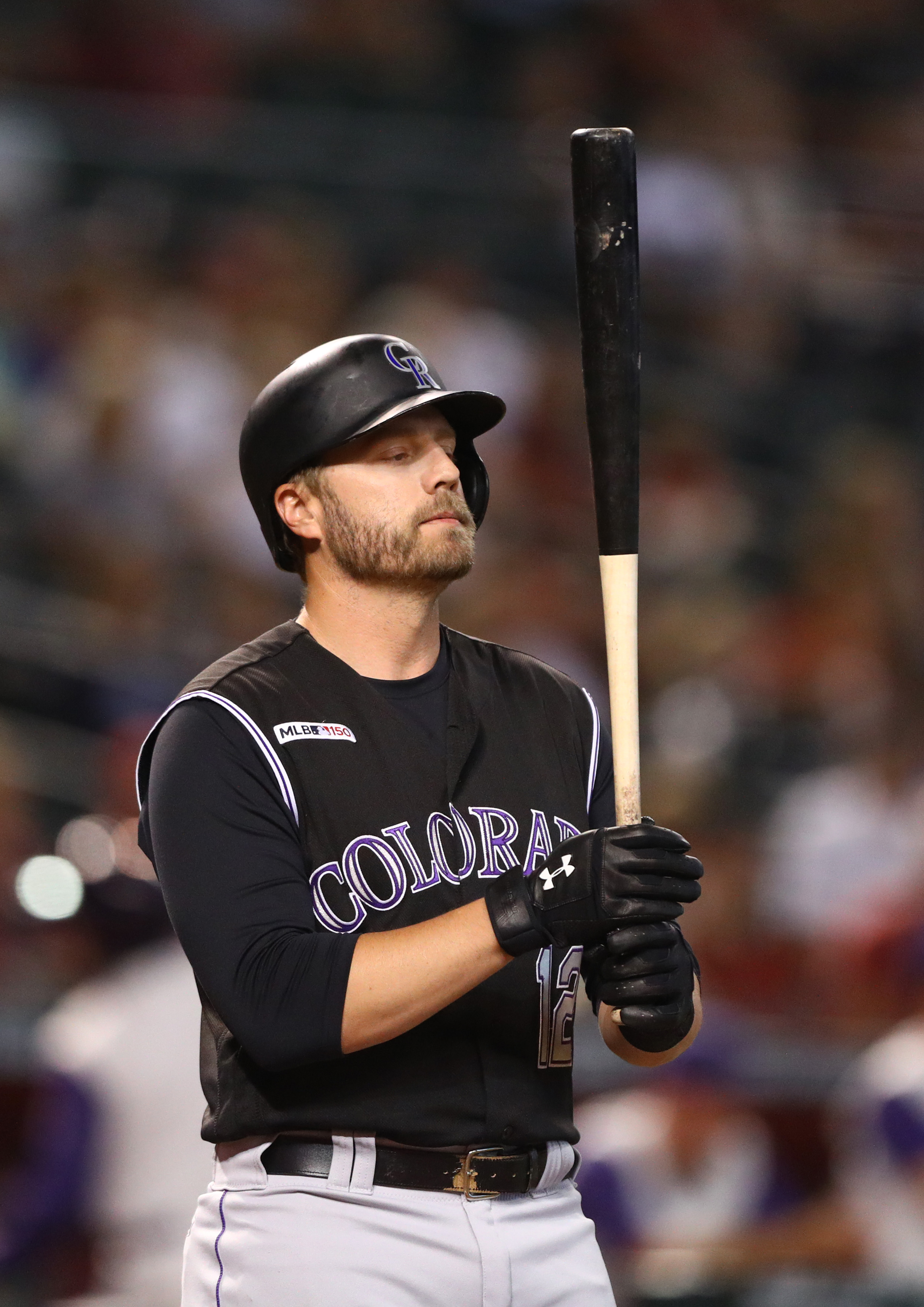
“I’ve moved beyond that,” Reynolds said when asked if he planned to seek another contract once MLB’s transaction freeze has been lifted. “I’ve retired. … I’m really enjoying time with my family, and it’s time for me to move on and find something else to do.”
The 36-year-old Reynolds spent the majority of the 2019 season in the Rockies organization, serving as a part-time first baseman and a bench bat until he was cut loose on July 28. He’d enjoyed a quality season with the Nationals a year prior in 2018, but Reynolds struggled to the lowest offensive numbers of his career with the Rox last year.
Originally a 16th-round pick of the Diamondbacks out of the University of Virginia back in 2004, Reynolds made his big league debut less than three years after being drafted. Reynolds was never considered one of the organization’s premier prospects — his No. 7 ranking on Baseball America’s list of D-backs prospects prior to the ’07 campaign was the only time he broke their top 30 — Reynolds hit the ground running. He was promoted to the big leagues in mid-May and closed out the remainder of the season as a regular in the lineup, hitting .279/.349/.495 with 17 home runs.
By 2008, Reynolds was Arizona’s everyday third baseman. His power was unquestionable, although the same could be said of his questionable contact skills. Reynolds became one of the game’s quintessential boom-or-bust players, regularly headlining home run and strikeout leaderboards alike. From 2008-11, he averaged 35 big flies per season but also led his league in strikeouts each year along the way. At that time, a player who was punching out in roughly a third of his plate appearances was an alarming anomaly; the league average strikeout rate back in Reynolds’ first full year was 17.5 percent — a full six percent lower than 2019’s mark.
Reynolds had a rough year in 2010, prompting the D-backs to trade him to the Orioles in return for reliever David Hernandez and prospect Kam Mickolio. He bounced back with the Birds and helped them to the postseason in 2012, but Baltimore declined an $11MM club option over Reynolds’ final arbitration year that offseason and non-tendered him, making him a free agent for the first time in his career.
Reynolds would bounce from Cleveland to New York to Milwaukee to St. Louis to Colorado to D.C. and back to Colorado on a series of one-year and minor league deals from that point forth. He delivered some productive seasons along the way and even popped 30 homers for the 2017 Rockies before giving the Nationals an absurd 5-for-5, two-homer, 10-RBI day in 2018 (video link).
Reynolds will conclude his playing career with a .236/.328/.453 batting line over the life of 6243 plate appearances and 1688 Major League games. In that time, he belted 298 home runs, 253 doubles, 14 triples and stole 64 bases while also scoring 794 times and knocking in 871 runs. The slugger took home nearly $30MM in career earnings while providing a litany of tape-measure home runs on which we can all fondly look back. Best wishes to Reynolds and his family in whatever lies ahead.
The Cardinals’ Blocked Prospects
The Cardinals haven’t had a losing record since 2007. Despite a recent playoff “drought” — a three-year stretch from 2016-18 that only qualifies as such by the St. Louis organization’s lofty standards — the Cards have run out a solid roster on an annual basis. Riding a blend of productive veterans, high-end prospects who emerge as key contributors and what seems like an out-of-nowhere success story or two every year (we see you, Tommy Edman), the Cardinals have established themselves among MLB’s more consistent franchises.
And while their strong track record in player development allows them to continually filter up quality young players to complement the veterans on the roster, it also inevitably leaves some talented players on the outside looking in. Because they’ve been able to develop so many quality youngsters, the Cards simply don’t have the space to play them all. (That’s a partial driver behind the outfield carousel they’ve experienced in recent years — though certainly not the only factor.)
Just look at some of the young players the Cardinals have traded away prior to 2019 while still managing to field competitive rosters:
- Carson Kelly, Luke Weaver — traded to D-backs in the Paul Goldschmidt deal
- Tommy Pham — traded to Rays in return for Genesis Cabrera, Justin Williams and Roel Ramirez
- Oscar Mercado — traded to the Indians in exchange for Conner Capel and Jhon Torres
- Luke Voit — traded to the Yankees in the deal that brought Giovanny Gallegos to St. Louis
- Sandy Alcantara, Zac Gallen — traded to the Marlins in the Marcell Ozuna deal
- Marco Gonzales — traded to the Mariners in return for Tyler O’Neill
- Randal Grichuk — traded to the Blue Jays in return for Dominic Leone and Conner Greene
That’s nine big league regulars/rotation pieces shipped out — in some cases, for disappointing returns — without causing the final on-field product to dip below .500. It’s a testament to the Cardinals’ amateur scouting and player development staffs that they’re so regularly deep with talent that they’re able to ship it off for veterans, potential areas of need or larger quantities of further-off talent. Certainly, not all of those swaps have worked out — Mercado or Pham would look nice in the outfield right now — but the Cardinals have rarely come up completely empty-handed on a deal.
Trades of this nature have become the norm for the Cards, and it’s likely that will continue to be the case. With Yadier Molina reportedly talking extension prior to the shutdown and Paul Goldschmidt signed five more years, for instance, the Cards look to have a pair of roadblocks to some more young talent. The outfield, too, has more names than playing time available. It seems likely that we’ll see more young players change hands as a result in the next calendar year, so let’s run through some possibilities.
Catcher
If a Molina extension does indeed come together, that doesn’t leave much of a path to regular playing time for 25-year-old Andrew Knizner — a fairly well-regarded backstop whose bat looks close to big league ready. In 83 games and 341 plate appearances in Triple-A, Knizner is a .283/.362/.453 hitter with an 8.2 percent walk rate and just a 13.1 percent strikeout rate. Scouting reports on Knizner question his receiving and framing skills, but he notched a 42 percent caught-stealing rate with Triple-A Memphis in 2019.
If Knizner does indeed change hands following a Molina extension — the Cards brought Matt Wieters back to serve as his backup again — then perhaps 19-year-old Ivan Herrera will emerge as the true heir-apparent to Molina and his Hall of Fame legacy.
First Base
Luken Baker isn’t an elite prospect — few first-base-only prospects are considered as such — but FanGraphs’ Eric Longenhagen put a 70 grade on his raw power in this year’s scouting report on the hulking 6’4″, 265-pound slugger in the making. Baker hasn’t tapped into that power just yet, though he spent the 2019 season in a pitcher-friendly Florida State League (Class-A Advanced). He’s managed his strikeouts to this point (21.6 percent) and also walked in 10.5 percent of his plate appearances. With Goldschmidt entrenched at first base through 2024, there’s no hope of Baker emerging as a regular in the near future, which seemingly puts him on a similar track to Voit.
Elsewhere on the roster, 27-year-old Rangel Ravelo (28 later this month) is out of minor league options and limited to a bench role. A career .293/.369/.452 hitter in 1652 Triple-A plate appearances who also slashed .310/.385/.473 in 649 Double-A plate appearances, Ravelo has done enough in the minors to suggest that he could hit in the big leagues. He’s played a little corner outfield, so perhaps the Cards view him as a replacement for the recently traded Jose Martinez. However, it’s possible that another club could view him as a potential late-blooming regular at first base.
The Outfield
The Dexter Fowler signing clearly hasn’t panned out as hoped, but the switch-hitting veteran’s five-year, $82.5MM deal runs through the 2021 season. Had the 2019 campaign been as much of a struggle as his 2018 season, he’d perhaps be a release candidate, but Fowler’s bat bounced back to roughly league-average levels last year (103 wRC+, 98 OPS+), and his contract should grant him a decent leash.
Harrison Bader was one of the game’s best defenders in center (14 Defensive Runs Saved, 12.9 Ultimate Zone Rating, 13 Outs Above Average), so he’s probably locked into center field despite a rough sophomore showing at the dish (.205/.314/.366).
Left field was to be determined in camp, with the likes of Dylan Carlson, Tyler O’Neill, Lane Thomas, Justin Williams and waiver claim Austin Dean vying for playing time. Carlson ranks among baseball’s elite overall prospects and should be installed as a regular at some point in 2020 (assuming a season is played). Even in the unlikely event that the club quickly moves on from Fowler, there’d be O’Neill, Thomas and Williams left to compete for that theoretical spot.
O’Neill was a ballyhooed prospect himself when acquired from Seattle, and though strikeouts have been an issue, he’s a passable corner defender with light-tower power and a history of drawing walks in the upper minors. Thomas can play a solid center field and owns a career .270/.342/.472 slash through 444 plate appearances in Triple-A. Williams is a corner bat who draws good marks for his raw power. He’s yet to show off that power in the minors, but FanGraphs points to his high-end exit velocity as a source of optimism if he can add more lift to his swing.
—
Most organizations would love to have the “more talent than playing time” issue on the big league roster — and you certainly won’t head president of baseball ops John Mozeliak or GM Mike Girsch complain about the reality. But that duo and the rest of the Cards’ front office figure to continue to find creative ways to deal with those surpluses, and it shouldn’t come as a big surprise if some of the above names finally get their chance at playing time in another organization,
The Cardinals’ Outfield Carousel
No doubt you’ve heard it said that the Cardinals have gone through quite a few outfielders in recent years. That puts it mildly. The organization is now awaiting the readiness of top prospect Dylan Carlson, with hopes that he’ll not only blossom into a star but bring some long-term stability.
Churning through players isn’t necessarily a bad thing. Every deal is an opportunity, of course. But it’s quite remarkable how much turnover the Cards have had over the past five seasons. Teams play around 1400 innings a year … over seven thousand frames have been played in that span by the St. Louis team, but no single outfielder has come close to appearing in half of them.
Here’s a log of the players who have come and gone (or who remain on hand). They’re ordered by the number of innings played in the outfield, with all statistical accumulations provided for only the seasons in question (2015-19).
Dexter Fowler (2017-19)
- Originally acquired: Signed five-year, $82.5MM free agent contract
- Output: 2,720 1/3 total OF innings; .233/.335/.410 (97 OPS+)
- Outcome: Still on roster
Stephen Piscotty (2015-17)
- Originally acquired: 2012 1st round draft pick
- Output: 2,588 2/3 total OF innings; .268/.346/.438 (109 OPS+)
- Signed six-year, $33.5MM extension
- Outcome: Traded to Athletics for Yairo Munoz, Max Schrock
Tommy Pham (2015-18)
- Originally acquired: 2006 16th round draft pick
- Output: 2,535 2/3 total OF innings; .271/.365/.463 (121 OPS+)
- Outcome: Traded with international bonus money to Rays for Justin Williams, Genesis Cabrera, Roel Ramirez
Randal Grichuk (2015-17)
- Originally acquired: Acquired with Peter Bourjos from Angels for David Freese, Fernando Salas
- Output: 2,529 total OF innings; .249/.297/.488 (107 OPS+)
- Outcome: Traded to Blue Jays for Dominic Leone, Conner Greene
Marcell Ozuna (2018-19)
- Originally acquired: Acquired from Marlins for Sandy Alcantara, Magneuris Sierra, Zac Gallen, Daniel Castano
- Output: 2,395 1/3 total OF innings; .262/.327/.451 (106 OPS+)
- Outcome: Declined qualifying offer; Signed with Braves as free agent
Harrison Bader (2017-19)
- Originally acquired: 2015 3rd round draft pick
- Output: 2,013 total OF innings; .236/.320/.393 (90 OPS+)
- Outcome: Still on roster
Jason Heyward (2015)
- Originally acquired: Acquired with Jordan Walden from Braves for Shelby Miller, Tyrell Jenkins
- Output: 1,268 1/3 total OF innings; .293/.359/.439 (117 OPS+)
- Outcome: Declined qualifying offer; signed with Cubs as free agent
Jose Martinez (2016-19)
- Originally acquired: Acquired from Royals for cash considerations
- Output: 1,199 1/3 total OF innings; .298/.363/.458 (119 OPS+)
- Outcome: Traded with Randy Arozarena and comp balance pick to Rays for Matthew Liberatore, Edgardo Rodriguez, comp balance pick
Matt Holliday (2015-16)
- Originally acquired: Acquired from Athletics for Brett Wallace, Clayton Mortensen and Shane Peterson; subsequently signed seven-year, $120MM free agent contract
- Output: 1,139 1/3 total OF innings; .259/.350/.442 (113 OPS+)
- Outcome: Signed with Yankees as free agent
Brandon Moss (2015-16)
- Originally acquired: Acquired from Indians for Rob Kaminsky
- Output: 586 2/3 total OF innings; .231/.311/.466 (106 OPS+)
- Outcome: Signed with Royals as free agent
Tyler O’Neill (2018-19)
- Originally acquired: Acquired from Mariners for Marco Gonzales
- Output: 552 1/3 total OF innings; .258/.307/.454 (101 OPS+)
- Outcome: Still on roster
Jon Jay (2015)
- Originally acquired: 2006 2nd round draft pick
- Output: 496 2/3 total OF innings; .210/.306/.257 (56 OPS+)
- Outcome: Traded to Padres for Jedd Gyorko and cash
Peter Bourjos (2015)
- Originally acquired: Acquired with Randal Grichuk from Angels for David Freese, Fernando Salas
- Output: 476 2/3 total OF innings; .200/.290/.333 (70 OPS+)
- Outcome: Claimed by Phillies
Jeremy Hazelbaker (2016) –
- Originally acquired: Signed to minor-league deal as free agent
- Output: 402 1/3 total OF innings; .235/.295/.480 (104 OPS+)
- Outcome: Claimed by Diamondbacks
Yairo Munoz (2018-19)
- 212 total OF innings
- Released
Magneuris Sierra (2017)
- 137 1/3 total OF innings
- Traded to Marlins with Sandy Alcantara, Zac Gallen, Daniel Castano for Marcell Ozuna
Kolten Wong (2016)
- 106 total OF innings
- Still on roster (primarily INF)
Tommy Edman (2019)
- 82 2/3 total OF innings
- Still on roster (primarily INF)
Lane Thomas (2019)
- 81 2/3 total OF innings
- Still on roster
Randy Arozarena (2019)
- 43 2/3 total OF innings
- Traded with Jose Martinez and comp balance pick to Rays for Matthew Liberatore, Edgardo Rodriguez, comp balance pick
Mark Reynolds (2015)
- 42 total OF innings
- Departed via free agency
Matt Adams (2017)
- 34 1/3 total OF innings
- Traded to Braves for Juan Yepez
Adolis Garcia (2018)
- 30 1/3 total OF innings
- Traded to Rangers for cash considerations
Others receiving OF playing time:
- Aledmys Diaz (2017) – 9 innings; since traded
- Pete Kozma (2015) – 7 innings; since departed via free agency
- Drew Robinson (2019) – 5 1/3 innings; since released
- Jedd Gyorko (2017) – 2 innings; since traded
NL Notes: Crawford, Kim, Mikolas, Cecil, Johnson
Brandon Crawford gave the San Francisco Chronicle’s John Shea a rundown of his daily routine, as the Giants shortstop is busy balancing his time with his wife and four young children alongside workouts and engaging in whatever baseball activities he can manage from his house. On this particular day, for example, Crawford and the Giants’ team yoga instructor met via video conferencing for a session “based on baseball mobility and movements that we need,” Crawford said.
Some more from the National League…
- While Crawford is one of many players staying at home with his family during the shutdown, newly-signed Cardinals left-hander Kwang-hyun Kim is in St. Louis while his family is in South Korea. Cardinals president of baseball operations John Mozeliak told reporters (including MLB.com’s Anne Rogers) that Kim could potentially return to Korea while Major League Baseball is on hiatus. “I can only imagine the mental challenge [Kim is] under with his wife and children back in South Korea, trying to adapt to a new country, a new team, and then have all this thrust upon him,” Mozeliak said. “So we’re trying to navigate that as best we can, but…clearly this has not been easy for him, and I think all of us could understand why.”
- From that same teleconference earlier this week, Mozeliak also provided updates on some injured Cardinals players. Miles Mikolas continues to make progress after suffering a flexor tendon strain in February and receiving a platelet-rich plasma injection, as Mikolas will soon throw a bullpen session and is currently throwing from 120 feet. Brett Cecil recently took time off from his hamstring injury rehab for personal reasons, but Mozeliak said Cecil will resume the process next week. Cecil suffered what manager Mike Shildt described as a “fairly significant” right hamstring strain in mid-March, and while no specific timeline was put in place, it was thought that Cecil was facing “multiple weeks of treatment.”
- After pitching in Japan in 2019, Pierce Johnson signed a two-year, $5MM deal with the Padres this offseason to mark his return to North American baseball. As Johnson told Fangraphs’ David Laurila, “a few other teams kicked the tires” on the right-hander’s availability, and he also came “really close to taking” an offer to remain with the Hanshin Tigers. Ultimately, Johnson chose the Padres and MLB in order to bring his family back closer to home. Johnson posted only a 5.44 ERA over his 44 2/3 career Major League innings with the Cubs and Giants in 2017-18, though his season in Nippon Professional Baseball greatly elevated his stock, as the righty posted a 1.38 ERA, 14.0 K/9, and 7.00 K/BB rate over 58 2/3 relief innings for the Tigers.
Latest News & Notes On Coronavirus & Baseball
We’re all pining for the return of baseball. It’d be nice to watch, especially in these trying times. More than anything, though, the start of play would mean that we’ve achieved some amount of control over the spread of the coronavirus — and, perhaps, that there’d be an end in sight to the suffering it has wrought. In the meantime, we join all those around the world in honoring the brave health care professionals, first responders, logistical employees, and others who are doing everything they can to sustain us.
- The unfolding tragedy is particularly acute in New York, the present American epicenter of the COVID-19 crisis. Baseball is an afterthought. Any hope of playing it will depend upon addressing the broader public health need, as Yankees reliever Zack Britton acknowledges (via MLB Network Radio on Sirius XM, on Twitter). “At the end of the day,” he says of talk regarding the scheduling of the 2020 season, “it doesn’t matter until the virus gets under control and cities and people are able just to go back to everyday life, let alone being able to go and watch baseball or us play baseball.” Getting to a point where the spread is manageable seems an obvious prerequisite for sports, even if played without fans. But the league and union are rightly thinking ahead and trying to plan to move back online as soon as possible. Britton says the sides have already begun considering potential neutral sites to stage games, potentially providing alternative venues that could be utilized as needed. The unnamed locations would have the sorts of playing, lodging, and other facilities required to make play possible.
- We’ve seen many MLB players pitch in financially and otherwise. They’re also quite understandably thinking of the needs of their families. Veteran Yankees starter Masahiro Tanaka has headed back to his native Japan with his wife and child while waiting for baseball to resume, Brendan Kuty of NJ.com reports. Tanaka says he felt in “danger” in Florida, where the virus is a growing threat. He also chose against returning to the home he maintains in New York. (There is at least a touch of baseball-specific news on the Yankees’ pitching staff, as we covered here yesterday.)
- Cardinals president of baseball operations John Mozeliak has revealed that one employee of the team has tested positive for COVID-19, as Mark Saxon of The Athletic tweets. The unnamed employee was not on hand at the club’s spring facility during camp; rather, he or she was stationed in St. Louis. MLBTR extends its best wishes for a quick and full recovery. Fortunately, that seems to be just what occurred for legendary former Cardinals and Angels outfielder Jim Edmonds. As Jeff Fletcher of the Orange County Register writes, Edmonds ended up in the hospital for pneumonia and ultimately tested positive for COVID-19. But he’s thankfully already on the mend.
- It’s always worth highlighting the good acts that take place in times of crisis. As Marc Topkin of the Tampa Bay Times writes, the Rays have initiated some assistance to local charity Feeding Tampa Bay, promising $100K and another $150K in matching funds to help spur a food drive. The Feeding Tampa Bay executive director calls it a “tremendous gift.” Meanwhile Rockies first baseman Daniel Murphy is the latest veteran player to make a sizable financial commitment. He’s giving $100K to a “family assistance fund” to assist minor-leaguers who support children or other family members. More on that initiative here.
MLB Cancels 2020 London Series
Major League Baseball has officially announced the cancellation of the 2020 London Series. The Cubs and Cardinals had been scheduled to play a two-game UK set in mid-June.
This hardly rates as a surprise given the coronavirus crisis that has engulfed the world. Putting on MLB contests, with or without fans in attendance, will be hard enough to pull off in North America. There was little reason to attempt play across the pond when it’s quite likely a live audience wouldn’t even be permitted.
One might have expected the league to postpone the London series rather than cancelling it outright. But even a move to a later point in 2020 would’ve come with immense challenges: added logistics, difficulties of international travel, and conflict with a highly condensed schedule.
In the long run, MLB surely hopes to resume play in London. The league was able to do so in 2019. It has also held regular season contests in Tokyo, Sydney, and Monterrey over the years.
This Date In Transactions History: An Expensive Mistake
Big-money free-agent signings in late March aren’t all that common, but the Cardinals pulled one off exactly two years ago. In hindsight, they probably wish it wouldn’t have happened. On March 31, 2018, the Cardinals added right-handed reliever Greg Holland on a one-year, $14MM contract. Holland was supposed to solidify the back end of the Cards’ bullpen, a unit that lost then-standout Trevor Rosenthal to Tommy John surgery late in the previous season. Instead, though, Holland endured a woeful few months as a Cardinal, didn’t finish the season in their uniform and has seen a once-great career continue to go downhill since then.
Holland entered free agency off a nice 2017 showing in Colorado, where he led the National League in saves (41) and logged a 3.61 ERA/3.72 FIP with 10.99 K/9 and 4.08 BB/9 over 57 1/3 innings. Not dominant numbers overall, but Holland picked up his third All-Star nod and was quite strong outside of a couple of blowups. Plus, the fact that it was his first action after a serious injury made his production look even better.
Holland’s best known for putting up excellent numbers in Kansas City from 2011-15, and he was close to untouchable during the Royals’ pennant-winning 2014 campaign. The decline began after that, though, as Holland suffered a torn right ulnar collateral ligament that ended his 2015 season in September. The injury prevented him from aiding the Royals in their run to a World Series championship that fall, forced Holland to undergo Tommy John and then caused him to sit out all of the next season.
Both the Rockies and the Cards were clearly impressed by the post-surgery Holland in 2017. He turned down his half of a $15MM mutual option after the season, but the Rockies then issued him a $17.4MM qualifying offer. Holland also said no to that, which may have been a mistake; however, expectations were that he’d beat that guarantee on the open market. MLBTR forecast a four-year, $50MM guarantee for Holland, but it turns out that he was not among the several free-agent relievers that winter who found a lucrative multiyear contracts (former Royals bullpen mate Wade Davis, who took Holland’s place in Colorado, led the way). Unfortunate for Holland, but considering the way his career has gone since then, the rest of the league’s teams dodged a bullet.
Because he didn’t sign until a couple days after the Cardinals’ season began, Holland did not have the benefit of a normal spring training. He took a bit of time to ramp up and then debuted with St. Louis on April 9, which proved to be his first of several poor outings with the club. Holland took the loss in that game after walking four of the five batters he faced. Walks were an all-too-common problem throughout Holland’s brief run as a Cardinal, as he wound up posting an extremely unusual and hideous line consisting of a 7.92 ERA with 7.92 K/9 and 7.92 BB/9. Holland never even registered a save for the club, which cut ties with him on Aug. 1, 2018, and ate almost $5MM in the process. To worsen the blow for the Cardinals, because Holland was a QO recipient, they had to cough up their second-round pick in 2018 and $500K of international money for inking him.
To his credit, Holland quickly rebounded from his abysmal Cards career. He closed 2018 in outstanding fashion as a member of the Nationals, with whom he recorded an almost flawless 0.84 ERA in 21 1/3 innings. Holland couldn’t follow that up in 2019, however, as he ended up with mediocre stats as a Diamondback. And they, like the Cardinals a year before them, designated Holland for assignment before the season concluded.
The 34-year-old Holland is now once again looking to rebound, this time back in his old Kansas City stomping grounds after the Royals reunited with him on a minor league contract in January. Perhaps Holland will revive his career either in KC or elsewhere in 2020, but the fact that he settled for a non-guaranteed deal two years after receiving such a sizable payday shows how far he has fallen.
Rookie Radar: NL Central
We’ve already run through the NL West, the NL East, the AL West and the AL Central in our look at some of the up-and-coming talent that figures to step into the Major League spotlight whenever play resumes. Let’s take a run through the NL Central…
Chicago Cubs
Nico Hoerner is the most interesting name to watch. The 2018 first-rounder skyrocketed through the system to make his MLB debut late last season, and while his .282/.305/.436 output didn’t exactly set the world on fire, it capped an impressive rise for a 22-year-old in his first full pro season. The Cubs hope there’s a potential everyday option at second base here. We could also see 27-year-old Robel Garcia and his light-tower power get another audition, though his contact skills (or lack thereof) are a notable red flag.
The organization lacks high-end, MLB-ready pitching prospects, but it wasn’t that long ago that righty Adbert Alzolay was considered to be just that. He was limited by a triceps injury last year and pitched just 81 2/3 innings between the minors and a brief MLB call-up, but his strikeout numbers are intriguing. Other rotation options include Cory Abbott, Tyson Miller and Justin Steele, but no one from the bunch is regarded as a blue chipper.
In the ‘pen, expect some combination of James Norwood, Dillon Maples and Duane Underwood Jr. to be called into action as injuries arise. All three are on the 40-man roster.
Cincinnati Reds
Shogo Akiyama will be one of the most interesting “rookies” to watch this season. He’s of course new to the MLB circuit but no stranger to playing professionally, having starred for Japan’s Seibu Lions over a nine-year career in Nippon Professional Baseball. A career .301/.376/.454 hitter in Japan, Akiyama hit .296 or better with at least a .385 OBP in each of his final five seasons with the Lions.
The Reds are suddenly a somewhat veteran club, so there aren’t many rookies who’ll be trusted with an Opening Day role. Well-regarded catcher Tyler Stephenson could be summoned in the event of an injury to Tucker Barnhart or Curt Casali. Shortstop Jose Garcia drew some eyes with a big spring showing but has yet to reach Double-A. He probably needs some more minor league time.
If a starter goes down, right-hander Tony Santillan has steadily climbed the ranks, although he struggled in a pitcher-friendly Double-A setting a year ago. Still, with the Reds set to potentially lose both Trevor Bauer and Anthony DeSclafani to free agency next winter, they’ll probably want to get a look at Santillan at some point.
The bullpen has a host of potential options — Vladimir Gutierrez, Reiver Sanmartin, Joel Kuhnel and Tejay Antone among them. Gutierrez has worked as a starter but struggled enormously in Triple-A, and his power fastball would seemingly play well in relief. Kuhnel has already made his MLB debut.
Milwaukee Brewers
The Brewers signed 10 Major League free agents this winter, traded for several players who’ll be on the Opening Day roster and don’t have a particularly well-regarded farm. All of that is to say — their rookie contributions might be few and far between. (To be fair, there are some semantics at play here; neither Keston Hiura nor Luis Urias is technically a rookie despite lacking a full season in the Majors. Both are highly intriguing young players.)
Jacob Nottingham might be called upon should Omar Narvaez or Manny Pina fall to injury. Outfielder Tyrone Taylor made his MLB debut last year but is buried behind a host of more experienced options. Former first-round pick Corey Ray has yet to debut but also finds himself on the wrong end of that deep outfield mix. Milwaukee picked up Mark Mathias in a small trade with the Indians and kept the versatile infielder on the 40-man roster, but it might take multiple injuries and/or a huge Triple-A showing to get to the Majors.
Righty Devin Williams leads the pack of bullpen candidates, having debuted with a 3.95 ERA in 13 2/3 frames last year. Right-handers J.P. Feyereisen and Angel Perdomo figure to emerge at some point, too, and waiver claim Eric Yardley provides a left-handed option who posted big numbers in Triple-A with the Padres last season. Rotation candidates include righty Drew Rasmussen, who had a nice year in Double-A in ’19. Trey Supak was rocked in seven Triple-A starts after a solid Double-A showing himself.
Pittsburgh Pirates
Right-hander Mitch Keller barely still qualifies a a rookie and should have a rotation spot for much of the season. Keller, long one of MLB’s premier prospects, was clobbered in his debut effort, but it’ll be interesting to see how he fares without the juiced ball and (presumably) without the prior front office/coaching staff’s emphasis on a two-seam fastball.
The Bucs have already talked extension with third base prospect Ke’Bryan Hayes — one of the game’s best defensive minor leaguers. Hayes didn’t have a great year at the plate in Triple-A in 2019, but he’ll open the season there and should break into the big leagues this year. As the club’s potential third baseman of the future, he’s a definite name to watch.
After that pairing, there’s a drop. Jason Martin and Jared Oliva might get some time in the outfield, and depending on injuries middle infielder Kevin Kramer and first baseman Will Craig are possibilities.
It feels like Nick Burdi has been a prospect forever, but the 27-year-old was healthy and opened some eyes this spring with a good showing. He’s undergone both Tommy John and thoracic outlet surgery but boasts a triple-digit heater when healthy. Blake Cederlind and Cody Ponce could see time in the ‘pen, as JT Brubaker could in the rotation.
St. Louis Cardinals
Among NL Central prospects who could plausibly debut in 2020, outfielder Dylan Carlson is perhaps the most highly regarded. A consensus top 20 minor leaguer who belted 26 home runs, stole 20 bases and posted a combined OPS north of .900 between Double-A and Triple-A last year, Carlson is viewed as a potential cornerstone piece. He’ll have to stave off Tyler O’Neill, Lane Thomas and fellow rookie Justin Williams, but Carlson has the highest ceiling of the bunch.
Yadier Molina just keeps on going, so there’s little hope of Andrew Knizner seeing meaningful time unless there’s an unfortunate injury to Molina. But Knizner is touted as a potential starting catcher himself and is more or less MLB-ready. Likewise, infielder Edmundo Sosa is ready for an MLB look but lacks an obvious path given the team’s veteran infield mix.
Left-handers Genesis Cabrera and Kwang-Hyun Kim give the Cards a southpaw option both in the rotation and in the bullpen. Kim, long one of the better pitchers in the Korea Baseball Organization, had an eye-opening spring showing. Right-hander Junior Fernandez tops the list of intriguing bullpen candidates thanks to a sub-2.00 ERA in the minors last year and a heater that averaged nearly 97 mph on a brief MLB cup of coffee.
Quick Hits: Miller, Wacha, Expansion
Some items from around the game…
- Cardinals reliever Andrew Miller spoke to Rick Hummel of the St. Louis Post-Dispatch about several topics, including the recent agreement between the league and players’ union about the 2020 season, how Miller is handling the shutdown, and the rather mysterious arm problem that sidelined Miller earlier this month. “There are some explanations for some of what I’m going through and I have a lot of appreciation for the amount of time [Cardinals head athletic trainer] Adam Olsen and Dr. [Brian] Mahaffey have put in helping me to look for some answers,” Miller said. Though there still isn’t an actual diagnosis of Miller’s issue, “I think I have answers that make a lot of sense and they’re not the type of thing that brings any sort of concern to my health and my livelihood.” The southpaw is currently throwing, albeit under “not…ideal” circumstances working out at his home rather than in a normal training environment.
- Michael Wacha turned to some offseason video analysis with his father to help solve mechanical problems from the 2019 season, which put him in a good place heading into his first Spring Training with the Mets, Deesha Thosar of the New York Daily News writes. By the time Wacha met with pitching coach Jeremy Hefner and assistant pitching coach Jeremy Accardo in camp, “they said my mechanical changes that I made over the offseason were exactly what they were going to be telling me,” Wacha said. “Exactly the same type of information or helpful tips that they were trying to get me into, I already made them on my own.” The early returns in Grapefruit League action were somewhat promising, as Wacha posted a 1.17 ERA over 7 2/3 innings, albeit with four walks against only five strikeouts. However, Wacha also didn’t allow any home runs, which was a positive sign after an ugly 1.8 HR/9 helped push his ERA to 4.76 over 126 2/3 innings with the Cardinals last season. Wacha signed a one-year, $3MM with the Mets in the offseason and now looks to be a member of their starting five, in the wake of Noah Syndergaard‘s season-ending Tommy John surgery.
- With league revenues bound to take a massive hit due to the shutdown, could expansion be an ideal way to inject some new money into the sport? Fangraphs’ Craig Edwards explores the question, noting that adding two new teams worth $750MM each (which is perhaps a conservative estimate for the price tag of a new club) in franchise fees would give each current team an extra $50MM in revenue. Commissioner Rob Manfred has often said that the league would only consider increasing its membership after all of the current 30 teams (namely the A’s and Rays) had some type of plans in place for a new ballpark, and Edwards observes that the league hasn’t had any real financial incentive to expand in recent years. Of course, the pandemic could now change that stance entirely, though Edwards also points out that the worldwide financial uncertainty caused by the ongoing crisis could lead to fewer potential owners willing meet the price for an expansion team, and cash-strapped cities will now have even less of a reason to spend resources on building a new stadium for a new team.
Cardinals Option 4 Players To Triple-A
St. Louis is among many teams that has trimmed down its roster Thursday. The team announced that it has optioned four players – right-handers Alex Reyes and Junior Fernandez, lefty Genesis Cabrera and catcher Andrew Knizner – to Triple-A Memphis.
Reyes, once among the highest-rated prospects in the game, is the most recognizable name in the group. Thanks in large part to a variety of injuries, the 25-year-old hasn’t been able to live up to the vast hype he generated in his younger days. As of a couple months ago, the hope was that he’d at least emerge as a quality bullpen piece this season for the Cardinals. Perhaps that will indeed happen, but he’ll have to work his way back from the minors first. Thus far, Reyes has endured his fair share of difficulty in Triple-A, including during a 2019 showing in which he stumbled to a 7.39 ERA with 12.2 K/9 and 7.7 BB/9 in 28 innings.
The hard-throwing Cabrera, 23, wasn’t a great deal more successful at preventing runs than Reyes last year in Memphis, where he put up a 5.91 ERA with 9.64 K/9 and 3.55 BB/9 over 99 innings. But Cabrera, like Reyes, still counts as one of the Cardinals’ most promising young arms. Baseball America ranked Cabrera as the Cardinals’ No. 4 prospect after last season, when he totaled 20 1/3 major league innings with a 4.87 ERA and 8.41 K/9 against 4.87 BB/9.
BA also has favorable opinions of Fernandez (the Cardinals’ No. 13 prospect) and Knizner (No. 8). The 23-year-old Fernandez debuted at both the Triple-A and major league levels last season. He was especially strong in 24 1/3 frames as a member of Memphis, with which he logged a 1.48 ERA, induced grounders at a 61.7 percent clip and struck out 9.99 batters per nine with 4.07 BB/9.
Knizner batted .276/.357/.463 with 12 home runs in 280 Triple-A plate appearances a year ago, though the .226/.293/.377 line he registered in his first 58 PA in the majors fell well short. He’ll continue to remain behind Yadier Molina and Matt Wieters in the Cardinals’ pecking order at catcher.