
The D-backs Replaced Paul Goldschmidt With A Waiver Claim — And It Worked
It’s been three years since Christian Walker rode the waiver carousel. A 2012 fourth-round pick of the Orioles, Walker’s chance of being a regular with the Baltimore organization likely went up in flames the moment owner Peter Angelos green-lighted the seven-year, $161MM deal that brought Chris Davis back to the club after he’d reached free agency. The Orioles still had a designated hitter spot, but a year later in the 2016-17 offseason, the Orioles re-signed Mark Trumbo to a three-year deal that only further cut into Walker’s opportunities. In Spring Training 2017, Walker was cut loose when the O’s acquired Richard Bleier from the Yankees.
From there, it was a whirlwind month for Walker — and likely one with a fair bit of frustration. After being blocked in Baltimore by Davis and Trumbo, Walker was surely hoping for a clearer path to the Majors. Instead, he landed in the National League, with no DH… behind Freddie Freeman. The Braves claimed Walker four days after his DFA in Baltimore but tried to sneak him through waivers themselves not two weeks later. Walker was again left to hope for a path to the Majors. Upon landing in Cincinnati on another claim, he was, of course, looking straight up at an in-his-prime Joey Votto. Three weeks later, Walker hit waivers again when the Reds tried to outright him at the end of camp. This time, he landed directly behind Paul Goldschmidt in Arizona.
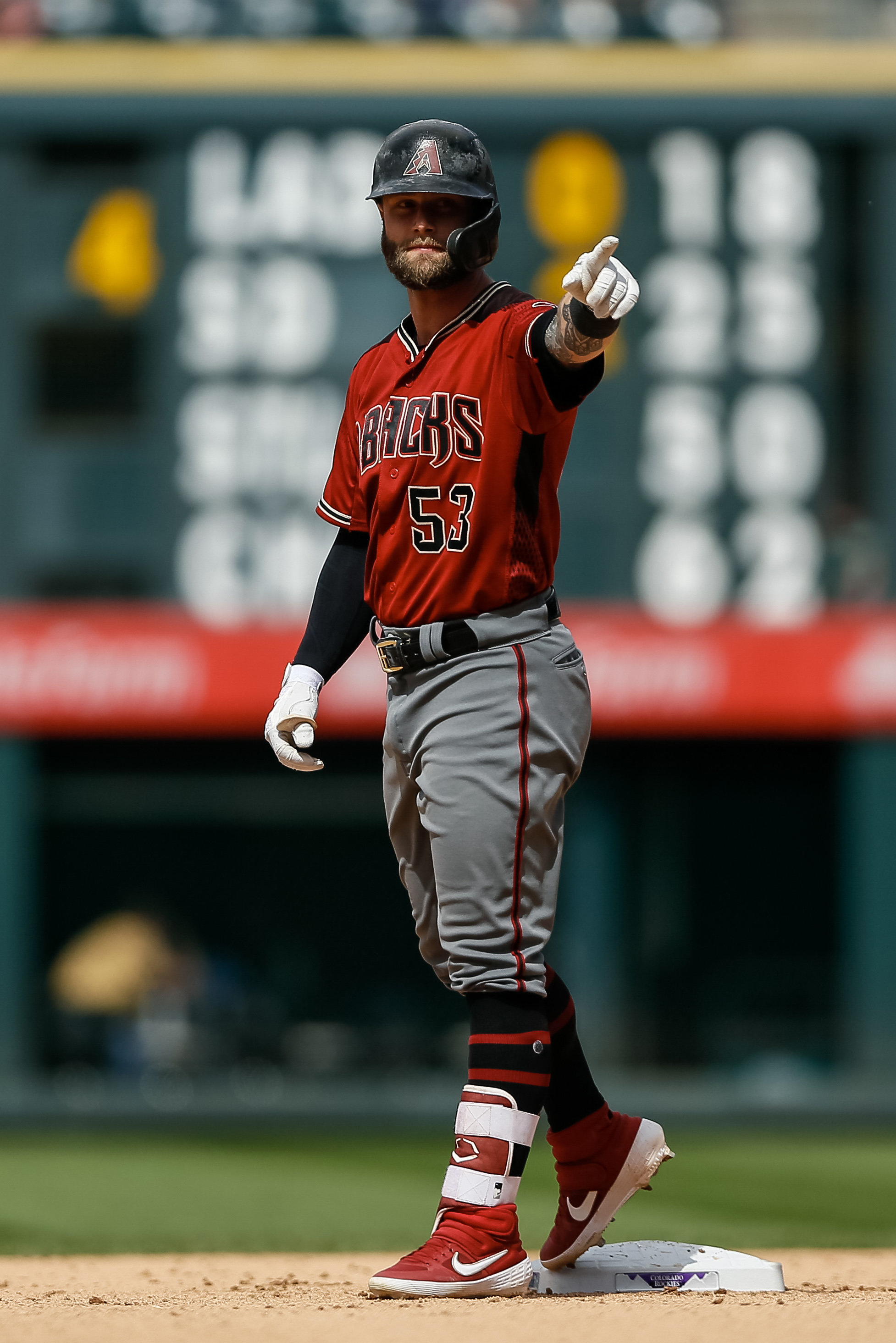
The D-backs finally succeeded in passing him through waivers, though they selected him back to the big leagues later that year. For two seasons, Walker obliterated Triple-A opposition, slashing a combined .305/.372/.586 (142 wRC+) with 50 home runs, 59 doubles and 13 triples. And yet, his Major League counterpart matched him blow for blow in the big leagues; Goldschmidt posted a ridiculous .294/.396/.547 (144 wRC+) with 69 home runs, 69 doubles and eight triples. By the time the 2018 season concluded, Walker was out of minor league options while Goldschmidt entered the final season of his contract.
A trade of Goldschmidt seemed plausible but hardly a sure thing entering the winter of 2018-19. There was little hope of the D-backs re-signing him with Zack Greinke still on the books. Goldschmidt had already signed one team-friendly extension in his career and wasn’t likely to do so a second time. The D-backs explored deals involving both Goldschmidt and Greinke that winter, ultimately lining up with the Cardinals on a return of Luke Weaver, Carson Kelly, Andy Young and a Competitive Balance draft pick (Round B).
Even at that point, though, Walker wasn’t a lock to step into Goldschmidt’s shoes. The D-backs had re-signed Eduardo Escobar to a three-year deal, crowding the third base mix and perhaps pushing Jake Lamb across the diamond to first base. Lamb’s 2018 season was ruined by a shoulder injury, but he hit 59 home runs from 2016-17, batting a combined .248/.345/.498 along the way. A platoon looked to be the likeliest outcome for the right-handed-hitting Walker and the lefty-swinging Lamb, and that’s indeed how the club operated — until Lamb landed on the injured list once again on April 5 with a quadriceps injury that would sideline him into late June.
Prior to the 2019 season, Walker hadn’t started consecutive games in the Majors since Sept. 2014. With Goldschmidt out the door and Lamb on the shelf, however, the everyday opportunity he’d sought in the nearly five years since making his MLB debut was sitting right in front of him, and he seized it. Walker appeared inn 71 games while Lamb was on the IL — starting 66 of them — and hit .258/.333/.461 with 11 homers, 17 doubles, a triple, four steals and elite defense at first base. Even with Lamb back in the fold and playing on a $4.825MM salary, Walker had earned the trust of the organization and earned himself an everyday role.
By season’s end, the then-28-year-old Walker had compiled a .259/.348/.476 slash and 29 home runs. While his hitter-friendly home park and the juiced ball that prompted home run totals throughout the league to explode rendered that production perhaps a bit lighter than some might expect (112 wRC+, 111 OPS+), Walker complemented his output at the plate with quality baserunning and with some of the best glovework of any first baseman in the Majors. Walker’s 11 Defensive Runs Saved and 9 Outs Above Average trailed only Oakland’s Matt Olson for the MLB lead at his position. Walker’s 3.0 bWAR, in fact, topped the 2.4 mark of the franchise icon he’d replaced.
It’ll be important to see how he carries himself at the plate in the event of a course correction with regard to the composition of the baseball, but there’s little reason to doubt his ability. Walker (fittingly) drew a base on balls in 11.1 percent of his plate appearances and was among the game’s very best in terms of hard-hit rate (94th percentile), average exit velocity (85th percentile), xwOBA (81st percentile) and percentage of barreled balls (90th percentile). And even if those numbers take a step back, his superb glovework and excellent baserunning (relative to his positional peers) help to give Walker a relatively high floor.
All of that should be music to the ears of the D-backs, whose patience in hanging onto Walker was rewarded not only with a potential everyday heir to the first base slot — but one that can be controlled all the way through the 2024 campaign. Heading into the 2020 season — assuming there is one — there should be little doubt that Walker has a firm grip on the starting job that’s eluded him for his entire career. As insane as it would have sounded when Walker was acquired in 2017 and as improbable as it might’ve seemed even last spring, the D-backs look like they’ve successfully replaced Goldschmidt with a waiver claim.
Revisiting The Nats’ “Steal” Of A Deal
Back in the 2013-14 offseason, the Tigers were looking to move a veteran starter … but not because they were in a rebuild. The club had taken three consecutive AL Central titles (and would add another in the ensuing campaign).
The issue was quite the opposite: with Justin Verlander, Max Scherzer, Doug Fister, Rick Porcello, Anibal Sanchez, and Drew Smyly all on the staff, the Detroit organization felt it had depth to spare. Looking ahead at the cost to retain the team’s stars — they ultimately failed to reach a deal with Scherzer but inked a monster extension with Miguel Cabrera later that offseason — the decision was made to trim some costs where possible and bring back some long-range talent.
Meanwhile, the Nationals were in search of a quality arm to plug into would land Fister in a swap that sent a largely underwhelming three-player package back to the Tigers. Utilityman Steve Lombardozzi and lefty reliever Ian Krol were each young players with MLB experience but little in the way of apparent ceiling. The Tigers hoped that they’d be affordable contributors, but neither carved out a career in Detroit. The most interesting long-term piece was a notable but not overly heralded lefty pitching prospect by the name of Robbie Ray.
This wasn’t quite how the Tigers wanted talks to play out. The club reportedly wanted a different young hurler to headline the deal: Taylor Jordan, who had emerged out of obscurity in 2013. Jordan utilized his decidedly Fister-esque skillset to compile 51 2/3 innings of 3.66 ERA work in 2013, averaging just 5.1 K/9 but limiting the walks (1.9 BB/9) and homers (0.52 HR/9) while generating lots of groundballs (57.5%). It seemed Jordan might well be a long-term rotation piece, even if it was unlikely he’d ever really dominate.
Ray, a 22-year-old former 12th-round pick, hadn’t yet reached the highest level of the minors, let alone the bigs. But he was perhaps a higher-ceiling young hurler than Jordan. In 2013, Ray worked to a 3.68 cumulative ERA over 142 frames at the High-A and Double-A levels while racking up 10.1 K/9 against 3.9 BB/9.
For good reason, the Nationals were widely lauded for their acquisition. I characterized the deal as a value-laden, well-timed strike. Dave Cameron of Fangraphs said the Nats had paid “a shockingly low price, considering that Fister is one of the game’s most underrated pitchers.” While anything but flashy, the tall right-hander had a nice track record of high-quality rotation work — over 800 frames of 3.53 ERA ball — and came with two seasons of remaining arbitration control. The thievery metaphor was popular, beginning with the title of Cameron’s post. Plenty of people termed the swap a “steal,” especially after Fister turned in an outstanding 2014 campaign.
There’s no discounting Fister’s excellence in his first year in D.C. Though he missed some action, he still managed to spin 164 innings of 2.41 ERA ball. But as it turned out, that would be the last truly productive campaign of his career. Fister struggled with a lat injury at the start of the ensuing campaign and never really got going. He did manage a useful 4.19 ERA in 103 frames in 2015, so it was hardly a minimal contribution, but the peripherals didn’t support the results and the output didn’t account for his final arbitration salary of $11.4MM. Any thoughts of recouping draft compensation by issuing a qualifying offer went right out the window.
On the other side of the swap … well, the Tigers didn’t quite get what they hoped for either, but they only had their own ensuing actions to blame. After watching Ray struggle in a brief 2014 debut, Detroit ended up sending him out in a memorable three-team trade that really didn’t work out for the Motown side. That deal, which also cost the Tigers a decent infield prospect in Domingo Leyba, returned righty Shane Greene. While he had his moments in Detroit, they came after he transitioned to a relief role. Greene was swapped out last summer. The arrangement would have gone better had the Tigers simply taken shortstop Didi Gregorius, who ended up with the Yankees.
By that point, Ray was ready for a full test at the MLB level. He turned in a very strong debut in 2015. And while the results have taken a bit of a rollercoaster ride since, he has produced huge strikeout numbers and generally fared well in the eyes of advanced metrics. Ray has contributed 762 innings of 3.96 ERA ball in Arizona while racking up 11.3 K/9 against 4.1 BB/9. The long ball has been an issue, but it hasn’t stopped him from compiling 10 rWAR and a dozen fWAR — well over twice what Fister ended up providing to the Nats (4.5 rWAR / 1.7 fWAR) — in advance of his final season of arbitration eligibility.
Photos courtesy of USA Today Sports Images.
Revisiting Dave Stewart’s D-backs Trades
Dave Stewart’s transition from agent to Diamondbacks general manager was both brief and frenetic. Not afraid to make moves that bucked industry trends, Stewart’s regime aggressively moved young talent for veterans, seemingly placed a lower value on draft picks than other clubs and made what proved to be a pair of high-profile missteps on the international market as they set out on a clear win-now path.
In 2016, the Diamondbacks marketed an “evolutionary” year for the franchise following an offseason that was headlined by their stunning signing of Zack Greinke to a six-year, $206.5MM deal. That 2016 campaign did prove to be a major turning point for the organization, although surely not in the manner the front office had hoped; Arizona finished out the year with a 69-93 record that led to a swift front office overhaul and the dismissal of manager Chip Hale.
Here’s a look back at the two years of hectic wheeling and dealing under the watch of Stewart, Tony La Russa and De Jon Watson…
2014-15 Offseason
- Acquired RHP Jeremy Hellickson from the Rays in exchange for OF Justin Williams and SS Andrew Velazquez
- Acquired LHP Robbie Ray and 2B/SS Domingo Leyba from the Tigers in a three-team trade that sent SS Didi Gregorius from D-backs to Yankees and RHP Shane Greene from Yankees to Tigers
- Acquired RHPs Zack Godley and Jeferson Mejia from the Cubs in exchange for C Miguel Montero
- Acquired RHPs Rubby De La Rosa and Allen Webster and INF Raymel Flores from the Red Sox in exchange for LHP Wade Miley
- Acquired RHP Myles Smith from the Red Sox in exchange for RHP Zeke Spruill
- Acquired OFs Josh Elander and Victor Reyes and cash from the Braves in exchange for RHP Trevor Cahill and a Competitive Balance Round B pick (announced as two separate deals on April 2 and April 6, as competitive balance picks couldn’t technically be swapped until after Opening Day)
2015 Season
- Acquired C Welington Castillo, RHP Dominic Leone, OF Gabby Guerrero and INF Jack Reinheimer from the Mariners in exchange for 1B/OF Mark Trumbo and LHP Vidal Nuno
- Acquired SS Phil Gosselin from the Braves in exchange for RHP Touki Toussaint and RHP Bronson Arroyo (the Braves effectively purchased Toussaint by taking on the remainder of the injured Arroyo’s contract)
- Acquired SS Dawel Lugo from the Blue Jays in exchange for INF Cliff Pennington
- Acquired LHP Junior Garcia from the Astros in exchange for LHP Oliver Perez
- Acquired RHPs Matt Koch and Miller Diaz from the Mets in exchange for RHP Addison Reed
2015-16 Offseason
- Acquired C/OF Chris Herrmann from the Twins in exchange for OF Daniel Palka
- Acquired RHP Sam McWilliams from the Phillies in exchange for RHP Jeremy Hellickson
- Acquired RHP Shelby Miller and LHP Gabe Speier from the Braves in exchange for SS Dansby Swanson, OF Ender Inciarte and RHP Aaron Blair
- Acquired SS Jean Segura and RHP Tyler Wagner from the Brewers in exchange for RHP Chase Anderson, 2B Aaron Hill, 2B Isan Diaz and $5.5MM
2016 Season
- Acquired INF Luis Alejandro Basabe and RHP Jose Almonte from the Red Sox in exchange for Brad Ziegler
- Acquired RHP Vicente Campos from the Yankees in exchange for RHP Tyler Clippard
- Acquired OF Jason Heinrich from the Orioles in exchange for OF Michael Bourn
—
How would you grade Stewart’s swaps as general manager in Arizona? (Link to poll for Trade Rumors mobile app users.)
Grade Dave Stewart's trades as D-backs GM:
-
D 34% (2,291)
-
C 30% (2,026)
-
F 23% (1,549)
-
B 12% (818)
-
A 2% (143)
Total votes: 6,827
Curious to look back on additional GMs and their trade histories?
We’ve already polled on Diamondbacks GM Mike Hazen, recently fired Astros president Jeff Luhnow, Brewers president of baseball ops David Stearns, Angels GM Billy Eppler, Rockies GM Jeff Bridich, Tigers GM Al Avila, Braves GM Alex Anthopoulos, Blue Jays GM Ross Atkins, Mariners GM Jerry Dipoto, Phillies GM Matt Klentak, Padres GM A.J. Preller, Dodgers president of baseball operations Andrew Friedman, Rays GM Erik Neander, ex-Red Sox front office leader Dave Dombrowski, Mets GM Brodie Van Wagenen, Reds GM Dick Williams and Orioles GM Mike Elias.
Mark Reynolds Announces Retirement
Veteran slugger Mark Reynolds, who enjoyed a 13-year big league career split between the Diamondbacks, Rockies, Orioles, Indians, Cardinals, Nationals, Yankees and Brewers, announced in an appearance on Mad Dog Sports Radio on SiriusXM that he’s officially retired (Twitter link, with audio).
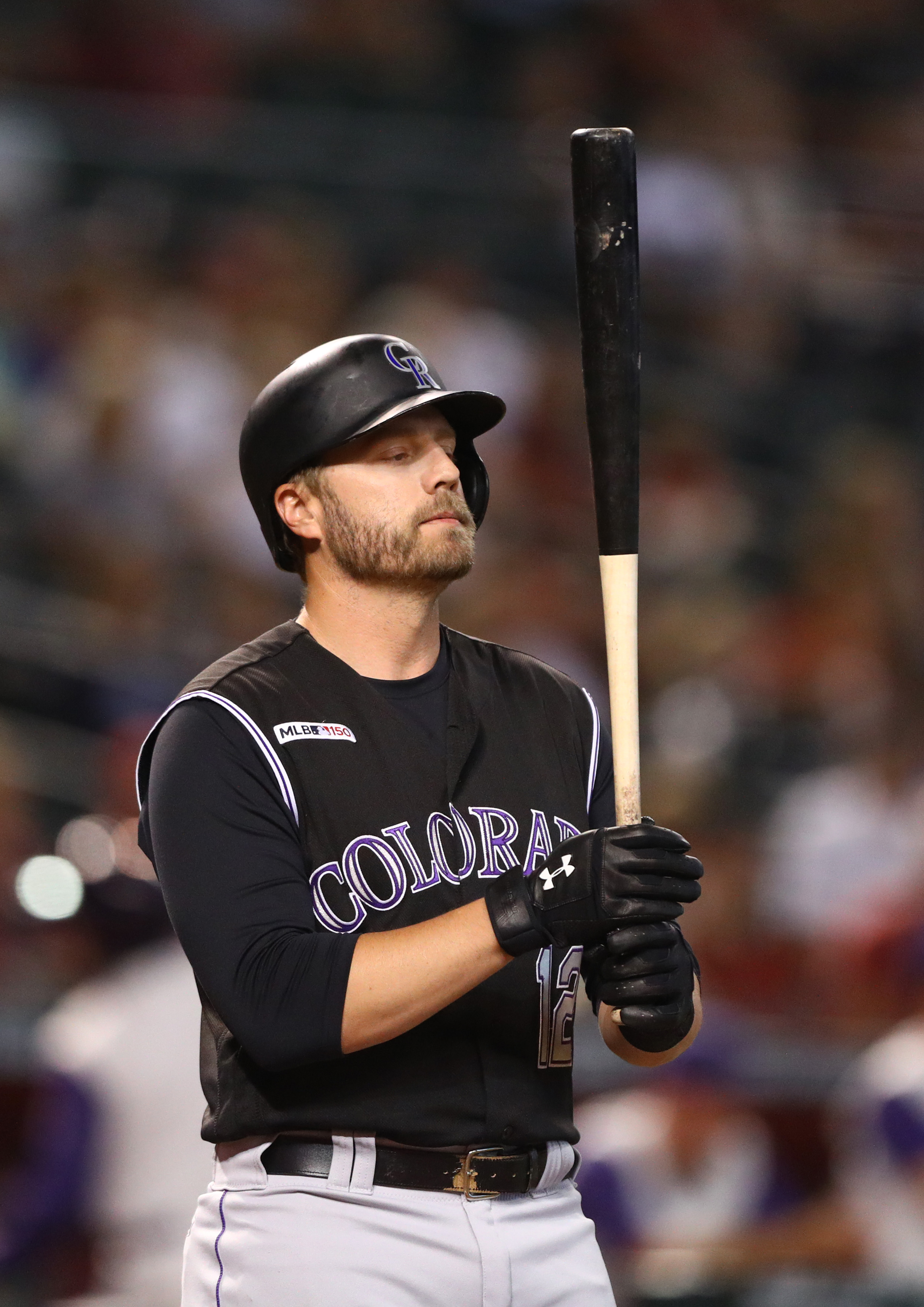
“I’ve moved beyond that,” Reynolds said when asked if he planned to seek another contract once MLB’s transaction freeze has been lifted. “I’ve retired. … I’m really enjoying time with my family, and it’s time for me to move on and find something else to do.”
The 36-year-old Reynolds spent the majority of the 2019 season in the Rockies organization, serving as a part-time first baseman and a bench bat until he was cut loose on July 28. He’d enjoyed a quality season with the Nationals a year prior in 2018, but Reynolds struggled to the lowest offensive numbers of his career with the Rox last year.
Originally a 16th-round pick of the Diamondbacks out of the University of Virginia back in 2004, Reynolds made his big league debut less than three years after being drafted. Reynolds was never considered one of the organization’s premier prospects — his No. 7 ranking on Baseball America’s list of D-backs prospects prior to the ’07 campaign was the only time he broke their top 30 — Reynolds hit the ground running. He was promoted to the big leagues in mid-May and closed out the remainder of the season as a regular in the lineup, hitting .279/.349/.495 with 17 home runs.
By 2008, Reynolds was Arizona’s everyday third baseman. His power was unquestionable, although the same could be said of his questionable contact skills. Reynolds became one of the game’s quintessential boom-or-bust players, regularly headlining home run and strikeout leaderboards alike. From 2008-11, he averaged 35 big flies per season but also led his league in strikeouts each year along the way. At that time, a player who was punching out in roughly a third of his plate appearances was an alarming anomaly; the league average strikeout rate back in Reynolds’ first full year was 17.5 percent — a full six percent lower than 2019’s mark.
Reynolds had a rough year in 2010, prompting the D-backs to trade him to the Orioles in return for reliever David Hernandez and prospect Kam Mickolio. He bounced back with the Birds and helped them to the postseason in 2012, but Baltimore declined an $11MM club option over Reynolds’ final arbitration year that offseason and non-tendered him, making him a free agent for the first time in his career.
Reynolds would bounce from Cleveland to New York to Milwaukee to St. Louis to Colorado to D.C. and back to Colorado on a series of one-year and minor league deals from that point forth. He delivered some productive seasons along the way and even popped 30 homers for the 2017 Rockies before giving the Nationals an absurd 5-for-5, two-homer, 10-RBI day in 2018 (video link).
Reynolds will conclude his playing career with a .236/.328/.453 batting line over the life of 6243 plate appearances and 1688 Major League games. In that time, he belted 298 home runs, 253 doubles, 14 triples and stole 64 bases while also scoring 794 times and knocking in 871 runs. The slugger took home nearly $30MM in career earnings while providing a litany of tape-measure home runs on which we can all fondly look back. Best wishes to Reynolds and his family in whatever lies ahead.
These Players Can Exit Their Contracts After 2020
No matter if a Major League Baseball season takes place in 2020, there are certain players who will be in position to decide whether to exit their current contracts next winter. Whether it be by way of an opt-out clause or a mutual option, here’s a look at the players who will be able to choose to take their chances in free agency…
Opt-Outs
Back when the Marlins extended outfielder Giancarlo Stanton on a historic pact worth $325MM over 13 years in 2014, they included a one-time opt-out for next winter. Stanton has put up at least one phenomenal season since he signed that deal – he won the NL MVP and hit 59 home runs in 2017 – but injuries have hampered him on a regular basis. He’s now a member of the Yankees, who acquired him in a December 2017 deal, but Stanton played in just 18 games last season. He’ll still be owed $218MM for seven years after this season, and for at least the time being, it’s very tough to think of Stanton leaving that money on the table to test free agency.
Designated hitter J.D. Martinez, a member of the Yankees’ archrival in Boston, will have two years and $38.75MM remaining on his contract after this season. He’ll be 33 then, and will continue to be someone who’s known as a defensive liability, so should be opt out? It’s up for debate. The big-hitting Martinez remains an offensive standout, but his production last season fell (granted, he did still slash .304/.383/.557 with 36 home runs in 657 plate appearances). He subsequently chose not to opt out after last season, as doing so would have cost him his $23.75MM salary for this year.
One of Martinez’s former Tigers teammates, outfielder Nicholas Castellanos, will also have to choose whether to revisit free agency next offseason. Castellanos is another defensively challenged slugger, one whom the Reds guaranteed $64MM over four years this past winter. He’ll be 29 by the time the 2021 season rolls around, and by saying goodbye to his Reds pact, he’d be leaving $48MM on the table (including a $2MM buyout in 2024). It’s not easy to determine whether that will happen; some of it depends on how well Castellanos fares in 2020, if a season occurs. Carrying over the tremendous production he posted late last season after the Cubs acquired him from the Tigers may make Castellanos more inclined to try his luck on the market again, but his output at the plate has been more good than great throughout his career.
Mutual Options
For the most part, mutual options don’t get picked up. Either a player’s so effective that he opts for free agency or he’s not useful enough for his team to exercise the option. Rockies first baseman Daniel Murphy and reliever Wade Davis are among those who have mutual option decisions waiting after the season, but they’ve struggled in the club’s uniform so far. With that in mind, Murphy’s on track for a $6MM buyout (as opposed to a $12MM salary), while Davis figures to receive a $1MM buyout instead of a $15MM payday.
Brewers outfielder Ryan Braun ($15MM mutual option, $4MM buyout), Diamondbacks right-hander Mike Leake ($18MM mutual option, $5MM buyout) and Cubs lefty Jon Lester ($25MM mutual option, $10MM buyout) could also find themselves looking for new contracts next winter. The same goes for Mets reliever Dellin Betances, though it’s tougher to say in his case. The former Yankee barely pitched at all season on account of injuries, and if there isn’t a season in 2020, would he turn down a guaranteed $6MM in 2021? And would the Mets buy him out for $3MM? That’s one of the many interesting questions we could face next offseason.
Offseason In Review: Arizona Diamondbacks
The D-Backs spent significant sums in free agency for the first time since GM Mike Hazen came aboard and pulled off an interesting trade for a key veteran. But is it enough to mount a real challenge to the dominant division force?
Major League Signings
- Madison Bumgarner, SP: five years, $85MM
- Kole Calhoun, OF: two years, $16MM (includes $2MM buyout on $9MM club option)
- Stephen Vogt, C: one year, $3MM (includes $500K buyout of $3MM vesting/club option)
- Hector Rondon, RP: one year, $3MM (includes $500K buyout of $4MM club option)
- Junior Guerra, RP: one year, $2.65MM (includes $100K buyout of club option)
- Total spend: $109.65MM
Trades and Claims
- Acquired OF Starling Marte (with $1.5MM salary offset) from Pirates in exchange for SS Liover Peguero, RHP Brennan Malone and $250K of international bonus availability
- Acquired RHP Jeremy Beasley from Angels in exchange for RHP Matt Andriese
- Claimed INF Pat Valaika off waivers from Orioles (Baltimore later reacquired Valaika via waivers)
Extensions
Notable Minor League Signings
- Aaron Blair, John Hicks, David Huff, Edwin Jackson, Jon Jay, Mark Leiter Jr., Joe Mantiply, Dalton Pompey, Travis Snider, Trayce Thompson
Notable Losses
- Wilmer Flores, Taijuan Walker, Steven Souza Jr., Adam Jones, Jarrod Dyson, Yoshihisa Hirano, Alex Avila, Caleb Joseph, Abraham Almonte, Blake Swihart
Hazen has rightly drawn plaudits — including from us at MLBTR! — for his work since coming aboard in 2016. The organization has managed to stay competitive and build up an increasingly deep and well-regarded farm system.
It’s tough to do both of those things at the same time. Entering the winter, it was hardly clear exactly what direction the Arizona organization would take — if it would move one way or the other at all. There’s a danger of stasis and bland mediocrity in the middle as well.
From the outset, there was talk of the D-Backs trading Robbie Ray. Having already sent out a number of other shorter-term veterans in recent years — most prominently, Paul Goldschmidt and Zack Greinke — it seemed possible or even likely that the club would again look to increase its long-term talent pool while back-filling with younger MLB talent. That has worked out exceedingly well in both of the above cases. Luke Weaver and Carson Kelly came over in the Goldy swap. The Snakes snagged Zac Gallen in a separate deal even as they moved Greinke for some MLB-ready talent (including Corbin Martin and Josh Rojas).
It’s important to remember just how little Hazen had done in free agency. Before this offseason, he had never inked an open-market deal worth even $10MM — though he had done a few such extensions. As it turned out, the Diamondbacks moved in a decidedly win-now direction, though they did so in a far less splashy manner than when they acquired Greinke and Shelby Miller in that memorable winter under the prior regime.
With an ever-flexible, opportunistic approach to roster-building, Hazen may well have set his course when he learned of a fairly unique opportunity. Madison Bumgarner, a legitimate franchise legend of the division-rival Giants, had keen interest in playing for Arizona. The club sorted out a back-loaded contract that could make MadBum a D-Back for the rest of his career. It’s not a zero-risk proposition, and he probably isn’t going to return to his prior levels of dominance, but it was a nice price for a veteran performer who’s a clear rotation upgrade.
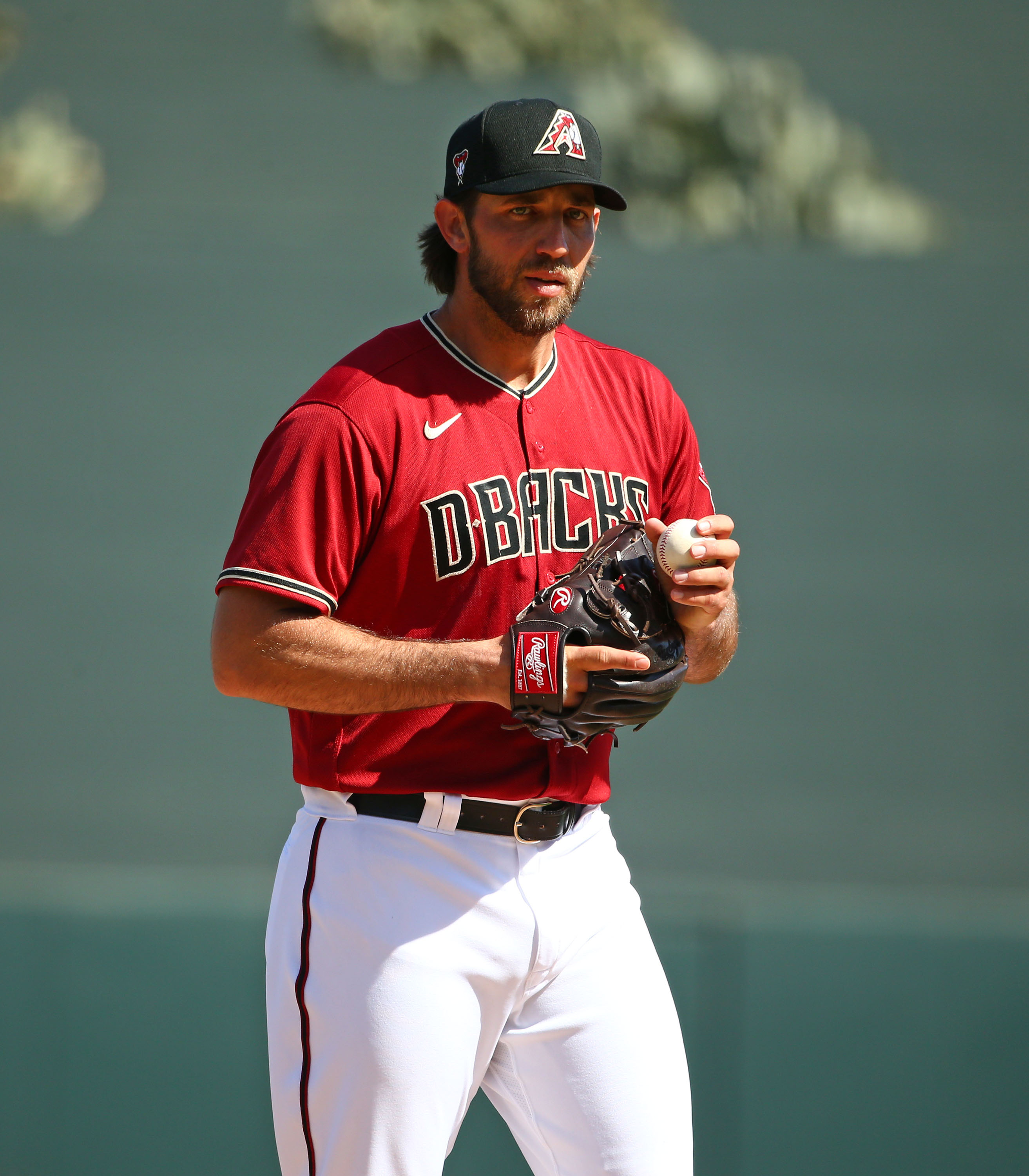
It was settled: Ray would stay, pairing with Bumgarner as a veteran 1-2 southpaw punch. The rotation was set with the steady Mike Leake and aforementioned Weaver and Gallen, with swingman Merrill Kelly ready to step in where needed. There was already a series of quality upper-level arms available — Jon Duplantier, Alex Young, Taylor Clarke, Taylor Widener — which left the team without need of Taijuan Walker. Rather than taking a roll of the dice on Walker, the D-Backs non-tendered him.
The Snakes also non-tendered outfielder Steven Souza, who joined Walker as a disappointing prior trade acquisition. That left the team with another outfield slot to be filled — to go with the potential opening in center field that would allow emergent star Ketel Marte to move back into the infield, as the club preferred.
There were loads of possibilities for adding the requisite outfield pieces. The D-Backs ultimately grabbed two veterans, both on reasonable salaries — one via free agency and the other via trade. Kole Calhoun forms a lefty-lefty corner duo with David Peralta, who also inked an affordable three-year extension. Calhoun isn’t likely to be a star-level performer, but he’s sure to be a grinder and fills a need at a palatable rate of pay.
Of greater interest: the D-Backs cashed in two of their far-off farmhands to land talented center fielder Starling Marte. He’ll cost the team $11.5MM this year and $12.5MM next, less the $1.5MM the Bucs chipped in. As I wrote in previewing the offseason for this club, “there’s an argument to be made that [Marte] fits in just the right space (two years of affordable but not cheap control) for the D-Backs.” That’s obviously how the team saw it.
(Starling) Marte should offer a nice blend of floor and upside for the Snakes, who could still pivot and deal him if circumstances warrant. It’s much the same approach Hazen has taken time and again when he sees solid value in quality, established players. The team has now done so several times in the extension context — first with infielder Eduardo Escobar, this winter with Peralta and shortstop Nick Ahmed.
Now that (Ketel) Marte is back in the infield, the club has extended players occupying the 4-5-6 positions. Christian Walker and Jake Lamb will handle first base (with the latter also appearing at the hot corner), rounding out the chief needs. There are a variety of reserve and depth options already on the 40-man roster, including utility infielder Ildemaro Vargas, first baseman Kevin Cron, and second/third base candidate in Rojas.
Behind the dish, the Snakes will hope that Carson Kelly can keep things moving in a positive direction. They replaced Alex Avila with another left-handed-hitting bat-first receiver in Stephen Vogt.
As with the addition of Vogt, the D-Backs decided on some modest veteran spending to bolster the relief unit. Junior Guerra and Hector Rondon will each occupy setup slots in front of returning closer Archie Bradley. It’s tough to project this unit as a marked strength, but the Arizona org will be aided by its collection of 40-man pitching depth (which includes some of the aforementioned players and a host of others with no or little MLB experience).
2020 Season Outlook
This is a strong overall roster that doesn’t really have holes … but still doesn’t seem near the overall talent level of the Dodgers. Even if the double-Marte combination stars and all of the solid veterans play well, it’s going to be awfully tough to prevent the L.A. behemoth from an eighth-straight NL West crown.
Still, the Diamondbacks are good enough that they could yet surprise if the Dodgers falter — especially in a short-season format. And a Wild Card spot is firmly in play. The club obviously feels it has set itself up for continued competitiveness in the near-term without sacrificing its long-term ability to contend — either by mortgaging the farm or bogging down the payroll. That’s the general approach that most mid-market teams have tried to find, but the current Diamondbacks regime is looking particularly adept at striking that balance.
How would you grade the club’s offseason efforts? (Link to poll for Trade Rumors mobile app users.)
Grade the Diamondbacks' offseason:
-
B 43% (931)
-
A 42% (905)
-
C 11% (245)
-
F 2% (45)
-
D 1% (30)
Total votes: 2,156
Three Diamondbacks Minority Owners Sue Managing General Partner
A trio of Diamondbacks minority owners have filed a lawsuit against the franchise’s managing general partner Ken Kendrick, according to a report from Zach Buchanan of The Athletic. The plaintiffs allege that Kendrick illegally forced them to either increase their stake in the Diamondbacks or have their shares bought out by the team. Kendrick argues that he and the team were within their rights to issue such an ultimatum.
The dispute stems from a letter in which Kendrick instructed minority owners with stakes of less than one percent to either increase their share to at least that threshold or to sell their shares back to the team at a price determined by a third-party appraiser. That decision was motivated by the Diamondbacks’ desire to “streamline its ownership group” and decrease the number of owners with minimal stakes in the franchise.
That initiative was backed by MLB, which “prefers” that teams maintain smaller ownership groups to facilitate more efficient governance. However, the suing owners argue that since the idea originated with the Diamondbacks and was brought to MLB for approval, the minority owners maintain their status as eligible holders.
For what it’s worth, Buchanan went on to say via Twitter that the lawsuit is in no way related to the team’s ballpark concerns, which have prompted rumors about relocation. Since the three stakeholders involved in the lawsuit all own less than one percent of the team, Buchanan says, “they have no governing power over it,” and therefore the franchise could relocate with them on board. Kendrick and team president and CEO Derrick Hall spoke in February about the team’s stadium situation, hinting at a persisting hope to construct a new ballpark (be it in Arizona or elsewhere). The team’s stadium lease with Maricopa County would allow the D-Backs to leave Chase Field as early as 2022.
It’ll be a story worth following as the suit progresses, and we’ll be sure to provide updates for you as they come.
NL West Notes: Martin, Giants, Ubaldo
Right-hander Corbin Martin, one of four players the Astros sent to Arizona in the Zack Greinke blockbuster, had been on the Diamondbacks‘ radar for awhile, writes Zach Buchanan of The Athletic (subscription required). They’d first targeted him in the 2017 draft and again in trade talks with the ‘Stros centered around Paul Goldschmidt — but Houston wasn’t keen on including him in such a deal. At the time, Martin was 22 and fresh off 122 innings of 2.51 ERA ball between Class-A Advanced and Double-A, while Goldschmidt only had a year of control left.
Martin made his MLB debut in 2019 but underwent Tommy John surgery in July and was suddenly on the shelf for a win-now Astros club. Thus, D-backs GM Mike Hazen inquired again, and the Astros were more willing to listen the second time around. A package of Martin, J.B. Bukauskas, Seth Beer and Josh Rojas (plus plenty of cash to help offset Greinke’s salary) got the job done. Martin may not be an option for the Snakes until 2021, but he’s a second-rounder with a career 2.58 ERA in the minors who has ranked on Top 100 lists in both of the past two offseasons, making him an intriguing piece down the road. D-backs and Astros fans alike will want to check out the piece for thoughts from Hazen and assistant GM Amiel Sawdaye on the club’s longstanding interest in Martin.
Some more out of the NL West…
- The Giants‘ release of veteran lefty Jerry Blevins only increased the odds of southpaws Jarlin Garcia and Wandy Peralta making the club, notes Alex Pavlovic of NBC Sports Bay Area. Both pitchers hurled five shutout innings when exhibition games were still being played — Garcia with an 8-to-1 K/BB ratio and Peralta with a 10-to-4 mark. Given that Garcia is out of minor league options, he’d appear a particularly likely candidate to secure a spot in the ‘pen, although there’s certainly room for both. The Giants claimed both lefties off waivers, with Peralta coming over from the Reds in September and Garcia coming over from the Marlins over the winter. Each has had some success in the Majors and is controllable all the way through the 2023 season should things pan out in the Bay Area.
- Baseball’s shutdown put Ubaldo Jimenez‘s comeback attempt with the Rockies on hold, but the right-hander is open to pitching in the minors if play is able to resume, writes Nick Groke of The Athletic in an excellent column on Jimenez’s unexpected bid to revive his career (subscription required). As Groke details, Jimenez received a “fringy” Major League offer in the 2017-18 offseason but opted to stay home in the Dominican with his pregnant wife and soon-to-be-born child. This offseason, wanting to take one last shot, he called Rockies VP of international scouting Rolando Fernandez about using the team’s complex in the Dominican to refine his mechanics. That eventually turned into a solid Dominican Winter League stint, a minor league deal with the Rox and several weeks serving playing the role of wise old sage to younger Rockies pitchers like German Marquez. Manager Bud Black tells Groke that Jimenez was sitting around 91 mph with his heater early in camp. A comeback at age 36 is a long shot but would make for one heck of an in-season storyline to root for.
Transaction Retrospection: An Arizona-Seattle Blockbuster
MLBTR’s Steve Adams just recapped the notable trades that Mariners general manager Jerry Dipoto has made dating back to his hiring late in the 2015 season. That was an unenviable task when you consider the eye-popping amount of deals that Trader Jerry has swung since he arrived in Seattle. One of Dipoto’s most significant moves so far came on Nov. 23, 2016, when the Mariners and Diamondbacks made a trade that will likely impact both franchises for the foreseeable future.
The Mariners sent right-hander Taijuan Walker and middle infielder Ketel Marte to the Diamondbacks for middle infielder Jean Segura, outfielder Mitch Haniger and lefty Zac Curtis. The only member of the quintet who hasn’t established himself in the majors is Curtis, who pitched 38 innings in the bigs from 2016-18 but is now a free agent after the Rangers released him last July. On the other hand, Walker, Marte, Segura and Haniger have all enjoyed at least some success at the MLB level.
Walker, once a blue-chip prospect, hasn’t really lived up to the hype thus far. After a so-so run with the Mariners, he did well for Arizona in 2017, throwing 157 1/3 innings of 3.49 ERA/4.04 FIP ball. Unfortunately, injuries have cut down Walker since then. He underwent Tommy John surgery early in 2018, forcing him to miss almost all of that season, and then made just one appearance last season as he recovered from TJS and battled shoulder problems. The 27-year-old is now back with the Mariners on an inexpensive contract, so it’s clear that the acquisition didn’t work out as hoped for the Diamondbacks.
On the other side, the Marte pickup has gone swimmingly for Arizona. Marte was not the headliner in the deal at the time, but he’s a former top-100 prospect who has emerged as one of the majors’ stars during his short MLB career. The switch-hitting Marte, now 26, had his struggles in his first season as a D-back, but that didn’t stop GM Mike Hazen from extending him on a five-year, $24MM guarantee going into 2018. That decision has worked out beautifully for Arizona, which benefited from Marte’s 2.6-fWAR effort in 2018 and far more from his 7.1-fWAR showing last season. Marte divided his nearly MVP-caliber 2019 campaign between second base and center field – positions that were sore spots for the Mariners.
The Mariners miss Marte, but that doesn’t mean they came away empty-handed in this swap. As noted earlier, they got back Walker on a low-cost pact that may or may not pay dividends. Segura gave the team two productive seasons before it traded him to the Phillies in a deal for shortstop J.P. Crawford, who has a chance to end up as the M’s long-term answer at the position. And then there’s Haniger, who thrived from 2017-18 before a gruesome injury (a ruptured testicle) deprived him of 99 of 162 games in 2019. Haniger was not viewed as a can’t-miss prospect when the trade went down, but he ran roughshod over Triple-A pitching and has held his own in the majors when healthy. He’s under control through 2022, so a healthy version could either continue as an asset for the rebuilding Mariners or wind up as a valuable trade chip.
Adding everything up, this counts as one of the most fascinating deals of the past few years. Both sides landed good players, but Marte has clearly been the most valuable piece to this point. The Marte addition is among the reasons D-backs GM Mike Hazen’s trade history has gone over so well.
Video: Grading Mike Hazen’s Trades As Diamondbacks GM
Since being hired as Executive Vice President & General Manager of the Diamondbacks in 2016, Mike Hazen has engineered trades involving Zack Greinke, Paul Goldschmidt, J.D. Martinez, Ketel Marte, Starling Marte, and more. MLBTR’s Jeff Todd assesses Hazen’s wheeling and dealing in today’s video.