
Yankees Notes: Devin Williams, Kyle Tucker, Payroll
The Yankees are interested in bringing free agent closer Devin Williams back to the Bronx. League sources told Ken Rosenthal and Will Sammon of The Athletic that the team has discussed a reunion with Williams’ camp.
Williams is one of the top names on the closer market. He landed at No. 16 on our Top 50 Free Agents list, which put him second among relievers, behind only Edwin Diaz. The 31-year-old is expected to have many suitors, with the Reds and Red Sox linked to him last week, and the Mets, Tigers, and Giants joining the mix this week. The Dodgers and Marlins have also been connected to Williams.
New York sent Caleb Durbin and Nestor Cortes to Milwaukee for Williams in December 2024. He struggled in his first month with the team, losing the closer role by May. An injury to fill-in closer Luke Weaver allowed Williams to regain the role, and he pitched well in June and July. The trade deadline acquisition of David Bednar pushed Williams back into setup duty. He closed the year with his best stretch of the campaign, posting 13 scoreless innings from September 7 through the postseason.
Williams said he would “definitely be open” to returning to the Yankees back in October. As for whether being the closer would impact his next destination, Williams said it “depends on the scenario.” While Weaver is a free agent, New York still has Bednar and fellow trade deadline acquisition Camilo Doval under team control for next season.
Williams isn’t the only high-profile free agent on the Yankees’ radar. General manager Brian Cashman told reporters on Thursday, including Bryan Hoch of MLB.com, that he’s been in contact with agent Casey Close on several players. That list of possible targets includes Kyle Tucker, Kyle Schwarber, Michael King, and former Yankee Paul Goldschmidt. Cashman also mentioned interest in Tatsuya Imai, who was posted by the Seibu Lions earlier this week. “We’re certainly engaging all these players in the marketplace,” Cashman said.
Tucker will likely have just as many suitors as Williams, perhaps more. Toronto is considered by some teams to be the favorite to land the star outfielder, but the Dodgers, Yankees, and Orioles have been linked to him. Given that he’s the big prize in free agency this offseason, additional teams are bound to come forward as potential candidates.
New York regained an outfielder when Trent Grisham accepted the qualifying offer, but lost one when Cody Bellinger opted out of his contract. Jasson Dominguez is penciled in alongside Grisham and Aaron Judge, but he hasn’t performed well enough to discourage the Yankees from going after a massive upgrade in Tucker. They could also re-up with Bellinger.
As far as paying for these potential acquisitions, Cashman was noncommittal about whether payroll would exceed $300MM. “I think it could go both ways. So it just depends on how things shake out and what opportunities present themselves,” he told reporters, including Hoch. FanGraphs’ RosterResource tool currently has the Yankees’ payroll at around $260MM next season. Grisham’s deal added about $22MM to the ledger, and he’s just the sixth-highest-paid player on the team next year. New York’s payroll was around $296MM this past season after topping $300MM in 2024.
A deal for Tucker, Schwarber, Williams, or any of the other marquee names will likely require a big commitment across many years. The Yankees already have several of those types of deals on the books between Judge, Max Fried, Gerrit Cole, and Carlos Rodon, who are all on large contracts through at least 2028. Cashman expressed confidence he could make it work, though. “The job right now is to find out what’s available, and those all have different price points,” Cashman said. “There could be cheap players that are available that are good, or there could be very expensive players that are available that are good.”
Nine Players Reject Qualifying Offer
The deadline to accept the qualifying offer has passed. Four players — Trent Grisham, Gleyber Torres, Brandon Woodruff, and Shota Imanaga — chose to accept the one-year, $22.025MM deal and remain with their current clubs. The remaining nine players rejected the deal. They are: Cubs outfielder Kyle Tucker, Phillies DH Kyle Schwarber, Blue Jays infielder Bo Bichette, Astros lefty Framber Valdez, Padres righty Dylan Cease, Phillies lefty Ranger Suarez, Mets closer Edwin Diaz, Diamondbacks righty Zac Gallen, and Padres righty Michael King. All nine are now free agents.
There’s not much surprise in any of the nine players who rejected. Tucker, Schwarber, Bichette, Valdez, Cease, Suarez and Diaz were all locks. Gallen may have given some brief thought to accepting after a rough showing in 2025, but he finished strong and has a track record as a high-end starter who’s garnered multiple top-five finishes in NL Cy Young balloting. King was hobbled by nerve and knee injuries in an odd season but was dominant in 2023-24 and through the first two months of the current season. He was healthy late in the year and fanned three in his lone inning of postseason work. He’ll test the waters in search of a multi-year deal as well.
Now that this nonet has rejected qualifying offers, they’ll all be subject to draft compensation. Interested teams will need to surrender a draft pick (or multiple picks) and, in some cases, space from their bonus pool for international amateurs in order to sign any of this group. The extent of that draft compensation depends on the revenue-sharing and luxury tax status of the new team. MLBTR broke down which pick(s) each club would forfeit by signing a “qualified” free agent last month.
Similarly, the compensation for each player’s former club is dependent on revenue-sharing and luxury tax status — as well as the size of the contract signed by the player in question. MLBTR also ran through the compensation each team would receive if their qualified free agents turned down the offer and signed elsewhere.
Red Sox Interested In Bo Bichette, Kyle Schwarber
With holes to fill in the lineup, the Red Sox are exploring two of the bigger free agent bats on the market. WEEI.com’s Rob Bradford reports that “the Red Sox have shown interest in” Bo Bichette, and MLB Network’s Jon Morosi reports that the club has likewise “checked in on Kyle Schwarber.”
Chief baseball officer Craig Breslow‘s recently commented that Boston is looking to add extra pop to its lineup, and either player would certainly fit in this regard. Schwarber is an elite power bat coming off a career year, hitting 56 homers and slashing .240/.365/.563 over 724 plate appearances for the Phillies. Bichette rebounded from an injury-shortened down year in 2024 to hit .311/.357/.483 with 18 homers over 628 plate appearances for the Blue Jays this sesason.
The injury bug did bite again for Bichette, as a knee sprain kept Bichette sidelined for most of September and most of the Jays’ playoff run until he was able to return in the World Series, but he still did plenty to re-establish himself as one of the preeminent infield bats in the sport. MLB Trade Rumors ranked Bichette second on our list of the offseason’s top 50 free agents, and projected the shortstop to land an eight-year, $208MM contract.
Schwarber ranked ninth on the list with a five-year, $135MM projection. Schwarber is entering his age-33 season and is basically a full-time designated hitter, but while teams have traditionally been wary of committing major dollars to such aging and defensively limited players, Schwarber’s numbers are so outsized that he’ll very likely command a lengthy contract. There is also a sense that his market could be driven upwards by the Phillies, who have been very open about their desire to re-sign the slugger.
The Red Sox are very familiar with Schwarber, as he posted big numbers and quickly became a clubhouse favorite after Boston acquired him from the Nationals at the 2021 trade deadline. Schwarber was just a rental pickup as he entered free agency that winter and signed his four-year, $79MM deal with Philadelphia. On paper, Schwarber might not be an entirely ideal fit for the Sox since he’ll monopolize the DH spot and add another left-handed bat to an already lefty-leaning lineup, but these could be relatively minor concerns given the upside of Schwarber’s offense.
Bichette is a right-handed hitter, but his defensive fit is an open question, as whether or not Bichette remains at shortstop will be one of the key subplots of his free agency. Bichette’s defense has been a question mark for years, and such public metrics as Defensive Runs Saved (-12) and Outs Above Average (-13) hated his glovework in 2025.
In the early days of the offseason, suitors “haven’t been scared off of Bichette at shortstop,” ESPN’s Jeff Passan writes, and it isn’t yet known if Bichette and his reps at Vayner Sports are marketing him strictly as a shortstop, or if Bichette is open to a position change. He did make his big league debut at second base during the World Series, in a nod to the physical limitations of his PCL sprain.
As it relates to the Red Sox, Trevor Story is lined up as the team’s shortstop. Story’s own defensive metrics were well below average in 2025, marking a surprising decline for a player who has been a very strong defensive shortstop for much of his career. Breslow has said that Story will play shortstop next year, but since Story has shown a willingness to play other positions in the past (he was Boston’s regular second baseman when healthy in 2022), it is possible some shifting could go on within the Sox infield. The simpler solution would be to just slot Bichette at second base alongside Story at shortstop, or Bichette could potentially factor into Boston’s third base picture.
The Sox have a prominent free agent infielder of their own in Alex Bregman, who MLBTR projects for a six-year, $160MM contract. This puts Bregman as less expensive than Bichette and only a bit pricier than Schwarber. Beyond just the cost of pure dollars, the Sox would need to give up draft pick compensation for signing a qualifying offer-rejecting free agent like Bichette or Schwarber, whereas Bregman could be re-signed for just money. Bregman is also a known commodity for the organization, and he made a big impact both on and off the field in his one season in Boston.
That said, Bichette is also almost four years younger than Bregman and five years to the day younger than Schwarber. Top prospect Marcelo Mayer made his MLB debut in 2025 and seems poised to take on a more regular role somewhere in Boston’s infield, so Mayer could conceivably take over Bregman’s old spot at third base while Bichette plays second or shortstop. With Triston Casas rumored to be a trade candidate, first base has also been mentioned as target area for Boston, with names like Pete Alonso, Kazuma Okamoto, and Munetaka Murakami floated as speculative candidates to join the Sox.
Pirates Interested In Kyle Schwarber, Showed Interest In Josh Naylor
Pirates GM Ben Cherington said last week that he had “more [financial] flexibility than we’ve had in other offseasons I’ve been in Pittsburgh,” and subsequent reports indicated that Bucs ownership could approach the $40MM mark with their spending plans this winter. This willingness to spend has translated to some early interest in two of the best hitters on the free agent market, as ESPN’s Jeff Passan reports that the Pirates have interest in Kyle Schwarber, and also had interest in Josh Naylor before Naylor re-signed with the Mariners.
The exact nature of the Bucs’ talks with Naylor weren’t specified, yet Passan indicated that the Pirates were prepared to offer Naylor more than $78MM. This would’ve been, by a wide margin, the priciest free agent deal in Pirates history. Francisco Liriano‘s three-year, $39MM deal from December 2014 remains the biggest guarantee the perennially low-spending Buccos have ever given to a free agent.
Naylor re-upped with the Mariners for five years and $92.5MM. Beyond just the money, there was plenty of mutual interest between Naylor and the M’s in continuing their relationship, as evidenced by the fact that Naylor agreed to a new deal so soon after the free agent market opened. Seattle looks well-positioned to keep contending throughout Naylor’s tenure, so it likely would’ve taken a drastic overpay from the Pirates to convince him to leave the Mariners for a Pittsburgh club that has struggled through seven straight losing seasons.
Along these same lines, Schwarber is expected to receive plenty of offers from big-market contenders, including his former team in Philadelphia. MLB Trade Rumors projects Schwarber to receive a five-year, $135MM contract, even though he is entering his age-33 season and is essentially a DH-only player at this point in his career. Schwarber’s huge power, consistent production, and reputation as a clubhouse leader will very likely outweigh concerns about his age, and the Phillies (like the Mariners with Naylor) are prioritizing bringing Schwarber back into the fold.
This being said, the fact that Schwarber and Naylor are even being mentioned in connection to the Pirates is eye-opening, and perhaps indicative of how uncharacteristically aggressive Pittsburgh may be in trying to upgrade its lineup. While the Pirates have been rebuilding for the bulk of Cherington’s tenure, his last couple of offseasons have seen the GM spread out his limited spending capacity over multiple players, with the idea of addressing several needs rather than making one single big strike. The tactic makes sense on paper, but it hasn’t really worked in practice, as the Bucs have remained under the .500 mark.
With this in mind, Pittsburgh might now be more open to adding one clear-cut star bat to its lineup, even if it means going outside the team’s usual financial comfort zone. The very top of the free agent hitting market (i.e. Kyle Tucker or Bo Bichette) is likely still out of the question for the Pirates. But, if Schwarber and Naylor are on the radar, players like Cody Bellinger, Pete Alonso, Eugenio Suarez, Kazuma Okamoto, and any number of other available bats could now conceivably be within Pittsburgh’s spending range.
Bucs fans can be forgiven for taking a “we’ll believe it when we see it” stance on the Pirates’ pursuit of major free agents. That said, Paul Skenes‘ immediate impact as arguably baseball’s best pitcher has created more pressure on the team to return to contention while Skenes is still under team control. Skenes and the Pirates’ collection of promising young arms was let down by a dismal offense in 2025, so adding hitting is the obvious top priority on the team’s offseason checklist.
The common theory going into the winter was that Pittsburgh was again going to trade from its stockpile of hurlers to obtain some much-needed hitting help. Cherington had already flatly shot down any possibility of Skenes being dealt, but conceivably any of the less-experienced arms could be dealt for an equally promising young bat. As for the Buccos’ more seasoned pitchers, the Athletic’s Ken Rosenthal and Will Sammon reported today that Johan Oviedo is drawing trade interest, and Mitch Keller has been mentioned in trade rumors for months.
Keller is also the Pirates’ second-highest paid player, so dealing the right-hander would free up more payroll room for further moves. This could mean more exploration at the higher end of the free agent market, or the Pirates could conceivably take on some salary in a trade for a more expensive hitter. Trading Keller for a similarly-priced hitter would be the smoothest way to accomplish this goal, though such an easy match isn’t obvious on the trade front.
The fact that the Pirates were looking at Naylor doesn’t necessarily mean that the team isn’t satisfied with incumbent first baseman Spencer Horwitz, as Horwitz could be moved to DH in the event that another first baseman was added. It also could mean that Pittsburgh was more broadly looking at any available top bat, and figuring out the positional fit can come after the fact.
One position that probably won’t receive much attention is shortstop, as top prospect Konnor Griffin is expected to be in the majors at some point in 2026. This could even be as early as Opening Day, as Passan writes that “the Pirates are strongly considering giving [Griffin]…the opportunity to win their big league shortstop job” in Spring Training. It would be a bold promotion for a 19-year-old who has only one year of pro ball under his belt, and Griffin’s resume consists of 21 Double-A games and zero Triple-A games.
Nevertheless, Griffin is viewed as perhaps the best prospect in baseball, and he looked so impressive in 2025 that he already appears to be on the verge of his MLB debut. Putting Griffin on the Opening Day roster and keeping him in the majors throughout 2026 could eventually earn the Pirates a bonus draft pick via the Prospect Promotion Incentive program, should Griffin win Rookie of the Year honors, or if he has a top-three finish in NL MVP voting during his pre-arbitration years.
Shohei Ohtani Wins NL MVP Award
Shohei Ohtani has his fourth MVP award. As expected, the two-way superstar repeated as NL MVP and has now won the award twice in each league. He’s the second player in MLB history to win a fourth MVP. Barry Bonds won the award seven times. Until tonight, he’d been the only player to earn that title more than thrice. Ohtani won the award unanimously for the third consecutive season and has gotten all 30 first-place votes in all four of his wins.
It’s a third consecutive MVP for the Dodgers slugger. He won the AL version in 2023 during his final season as a member of the Angels. He has taken the crown in both seasons as a Dodger, winning a World Series in each. His $700MM free agent contract is already among the most successful in league history. He’ll have the opportunity to match Bonds’ record of four consecutive MVP wins next season. Bonds won the award as a member of the Giants each season from 2001-04.
Ohtani beats out Kyle Schwarber and Juan Soto, the other NL finalists. He led the majors with 146 runs scored while slashing .282/.392/.622 across 727 plate appearances. Ohtani paced the NL in slugging percentage and OPS. He hit a career-high 55 home runs, one back of Schwarber for the Senior Circuit lead. Ohtani’s 102 runs batted in were “only” good for sixth in the NL, though that’s partially because he spent all but one week of the season working out of the leadoff spot.
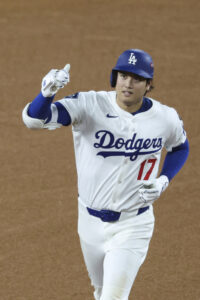
While Schwarber matched Ohtani from a power perspective, the latter had the advantage of more than .040 points of batting average and .025 points in OBP. He also stole 20 bases and was a far more valuable overall baserunner. That’s before considering his achievements on the mound.
Ohtani finally returned after an extended layoff from pitching following his second career elbow surgery. He chipped in 47 innings of 2.84 ERA ball with 62 strikeouts over 14 starts. Ohtani probably would have won the MVP even if he were simply a DH, as he did in 2024. That he’s also capable of pitching at a top-of-the-rotation level when healthy only reaffirms his status as the sport’s greatest player today and arguably ever.
The award voting takes place at the end of the regular season. Ohtani added another eight homers with a .265/.405/.691 slash over 84 plate appearances in the postseason. He’d been only average during the Dodgers’ World Series run in 2024. That changed this October. Ohtani leveled up when the lights were brightest, hitting .333 with a .500 on-base percentage during the Fall Classic. He set a playoff record with nine times on base during the marathon Game 3, when a couple early homers led Jays manager John Schneider to intentionally walk him every time he came up in extra innings.
Ohtani’s monster showing shouldn’t take away from Schwarber’s phenomenal year. He led the NL in homers and took home the major league RBI crown by driving in 132 runs. Schwarber hit .240/.365/.563 across 724 plate appearances while starting all 162 games for the Phillies. He hit 187 home runs over the course of his four-year, $79MM free agent deal with the Phils and is now set to cash in during a return trip to free agency. Schwarber and Ohtani are tied for second in the majors in homers over the past four seasons, trailing only Aaron Judge. He has received MVP votes in four straight seasons, but this is his first time as a finalist.
Soto just wrapped up the first season of his free agent mega deal with the Mets. It was a disappointing year for the team, as they melted down in September and lost out on a playoff berth to an 83-win Cincinnati club. Soto came under some fire early after getting out to a slow start, but he was a monster from June onward. He finished the year with a .263/.396/.525 slash across 715 trips to the plate. Soto led the majors with 127 walks and paced the NL in on-base percentage. That’s to be expected for the hitter with the game’s best eye. Far more surprising is that he also tied for the NL lead with 38 stolen bases after entering the season with 57 steals over his first six and a half seasons. Soto has never won an MVP but has finished in the top three on three occasions.
FanGraphs credited Ohtani with an NL-best 9.4 wins above replacement between his pitching and hitting. Baseball Reference had him in second place at 7.7 WAR, narrowly behind Cy Young runner-up Cristopher Sánchez at eight WAR. BRef actually had Diamondbacks shortstop Geraldo Perdomo as the WAR leader solely among position players, excluding Ohtani’s pitching stats. Perdomo was second in fWAR behind Ohtani.
Schwarber received 23 of the 30 second-place votes. Four voters had Soto second on their ballot, while the other three placed Perdomo in that spot. The three finalists were the only players who appeared among the top five on all 30 ballots. Trea Turner, Pete Alonso and Freddie Freeman all received one third-place vote, with the rest split between Schwarber, Soto and Perdomo. Perdomo finished in fourth place, while Turner landed in fifth. Cy Young winner Paul Skenes came in sixth and was the top pitcher on the ballot. Corbin Carroll, Fernando Tatis Jr., Pete Crow-Armstrong and Francisco Lindor rounded out the top 10. Twenty three players received at least one vote.
Image courtesy of Kiyoshi Mio, Imagn Images. Full vote breakdown available via BBWAA.
13 Players Receive Qualifying Offers
Thirteen players have received a qualifying offer this year, reports Jeff Passan of ESPN. The list is as follows:
- Kyle Tucker, OF, Cubs
- Kyle Schwarber, OF/DH, Phillies
- Bo Bichette, SS/2B, Blue Jays
- Framber Valdez, LHP, Astros
- Dylan Cease, RHP, Padres
- Ranger Suarez, LHP, Phillies
- Edwin Diaz, RHP, Mets
- Zac Gallen, RHP, D-backs
- Shota Imanaga, LHP, Cubs
- Michael King, RHP, Padres
- Trent Grisham, OF, Yankees
- Gleyber Torres, 2B, Tigers
- Brandon Woodruff, RHP, Brewers
This year’s QO is valued at $22.025MM. All 13 players will have until Nov. 18 to decide whether to accept that one-year offer or decline and become a free agent. They can spend that time gauging the open market to determine interest in their services. If a player accepts the QO, he’ll be treated as a free agent signing and thus will be ineligible to be traded without his consent until June 15 of next year. If he declines, any team that signs him will be subject to draft and/or international bonus forfeitures, depending on its revenue-sharing and luxury tax status.
The bulk of the list was generally expected. Every recipient other than Torres and Imanaga was pegged as likely or a no-doubter to receive the QO on MLBTR’s annual lists of qualifying offer previews for position players and for pitchers. Torres was viewed as something of a long shot, at least on the MLBTR staff. He’s coming off a nice season in Detroit but struggled through a poor finish — perhaps in part due to injury — and wasn’t hit with a QO last offseason when coming off a comparable year at the plate in the Bronx.
Imanaga was listed as a borderline call on our preview as well. The Cubs declined a three-year, $57.75MM option on Imanaga last week. He subsequently declined a $15.25MM player option (which came with an additional player option at $15.25MM) — effectively opting out of a remaining two years and $30.5MM. The Cubs are banking on Imanaga also turning away one year at just over $22MM after turning down that remaining $30.5MM in guaranteed money.
The qualifying offer is determined each year by taking the average of the game’s 125 highest-paid players. We’ve already covered the penalties that each team would face for signing a qualified free agent, as well as the compensation each club would get for losing a qualified free agent to another team.
Among the notable free agents to not receive a qualifying offer are Lucas Giolito, Robert Suarez, Devin Williams and Jorge Polanco. Giolito might have received one had it not been for a late elbow issue that ended his season. Suarez has been excellent and just opted out of the remaining two years and $16MM on his contract, but he’ll be 35 next year. The Padres have been reducing payroll in recent seasons and likely didn’t want to risk Suarez locking in that weighty one-year sum. Williams would have received a QO with a typical season, but he struggled throughout much of the season’s first four months before a dominant finish. Polanco enjoyed a terrific rebound campaign but is 32 years old and was limited to DH work for much of the season due to ongoing injury issues.
The qualifying offer grants each of these free agents the chance at a notable one-year payday, though the majority of them will reject without much thought. Players like Tucker, Bichette, Schwarber, Valdez, Cease, Suarez and Diaz are likely to see comparable or larger (much larger, in Tucker’s case) salaries on multi-year deals in free agency. Even players like Grisham, who probably won’t land a $22MM annual value over multiple years, are still likely to reject. Major league free agents typically — though not always — prioritize long-term earning over short-term, higher-AAV pacts. A three- or four-year deal worth $14-16MM per year, for instance, is typically viewed as preferable to accepting one year at a higher rate.
There’s risk in declining the offer, of course. Teams are more reluctant to sign players who’ll cost them valuable draft picks and/or notable portions of their hard-capped bonus pool for international amateurs. Every offseason, there are a handful of free agents whose markets are weighed down by the burden of draft pick compensation. That typically applies to the “lower end” of the QO recipients. For top stars like Tucker, Bichette, etc. — draft/international forfeitures are simply considered the cost of doing business and don’t tend to have much (if any) impact on the player’s earning power.
The Case For The Reds To Sign A Big Bat
The Reds’ immediate exit from the playoffs makes it easy to forget the successes of the regular season. Cincinnati snapped a four-year postseason drought in manager Terry Francona’s first season. They won 83 games for just the second time since 2013. This team has something to build on heading into 2026, and now is the time to make a splash in free agency.
As MLBTR’s Anthony Franco explored in Cincinnati’s Offseason Outlook for Front Office subscribers, improving the offense will be key this offseason. The club did not have the depth or high-end talent to compete with the best of the National League. Cincinnati could make smaller moves around the margins, as they’ve done in recent seasons, but why not take a bigger swing?
Financially, the team is in a decent spot. FanGraphs’ RosterResource tool has the Reds with an estimated payroll of around $94MM heading into next season. They were close to $120MM this past season, and have been above $130MM in each season from 2020 to 2022. The biggest current commitment for 2026 is the $13MM owed to Jeimer Candelario. While it stings to be shelling out that amount to a player no longer in the organization, Candelario is the only one on the books for eight figures right now, assuming the team declines Austin Hays‘ $12MM mutual option. MLBTR contributor Matt Swartz has Brady Singer projected to earn $11.9MM in arbitration, but the righty will likely be the only significant commitment coming from the arbitration process.
Cincinnati’s largest free agent contract by total value is a tie between Nick Castellanos and Mike Moustakas at $64MM over four years in 2020, as shown on MLBTR’s Contract Tracker. The club will have to go well beyond a $16MM average annual value to entice Kyle Schwarber or Pete Alonso, but maybe combining the outlay on Castellanos and Moustakas would be enough to make an interesting offer.
Part of the reason for the offense being the offseason focus is that the pitching staff was excellent in 2025. Hunter Greene looked like an ace when healthy. Andrew Abbott delivered a breakout season. Singer and Nick Lodolo provided stable innings. Chase Burns posted electrifying strikeout numbers upon getting called up. Cincinnati ranked ninth in starting pitcher ERA. Only six other starting staffs had more strikeouts.
The success on the mound is made more impressive by Cincinnati’s home venue. Great American Ball Park ranks third in StatCast’s Park Factor metric. It’s the second-highest rated park for home runs. The strides made by the starting pitching unit make the shortcomings of the offense harder to swallow, especially given the favorable hitting environment.
Though they snuck into the playoffs after chasing down the Mets, the Reds finished third in the NL Central. They haven’t been better than third in the division since winning it in 2012. This might be the perfect time to buck that trend.
Pittsburgh and St. Louis are in rebuilding mode, making this a three-horse race heading into next season. Milwaukee and Chicago both won 90+ games in 2025, but could be facing significant losses. Kyle Tucker is a free agent. He would fit the bill as a significant splash for Cincinnati, though he’s likely out of their price range. The more likely impact is removing a key contributor from the middle of the Cubs’ lineup. Speaking of important losses, Milwaukee could be considering a Freddy Peralta trade. It would be a massive loss for a rotation without much proven depth and some health questions.
The Brewers and Cubs are still likely the favorites to win the NL Central next season, but the Reds can close the gap. Their finances make a big move possible, and their pitching staff deserves better support. Schwarber said it would be “cool” to suit up for his hometown team. The Reds might as well try to make that happen.
Phillies Notes: Schwarber, Realmuto, Suarez
The Phillies are keeping manager Rob Thomson in place for the 2026 season, but there are still some potentially notable changes coming to the roster. Kyle Schwarber, Ranger Suarez and J.T. Realmuto are among the team’s most notable free agents. Zack Wheeler‘s health outlook is a question mark after he required thoracic outlet surgery. With Suarez and Wheeler’s status uncertain at best and Aaron Nola coming off an ERA north of 6.00, Philadelphia’s rotation isn’t the typical powerhouse to which we’ve become accustomed in recent seasons.
First and foremost, it sounds as though retaining Schwarber will be one of the top’s top priorities — if not the very top item on president of baseball operations Dave Dombrowski’s to-do list. Scott Lauber of the Philadelphia Inquirer writes that executives with other clubs expect owner John Middleton to do whatever it takes to keep Schwarber in the City of Brotherly Love. Matt Gelb of The Athletic suggests that Schwarber, who’ll turn 33 next spring, is planning to seek a five-year contract in free agency.
That’d be unheard of for a designated hitter at his age, but Schwarber’s 2025 season was the best of his career. He clubbed an NL-best 56 home runs en route to a .240/.365/.563 slash. Schwarber topped the century mark in both runs scores and runs driven in for a third consecutive season.
Schwarber’s 14.9% walk rate was 6.5 percentage points higher than the 8.4% league average, and while Schwarber’s 27.2% strikeout rate was also considerably higher than average (22.2%), it was also his lowest since 2021. The NL home run leader has also made immense gains against left-handed pitching in recent seasons, shedding platoon concerns that followed him earlier in his career. Schwarber was actually better against lefties than righties, hitting same-handed opponents at a .252/.366/.598 against clip.
If one were to set MLBTR’s Contract Tracker to show the number of position players commanding a five-year free agent deal beginning in their age-33 season, well … there aren’t any. In fact, the only free agent hitters in the past decade to sign even a four-year deal beginning at age 33 or later are Ben Zobrist ($56MM), Starling Marte ($78MM) and Josh Donaldson ($92MM). All are at least four years old now (10, in Zobrist’s case), and Schwarber is coming off such a prodigious offensive showing that he should top all of them with ease.
Gelb also suggests that Realmuto is expected to seek a three-year deal — a hefty ask considering he’ll turn 35 next spring. Again, looking to our Contract Tracker to find catchers who signed for three or more guaranteed years beginning with their age-35 season (or older) reveals only two: Carlos Ruiz‘s three-year, $26MM deal to return to the Phillies all the way back in 2013 and Yadier Molina‘s three-year, $60MM extension back in 2017.
Realmuto showed in 2025 that there’s still plenty left in the tank, but his days as a premium all-around catcher also look to be in the past. His .257/.315/.384 batting line was 6% worse than league-average, by measure of wRC+, but still checked in a bit better than that of the average catcher, specifically. He’s still plus when it comes to controlling the run game (29.7% caught-stealing rate), but Realmuto has now registered negative blocking grades (according to Statcast) in consecutive seasons and has seen his once-vaunted framing grades decline sharply.
The market offers little in the way of starting-caliber catchers, which could work to Realmuto’s benefit. Victor Caratini and Danny Jansen are arguably the most notable alternatives on the open market. The former has posted nice rate stats in the batter’s box but has primarily operated as a backup. The latter has now had back-to-back poor seasons at the plate. Potential non-tenders (e.g. Jonah Heim, Joey Bart) could add some change-of-scenery candidates to the list of options, and the trade market will surely offer a few names to ponder (e.g. Ryan Jeffers, Jake Rogers, Ivan Herrera).
Turning to Suarez, he made no secret of his hope to remain in Philadelphia. MLB.com’s Todd Zolecki writes that the left-hander was among the last players to leave the clubhouse after the 2025 season ended. He told reporters at the time: “I don’t want it to be the last year with the team.”
The 30-year-old Suarez has been a rock in the Philly rotation, averaging 26 starts per season across the past four years and pitching to a 3.59 ERA in that time. He’s been even better in the playoffs, with a sub-2.00 ERA in his postseason career. Suarez doesn’t throw especially hard, sitting 91-92 mph with his sinker, but he still consistently posts better-than-average strikeout, walk and ground-ball rates.
As it stands, the Phillies’ rotation will include Nola, Cristopher Sanchez and Jesus Luzardo. The team hasn’t yet provided a timetable for Wheeler’s recovery from his thoracic outlet procedure. Taijuan Walker is signed for $18MM in 2026, but the Phillies would probably welcome the opportunity to shed the some or all of that remaining sum. Top prospect Andrew Painter could make his long-awaited debut next year, but he posted uneven minor league results in his return from Tommy John surgery. Mick Abel was traded to the Twins in the Jhoan Duran swap.
Retaining Suarez would go a long way toward solidifying a rotation with an atypical number of red flags, but the Phillies already project for a nearly $228MM payroll before making any additions or bringing back any potential free agents (via RosterResource). It’s hard to imagine them keeping all three of those prominent impending free agents — particularly when there are other needs elsewhere on the roster.
Poll: Will Anyone Get To 60 Home Runs This Year?
It’s been a great year for power hitters in MLB, as five different players slugged their 40th home run of the season before the end of August. It’s not often that so many hitters enter September with a realistic shot at the lofty threshold of 60 home runs in a season. It’s a feat that’s only been accomplished nine times, and the combination of Sammy Sosa and Mark McGwire account for five of those nine 60-homer seasons. Of course, it’s an incredibly rare feat for a reason, and many promising campaigns fall short in the season’s final month. 12 seasons with between 56 and 59 home runs have been logged throughout MLB history, after all.
Will this year’s biggest power threats join that club of also-ran seasons, or will we see the tenth 60-homer season in MLB history come to fruition this year? Here’s a look at each of the top home run hitters from this season and their chances of reaching that illustrious 60-homer plateau, in order of their current home run totals for 2025:
While everyone else on this list hit their 40th homer of the season in August, Raleigh’s 40th home run was actually slugged on July 26. The Mariners’ catcher has had a historic season this year, setting the all-time single season home run record for a catcher while sitting just four behind Mickey Mantle for the all-time single season record for home runs by a switch hitter. With 50 homers tallied so far this year, it’s hard not to see why Raleigh could have a very real shot at hitting 60 home runs this season. He’s hit at least ten homers in three of the season’s five months so far, and has never hit less than eight in a month this year. With that being said, it’s also worth noting that Raleigh has slowed down a bit in the second half of the season. In 40 games since the All-Star break, Raleigh has posted just a 112 wRC+ with 12 home runs. With just 25 games left to play on the Mariners’ schedule, he’ll need to pick up the pace if he’s going to reach 60 homers this year.
Schwarber is just one homer back of Raleigh in the race for the MLB home run lead after an incredible four-home run performance on August 28. Schwarber has long been one of the game’s premiere power threats and, like Raleigh, has hit at least 10 homers in three of this season’s five months so far. He’ll need to hit 11 in 25 September games in order to reach 60 homers, but one thing working in his favor is that he’s saved most of his power for the second half this year. He’s hit 12 home runs in both July and August, so if he can put up just one more month like the last two, he’ll get there. Of course, a player slugging .655 over his past 52 games also runs the risk of getting pitched around, which could damage Schwarber’s chances of making it to 60. One thing that could work in Schwarber’s favor is his home ballpark, as Statcast considers Citizens Bank Park to be the fifth-most homer friendly stadium in the majors this year.
With three MVP awards in the past four years, no one should put anything past baseball’s two-way superstar. Ohtani became the first player to go 50-50 last season, and with 54 homers tied with Mantle (and seven other seasons) at 22nd on the single-season home run leaderboard. With 45 home runs headed into September, he has an outside shot at not only breaking that personal record, but getting a coveted 60-homer season. 15 home runs in a single month is a tall order for any player, but Ohtani did exactly that back in May when he crushed 15 long balls in 27 games. The Dodgers have two fewer games than that in September, but Ohtani will benefit from playing his home games at Dodger Stadium, which is far and away the most homer-friendly ballpark in the majors this year per Statcast.
Aaron Judge hit his 43rd home run of the season yesterday, and that makes it a tall order for him to reach 60 homers this season. With that being said, onlookers around the game should know better than to doubt the hulking slugger’s offensive abilities at this point, with MVP wins in two of the last three seasons and a completely absurd 202 wRC+ since the start of the 2022 season. Judge is also, of course, the only active player who’s already a member of the 60 home run club after bashing 62 long balls to take the AL home run record from Roger Maris during his 2022 AL MVP campaign. Judge finished just short with 58 home runs last year, but perhaps this year will be different. In order to reach 60 on the season, Judge will need to make a different kind of history: as noted by Thomas Harrigan of MLB.com last year, the record for home runs hit in September (and October, in seasons where it hosts regular season games) belongs jointly to Albert Belle and Babe Ruth. Judge would need to at least tie that duo’s 17 homers in the final month of the year in order to crack 60 long balls this year.
What do MLBTR readers think? Will the league enjoy a 60-homer campaign for the second time in four years this season? And if so, who is most likely to pull it off? Have your say in the polls below:
Will there be a 60 homer season in 2025?
-
No 59% (2,782)
-
Yes 41% (1,920)
Total votes: 4,702
If someone WERE to hit 60 home runs this year, who would it be?
-
Cal Raleigh 44% (2,001)
-
Kyle Schwarber 43% (1,928)
-
Aaron Judge 8% (341)
-
Shohei Ohtani 6% (264)
Total votes: 4,534
Dombrowski: Phillies Focused On Bullpen Help
The Phillies enter deadline season as clear buyers, sitting atop the NL East with a 47-32 record — the third-best record of any club in the game. It’s a familiar refrain, but president of baseball operations Dave Dombrowski made clear this week in interviews with Daniel Alvarez Montes of El Extrabase and Jayson Stark of The Athletic that his focus will be on adding to the bullpen.
“Our starting pitching’s so good,” Dombrowski told Alvarez Montes. “When [Bryce] Harper comes back, our lineup is in pretty good shape at that time. It’s probably bullpen is our biggest focus.”
Dombrowski offered similar sentiments in his chat with Stark and podcast co-host Doug Glanville, though he expanded a bit deeper. While the Phils clearly have a need for some relief help, The longtime baseball ops leader reminded that lefty José Alvarado will be back for the end of the regular season, which will be a boost to the team’s bullpen. Because Alvarado is serving an 80-game PED ban, he’s ineligible for this year’s postseason, but Dombrowski noted that his club will likely shift multiple members of its vaunted rotation into the ‘pen for the postseason, just as one of his former teams — the 2018 Red Sox — did to great effect when plugging Nathan Eovaldi and David Price into the playoff bullpen.
That’s not to say the Phillies won’t go out and add a bullpen arm (or perhaps even two). Dombrowski is nothing if not aggressive and straightforward when his team has a need. He emphasized to Stark and Glanville that winning opportunities only come around so often and should not be taken for granted, even if it means “you may give up a little more than you would want to in other circumstances.”
[Related: Philadelphia Phillies Trade Deadline Outlook]
Dombrowski pointed back to his 2022 trade of righty Ben Brown to Chicago in exchange for David Robertson as one such example, noting that it was a painful decision that was made out of what he believed to be strong pitching depth in the system and a major league roster that was capable of making a deep postseason run. Brown, 22 at the time, was ranked as the Phillies’ No. 7 prospect at Baseball America and was ready for a bump from High-A to Double-A. Robertson was a pure rental but in the midst of a terrific rebound season for the Cubs. He went on to pitch well for the Phils down the stretch and into the postseason. Brown was in the majors less than two years after the trade. He’s struggled in 2025 (and was optioned yesterday) but pitched quite well for Chicago last year and is still viewed as a viable long-term member of the pitching staff.
Phillies relievers currently rank 25th in the majors with a 4.63 ERA. They’re slightly better when it comes to FIP (4.24, 22nd) and SIERA (3.78, 15th). The Philadelphia bullpen has a 22.2% strikeout rate that’s right in line with the 22.4% league-average for relievers, and their 8.8% walk rate is a bit shy of the 9.4% league-average mark. However, the group has been far too homer-prone overall, sitting with a 1.29 HR/9 mark that is tied for the second-worst mark in the majors.
The Phillies have gotten generally good work from Matt Strahm, Orion Kerkering, Tanner Banks and (before he was suspended) Alvarado. Offseason signee Jordan Romano struggled considerably in the season’s first month but has posted a 2.95 ERA with a huge 35.6% strikeout rate and 9.6% walk rate over the past two months. Taijuan Walker, moved from the rotation to the bullpen, has shown flashes of excellence — he tossed three scoreless innings of one-hit ball and fanned seven Rays in a relief outing back in May, for instance — but has been inconsistent and stumbled as of late.
Stark did touch on other topics with Dombrowski, notably wondering whether the Phillies might be open to moving Harper back to the outfield if the opportunity to acquire a right-handed-hitting first baseman presented itself. The Phillies’ president declined to speak in absolutes but said he would strongly prefer not to do so, citing Harper’s defensive acumen at first base. In more general terms, Dombrowski downplayed the possibility of adding a bat in any capacity, pointing to previous trade deadlines where he’s promoted players from the farm rather than make an outside acquisition. Twenty-five-year-old Otto Kemp, who hit .313/.416/.594 in Triple-A before a recent promotion to the majors, is currently getting a look and was mentioned specifically by Dombrowski.
Dombrowski also spoke in broad terms about hoping to re-sign Kyle Schwarber and J.T. Realmuto after the season, as both are up for free agency this winter. Phillies fans, in particular, will want to check out both interviews, which clock in around six minutes (Alvarez Montes) and 30 minutes (Stark/Glanville) in length.