
Yoan Moncada, Nolan Arenado Leave WBC Game Due To Injuries
The United States advanced to the final of the World Baseball Classic after tonight’s 14-2 victory over Cuba, though the game saw prominent players from both teams make early exits. Nolan Arenado was hit in the right hand by an Elian Leyva pitch in the bottom of the fifth inning and was removed from the game. In the bottom of the sixth, Yoan Moncada tracked back from third base in pursuit of a Kyle Schwarber fly ball, but collided with left fielder Roel Santos (who made the catch).
Moncada is the more serious situation, as at the very least, the third baseman is day-to-day with a bruised rib, as the White Sox announced during the game. Afterwards, Cuba manager Armando Johnson told reporters (including ESPN’s Alden Gonzalez) after the game that Moncada had suffered a concussion, but USA Today’s Bob Nightengale tweeted that Moncada was cleared after being treated for a possible concussion.
As for Arenado, x-rays were negative on his hand, and the Cardinals third baseman appeared to be in relatively good spirits in the dugout following the HBP. United States manager Mark DeRosa told ESPN’s Marly Rivera and other reporters postgame that Arenado “would have fought me on” staying in the game had the score not been so lopsided.
Injuries have been an ongoing storyline of the WBC, particularly Jose Altuve‘s thumb fracture that will require surgery, or Edwin Diaz‘s season-threatening right knee surgery. Losing Moncada and Arenado to significant injuries would’ve only added to the debate over the added risks posed by players’ participation in this high-intensity games, and yet naturally, risk is inevitable in any kind of competitive environment. Given the long list of injuries suffered by players in Spring Training (either in games or in workout drills) and the random nature of injuries in general, it is hard to say that players would’ve necessarily be safer in camp with their teams than playing in the WBC.
Given the uncertainty around Moncada, the White Sox will likely keep him sidelined for at least a few days to fully monitor his health. It’s possible this might be all Moncada needs to recover, but with Opening Day looming, the Sox will surely at least consider an injured-list placement to begin the season if Moncada’s rib problem is still lingering, or if any concussion symptoms surface.
Cardinals Notes: Arenado, Fermin, Pitching Staff
Cardinals third baseman Nolan Arenado has watched several teammates play into their age-40 seasons in recent years, but he tells MLB.com’s John Denton that as things stand right now, he’s not planning to follow Yadier Molina, Albert Pujols and Adam Wainwright down that path. Arenado tells Denton he’d like to play until age 38 — long enough that his infant daughter can eventually watch him play in the Majors. Calling it quits at 38 would also give Arenado an earlier path to spending more time with his young family, of course. As you’d expect, Arenado qualifies that the age-38 plan is subject to change, noting that his body, on-field performance and other factors will play sizable roles in the decision as time passes.
On a surely related note, Arenado talks with Denton about the intensity with which he prepares for and plays the game, acknowledging that it can take a toll on him. Arenado wonders whether that intensity can be “too much” for both his own psyche and, at times, his teammates, adding: “I actually need to relax more.” It’s an interesting look at Arenado’s personality, mentality and place within the organization. Cards fans — and, more broadly, fans of Arenado in general — will want to check it out in full.
A few more items pertaining to the Cards…
- Infielder Jose Fermin has a strained quadriceps and will be shut down for at least the next two weeks, manager Oli Marmol announced to reporters this morning (Twitter link via Derrick Goold of the St. Louis Post-Dispatch). Acquired in a November trade with the Guardians, the 23-year-old Fermin (24 late this month) has been competing for a bench spot, but this injury all but eliminates the possibility of him landing on the Opening Day roster. He’s out to a 1-for-8 start thus far in Grapefruit League play and is coming off a shaky .215/.336/.322 showing in 330 Triple-A plate appearances a year ago. Even while struggling in Triple-A, however, Fermin fanned at a tiny 13.9% clip against a hearty 12.7% walk rate. He’s long drawn praise for his bat-to-ball skills, above-average speed and above-average defensive potential. He has very little power, but a healthy Fermin could seemingly make the Cardinals as a versatile utility player with a knack for putting the ball in play. He’s in the first of three minor league option seasons and is already on the 40-man roster, so he could potentially impact the team’s bench mix for several years.
- Jeff Jones of the Belleville News-Democrat takes a thorough look at the Cardinals’ pitching depth, noting that this is the deepest staff of arms the Cards have carried in some time. A few items of particular note include that righty Drew VerHagen and lefty Zack Thompson, both of whom have been rotation options in the past, have been brought along on reliever schedules this spring. Sophomore righty Andre Pallante started 10 games for the Cards in 2022, but it seems the team is monitoring his workload even as he preps to pitch for Team Italy in the World Baseball Classic; the Cards have asked that Team Italy not push him beyond 45 pitches in any outing. Pallante is likely ticketed for a relief role in 2023, given the presence of Wainwright, Miles Mikolas, Steven Matz, Jordan Montgomery and Jack Flaherty in the rotation (with Matthew Liberatore, Dakota Hudson, Jake Woodford and top prospect Gordon Graceffo all on hand as depth options). It should be noted that Matz is the only member of that rotation signed/controlled beyond 2023, however, so the Cards will surely be hoping for some in-house arms to step up and prove they can be relied upon in 2024 and beyond (even if the addition of an arm or two next winter feels inevitable).
Each MLB Team’s Players On WBC Rosters
The World Baseball Classic is returning this year, the first time since 2017. The quadrennial event was supposed to take place in 2021 but was scuttled by the pandemic, now returning after a six-year absence. Rosters for the tournament were announced today and those can be found at this link. Here is a breakdown of which players from each MLB team are set to take participate. Quick caveat that this list is fluid and might be changed as more information becomes available.
Without further ado…
Angels
- Glenn Albanese Jr.
- Jaime Barria
- Gustavo Campero
- Alan Carter
- Jhonathan Diaz
- Carlos Estevez
- David Fletcher
- Jake Kalish
- D’Shawn Knowles
- Shohei Ohtani
- Jose Quijada
- Luis Rengifo
- Gerardo Reyes
- Patrick Sandoval
- Mike Trout
- Gio Urshela
- Cesar Valdez
- Zack Weiss
- Aaron Whitefield
Astros
- Bryan Abreu
- Jose Altuve
- Ronel Blanco
- Luis Garcia
- Colton Gordon
- Cristian Javier
- Martin Maldonado
- Rafael Montero
- Hector Neris
- Jeremy Pena
- Ryan Pressly
- Andre Scrubb
- Kyle Tucker
- Jose Urquidy
- Derek West
Athletics
Blue Jays
- Jose Berrios
- Jiorgeny Casimiri
- Yimi Garcia
- Vladimir Guerrero Jr.
- Spencer Horwitz
- Alejandro Kirk
- Otto Lopez
- Damiano Palmegiani
Braves
Brewers
- Willy Adames
- Sal Frelick
- Alex Hall
- Matt Hardy
- Joel Payamps
- Rowdy Tellez
- Abraham Toro
- Luis Urias
- Michele Vassalotti
- Devin Williams
Cardinals
- Nolan Arenado
- Genesis Cabrera
- Tommy Edman
- Giovanny Gallegos
- Paul Goldschmidt
- Ivan Herrera
- Matt Koperniak
- Noah Mendlinger
- Oscar Mercado
- Miles Mikolas
- Lars Nootbaar
- Tyler O’Neill
- JoJo Romero
- Adam Wainwright
- Guillermo Zuniga
Cubs
- Javier Assad
- Owen Caissie
- Danis Correa
- Ben DeLuzio
- Roenis Elias
- Miles Mastrobuoni
- Matt Mervis
- B.J. Murray Jr.
- Vinny Nittoli
- Fabian Pertuz
- Liam Spence
- Seiya Suzuki
- Marcus Stroman
- Pedro Strop
- Nelson Velazquez
- Jared Young
Diamondbacks
- Dominic Fletcher
- Jakob Goldfarb
- Gunnar Groen
- Merrill Kelly
- Ketel Marte
- Eric Mendez
- Dominic Miroglio
- Emmanuel Rivera
- Jacob Steinmetz
- Mitchell Stumpo
- Alek Thomas
Dodgers
- Austin Barnes
- Mookie Betts
- Freddie Freeman
- Clayton Kershaw
- Adam Kolarek
- Miguel Rojas
- Will Smith
- Trayce Thompson
- Julio Urias
Giants
Guardians
- Enyel De Los Santos
- Dayan Frias
- Andres Gimenez
- Bo Naylor
- Richie Palacios
- Cal Quantrill
- Cade Smith
- Meibrys Viloria
- Josh Wolf
Marlins
Mariners
- Matt Brash
- Diego Castillo
- Matt Festa
- Harry Ford
- Teoscar Hernandez
- Milkar Perez
- Julio Rodriguez
- Eugenio Suarez
- Blake Townsend
Mets
- Pete Alonso
- Jonathan Arauz
- Edwin Diaz
- Eduardo Escobar
- Dominic Hamel
- Elieser Hernandez
- Francisco Lindor
- Jeff McNeil
- Omar Narvaez
- Cam Opp
- Adam Ottavino
- Jose Quintana
- Brooks Raley
- Claudio Scotti
Nationals
Orioles
Padres
- Xander Bogaerts
- Nabil Crismatt
- Nelson Cruz
- Jarryd Dale
- Yu Darvish
- Jose Espada
- Ruben Galindo
- Luis Garcia
- Ha-Seong Kim
- Manny Machado
- Nick Martinez
- Evan Mendoza
- Juan Soto
- Brett Sullivan
- Julio Teheran
Phillies
- Jose Alvarado
- Erubiel Armenta
- Malik Binns
- Jaydenn Estanista
- Vito Friscia
- Brian Marconi
- J.T. Realmuto
- Kyle Schwarber
- Noah Skirrow
- Gregory Soto
- Garrett Stubbs
- Ranger Suarez
- Trea Turner
- Taijuan Walker
- Rixon Wingrove
Pirates
- David Bednar
- Tsung-Che Cheng
- Roansy Contreras
- Alessandro Ercolani
- Santiago Florez
- Jarlin Garcia
- Antwone Kelly
- Josh Palacios
- Jeffrey Passantino
- Tahnaj Thomas
- Duane Underwood Jr.
- Chavez Young
- Rob Zastryzny
Rangers
Rays
- Jason Adam
- Jonathan Aranda
- Randy Arozarena
- Christian Bethancourt
- Trevor Brigden
- Wander Franco
- Andrew Gross
- Joe LaSorsa
- Francisco Mejia
- Isaac Paredes
- Harold Ramirez
- Graham Spraker
Red Sox
- Jorge Alfaro
- Richard Bleier
- Rafael Devers
- Jarren Duran
- Ian Gibaut
- Rio Gomez
- Norwith Gudino
- Enrique Hernandez
- Nick Pivetta
- Henry Ramos
- Alex Verdugo
- Masataka Yoshida
Reds
- Donovan Benoit
- Silvino Bracho
- Luis Cessa
- Fernando Cruz
- Alexis Diaz
- Arij Fransen
- Kyle Glogoski
- Tayron Guerrero
- Evan Kravetz
- Nicolo Pinazzi
- Reiver Sanmartin
- Vin Timpanelli
Rockies
- Daniel Bard
- Jake Bird
- Yonathan Daza
- Elias Diaz
- Kyle Freeland
- Justin Lawrence
- German Marquez
- Michael Petersen
- Alan Trejo
Royals
- Max Castillo
- Robbie Glendinning
- Carlos Hernandez
- Nicky Lopez
- MJ Melendez
- Vinnie Pasquantino
- Salvador Perez
- Brady Singer
- Bobby Witt Jr.
- Angel Zerpa
Tigers
- Javier Baez
- Miguel Cabrera
- Chavez Fernander
- Andy Ibanez
- Jack O’Loughlin
- Jacob Robson
- Eduardo Rodriguez
- Jonathan Schoop
- John Valente
Twins
- Jose De Leon
- Edouard Julien
- Jorge Lopez
- Pablo Lopez
- Carlos Luna
- Jose Miranda
- Jovani Moran
- Emilio Pagan
- Christian Vazquez
White Sox
- Tim Anderson
- Kendall Graveman
- Eloy Jimenez
- Lance Lynn
- Yoan Moncada
- Nicholas Padilla
- Luis Robert
- Jose Ruiz
Yankees
Paul Goldschmidt Wins NL MVP
Cardinals first baseman Paul Goldschmidt has been named the National League’s Most Valuable Player, according to an announcement from the Baseball Writers Association of America. He was followed in the voting by Manny Machado of the Padres and his teammate Nolan Arenado.
Though he’s come close many times, this is the first MVP award for the veteran, who just turned 35 in September. Though he’s older than the typical prime years of most athletes, he had arguably the best campaign of his career in 2022. He hit 35 home runs and produced a .317/.404/.578 batting line. That production was an incredible 77% better than the league average hitter, as evidenced by his 177 wRC+. When combined with his solid defense at first base, he was considered to be worth 7.1 wins above replacement in the eyes of FanGraphs and 7.8 in the estimation of Baseball Reference.
Goldschmidt finished second among qualified NL batters in on-base percentage, trailing only Freddie Freeman. He led the league in slugging and tied for fifth in longballs. Along the way, he was named to his seventh All-Star game. Goldschmidt secured a fifth career Silver Slugger award and has appeared on MVP ballots each season going back to 2015. He’s under contract for two more years on the five-year extension he inked shortly after St. Louis acquired him from the Diamondbacks in a franchise-altering trade.
Machado secured a runner-up finish, the highest of his career to date. He’s now gotten into the top five in the voting on four separate occasions, including two of his four seasons in San Diego. He hit .298/.366/.531 with 32 homers and 37 doubles, appearing in 150 games. Machado finished 7th in the NL in on-base percentage and fourth in slugging. He earned his sixth career All-Star nod in the process.
Arenado picked up his 10th straight Gold Glove award this year with a typically excellent season at the hot corner. He also had arguably the best offensive year of his career, putting up a .293/.358/.533 line over 620 plate appearances. Only Goldschmidt and Mookie Betts topped him in slugging, while he finished ninth in on-base percentage. Arenado secured his seventh All-Star selection and fourth top-five MVP finish.
Goldschmidt picked up 22 of 30 first-place votes, while Machado secured seven votes. Arenado was the other player who got a first-place nod. Freeman finished in fourth overall and was penciled into six ballots in second place. Betts rounded out the top five, while Mets star Pete Alonso (who finished eighth) was the only other player to get a second-place vote. Austin Riley, J.T. Realmuto, Alonso, Francisco Lindor and Cy Young winner Sandy Alcantara placed sixth through tenth, respectively.
Full voting breakdown available here.
MLB Announces 2022 Gold Glove Winners
Major League Baseball announced the 2022 Gold Glove award winners this evening. This season was the first in which the league added a “utility” award to honor multi-positional players, in addition to the standard nine positions in each league. There are 20 winners overall, 14 of whom received a Gold Glove for the first time. Only two players who won last year claimed the award yet again.
Five teams had multiple winners, with the AL Central-winning Guardians leading the pack with four honorees. Cleveland ranked fourth in the majors (third in the American League) in turning balls in play into outs, with opponents managing a .274 batting average on balls in play against them. That excellent defensive group was an underrated part of the quality run prevention unit that helped Cleveland to a surprising playoff berth.
Here are the full list of winners:
American League
Pitcher: Shane Bieber (Guardians), 1st career selection
Other finalists: José Berríos (Blue Jays), Jameson Taillon (Yankees)
Catcher: Jose Trevino (Yankees), 1st career selection
Other finalists: Sean Murphy (Athletics), Cal Raleigh (Mariners)
First Base: Vladimir Guerrero Jr. (Blue Jays), 1st career selection
Other finalists: Luis Arraez (Twins), Anthony Rizzo (Yankees)
Second Base: Andrés Giménez (Guardians), 1st career selection
Other finalists: Jonathan Schoop (Tigers), Marcus Semien (Rangers)
Third Base: Ramón Urías (Orioles), 1st career selection
Other finalists: Matt Chapman (Blue Jays), José Ramírez (Guardians)
Shortstop: Jeremy Peña (Astros), 1st career selection
Other finalists: Xander Bogaerts (Red Sox), Carlos Correa (Twins)
Left Field: Steven Kwan (Guardians), 1st career selection
Other finalists: Andrew Benintendi (Royals/Yankees), Brandon Marsh (Angels/Phillies)
Center Field: Myles Straw (Guardians), 1st career selection
Other finalists: Cedric Mullins (Orioles), Michael A. Taylor (Royals)
Right Field: Kyle Tucker (Astros), 1st career selection
Other finalists: Jackie Bradley Jr. (Red Sox/Blue Jays), Max Kepler (Twins)
Utility: DJ LeMahieu (Yankees), 4th career selection
Other finalists: Whit Merrifield (Royals/Blue Jays), Luis Rengifo (Angels)
National League
Pitcher: Max Fried (Braves), 3rd career selection/3rd consecutive win
Other finalists: Tyler Anderson (Dodgers), Corbin Burnes (Brewers)
Catcher: J.T. Realmuto (Phillies), 2nd career selection
Other finalists: Travis d’Arnaud (Braves), Tomás Nido (Mets)
First Base: Christian Walker (Diamondbacks), 1st career selection
Other finalists: Paul Goldschmidt (Cardinals), Matt Olson (Braves)
Second Base: Brendan Rodgers (Rockies), 1st career selection
Other finalists: Jake Cronenworth (Padres), Tommy Edman (Cardinals)
Third Base: Nolan Arenado (Cardinals), 10th career selection/10th consecutive win
Other finalists: Ke’Bryan Hayes (Pirates), Ryan McMahon (Rockies)
Shortstop: Dansby Swanson (Braves), 1st career selection
Other finalists: Ha-Seong Kim (Padres), Miguel Rojas (Marlins)
Left Field: Ian Happ (Cubs), 1st career selection
Other finalists: David Peralta (Diamondbacks/Rays), Christian Yelich (Brewers)
Center Field: Trent Grisham (Padres), 2nd career selection
Other finalists: Víctor Robles (Nationals), Alek Thomas (Diamondbacks)
Right Field: Mookie Betts (Dodgers), 6th career selection
Other finalists: Juan Soto (Nationals/Padres), Daulton Varsho (Diamondbacks)
Utility: Brendan Donovan (Cardinals), 1st career selection
Other finalists: Tommy Edman (Cardinals), Daulton Varsho (Diamondbacks)
Cardinals Notes: Arenado, Holliday, Coaching Staff
Perhaps the biggest offseason question facing the Cardinals was resolved over the weekend when Nolan Arenado informed the team he would bypass his chance to test the free agent market. He’ll play out the final five years and $144MM on his deal with St. Louis, staying with the Cards through 2027.
The star third baseman would almost certainly have found a stronger financial offer if he hit the open market. He’s likely to be an NL MVP finalist after arguably the best season of his career, a .293/.358/.533 showing paired with his typical elite defense. Even heading into his age-32 campaign, he had a strong case for a six-year deal that bested the $28.8MM average annual value remaining on his contract.
Arenado has maintained on a few occasions that he’s happy in St. Louis, however. He reiterated that sentiment in speaking with Derrick Goold of the Post-Dispatch about his decision over the weekend. “For me, to get traded to St. Louis was a very complicated deal and it wasn’t easy to get here,” Arenado told Goold. “There was a lot of time and effort put into it. It meant a lot to me they went that far beyond for me. I really appreciate their effort they took to get me here and I want to hold up my end of the bargain. Everything has been, for me since I’ve been here, better than I thought it would be.”
St. Louis made the postseason in each of Arenado’s first two seasons with the club, including an NL Central-winning team this year. Colorado reached the playoffs twice during his eight years on the roster, both times as a Wild Card entrant. Arenado spoke publicly about how meaningful he found it to be part of a division-winning roster in the immediate aftermath of St. Louis clinching the Central, and Goold writes he expressed that again during a sit-down with president of baseball operations John Mozeliak last week.
While the Cardinals have had plenty of regular season success over the last two years, they’ve gone 0-3 in the postseason and been dispatched from the playoffs quickly (first in the 2021 Wild Card game, then in the newly-implemented Wild Card series). Mozeliak and his staff will look to bolster the roster again this winter in hopes of positioning the team for a deeper postseason run. The Cards’ front office head told reporters last week that ownership had signed off on a payroll increase and highlighted catcher as an area the team would look to address over the coming months.
They’ll also work with manager Oliver Marmol about building a coaching staff that saw a trio of notable departures. Neither hitting coach Jeff Albert nor pitching coach Mike Maddux are returning in 2023, and bench coach Skip Schumaker departed to become the Marlins manager. That leaves St. Louis to fill three key voids, and they could look to a marquee name for one of those spots.
John Denton of MLB.com reported last week that Matt Holliday is expected to garner some consideration for the hitting coach vacancy. Holliday played for St. Louis from 2009-16, a tenure which included four trips to the All-Star game and four appearances on MVP balloting. He raked at a .293/.380/.494 clip over his eight seasons with the club.
Holliday last appeared in the big leagues in 2018 and currently coaches at Oklahoma State, where his brother Josh Holliday is the head baseball coach. Reports last offseason suggested Matt Holliday would have some interest in the St. Louis managerial vacancy that eventually went to Marmol. Whether he’d be willing to assume a spot on Marmol’s staff is unclear, but the 42-year-old left open the possibility in an appearance on Hot Take Central on 590 The Fan in St. Louis this morning (Twitter link with audio). Asked about the chance to replace either Schumaker or Albert as bench coach or hitting coach, Holliday noted he’s not yet heard from Mozeliak but indicated he was open to having a conversation.
“I haven’t spoken with Mo yet,” Holliday said. “I think there’s a chance that I will have a conversation about what that might look like. I’m not going to say ‘no,’ but I’m not going to say ‘yes’ either. I think I probably will, at some point, have a conversation with Mo and Oli about what that could look like — being part of the organization in some capacity. I’m not quite sure, I don’t have an answer just yet for you.” That’s hardly a firm declaration Holliday will rejoin the St. Louis franchise, but it raises the possibility of the seven-time All-Star being in touch with key Cards decision-makers this winter.
Nolan Arenado Won’t Opt Out Of Cardinals Contract
Nolan Arenado faced another opt-out decision this offseason, but just like last year, the star third baseman has decided to remain in St. Louis. Katie Woo of The Athletic reports that Arenado has informed the Cardinals he won’t exercise the opt-out clause in his contract, and he’ll now remain with the Cards and earn $144MM over the final five years of the deal.
Since Arenado’s 2021 numbers were a bit below his usual standard (.255/.312/.494 in 653 PA), passing on the opt-out last year wasn’t too shocking, yet there was some expectation that Arenado might be tempted to test the market coming off a better platform year. The third baseman put himself into the MVP conversation in 2022 by hitting .293/.358/.533 with 30 home runs in 620 plate appearances, and he is again a Gold Glove finalist as he looks to win his 10th consecutive award.
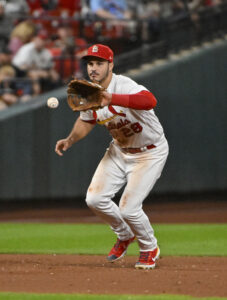 Arenado turns 32 in April, potentially limiting his odds of adding much in the way of years to his current pact. However, it’s easy to see how he could have surpassed his current $28.8MM average annual value. Notably, fellow third baseman Anthony Rendon managed to secure an AAV of $35MM in his seven year/$245MM contract he signed with the Angels prior to the 2020 season, while Freddie Freeman‘s six year, $162MM pact with the Dodgers last winter exceeds Arenado’s current deal in terms of both years and total value.
That said, Arenado’s $144MM is hardly a minor sum, and he has often spoke about his comfort level in St. Louis and his desire to remain a long-term piece of the Cardinals’ future. With this stability already in place, Arenado chose to pass on free agency, and he can now focus entirely on 2023 without the extra drama and uncertainty that follows even the names on the open market.
With Arenado’s decision now made, the Cards have checked another major task off their offseason to-do list, a few days after re-signing Adam Wainwright for the 2023 season. The Cardinals are expected to have significant room to make additions to their payroll this season, and not having to allocate additional resources to retaining Arenado should allow St. Louis to do more to address other areas of the roster. The starting rotation and outfield are possible target areas, as well as the obvious step of finding a catcher to replace retiring franchise stalwart Yadier Molina.
As The Athletic’s Nick Groke mentions, Arenado’s decision also keeps the Rockies committed to a significant financial obligation. As per the terms of the trade that sent Arenado from Colorado to St. Louis prior to the 2021 season, the Rockies owe the Cardinals $31.5MM to cover a portion of the third baseman’s salary — $16MM next season, and then $5MM each year from 2024 to 2026. The $16MM slated for Arenado is more than the Rockies are paying any player on their 2023 payroll, except for Kris Bryant.
Photo courtesy of USA Today Sports Images
Cardinals Recently Met With Nolan Arenado; Team Also Planning To Pursue Catching Help
It’s been a Cardinals-heavy day in the news, with the team agreeing to re-sign Adam Wainwright for what will be his 18th Major League season. St. Louis also announced that a trio of coaches will not return for the 2023 season — one day after losing bench coach Skip Schumaker, who’ll become the new Marlins manager. Beyond that pair of headlines, president of baseball operations John Mozeliak held court with the Cardinals beat, revealing in an extensive press conference that he recently met in person with Nolan Arenado about the third baseman’s looming opt-out (link via Jeff Jones of the Belleville News-Democrat). Beyond that, Mozeliak pledged that the Cardinals’ payroll will increase and unsurprisingly acknowledged he’ll be on the lookout for a successor to Yadier Molina this offseason.
Chief among those details is the team’s recent meeting with Arenado, who can opt out of the remaining five years and $144MM on his contract this winter. Mozeliak indicated there’s a sense of optimism regarding a resolution on that front, though there’s nothing official between the two parties just yet.
A year ago, that opt-out provision was far from a lock to come into play. Arenado chose to forego an opt-out clause last winter, when he could’ve returned to the market and sought a larger guarantee than the six years and $179MM he had remaining on the contract. Arenado was coming off a strong season but far from his best year, having batted .255/.312/.494 in his first season following a trade from the Rockies.
One year can make quite a difference, however. A sensational 2022 campaign has Arenado among the front-runners for National League MVP honors (alongside teammate Paul Goldschmidt), and with $144MM remaining on the deal, an opt-out now looks far likelier. The nine-time Gold Glove winner and five-time Platinum Glover turned in a sensational .293/.358/.533 batting line with 30 home runs, 42 doubles, a triple, a career-low 11.6% strikeout rate and his typical brand of elite defense at the hot corner. Despite the fact that he’ll turn 32 next April, Arenado suddenly has an easy case to eclipse the remaining money on his contract.
Granted, it’s rare for players of this age to secure contracts of more than five years in length, although exceptions are often made for the game’s top stars. One need only look to this past March, when Freddie Freeman inked a six-year deal with the Dodgers — one that, as will be the case with Arenado, begins in his age-32 season. Even if the market were to draw a hard line at five years for Arenado, there’d surely be a greater annual value than his current $28.8MM waiting for him in free agency. Annual salaries in excess of $30MM have become increasingly common, and Arenado himself at one point held the record for position player AAV ($32.5MM). That AAV took a hit when the Cardinals tacked on an additional year and $15MM at the time of the trade — but also granted Arenado a second opt-out opportunity.
Since Arenado signed his extension, Anthony Rendon ($35MM), Mike Trout ($36MM), Carlos Correa ($35.1MM), Corey Seager ($32.5MM) Francisco Lindor ($34.1MM) have all inked deals with annual salaries equal to or in excess of Arenado’s original AAV (to say nothing of Gerrit Cole’s $36MM annual value with the Yankees and Max Scherzer’s $43.33MM with the Mets). On the heels of such a brilliant season, Arenado could well find an AAV in the mid-30s over a five- or six-year term.
Understandably, the Cardinals appear to have little interest in allowing things to reach that point. Arenado’s opt-out decision is due five days after the World Series draws to a close, but the Cardinals can spend the interim trying to persuade him to stay. Tacking on an additional year or perhaps restructuring the deal to pay him at an annual rate more commensurate with the sport’s top hitters could well be in play over the next couple weeks.
All of that dovetails with Mozeliak’s comments about a forthcoming payroll hike. The Cardinals already have $105MM in guaranteed salary between Arenado, Goldschmidt, Miles Mikolas, Steven Matz, Giovanny Gallegos, Paul DeJong and Drew VerHagen (though the Rockies are reportedly covering $21MM of Arenado’s 2023 salary under the terms of the trade). Whatever salary Wainwright agreed to will add to that figure, and MLBTR contributor Matt Swartz projects just shy of $40MM in salary for the team’s 11 arbitration-eligible players. There are some non-tender candidates within — Mozeliak mentioned Alex Reyes’ name when discussing looming 40-man roster decisions, per Jones — but the majority of that arbitration class is a lock to return.
That gives the Cardinals more than $150MM on the books before even factoring in a slate of pre-arbitration players to round out the payroll. Jones notes that last year’s payroll, following trade deadline acquisitions, clocked in around $170MM. Extending or restructuring Arenado’s contract won’t necessarily impact the 2023 payroll on its own — he’s owed $35MM and the Rockies are paying that $21MM to the Cardinals even if Arenado were to opt out — but there are clearly other needs to consider.
Catching help, as Mozeliak acknowledged, figures to be among the most critical needs. Molina, a franchise icon, has played the final game of his Major League career, but the win-now Cardinals unsurprisingly aren’t content to merely hand the reins over to Andrew Knizner or prospect Ivan Herrera. Jones notes that the team will likely be looking for a starting-caliber option and not a part-time player.
The free-agent market has a handful of starting options, headlined by longtime division rival Willson Contreras but also including Christian Vazquez and Omar Narvaez. On the trade market, Oakland’s Sean Murphy will be available as the A’s continue their rebuild, and the Blue Jays have a surplus at backstop with Danny Jansen, Alejandro Kirk and Gabriel Moreno all on the 40-man roster and capable of shouldering a starter’s workload at the MLB level. Other options, of course, will emerge.
With Wainwright back, the rotation doesn’t figure to be a dire need, though depth could be pursued. The Cards will have Wainwright, Mikolas, Matz, Jack Flaherty and Jordan Montgomery as the likely top five, with Dakota Hudson, Matthew Liberatore, Zack Thompson and Jake Woodford serving as depth. Mozeliak and his staff will still likely be on the hunt for upgrades at some combination of shortstop, outfield and designated hitter, however, as the Cardinals look to inject more force into the lineup. Bullpen help is a near-annual need for every contending club.
For the time being, now that Wainwright’s status has been resolved, all roads will point to Arenado. Whether he and the Cardinals are able to reach a middle ground will not only shape the long-term outlook of the organization as we know it but also the very fabric of the 2022-23 offseason. If Arenado were to reach free agency, he’d join the likes of Aaron Judge, Trea Turner and Correa atop another star-studded open market.
Cardinals Notes: Wainwright, Arenado, Molina, Pujols
Following yesterday’s 0-2 loss to the Phillies, the Cardinals’ magical 2022 season has drawn to a close. After an above-average first half going 50-44, the Cardinals moved into a higher gear, winning 43 of their final 68 games (.632 win percentage) to take the NL Central with authority. Pivoting towards the 2023 season, the Cardinals have two key players with decisions to make, and two players who are expected to formally announce their retirements.
One of the most important free agents for the Cardinals is 41-year-old Adam Wainwright who didn’t appear during the Cardinal’s Wild Card series. Wainwright, a rotation stalwart for the Cardinals since 2007, signed a 1-year, $17.5MM extension for the 2022 season on the heels of a strong 2020 and 2021 season, pitching to a 3.08 ERA in 272 innings. He followed those strong numbers in 2022 with a 3.71 ERA in 191 2/3 innings, following his trademark of limiting hard contact (87.8 MPH average exit velocity, 36.6 HardHit%). However, he was hit hard over his last five starts, giving up 35 hits and 19 runs over his last 23 2/3 innings.
Wainwright has yet to officially announce whether he will return for the 2023 season, but hinted that he has decided on his status, as reported by Derrick Goold of the St. Louis Post-Dispatch. Regardless, Wainwright is expected to release something soon, with the veteran saying postgame that “we should know pretty soon if something happens … if not, then it’s been a good run.” The 17-year veteran added that he did not “like not pitching in a playoff season,” before coyly saying that fans could take the statement one of two ways, “as it’s been a good run” or “as a motivation to never let that happen again,” per Goold.
The Cardinals’ other high-profile free agent Nolan Arenado is technically under contract through the 2027 season; however, he can opt out this offseason. Acquired from the Rockies in February 2021, Arenado has posted back-to-back All-Star seasons with the Cardinals, slashing a combined .273/.335/.513 while playing superb defense at the hot corner (30 Outs Above Average). Arenado’s 2022 season has been particularly strong, batting .293/.358/.533 with 30 homers and 15 Outs Above Average.
Arenado has $144MM and five years remaining on his current contract, but he would be the clear-cut top third basemen on the free agent market. For his part, Arenado has previously stated that he’s “not opting out” and that he “will be coming back,” per Goold. He followed up these comments after yesterday’s game saying, “I love it here. I love the guys. I just feel like I fit well with this orgnaization.” Nevertheless, the seven-time All-Star will be 37 at the end of his current contract and may opt to find a longer agreement.
Elsewhere on the Cardinals, 19-year veteran Yadier Molina and 22-year veteran Albert Pujols are set to retire with the close of the 2022 season. Both legends in Cardinals’ lore, the duo won World Series titles with the Cardinals in 2006 and 2011, among numerous other awards throughout their careers. In a fitting moment, both players laced singles in their final at-bats at Busch Stadium.
Previewing Upcoming Opt-Out Decisions And Player Options
With the offseason approaching, so is the time for players and teams to decide upon any 2023 options in their contracts. MLBTR has taken a look through various option decisions in recent weeks: first with players whose deals contain vesting provisions, then a respective look at the team options in both the American and National Leagues.
Today, we’ll turn our attention to the players’ side. A number of players could hit free agency this winter either by triggering an opt-out clause in their current deal or bypassing a player option for the 2023 campaign. We’ll take a run through those decisions, many of which will have implications at the very top of the free agent market.
Note: All stats referenced are through play Sunday
Elite Potential Free Agents
- Nolan Arenado, Cardinals 3B (can opt out of final five years and $144MM)
Arenado was already on a Hall of Fame trajectory before 2022, but he’s bolstering his case with the best season of his career. Through 500 plate appearances, he owns a .306/.370/.567 line with 27 home runs. He’s had seasons with that kind of slash line in years past, but they came with the caveat that he’d played half his games at Coors Field. That’s no longer a factor, and it’s easily his best offensive output once one adjusts for the ballpark. Arenado’s 162 wRC+ is the fourth-best mark among qualified hitters.
That kind of offensive production alone would get him in the MVP discussion, but Arenado’s obviously valuable for far more than his bat. One of the best defensive third basemen in MLB history, he’s continued to post elite marks with the glove even as he’s entered his 30s. Arenado is among the top handful of players in the game. While walking away from $144MM wouldn’t be an easy decision, it’d seem the prudent one from a strict financial perspective. Freddie Freeman received six years and $162MM from the Dodgers (albeit with deferrals that reduced the net present value closer to the $148MM range) headed into his age-32 season. Freeman was coming off a 135 wRC+ platform showing, and he plays a less valuable position. Arenado and his camp could make a strong argument the Freeman contract should represent his floor, and it’s not outlandish to seek a six-year deal at the $35MM annual range Anthony Rendon received from the Angels (which would bring the guarantee to $210MM).
On paper, Arenado’s opt-out decision looks like a slam dunk. There’s at least some amount of uncertainty, though, as he forewent an opt-out opportunity last offseason and told Derrick Goold of the Post-Dispatch it was “always the plan” to remain in St. Louis long term. Passing on free agency coming off a .255/.312/.494 showing in 2021 is a lot easier than doing so after a career-best year that should make him an MVP finalist. Maybe he’s comfortable enough with the Cardinals he’ll return, but he’d probably be leaving a lot of money on the table to do so. At the very least, he looks to have a case for a renegotiation of his contract with the Cards, which is slated to pay him just $15MM in the final season (2027).
- Carlos Correa, Twins SS (can opt out of final two years and $70.2MM this offseason; deal also contains post-2023 opt-out if Correa opts in this winter)
Regarded by many (MLBTR included) as the top free agent in last winter’s class, Correa reportedly turned down at least one ten-year offer early in the offseason in search of a guarantee that rivaled the $341MM Francisco Lindor had received from the Mets last April. That proposal seemingly never came, and Correa reversed course in Spring Training. He signed a shocking three-year deal with the Twins that guaranteed him the largest annual salary ($35.1MM) for a free agent position player and afforded the opportunity to retest the market in either of the next two offseasons via opt-out.
Conventional wisdom was that Correa was sure to trigger his first opt-out and make another run at a long-term deal in a winter unaffected by a lockout. That still seems likely, although he hasn’t resoundingly made the case for teams to be more willing to approach the Lindor range that they had been. He’s having a similar offensive season as he did during his final year with the Astros. After posting a .279/.366/.485 showing his last year in Houston, Correa is hitting .276/.355/.439 over 440 plate appearances with Minnesota. His raw power production is down, but that’s not quite as alarming when considering the leaguewide slugging percentage has dropped from .411 to .395. Perhaps of greater concern is that the elite defensive marks that garnered Correa a Gold Glove last season are unanimously down, ranging anywhere from below-average (-2 Outs Above Average) to solid (+4 Defensive Runs Saved, +1 Ultimate Zone Rating).
There’s no question Correa’s an excellent player having a very good season. Yet he’s not likely to wind up a top five finisher in MVP balloting as he did in 2021. He’d top a $200MM guarantee on the open market, but he’s unlikely to reach the kind of money he anticipated last offseason. Could he return to Minnesota (where he’s by all accounts very happy) for one more year and look to trigger his post-2023 opt-out after hopefully putting up MVP-caliber numbers? That feels unlikely, but he’s already bet on himself once and would only be entering his age-29 season if he put off opting out for a year.
- Xander Bogaerts, Red Sox SS (can opt out of final three years and $60MM)
Bogaerts has been the Red Sox’s everyday shortstop since 2014, but his time in Boston could be nearing its end. He and the club didn’t make progress in extension talks this spring, and he’s a lock to opt out and top $60MM on the open market barring a catastrophic injury. One of the game’s top offensive shortstops, Bogaerts is amidst another strong season. He carries a .303/.372/.448 line through 508 plate appearances. His slugging output is below where it was from 2018-21, but he consistently gets on base and has a strong pre-2022 track record from a power perspective.
One can quibble about certain aspects of Boagerts’ profile. In addition to this year’s slugging dip, he’s traditionally rated as a below-average defender. Even with generally solid defensive metrics this season, clubs will probably have some question whether he’ll eventually need to move to second or third base. Those are nitpicks for whether Bogaerts would be a worthwhile investment in the $180MM – $200MM range, though. A 30-year-old shortstop with an elite durability track record and a .299/.370/.478 line since the start of 2020, he’s certainly going to shatter $60MM even if the market takes a relatively pessimistic view of his long-term projection.
- Jacob deGrom, Mets RHP (can opt of final year and $33.5MM this offseason)
There’s no suspense with this one, as deGrom has publicly maintained his plan to opt out for months. That’s in spite of elbow/shoulder injuries that kept him from throwing a major league pitch between July 2021 and this August. With only one guaranteed year remaining on his deal (plus a 2024 club option that’d go into effect if he doesn’t opt out this winter), that’s been a pretty easy call. To the extent there may have been any lingering doubts, deGrom has silenced them with his first five starts since returning from the injured list. He’s looked like his vintage self, averaging 99.3 MPH on his fastball while posting a laughable 46:2 strikeout-to-walk ratio through 29 1/3 innings. On an inning-for-inning basis, he’s the best starting pitcher on the planet.
deGrom’s free agent case will be fascinating. Even if he finishes the season healthy, he’ll have gone three consecutive years without topping 15 starts or 100 innings (although he’s obviously not at fault for the shortened 2020 schedule). What kind of volume a signing team can expect is an open question, particularly as he enters his age-35 season. Yet the upside of a healthy deGrom is through the roof. He’ll receive a multi-year deal that beats the $33.5MM remaining on his current contract. Can he top teammate Max Scherzer’s $43.333MM AAV over a three or even four-year term? Time will tell.
- Justin Verlander, Astros RHP ($25MM option for 2023)
While we’re on the topic of upper-echelon starting pitchers who are basically certain to opt out, let’s turn to Verlander. The future Hall of Famer triggered a $25MM option for next season by throwing 130 innings, but that’s largely a moot point. Verlander told Ken Rosenthal of the Athletic last week he was likely to opt out if things went as planned down the stretch. It’d have been surprising if he were even considering exercising the option.
Verlander has returned from 2020 Tommy John surgery to lead the major leagues with a 1.84 ERA. He’s striking out 26.5% of opponents and has a strong argument for a third career Cy Young award. He’s also a proven playoff performer and a prototypical ace who eats about as many innings as anyone else in the game. Even heading into his age-40 season, Verlander can try to beat the Scherzer AAV on a multi-year contract.
Verlander did injure his calf in his most recent start, resulting in a placement on the injured list just this afternoon. The Astros announced that an MRI of his calf revealed “fascial disruption, but no muscle fiber disruption” — an extremely specific diagnosis but one that both Verlander and GM James Click touted as good news. Click expressed hope the injury will be short-term, and Verlander suggested that had he sustained damage to the muscle fibers themselves, he’d likely have missed the remainder of the regular season and perhaps part of the postseason.
The manner to which Verlander rebounds will obviously be key in his opt-out scenario, but if he misses only a couple weeks’ time and returns strong for his final regular-season and postseason starts, this opt-out is an easy call.
- Carlos Rodón, Giants LHP ($22.5MM option for 2023)
We’ll wrap up the trifecta with Rodón, who’s also going to have an easy decision, barring injury. While there was some trepidation about Rodón’s breakout 2021 season — both due to his inconsistent track record before last season and some shoulder soreness and a velocity drop last August — he’s doubled down and looks to have cemented himself among the game’s top ten starters. Rodón has avoided the injured list thus far, and he’s striking out 32.1% of opponents while posting a 2.81 ERA through 25 starts. By topping 110 innings, he earned the right to opt out after this season.
Heading into his age-30 campaign, he should land the nine-figure deal that eluded him last offseason. Between his youth and last two years of production, Rodón has an argument for the largest guarantee of any free agent starter. He won’t get paid at the deGrom or Verlander level on an annual basis, but he could push for six years and look to top $150MM.
Quality Regulars Likely To Opt Out
- Anthony Rizzo, Yankees 1B ($16MM option for 2023)
Rizzo’s market last offseason seemed a bit underwhelming. The veteran first baseman was coming off two fine but unspectacular seasons, and it looked as if his best days might be behind him with his mid-30s approaching. Rizzo still made plenty of contact and hit the ball hard, but he’d gotten quite pull-oriented and had rough ball-in-play results against an increasing number of defensive shifts. He signed a two-year deal with the Yankees that paid him matching $16MM salaries and allowed him to opt out after this season.
That now looks like an easy call, as Rizzo has bounced back with a year more reminiscent of his peak days with the Cubs. He carries a .223/.337/.480 line and is going to top 30 homers for the first time since 2017. He’s still getting dismal results on balls in play and doesn’t have a particularly impressive batting average, but even that looks as if might turn around next year. It’s widely expected MLB will institute limits on shifting next spring. Few players would stand to benefit more than Rizzo, who’s facing a shift on a whopping 83.5% of his plate appearances according to Statcast. His age and lack of defensive versatility will limit the length of any deal, but he’ll probably beat the $16MM salary over at least a two-year term, even if the Yankees tag him with a qualifying offer.
- Jurickson Profar, Padres LF ($8.5MM option, $1MM buyout)
The Padres’ signing Profar to a three-year, $21MM deal that allowed him multiple opt-out chances was one of the more eyebrow-raising moves of the 2020-21 offseason. The switch-hitter was coming off a solid 2020 campaign, but that shortened schedule was the first in which he’d posted above-average production. It looked like a misstep when he struggled last year and unsurprisingly forewent his first opt-out clause, but Profar has rewarded the organization’s faith with a career-best showing in 2022.
Through 530 plate appearances, he’s hitting .241/.339/.387 with 12 homers. He’s walking at a robust 12.3% clip while only going down on strikes 15.1% of the time. He looks like a solid regular, and headed into his age-30 season, Profar’s a candidate for another multi-year deal this time around. After major throwing issues as an infielder early in his career, he’s played exclusively left field this year. Profar isn’t a prototypical corner outfield masher, but his plate discipline and bat-to-ball skills should allow him to top the guaranteed money remaining on his current deal.
Starting Pitchers With High Buyouts
- Taijuan Walker, Mets RHP ($6MM option, $3MM buyout)
Walker signed a $20MM guarantee with the Mets over the 2020-21 offseason. The deal was front-loaded but came with a $6MM player option or a $3MM buyout for 2023. Adding a player option allowed the Mets to soften the contract’s luxury tax hit. Because player options are treated as guaranteed money, it technically qualified as a three-year, $20MM deal with a $6.67MM average annual value for CBT purposes. Yet the $3MM gap between the option value and the buyout meant Walker was a virtual lock to opt out, barring injury that made him unable to pitch next season. The Associated Press reports the option has various escalators that could push its value as high as $8.5MM if Walker throws 175 innings this year, but even that figure is modest enough he’s going to decline.
Walker should opt out in search of a multi-year deal, as he’s been a valuable mid-rotation arm for New York. Over 117 1/3 frames, he owns a 3.38 ERA despite a modest 18.3% strikeout rate. His blend of plus control and solid ground-ball rates makes him a candidate for a three-year pact as he heads into his age-30 season. The Mets will have an interesting decision on whether to tag him with a qualifying offer.
- Jake Odorizzi, Braves RHP ($12.5MM option, $6.25MM buyout)
Like Walker, Odorizzi signed late in the 2020-21 offseason on a deal that locked in the first two seasons and gave the player a third-year option. Odorizzi’s contract with the Astros was similarly structured to facilitate a third-year buyout while diminishing the AAV for luxury tax purposes, although he’s deciding on a bit more money. The option was initially valued at $6.5MM with a $3.25MM buyout, but the Associated Press provided a breakdown of various escalators. The option value would jump by $2MM apiece if Odorizzi reached 20, 25 and 30 appearances between 2021-22 in which he either started the game or worked four-plus innings of relief. The buyout value would spike by $1MM apiece for hitting each of those thresholds.
Odorizzi has already made 41 such appearances over the past two years, so he’s long since maxed out both thresholds. He’ll therefore be deciding between a $12.5MM option to return to the Braves or taking a $6.25MM buyout and heading to free agency. With only a $6.25MM difference between the option value and the buyout, Odorizzi looks like a borderline opt-out case. He owns a 3.90 ERA across 85 1/3 innings this season, although his 18.3% strikeout rate is a few points below league average. He’ll be 33 by next Opening Day, and he didn’t find as robust interest as most expected he would during his last trip through free agency. He’s a quality strike-thrower and a perfectly fine back-of-the-rotation starter, but it’s now been three years since he’s missed bats at an above-average rate, and he was traded this summer in a one-for-one swap for an underperforming reliever (Will Smith).
Easy Calls To Return
- Chris Sale, Red Sox LHP (can opt out of final two years and $55MM)
Sale has the right to pass on the final two years of his extension with the Red Sox this winter, but he certainly won’t do so. He’s made just 11 starts over the past three seasons due to various injuries, including a 2020 Tommy John surgery and a trio of fractures (rib, finger and wrist) this year. Sale has still flashed mid-rotation or better upside in the limited time he’s been on the field, but there’s too much uncertainty with his health to land anywhere near $55MM were he to test the market.
- Eric Hosmer, Red Sox 1B (can opt out of final three years and $39MM)
Hosmer’s opt-in decision is a no-brainer. Since signing a $144MM contract with the Padres heading into 2018, he’s posted a league average .264/.325/.409 slash line. Paired with his lack of defensive versatility and mixed reviews on his glovework (public metrics have never been as fond of Hosmer as his four Gold Gloves would suggest), he’d probably be limited to one-year offers were he a free agent. The Padres will remain on the hook for virtually all of the money, as they agreed to pay down Hosmer’s deal to the league minimum salary to facilitate his trade to the Red Sox.
- Jorge Soler, Marlins LF (can opt out of final two years and $24MM; deal also contains post-2023 opt-out if Soler opts in this year)
Soler parlayed a big second half and huge batted ball metrics into a three-year deal with Miami last offseason. His massive raw power hasn’t translated into especially strong results since he’s become a Marlin, however. He’s been a below-average hitter, and it’s now been three years since he was a middle-of-the-order caliber player over a full season. Paired with a limited defensive profile that keeps him in the corner outfield or at designated hitter, he’s been right around replacement level this season. He’s not opting out this year, but a big showing in 2023 could allow him to reconsider the possibility next winter.
- AJ Pollock, White Sox LF ($11MM option, $5MM buyout)
The White Sox acquired Pollock just before the start of the season, sending Craig Kimbrel to the Dodgers in a surprising one-for-one swap. The hope was that they’d addressed a notable hole in the corner outfield, but Pollock’s production has cratered in Chicago. Just a season removed from a .297/.355/.536 showing in L.A., he’s stumbled to a .237/.284/.363 line through 401 plate appearances with the ChiSox. Even with a fairly modest $6MM gap between the option’s present value and the buyout, Pollock is likely to bypass a trip to free agency after a replacement-level platform season.
The present $11MM option value isn’t fixed, as Pollock’s contract contains escalators that could boost it a bit further. Originally set at $10MM, he’d lock in an extra $1MM for hitting each of 400, 450, 500, 550 and 600 plate appearances this season. He’s already surpassed 400 trips, and the 450 mark is well within range with 34 games remaining. Consistent playing time down the stretch would allow him to reach 500 plate appearances as well, although it’s hard to envision him getting to 550. The most likely outcome is that the option price ends up at $12MM, but anywhere between $11-13MM is viable.
- Jonathan Schoop, Tigers 2B ($7.5MM option)
Schoop signed a two-year, $15MM extension amidst a productive 2021 season in Detroit. While a defensible enough decision for the Tigers at the time, that hasn’t panned out. The veteran second baseman has a .235 on-base percentage that’s easily the worst in the majors among players with 400+ plate appearances. He’s posted otherworldly defensive marks this season and could well collect a Gold Glove, but the complete lack of production at the dish should make him a lock to exercise his option.
- Charlie Blackmon, Rockies DH/RF ($12MM option)
Blackmon exercised a 2022 option last season, and he went on the record at the time as saying he’d trigger the 2023 provision as well. There’s no intrigue as to his decision — he’ll be back in Colorado next year — the only question is how much he’ll make. The ’23 option came with a $10MM base value, but ESPN reported it’d escalate by $500K apiece if Blackmon reached 400, 425, 450, 475, 500, and 525 plate appearances in 2022. It’d jump another $1MM apiece at 550 and 575 trips.
The veteran outfielder enters play Tuesday with 490 plate appearances, so he’s already pushed the value to $12MM. Barring injury, he’s a lock to hit at least the 525 PA mark, and he’s quite likely to get all the way to 575. Colorado has 33 games remaining, and Blackmon is only 85 plate appearances (2.76 per game) from maxing out the plate appearance threshold at $15MM. The deal also contained escalators based on MVP finishes which Blackmon will not hit.
Relievers
- Nick Martinez, Padres RHP (can opt out of final three years and $19.5MM this offseason, $1.5MM buyout; deal also contains opt-out chances after 2023 and 2024 if Martinez opts in)
Martinez signed a four-year, $25.5MM guarantee with San Diego this past winter. That deal contained opt-out chances after each of the first three seasons for the former NPB hurler, but it seems unlikely Martinez will take his first opportunity to return to the open market. He has a strong 3.02 ERA over 92 1/3 innings during his return season in the big leagues, but he’s worked as a swingman for a San Diego team that has quite a bit of rotation depth. Martinez has excelled as a reliever, pitching to a 1.35 ERA while holding opponents to a .208/.258/.295 line in 40 innings. That’s come with a modest 21.5% strikeout rate, though, and he doesn’t brandish the power arsenal teams tend to prioritize late in games.
Entering his age-32 season, Martinez probably wouldn’t find a better deal that the opt-out laden three years and $18MM (after factoring in the buyout price) he’d be bypassing to return to the open market. The Friars have to be happy with their investment considering his excellence out of the bullpen, but the surprisingly strong deal they gave him in the first place makes it hard to see him doing much better elsewhere even on the heels of a quality first season.
- Andrew Chafin, Tigers LHP ($6.5MM option)
Detroit signed the ever-reliable Chafin late last offseason, and they’ve been rewarded with another excellent year. Through 43 1/3 innings, he’s posted a 2.91 ERA while striking out more than 30% of opponents with an excellent 52.3% ground-ball rate. The market probably undervalued Chafin last winter; it’d be hard to do so again after another very good season. In a vacuum, declining the option and topping $6.5MM in free agency seems likely.
That said, the Tigers decision to not trade Chafin at this summer’s deadline was tied to a belief he could stick around. Evan Petzold of the Detroit Free-Press reported shortly before the deadline that Detroit’s proximity to Chafin’s Ohio home could lead him to return in 2023 if he weren’t moved before August 2. That led to a disconnect in his trade value, with the Tigers confident they still possessed a year and a half of his services while other clubs viewed him as an impending free agent. From a strict financial perspective, opting out is the prudent call. Yet the family considerations Petzold noted would make the decision more complicated if Chafin’s priority isn’t simply to maximize his earnings.
- Robert Suárez, Padres RHP ($5MM option, $1MM buyout)
San Diego added Suárez, who’d never previously pitched in the majors, on the heels of an excellent career closing in Japan. He had a nightmare outing on Opening Day where he dished out free passes to all three batters he faced, but he’s been quite effective since that point. Excluding his first appearance, Suárez owns a 2.36 ERA with a strong 29% strikeout rate in 34 1/3 innings. He’s still had spotty control, but he’s averaging north of 97 MPH on his fastball. He’d only need to beat $4MM on the open market, and something around that rate over a multi-year term feels attainable heading into his age-32 season. A rough final couple months could change the calculus, but Suárez seems likely to retest free agency at the moment.