
AL West Notes: Astros, Angels, Rangers
Let’s check in on the latest notes from around the American League West …
- With or without baseball in 2020, the Astros will soon be faced with a gaping void in the outfield, Chandler Rome of the Houston Chronicle observes. Each of George Springer, Michael Brantley and Josh Reddick are slated to hit the open market at season’s end. And while top prospect Kyle Tucker can hopefully step up as an everyday option in their absence, the organization has little else waiting in the wings. Astros steal Yordan Alvarez is regarded as a part-time corner outfielder at best, while fleet-footed Myles Straw has looked like more of a reserve type than a regular. That trio’s potential departure does open up some payroll space, but the ‘Stros already have more than $134MM in luxury tax obligations — and that’s before arbitration raises to Carlos Correa, Roberto Osuna, Lance McCullers Jr., Chris Devenski, Aledmys Diaz and Joe Biagini.
- The Angels weren’t able to land any of their top rotation targets in free agency this winter, but general manager Billy Eppler and his staff hope that an emphasis on improved receiving from their catchers will contribute to better results on the pitching staff, writes Jeff Fletcher of the Orange County Register. Max Stassi and Jason Castro are considered to be two of the game’s best in terms of pitch framing, and the pair spoke about the fact that it’s not necessarily a coincidence that they’re considered as such. Both were with the Astros in 2013 when Astros analyst Mike Fast presented on the importance of the skill to Houston catchers during Spring Training. Both backstops provide their thoughts on the skill as a whole — Castro on why he feels “framing” is a misnomer and Stassi giving his thoughts on a potential automated strike zone. Framing has become an increased point of emphasis for the Angels in recent years, per Eppler: “…[I]f you have a catcher who you know can present a ball well and receive a ball well, that gives confidence to your pitchers and could potentially move a count from 2-1 to 1-2.”
- Rangers president of baseball operations Jon Daniels updated reporters on his organization, as Jeff Wilson of the Fort Worth Star-Telegram relays. Of note, three members of the organization – all minor leaguers – have shown coronavirus symptoms. Fortunately, those players seem to be recovering well. Meanwhile, after suffering a fractured jaw just under a month ago, outfielder Willie Calhoun continues to progress. Calhoun “has no limitations” at this point, Wilson writes. Assuming there is a season, Calhoun just might break out in 2020 after a promising showing last year.
Assessing Brodie Van Wagenen’s Trades
If you’re an MLBTR fan, then you know we’ve recently been asking readers to evaluate the trade histories of various high-ranking executives (or former execs) from around Major League Baseball. We’ve already polled you on Diamondbacks GM Mike Hazen, recently fired Astros president Jeff Luhnow, Brewers president of baseball ops David Stearns, Angels GM Billy Eppler, Rockies GM Jeff Bridich, Tigers GM Al Avila, Braves GM Alex Anthopoulos, Blue Jays GM Ross Atkins, Mariners GM Jerry Dipoto, Phillies GM Matt Klentak, Dodgers president of baseball operations Andrew Friedman, Rays GM Erik Neander and ex-Red Sox front office leader Dave Dombrowski.
It’s now time to go to New York and check in on the trades that GM Brodie Van Wagenen, a former agent, has swung since the team persuaded him to switch careers after the 2018 season. Considering he has only been on the job for two years, Van Wagenen’s body of work isn’t particularly large, but it’s one that’s sure to elicit some strong opinions (minor deals omitted; full details at transaction link)…
2018-19 Offseason
- Acquired 2B Robinson Cano and RHP Edwin Diaz from Mariners for OFs Jarred Kelenic and Jay Bruce, RHPs Anthony Swarzak and Gerson Bautista, and $20MM
- Acquired OF Keon Broxton from Brewers for RHPs Bobby Wahl and Adam Hill and 2B Felix Valerio
- Acquired INF/OF J.D. Davis and INF Cody Bohanek from Astros for 2B Luis Santana, OF Ross Adolph and C Scott Manea.
- Acquired RHP Walker Lockett and INF Sam Haggerty from Indians for C Kevin Plawecki
2019 Season
- Acquired RHP Wilmer Font from Rays for RHP Neraldo Catalina
- Acquired RHP Marcus Stroman from Blue Jays for LHP Anthony Kay and RHP Simeon Woods Richardson
2019-20 Offseason
- Acquired OF Jake Marisnick from Astros for LHP Blake Taylor and OF Kenedy Corona
(Poll link for app users)
Grade Van Wagenen's trades
-
C 35% (2,066)
-
D 31% (1,835)
-
F 18% (1,058)
-
B 14% (833)
-
A 2% (100)
Total votes: 5,892
MLB Contemplating Staging Part Of 2020 Season In Arizona
In search of creative solutions to the myriad problems posed by the coronavirus pandemic, MLB and the MLB Players’ Association have held initial discussions regarding a plan that would center at least part of the 2020 season in Arizona. Ronald Blum of the Associated Press reported on the latest developments in the ever-evolving effort.
It’s an interesting concept, at least in theory, given the presence of so many high-quality baseball facilities in the greater Phoenix area. The entire Cactus League apparatus would be available in addition to the Diamondbacks’ home park of Chase Field.
Staging contests in one metro area would drastically limit the cost, time, and risk of plane travel — potentially facilitating a much fuller schedule (more packed and later into the year) than would otherwise be possible. Teams are accustomed to marshaling necessary logistical resources in this area. And concentrating medical and other resources in one area might make it possible to navigate the exceedingly tricky matters that are sure to arise.
Needless to say, this wouldn’t be baseball-as-usual. Agent Scott Boras notes that the league would have to essentially define a group of participants (players, coaches, umpires, trainers, etc.) who’d have “very limited access … to the outside world” and would be “constantly tested.” It seems clear that such an approach would feature no or limited spectators at the ballparks. Even if fans were ultimately allowed in, there’s obviously no way the gate would come anywhere close to its typical levels.
The aim in this effort, should it even be pursued, would be to get the game on television sets across the country. There may even be a built-in competitive advantage for baseball as against the other major sports, which are also staring at difficult challenges. It’s certainly easier to imagine baseball being played, with appropriate protection and monitoring, than other sports that involve much more regular and intense physical contact between participants.
Clearly, this idea is still in its infancy, faces numerous challenges of its own, and is only one of many possibilities. It may ultimately function as a bridge to a more-typical playing situation, should that become possible. Depending upon one’s perspective, this all-Arizona approach could be a sobering disappointment … or an optimistic indication that the league and players are working hard to ensure that some kind of campaign is possible.
That Time The Yankees Pursued Craig Kimbrel
Possessing an excellent closer is one of the many things the Yankees have become known for over the years. There was Dave Righetti, Goose Gossage and Sparky Lyle decades back. And then there was John Wetteland, who was on the mound when the Yankees won the World Series in 1996. He formed a dominant late-game tandem with Mariano Rivera, who soon became the Yankees’ closer and evolved into perhaps the greatest reliever ever – someone who consistently shut opposing offenses down for almost 20 years. Now, the Yankees have yet another game-ending force in Aroldis Chapman, a two-time member of the team since it first acquired him in December 2015. But months before the Yankees swung a trade for Chapman, they went after another of the top closers in history in Craig Kimbrel.
Leading up to the trade deadline on July 31, 2015, the Yankees were said to be among the teams in hottest pursuit of Kimbrel, then a member of the Padres. New York held a six-game lead in the American League East at that point, thanks in part to the wonderful work of relievers Andrew Miller, Dellin Betances and Justin Wilson, but it wanted yet another bullpen weapon in Kimbrel. Then 27 years old, Kimbrel was fresh off an all-world run with Atlanta and in his first season in San Diego.
The Padres landed Kimbrel the previous offseason with the goal of pushing for contention, but the team instead endured more struggles. That wasn’t the fault of Kimbrel, who enjoyed yet another fine season. Despite interest from teams like the Yankees – who were reportedly unwilling to trade then-prospects Luis Severino, Aaron Judge and Greg Bird for the reliever – Kimbrel wound up spending that entire year with the Padres. They went on to win just 77 games, while the Yankees lost their division lead to the Blue Jays after the deadline and were ultimately knocked out of the wild-card round by the Astros (another team that looked into Kimbrel before the deadline).
The fact that the Kimbrel talks between the Yankees and Padres fell apart turned out to have a major impact on those two teams and more clubs. In November 2015, the Padres found a taker for Kimbrel in the Yankees’ hated rival, the Red Sox, who got him for a prospect package consisting of outfielder Manuel Margot, shortstop Javier Guerra, infielder Carlos Asuaje and lefty Logan Allen. Nobody from that group has made a significant on-field impact for the Padres (the jury’s out on Guerra, who’s now a reliever), but they did flip Margot for an outstanding bullpen arm in Emilio Pagan this past offseason. Prior to then, the Padres shipped Allen to the Indians last summer as part of a three-team trade that netted them high-end outfield prospect Taylor Trammell.
For their part, it’s fair to say the Red Sox would make the Kimbrel trade again. He was an integral part of their bullpen from 2016-18, all of which were playoff seasons and the last of which ended in the club’s most recent World Series championship. The Red Sox bettered the Yankees in each of those regular seasons with three straight AL East titles, but they elected to let Kimbrel (now a Cub) exit via free agency in 2019.
Speaking of the Cubs, they’re another team that has felt some impact from the Kimbrel non-trade between the Padres and Yankees. Having failed to reel in Kimbrel, the Yankees picked up Chapman from the Reds in December 2015. Chapman didn’t cost the Yankees that much (second baseman Tony Renda and righties Rookie Davis and Caleb Cotham) because he was facing domestic violence allegations at the time. He served a 30-game suspension for that to begin the 2016 campaign. Then, with the Yankees not looking like a real threat to compete for a title, they sent Chapman to the Cubs in a deal for Gleyber Torres around that summer’s deadline.
Four years later, Torres is a standout middle infielder and an irreplaceable member of the Yankees’ lineup. He’s missed in Chicago, but Chapman did help them to their first World Series in 108 years a few months after they acquired him. As the saying goes, flags fly forever. Chapman returned to the Yankees in free agency during the ensuing offseason, though. And Kimbrel’s now a member of the Cubs, who signed him to a three-year, $43MM contract that hasn’t gone their way thus far. Where would he and Chapman be right now had the Yankees traded for Kimbrel a half-decade ago? Nobody can say for sure, but it’s one of the many interesting questions to ponder in this what-if scenario.
Flashback: The Spring 2014 Contract Spat Between Max Scherzer & The Tigers
In the 2013-14 offseason, the Tigers were still riding high. Despite some postseason disappointments, the organization had run off three-straight AL Central titles and seemed poised for more. It also had a slate of big-time veterans coming ever closer to free agency.
The top priority, it seemed, was emergent ace Max Scherzer. He had seemingly supplanted Justin Verlander as the top dog on one of the best rotations in recent memory. But free agency beckoned at the end of 2014, Scherzer’s age-29 season.
You may recall that the Tigers ended up making a major long-term deal … but not with Scherzer. (No doubt we’ll write more on that one at some point soon.) Instead, club and player ended up engaging in a somewhat terse exchange of statements to the press at the end of camp, setting the stage for Scherzer’s ultimate departure.
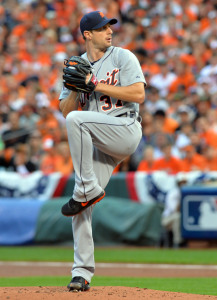
After showing so much tantalizing ability over the years, the former first-round draft pick finally put it all together in 2013. Scherzer spun 214 1/3 innings of 2.90 ERA ball, racking up 10.1 K/9 against 2.4 BB/9 and leading the league with a 0.970 WHIP. Scherzer not only nabbed his first All-Star appearance, but secured his first Cy Young Award.
The Tigers spent big and went for it under long-time owner Mike Ilitch, with veteran exec Dave Dombrowski swinging deals from the GM seat. Pursuit of an extension with Scherzer was inevitable.
Trouble was, Scherzer had taken his time turning into a complete pitcher. By the time the team was ready to place its bet on his future, he had ample leverage. And he had the game’s foremost lever puller running his negotiations: super-agent Scott Boras, long known for bringing his top clients to the open market.
Early-offseason moves freed some payroll availability; Dombrowski told MLBTR’s Zach Links the flexibility would make a Scherzer extension “more possible.” The sides were able to line up on a record-setting arbitration raise, which seemed generally promising. Scherzer indicated that he’d like to reach agreement on a deal to stay in Detroit for the long run.
And then came … a truly bizarre, late-spring exchange. We’ve occasionally seen teams issue statements when negotiations with a superstar fail to culminate in an agreement. But rarely are they so transparently salty as the one the Tigers unfurled …
“The Detroit Tigers have made a substantial, long-term contract extension offer to Max Scherzer that would have placed him among the highest paid pitchers in baseball, and the offer was rejected. As we have reiterated, it has been the organization’s intent to extend Max’s contract and keep him in a Tigers uniform well beyond the 2014 season. While this offer would have accomplished that, the ballclub’s focus remains on the start of the upcoming season, and competing for a World Championship. Moving forward there will be no further in-season negotiation and the organization will refrain from commenting on this matter.”
Well, then! Boras, naturally, responded. He wasn’t quite so spiteful, but certainly landed his own well-placed shot that left no doubt as to his views on the equal standing of the bargaining parties:
“Max Scherzer made a substantial long-term contract extension offer to the Detroit Tigers that would have placed him among the highest-paid pitchers in baseball, and the offer was rejected by Detroit. Max is very happy with the city of Detroit, the fans and his teammates, and we will continue negotiating with the Tigers at season’s end.”
So it seemed both sides had made their offers; neither proved amenable to further compromise. It emerged that the Tigers’ best offer was a match of the extant comparable of record: the six-year, $144MM Cole Hamels extension with the Phillies. The warring statements drew mixed reactions from the pundit class, but the consensus was that this number was never particularly likely to budge Boras and Scherzer.
Rather than bowing to worry over the season separating him from free agency, Scherzer took out an insurance policy. He was nearly as good in 2014 as he was in the season prior, landing a fifth-place Cy Young finish, obviating the need for that policy, and setting the stage for a proper bidding war. While there was indication at times that the Tigers remained involved, the team showed tepid interest and was not a finalist when push came to shove.
Scherzer, of course, signed a huge contract with the Nationals. Though the face value of $210MM didn’t account for deferrals, it handily topped the prior Tigers offer. Perhaps it was just as well for the Detroit organization. While the club was successful again in Scherzer’s final year, it crumbled in 2015, with Dombrowski stunningly departing after the trade deadline. Then again, Scherzer’s ongoing dominance made even that monster contract a relative bargain. Had the Tigers gone higher in their extension offer and managed to secure his services for the long haul, Scherzer would’ve been a nice trade chip to cash in and jump-start the rebuild.
Photo courtesy of USA Today Sports Images.
A.J. Puk Making Progress In Recovery From Shoulder Injury
Athletics lefty A.J. Puk was slowed by some shoulder trouble in early March, creating some unwelcome uncertainty for a player that just returned late last year from a major injury. Fortunately, Puk has been throwing throughout the COVID-19 shutdown and has progressed to long-tossing from 120 feet, he said in an appearance on Susan Slusser’s A’s Plus podcast (audio link).
Medical review had seemingly ruled out the most troubling potential scenarios. But Puk’s outlook was still a bit unclear when last we checked in. It seems he’s now firmly on the upswing/
“It’s probably the best my shoulder’s felt in awhile actually,” said Puk. “Coming back from Tommy John, a lot of people always seem to talk about how your shoulder kind of flares up and you’ve just got to work through it. I think I was at that stage.”
Puk, the former No. 6 overall pick, added that he has access to mounds from which to throw at nearby facilities. He and fellow top prospect Jesus Luzardo chatted with Slusser about the state of their workouts amid the current stoppage, detailed the ways they’ve kept busy and shared their thoughts on a potentially shortened season or playing in front of empty parks.
Al Kaline Passes Away
Tigers legend Al Kaline passed away Monday at his home at the age of 85, a family friend confirmed to John Lowe of the Detroit Free Press. An 18-time All-Star, a 10-time Gold Glover in the outfield, the 1955 AL batting champ and a key contributor on Detroit’s 1968 World Series-winning roster, Kaline is among the very best to ever play the game and joins Ty Cobb among the top players to ever suit up for the Tigers organization.
The Baltimore native posted a career .297/.376/.480 batting line with 3007 hits, 399 home runs, 498 doubles, 75 triples, 137 steals, 1622 runs scored and 1582 RBIs, establishing himself as the face of a generation of Tigers baseball from his debut in 1953 to the time he retired in 1974. He is the Tigers’ all-time leader in games played, home runs and walks, and he trails only franchise greats and fellow Cooperstown inductees like Cobb, Hank Greenberg and Charlie Gehringer in virtually all key offensive categories. His No. 6 was retired by the club in 1980, making him the first recipient of that honor.
Kaline’s importance to the organization reaches immeasurably beyond his on-field accolades, however. Even after he retired as a player, the next generation of Tigers fans who didn’t have the good fortune to watch him play instead grew up listening to his insights, anecdotes and experience as one of the voices of Tigers baseball. He also served as a special assistant in the club’s front office and regularly appeared in Spring Training to work with upcoming waves of young Tiger talent.
Kaline will be remembered both as a one of the all-time greats and a revered gentleman off the field. He was named the 1970 Fred Hutchison Award winner, recognizing “character and competitive spirit” and also named the winner of the 1973 Roberto Clemente Award. Media members, former teammates and Tigers players alike have flocked to social media to express their sorrow over the loss of one of the game’s iconic figures.
Said Justin Verlander: “Such a kind and generous man who meant so much to so many. I hope you knew how much I enjoyed our conversations about baseball, life, or just giving each other a hard time. I am honored to have been able to call you my friend for all these years. R.I.P. Mr Tiger, Al Kaline.” James McCann, John Hicks, Niko Goodrum, Grayson Greiner and Jake Rogers are among the many recent Tigers players who have echoed similar sentiments on Twitter.
We at MLB Trade Rumors join those around baseball in expressing heartfelt condolences to the friends, family, loved ones and legions of fans whose lives have been touched by Kaline.
Revisiting Dave Dombrowski’s Red Sox Trades
Dave Dombrowski’s ousting as general manager of the Tigers back in 2015 was a stunner throughout the baseball world. Just days after orchestrating a rare deadline sell-off for the AL Central powerhouse — David Price and Yoenis Cespedes were both shipped out in deals that netted Matthew Boyd and Michael Fulmer, respectively — Dombrowski was cut loose.
Most expected that Dombrowski, one of MLB’s most respected front-office figures, would another job in short order… but probably not as quickly as he ultimately did. Barely two weeks after being dismissed in Detroit, Dombrowski was named president of baseball operations for the Red Sox — a move that prompted general manager Ben Cherington to step down less than two years after his club had won a World Series.
As it turned out, Dombrowski’s tenure in Boston would closely mirror that of Cherington’s; his time in charge was relatively brief, and he was gone not long after winning a World Series. Less than year after capturing a championship in 2018, Dombrowski got the boot.
Let’s take a look back at Dealin’ Dave’s trade history in Boston…
2015 Season
- Acquired LHP Luis Ysla from the Giants in exchange for OF Alejandro De Aza and cash
2015-16 Offseason
- Acquired RHP Craig Kimbrel from the Padres in exchange for SS Javy Guerra, OF Manuel Margot, LHP Logan Allen and 2B Carlos Asuaje
- Acquired RHP Carson Smith and LHP Roenis Elias from the Mariners in exchange for LHP Wade Miley and RHP Jonathan Aro
2016 Season
- Acquired 2B/3B Aaron Hill and cash from the Brewers in exchange for RHP Aaron Wilkerson and INF Wendell Rijo
- Acquired INF/OF Michael Martinez from the Indians in exchange for cash
- Acquired RHP Brad Ziegler from the D-backs in exchange for RHP Jose Almonte and OF Luis Alejandro Basabe
- Acquired LHP Drew Pomeranz from the Padres in exchange for RHP Anderson Espinoza
- Acquired LHP Fernando Abad from the Twins in exchange for RHP Pat Light
2016-17 Offseason
- Acquired RHP Tyler Thornburg from the Brewers in exchange for 3B Travis Shaw, 2B/SS Mauricio Dubon and RHP Josh Pennington
- Acquired LHP Chris Sale from the White Sox in exchange for 2B/3B Yoan Moncada, RHP Michael Kopech, OF Luis Alexander Basabe and RHP Victor Diaz
- Acquired 2B Josh Tobias from the Phillies in exchange for RHP Clay Buchholz
2017 Season
- Acquired INF Eduardo Nunez from the Giants in exchange for RHPs Shaun Anderson and Gregory Santos
- Acquired RHP Addison Reed from the Mets in exchange for RHPs Gerson Bautista, Jamie Callahan and Stephen Nogosek
- Acquired OF Rajai Davis from the Athletics in exchange for OF Rafael Rincones
2017-18 Offseason
- Acquired C Mike Ohlman from the Rangers in exchange for cash
- Acquired OF Ramon Flores from the D-backs in exchange for cash
2018 Season
- Acquired RHP Josh Taylor from the D-backs as PTBNL for SS Deven Marrero
- Acquired RHP Nathan Eovaldi from the Rays in exchange for LHP Jalen Beeks
- Acquired 2B Ian Kinsler from the Angels in exchange for RHP Ty Buttrey and LHP Williams Jerez
2018-19 Offseason
- Acquired RHP Colten Brewer from the Padres in exchange for 2B Esteban Quiroz
2019 Season
- Acquired OF Marcus Wilson from the D-backs in exchange for C/OF Blake Swihart and $500K international bonus slot
- Acquired RHP Andrew Cashner and cash from the Orioles in exchange for OF Elio Prado and INF Noelberth Romero
—
We’ll revisit Dombrowski’s trade histories with other clubs in separate posts, but the question for now: How do MLBTR readers grade Dombrowski’s work as the Red Sox’ baseball ops boss? (Link to poll for Trade Rumors mobile app users.)
Grade Dave Dombrowski's trade history as Red Sox president:
-
B 37% (2,957)
-
C 32% (2,577)
-
D 13% (1,029)
-
A 13% (1,012)
-
F 5% (409)
Total votes: 7,984
Interested in how other GMs hold up under this exercise? We’ve covered Diamondbacks GM Mike Hazen, recently fired Astros president Jeff Luhnow, Brewers president of baseball ops David Stearns, Angels GM Billy Eppler, Rockies GM Jeff Bridich, Tigers GM Al Avila, Braves GM Alex Anthopoulos, Blue Jays GM Ross Atkins, Mariners’ GM Jerry Dipoto, Phillies’ GM Matt Klentak, Dodgers’ president of baseball operations Andrew Friedman and Rays GM Erik Neander as well.
Braves GM Alex Anthopoulos On Hamels, Third Base, Bullpen
As part of the team’s “Opener At Home” special on Friday evening, Braves general manager Alex Anthopoulos spent nearly 20 minutes chatting with broadcaster Chip Caray about the current state of baseball, the Braves’ roster and some of his offseason dealings (YouTube link).
First and foremost, the GM made clear that southpaw Cole Hamels, signed to a one-year, $18MM contract this winter but slowed by shoulder troubles, is now pain-free. “Under normal circumstances, he would’ve been going right now to get ready to start to prepare,” Anthopoulos said of the 36-year-old, implying that Hamels could’ve been embarking on a rehab assignment. Given that update, it seems reasonable to expect that Hamels will be a full strength if play is indeed able to resume this season.
Of course, that also have a domino effect on the rest of the pitching staff. Per Anthopoulos, two of Kyle Wright, Sean Newcomb and Felix Hernandez would’ve opened the season in the rotation. All three were throwing well in Spring Training, and a decision on those rotation spots was coming “down to the wire,” with the final couple of weeks set to prove pivotal in making that decision. Prior to the spring shutdown, here’s how each of the three had fared:
- Hernandez: 13 2/3 IP, 13 H, 3 ER, 5 BB, 14 K (1.98 ERA)
- Wright: 13 1/3 IP, 7 H, 3 ER, 3 BB, 15 K (2.03 ERA)
- Newcomb: 9 IP, 8 H, 2 ER, 2BB, 11 K (2.00 ERA)
A healthy Hamels would likely take one of the rotation spots for which that trio is vying, although depending on how a new schedule is constructed — frequent doubleheaders and fewer off-days have been oft-speculated upon — it’s possible that a sixth starter could be needed. At the very least, one would imagine that with expanded rosters early in the season, it’s possible there could be a place for all three.
Also discussed was the Braves’ third base battle: a competition known to be comprised of slugger Austin Riley and the versatile Johan Camargo. Neither player was going to fill the Josh Donaldson-sized void in the lineup, but both had their share of promise. Riley was a consensus top 100 prospect entering the 2019 season and had a strong debut before tailing off over the final few months. Camargo enjoyed an excellent season in 2018 before a step back last year. But while the debate had long centered around which of the two would make the Opening Day roster, Anthopoulos indicated that it was no longer an either-or-scenario:
Camargo and Riley were playing unbelievably well. We hadn’t made a decision yet. We had started to talk — the fact that with the minor league season scheduled to start on April 9, and we were going to start the 26th of March — we had started to talk about just carrying both. There was no reason, really, to leave them down in Florida. They both had been playing well enough to make the team. If it got to a point where we thought one of them needed to play each day, that would’ve been a conversation we could’ve had right when Gwinnett was going to open the season around [April 9], we could’ve sent a player down at that point.
It still seems likely that one of the two would’ve been tabbed for the lion’s share of playing time, but the fact that both were possibly in line for an Opening Day gig is of note. That’s particularly true given not only the likelihood of expanded rosters but also because it’s not yet certain just how (or if) the minor league season will be able to come together. With minor league play even more uncertain than big league play, it’s all the likelier that the Braves would carry both players on the roster to ensure they could get both could get in-game reps — even if it’s on less than an everyday basis.
Asked about his aggressive bullpen makeover — the Braves acquired Shane Greene, Chris Martin and Mark Melancon last July before re-signing Martin and Darren O’Day and signing Will Smith — Anthopoulos was candid about how his moves were shaped by his relievers’ struggles early in 2019.
I think a lot of it was just not having to live through the experience that we had in 2019. Obviously we had a great year — we won more games than we did in 2018, we had a great team — but our bullpen was up and down the entire year. … Having to give up a ton of young assets at the trade deadline is not something we want to have to go through again.
The Braves, Anthopoulos explained, had sought to make upgrades in the previous offseason but didn’t find deals to their liking either in free agency or on the trade market. But the poor first half and the postseason struggles — the GM pointed out that the Braves blew late leads in two of their first four NLDS losses prior to the Game 5 blowout — pushed the Braves to take an “aggressive” approach to the bullpen. Atlanta indeed spent a combined $56.25MM on Smith, Martin and O’Day this winter — plus the $14MM of the Melancon deal they took on at the deadline and a $6.25MM arbitration salary for Greene — in hopes of creating a deeper bullpen that could be called on to hold leads late in games but also in the middle innings.
Assuming the season is able to resume, the Braves will be considered clear postseason favorites, and the depth to which Anthopoulos makes frequent reference in his chat with Caray will be all the more vital if a condensed schedule is to be played. If nothing else, it’s a welcome distraction to hear a top-ranking executive talk about roster construction, offseason maneuverings and challenges/advantages that’ll be relevant the next time his team takes the field.
AL East Notes: Darwinzon, Cone, Armstrong
Although he enjoyed a strong finish to the 2019 season in the bullpen, Red Sox lefty Darwinzon Hernandez tells Peter Abraham of the Boston Globe that he still prefers to work as a starter in the long run. The 23-year-old emphasized that being on the team, whether as a starter or reliever, is still his top priority and voiced a willingness to pitch in any role the club fits. Notably, though, Abraham suggests that while former skipper Alex Cora believed Hernandez is best-suited for a short relief role, new manager Ron Roenicke agrees with Hernandez that he should be in the mix for a starting job. “You have to consider it,” Roenicke told Abraham. “He’s still a young pitcher, and there’s a lot to work with.”
Hernandez punched out nearly 39 percent of the hitters he faced in the Majors last year (57 in 30 1/3 innings) but also issued 16 walks in that time. Control has been a longstanding issue for the big lefty, evidenced by a career 5.5 BB/9 mark in the minors. Still, the Red Sox’ rotation is anything but settled at the moment, with Eduardo Rodriguez, Nathan Eovaldi, reclamation project Martin Perez and journeyman Ryan Weber occupying the top four spots. Certainly, there’s room to take a look to see if Hernandez can finally rein in his control and work as an effective big league starter.
More from the AL East to kick off the week…
- It’s already known that the Yankees interviewed former Cy Young winner and current YES Network Analyst David Cone for their pitching coach vacancy before hiring Matt Blake last November, but Cone talked more about the interview process and another potential role that was discussed in an interview with the New Jersey Star-Ledger’s Bob Klapisch. The pitching coach talks were “more exploratory” in nature, per Cone, but the two sides discussed a role in which he’d serve as a liaison between the club’s pitchers and the analytics department — utilizing his experience as a pitcher to help bridge the gap between data from the front office and implementation in a game setting. That role didn’t come together, clearly, but it’s nevertheless interesting both in a “what might’ve been” lens in addition to looking down the line at what could yet be in store if the two sides rekindle talks.
- Orioles righty Shawn Armstrong was considered a “sure thing” to make the bullpen heading into camp, writes Roch Kubatko of MASNsports.com, and he did nothing to change that thinking with six shutout frames and 11 punchouts. Expanded rosters early in a potentially delayed season would only make it easier for the club to hang onto the right-hander. The 29-year-old Armstrong went from Cleveland to Seattle to Baltimore over the past couple of seasons but only this past year got a full look in the Majors. He struggled to an ERA just north of 5.00 in Baltimore but also averaged 9.9 K/9 with an overall 24.2 percent strikeout rate and elite spin on his four-seamer. His 2018 work with Seattle — 14 2/3 innings, 1.23 ERA, 15-to-3 K/BB ratio — lends some reason for optimism as well. Armstrong is out of minor league options, so the Orioles would have to run him through waivers if they wanted to send him down to Triple-A Norfolk.