
MLB Looking To Move Athletics Back To Revenue-Sharing Recipient Status
The Athletics were singled out in something of a unique fashion in the last collective bargaining agreement, as their status as a revenue-sharing recipient was gradually phased out over the course of the five-year deal. Under the terms of the now-expired 2016-21 CBA, the Athletics’ normal take of revenue-sharing funds dropped to 75% in 2017, 50% in 2018, 25% in 2019, and then nothing for the CBA’s final two years.
As negotiations about the new CBA (slowly) continue between the owners and players, the league is now looking to once again reinstall the A’s as a recipient of revenue-sharing, MLB Trade Rumors’ Tim Dierkes reports (via Twitter). This appears to be one of the relatively few areas of common ground between the two sides, as the MLBPA is “willing to” restore the Athletics’ former status.
It remains to be seen exactly how baseball’s revenue-sharing system could be altered in the next CBA, though given the owners’ unwillingness to discuss any revenue-sharing changes whatsoever with the union, whatever changes are made could be pretty minor. It could be that Oakland’s shift back into the recipient category might stand as the biggest move in this area, as the A’s will now stand to make tens of millions of extra dollars each year.
Under the terms of the last CBA, 48% of each team’s local revenues were placed into a pool, then divided equally among all 30 teams. Since some teams’ local revenues are naturally much larger than others, this provided quite a windfall for smaller-market clubs. While the exact figures weren’t known, MLB.com’s Jane Lee wrote in December 2016 that the A’s received over $30MM in revenue-sharing funds in 2016.
This will have a wider impact on the other 29 teams, as the revenue-sharing teams will now be paying a slightly larger share of that revenue pot with the Athletics now removed from the sharers list. Likewise, the teams receiving funds will now also get a slightly lesser share of the pie, with the A’s joining the party. There was also the concept of the revenue-sharing rebate for larger-market teams in the last CBA (as explained by The Boston Globe’s Alex Speier) though it isn’t known if a similar mechanism might be in place for the next agreement.
The seemingly neverending saga of the Athletics’ quest for a new ballpark was the reason for their initial inclusion on the revenue-sharing list, and now the reason for their return. Despite the lack of revenue generated from the Coliseum, the A’s don’t exactly play in a “small market,” given the size of Oakland and the Bay Area market in general. As such, the decision was made to gradually remove the team from the group of revenue-sharers, though with over five years now gone, the Athletics are still not much closer to landing that long-desired new stadium.
Amidst much speculation about a potential move to Las Vegas, there has recently been more positive momentum towards a new ballpark in Oakland. The franchise’s longstanding concept of a new stadium in the Howard Terminal area was recently given a vote of confidence by Oakland’s City Council, which certified an environmental impact review on the project.
There are still more logistical hurdles to be jumped, however, and between those potential obstacles and the time necessary to actually build the ballpark and adjoining infrastructure, it is quite possible the A’s might not have their new stadium in place before the end of a hypothetical 2022-26 term of the next CBA. More will be known about the Athletics’ fate (whether in Oakland, Las Vegas, or elsewhere) in the next few years, so by the time the next CBA talks roll around, it would seem like the A’s would again be removed from the revenue-sharing recipient category if a new stadium project is indeed up and running.
In the interim, the A’s will reap the benefits of additional revenue. For Oakland fans wondering if this means the team will spend these new funds on player payroll, it’s worth remembering that Athletics weren’t big spenders in their previous era of receiving revenue-sharing money, so a sudden spending splurge probably isn’t likely. Since the A’s wouldn’t get any new funds until the end of the 2022 season anyway, it won’t do much to forestall the speculation that the A’s will be looking to cut payroll and move at least some of their higher-salaried players once the lockout is over.
From the MLBPA’s perspective, it was almost exactly four years ago today that the union filed a grievance against the Athletics, Rays, Pirates, and Marlins about how the teams were allocating the money collected via revenue-sharing, as receiving those funds wasn’t reflected in any boosts in player payroll. To that end, it might seem curious that the union would be okay with the A’s again joining the revenue-sharing list, though speculatively, there could be a bigger-picture tactic at play. As much as the league has claimed that any negotiations about revenue-sharing practices are a non-starter in CBA talks, the Athletics’ situation itself counts as a notable change in the revenue-sharing plan, which the MLBPA might perceive as a crack in the owners’ stonewall on the subject.
Beyond just the extra cash, the A’s may also benefit in another fashion from being a revenue-sharing recipient, depending on how the new CBA addresses free agent compensation. Under the last agreement, revenue-sharing recipients stood to land a compensatory draft pick directly after the first round if they had a free agent who rejected a qualifying offer and signed with another club for more than $50MM. While teams that lost certain free agents would still be eligible for a compensatory pick in the league’s new proposal, it remains to be seen exactly what the criteria would be for that compensation, or if revenue-sharing teams would be in line for a greater draft reward.
Padres Among Teams Interested In Matt Olson
Whenever transactions are again permitted to take place, A’s first baseman Matt Olson is among the most prominent names who’ll be discussed on the trade market. The 2021 All-Star and two-time Gold Glover has already been linked to the Yankees, Rangers and Braves, among others, and Dennis Lin of The Athletic suggests in his latest mailbag column that the Padres figure to be “in the mix” on Olson as well. President of baseball operations A.J. Preller has already at least touched base with the Oakland front office as part of a broader sweep of exploratory trade talks throughout the league, per Lin.
Interest notwithstanding, the Padres seem like a long shot to actually pull off a deal involving Olson for myriad reasons. San Diego already has Eric Hosmer installed at first base and signed for another four seasons at a total of $59MM. The Friars have reportedly pursued various trade scenarios involving Hosmer in an attempt to create payroll flexibility and reduce their luxury-tax ledger, but those efforts have unsurprisingly come up short.
Hosmer’s eight-year, $144MM deal with the Padres was widely panned from the start, and the first baseman’s tepid .264/.323/.415 batting line (99 wRC+) since signing hasn’t made the final four years of the contract any more appealing (though it should be noted that the contract is frontloaded, with Hosmer earning $20MM in 2022 and $13MM annually from 2023-25).
The universal designated hitter is viewed as something of a foregone conclusion by now, so one can imagine a scenario where Hosmer spends more time at DH and Olson plays first base. However, that’d still move the Padres’ payroll north by a good margin. Olson is projected by MLBTR contributor Matt Swartz to earn $12MM in 2022 before commanding one more raise in his final arbitration season in 2023. San Diego already has about $199MM on the books for the 2022 season, per Roster Resource’s Jason Martinez, in addition to about $215MM worth of luxury-tax obligations. The Padres narrowly exceeded the luxury tax in 2021, but it’s unclear whether they’d be willing to do so again in 2022 — particularly if it’s by a larger margin. Lin notes that owner Peter Seidler has “steadfastly declined” to discuss payroll and luxury tax to this point.
That $215MM figure is a substantial factor in the Padres’ reported efforts to move Hosmer and/or right fielder Wil Myers (who’s owed $21MM in the final season of a six-year, $83MM extension himself). Perhaps if the Padres could find a way to shed one or both salaries, the subsequent luxury breathing room could then be make a potential Olson acquisition more feasible. That, however, would require time to be on the Padres’ side — which is not the case. Post-lockout transactions are expected to be frenetic, and it doesn’t figure to be easy for Preller & Co. to find a trade involving Hosmer or Myers. The San Diego front office has been investigating trades involving the pair for at least the past year, after all — and longer than that with regard to Myers. If an Olson acquisition is predicated on moving Hosmer and/or Myers, it’s hard to imagine there’d be time to complete that deal then circle back to the A’s.
Some might suggest that the Padres simply try to send Hosmer back to Oakland as part of a deal, offering better prospects in return to push a deal across the finish line. That scenario appears decidedly unlikely, though. The cost on Olson figures to be sky-high in the first place, and the driving factor behind Oakland’s ostensibly looming sell-off is a desire to pare payroll. Taking on Hosmer’s deal runs counter to that. Lin speculates that the Padres could try to engineer a three-team swap that places Hosmer with a third team and Olson in San Diego, but that’s obviously an even more ambitious undertaking than simply finding a taker for Olson in a more straightforward two-team deal.
One wild card in all of this is the uncertainty surrounding the status of the luxury tax/competitive balance tax itself. The tax thresholds are a key talking point in collective bargaining talks between the league and the Players Association. The MLBPA is seeking major increases to the tax thresholds, beginning with a jump all the way to $245MM this coming season and cresting with a $273MM threshold in 2026. The league, meanwhile, has only been willing to offer far more marginal increases: $214MM in 2022-23 and incremental increases up to $222MM in 2026. MLB is also seeking to greatly increase the penalties for crossing the threshold, which the MLBPA considers a nonstarter.
[Related: Latest Collective Bargaining Positions For MLB, MLBPA]
It’s possible that whatever middle ground is reached will come with enough of an uptick in the first threshold that the Padres could technically squeeze Olson into the fray without needing to pay the tax. However, the Padres are also facing needs elsewhere on the roster — namely in one corner outfield spot. If the hope is to add an outfielder and/or deepen the pitching staff or bench at all, then San Diego would be looking at shoehorning more than just Olson’s salary into the puzzle.
All of that is based on a theoretical stance that Padres ownership is deterred by the luxury tax alone, but we can’t know that for certain. Last year’s bottom-line payroll of nearly $174MM shattered the former franchise-record payroll by more than $60MM. The current $199MM projection further trounces that number, and adding Olson and any others to the mix would bring the Padres well north of $200MM in actual 2022 salaries (and quite a bit higher in terms of AAV-based luxury calculations). It would require an unprecedented level of spending for the Padres, and we can’t know at what point ownership will simply be uncomfortable with further expenditures. It’s possible they’ve already reached that juncture.
To sum up a bit, there’s good reason to expect the Padres will indeed try to make something happen on the Olson front. Preller has shown time and again that he’ll always explore creative options when marquee talents are available. San Diego hired manager Bob Melvin away from the A’s earlier this offseason, and Melvin would surely love to have his former franchise first baseman follow him down I-5. If the Padres were to somehow move Hosmer, they’d have an opening at first base. It all makes sense on paper, and various permutations of Olson-to-San Diego deals or three-team blockbusters involving Olson, Hosmer, Myers and top prospects make for fun hypotheticals with Major League transactions approaching a three-month standstill.
At the end of the day, however, there are so many moving parts involved even in these theoretical exercises that it’s hard to see the Padres finding a way to make the pieces work. Still, even a tangential Padres involvement in the Olson market is of some note. Their lurking presence could carry implications on the asking price Oakland can put forth to other clubs, and if trade talks with other suitors drag on long enough post-lockout, it’d only give the Padres more time to pull off their latest trade-market stunner.
Oakland City Council Certifies Environmental Review Of A’s Stadium Plan
The A’s took another positive step in their quest to build a new stadium in Oakland this week, as Sarah Ravani of the San Francisco Chronicle reports that the Oakland City Council voted (six to two) to certify a 3500-page environmental impact review of their Howard Terminal ballpark project.
“We’ve never been this far in terms of making our vision for the waterfront ballpark for the A’s a reality,” A’s president Dave Kaval said following the council vote. “There is still a lot of work to be done. This is an important accomplishment and an important milestone to reach.”
The ballpark’s construction is part of a broader-reaching, $12 billion mixed-use development plan that also includes the construction of ample housing, office space, retail space and hotels in the surrounding area. If eventually approved, the new stadium would give the A’s a waterfront home with a capacity to host roughly 35,000 fans on a nightly basis. It would also finally move the team from the Oakland Coliseum — the last vestige of the once-popular multi-sport facilities that have been phased out across not only Major League Baseball but the majority of North American professional sports.
The city council’s certification of the Howard Terminal EIR was not without its detractors. Ravani writes that concerned citizens and the two councilmembers who voted against certification raised questions about the extent to which the review investigated affordable housing, the impact on port functions, traffic ramifications in the surrounding neighborhoods, the removal of toxic waste, and railroad safety regarding the nearby tracks.
It’s worth emphasizing that the EIR’s certification is just one step toward the project’s ultimate approval. The city will still need to approve the final terms of the project, and an exact timeline toward any such vote remains unclear. Annie Sciacca of the San Jose Mercury News writes that the City of Oakland and the Athletics still need to complete negotiations on key economic principals of the plan, including — among other critical elements — who will fund the infrastructure and how substantial a portion of the proposed housing units will be designated affordable housing. Those negotiations could take months, as could subsequent studies (e.g. a deeper dive into traffic management) that are now slated to follow the EIR. Nevertheless, the A’s and Oakland mayor Libby Schaaf — a proponent of the deal — have touted the EIR certification as a notable victory.
“Tonight’s vote by the City Council was a historic moment for Oakland’s future,” Schaaf said following the vote. “The companion resolution by Councilmembers Bas, Kaplan and Kalb ensures that all Oaklanders will benefit from the proposed waterfront ballpark district, and that a world-class development with 18 acres of new public parks, 3,000 units of housing – including new affordable housing – will get built with the most sustainable and highest environmental standards on our waterfront.
“Tonight’s action is more than a milestone – it’s a giant leap forward in our shared mission to create a regional destination that gives back our waterfront to the public, connects a new vibrant neighborhood to our downtown and provides tens of thousands good union jobs for our residents – and it does it all while keeping our beloved A’s rooted in Oakland.”
AL West Notes: Astros, Rangers, A’s
The Athletic’s Jake Kaplan takes a look at the Astros‘ depth chart for the upcoming season, highlighting a few minor areas the club could look to pursue depth. With top prospect Jeremy Pena currently atop the depth chart at shortstop and Aledmys Diaz slated to back up at all four infield positions, Kaplan suggests an additional shortstop candidate — ideally one with a minor league option remaining — would be a prudent addition. Obviously, the whole situation would change in the event that the ‘Stros re-sign Carlos Correa or pivot by inking fellow free agent Trevor Story. There aren’t too many free-agent options available in that bucket, but that’s the sort of player who can be found in a smaller-scale trade or on the waiver wire as teams make cuts amid the forthcoming flurry of transactions.
Kaplan also raises the “wild card” possibility of the Astros adding another corner outfielder (thus moving Kyle Tucker to center field) and suggests that if there’s one area from which the Astros are likely to trade in order to address other deficiencies, it’d be from their enviable starting pitching depth. (MLBTR listed veteran righty Jake Odorizzi among our likeliest trade candidates last week.) It’s a solid, broad-reaching look at where the Houston roster stands and how the team might attack some depth needs post-lockout, and ‘Stros fans in particular will want to take a full read-through.
Here’s a few more notes from the division…
- While the Rangers are likely to give Adolis Garcia the starting nod in center field again in 2022, Evan Grant of the Dallas Morning News suggests that there’s enough uncertainty that the club could pursue additional depth in the outfield. Seiya Suzuki has been connected to Texas, of course, but even absent a big splash like Suzuki or Michael Conforto, smaller-scale outfield additions seem plausible. Specifically, someone capable of playing center and also handling left field would be of intrigue, Grant notes. Garcia got out to a blistering start but cratered with a .219/.266/.386 slash from July 1 onward (334 plate appearances). Meanwhile, backup option Eli White is recovering from elbow surgery, while top prospect Leodys Taveras has yet to hit in the big leagues. Over in left field, Willie Calhoun has not yet proven himself capable of consistently hitting MLB pitching or remaining healthy. Speculatively, names like Kevin Pillar, Jake Marisnick and Jarrod Dyson could all fit the billing described by Grant, though there’s little reason to discount the possibility of Texas making a bigger splash, given their pre-lockout levels of aggression.
- In running through some of the minor league free agents already brought aboard by the Athletics this winter, Melissa Lockard of The Athletic suggests that the A’s probably aren’t done adding catching help. Twenty-eight-year-old Austin Allen received only eight plate appearances despite a robust .317/.351/.584 slash in 299 trips to the plate at the Triple-A level. The A’s instead gave 94 plate appearances to light-hitting Aramis Garcia and acquired veteran Yan Gomes at the trade deadline as a second catcher to pair with young backstop Sean Murphy. Neither Garcia nor Gomes is with the organization anymore, and the top option in Triple-A at the moment is journeyman Christian Bethancourt. Catching depth, then, indeed figures to be an area of focus for the A’s — be it via minor league free agency, the waiver wire or perhaps as part of the return in some of the trades they’re widely expected to execute when transactions resume.
Post-Lockout Trade Candidates: 27 Regulars Who Could Plausibly Change Teams
In recent days, MLBTR has taken a look at some players who could find themselves on the move between the conclusion of the lockout and the start of the season. First, Tim Dierkes looked at the league’s 14 likeliest trade candidates. Steve Adams then ran through some impact players who, to varying degrees, could find themselves in trade rumors whenever transactions resume.
Today we’ll look at other regulars who we could envision changing uniforms in the relatively near future. Acquiring any of the players on today’s list wouldn’t be quite as splashy as landing the stars we covered last week, but it’s easy to envision any one of them assuming an important, regular role on a new team.
Before we get into the list, a quick note on methodology. In defining “plausible” trade candidates, we looked at players we felt had somewhere between a 20% and 50% chance of being dealt before the start of the season. It’s not meant to be an exhaustive list of trade possibilities — almost any player around the league could theoretically move if another team made the right offer — but it’s meant to capture a tier of regulars we wouldn’t be surprised to see change hands. In an exercise of this nature, there has to be a somewhat arbitrary line that delineates the last of the players who, in our view, are “plausible” trade candidates. Players like Gary Sánchez and Jesús Aguilar were discussed internally but fell just on the other side of that line.
Now, on to the list. The players are ordered by what we feel to be their likelihood of getting traded (all arbitration projections via MLBTR contributor Matt Swartz):
John Means, Orioles SP
Buster Olney of ESPN reported in November that the Orioles were “dangling” Means in trade talks. Baltimore’s rebuilding and seemingly amenable to offers on anyone on the roster, but it remains to be seen how actively they’ll push to make their top starting pitcher available. With Means controllable through 2024 and projected for a modest $3.1MM salary, the O’s needn’t force a deal this offseason.
The 28-year-old presents a tricky evaluation for teams. He got off to an excellent start to the season, posting a 2.28 ERA (albeit with a 4.20 FIP) through his first 71 innings. Means then landed on the injured list with a shoulder strain. After returning in July, he posted a 4.88 ERA down the stretch, watching his strikeout rate tumble almost six percentage points in the process. The medical evaluation will be critical, but teams that are comfortable with the state of Means’ shoulder moving forward might expect him to regain the strong mid-rotation form he showed early in the year.
Isiah Kiner-Falefa, Rangers SS/3B
Kiner-Falefa has been a solid regular for the Rangers for the past couple seasons. He spent 2020 at third base, then was tasked with moving up the defensive spectrum to shortstop last year. Defensive Runs Saved loved his glovework at short; Statcast’s Outs Above Average did not. Kiner-Falefa finished third in the 2021 Fielding Bible shortstop award voting. There’s not much question he’s a very good defender at the hot corner, and most teams would probably at least feel comfortable with him moonlighting at shortstop if need be.
Texas remade their middle infield in free agency, signing Corey Seager and Marcus Semien. Kiner-Falefa could kick back to third base, but the Rangers have top prospect Josh Jung nearing big league readiness at the position. Controllable for two more seasons and projected for a $4.9MM salary, he could stick around as a utility guy. But if another team buys him as a plus defender at shortstop, it wouldn’t be a surprise to see Texas ship him somewhere he can continue playing everyday. Kiner-Falefa’s .271/.312/.357 line fits better at the bottom of a lineup, but he brings good contact skills and a solid infield glove to the table. MLBTR’s Steve Adams explored the possibility of a Kiner-Falefa trade at greater length this afternoon.
Raimel Tapia, Rockies LF
Reports out of Denver have suggested the Rockies could look to move Tapia, projected for a $3.9MM salary in his second-to-last arbitration-eligible season. The Rox need to bolster an offense that was among the league’s worst last year, and they’re seemingly planning to make a splash in the corner outfield. That’d probably push Tapia — who’s spent almost his entire MLB career in left field — out of the everyday lineup.
Tapia has never hit at the level one would hope from an everyday left fielder. One could argue he’s better suited for a fourth outfield role regardless. He’s a plus runner with good bat-to-ball skills, though, and he ranked among Baseball America’s top 50 overall prospects back in 2017. It’s certainly not out of the question another team takes a flier on him, particularly if the Rockies are willing to take a minimal return after acquiring his replacement.
Chris Paddack, Padres SP
The pre-lockout agreement with Nick Martínez bumped a bunch of the Friars’ younger arms down a peg on the rotation depth chart. As MLBTR’s Steve Adams recently explored, that could pave the way for them to move one of their controllable starters. If they do, Paddack looks the likeliest of the bunch. He’s arbitration-eligible and projected for a $2.1MM salary. That’s certainly affordable, but the Padres could be looking to open some payroll space after exceeding the luxury tax threshold last year.
Paddack has had back-to-back down seasons after a promising rookie campaign. But he’s still only 26 years old, boasts pristine control, and teams can dream on him recapturing his 2019 form. That he’s controllable for three seasons could be of particular appeal to teams like the Rangers and Nationals (who expressed interest at last summer’s deadline) who might be eyeing 2023 as a more plausible contention year.
Ryan Yarbrough, Rays SP
Yarbrough has been a flexible member of the Rays pitching staff for the past few years. He’s worked variably as a traditional long reliever, a bulk man behind an opener and as a true starting pitcher. Yarbrough posted an ERA of 4.13 or lower in each of his first three seasons, but he scuffled to a 5.11 mark in 2021. That came without meaningful changes to his strikeout and walk numbers, though, and Yarbrough remained excellent at avoiding hard contact.
The Rays likely anticipate the southpaw will return to form, but his price is escalating. Tampa Bay is already projected for a franchise-record payroll, so it wouldn’t be surprising if they move some of their arbitration-eligible players for pre-arb or minor league talent. Yarbrough is projected for a $4.4MM salary and remains under team control through 2024.
Austin Meadows, Rays LF/DH
Marc Topkin of the Tampa Bay Times wrote over the weekend that the Rays could be open to moving Meadows, who is projected for a $4.3MM salary. Controllable through 2024, Meadows would be a long-term option for Tampa Bay or any potential acquiring team, but the Rays have proven willing to field offers on almost anyone on the roster. And with the aforementioned payroll outlook for the typically low-spending club, the front office figures to be amenable to ways to pare back costs.
Meadows is coming off a decent season, in which he hit .234/.315/.458 with 27 homers over 591 plate appearances. That marked a bounceback from a below-average offensive showing during the shortened 2020 schedule, but it’s a fair bit shy of his career-best .291/.364/.558 line the season before that. Meadows isn’t a great defender, so he needs to mash to be a star. He did that in 2019, but he’s otherwise been a good-not-great hitter. That’s still a valuable player to have on hand, but unless the Rays anticipate him replicating his peak season this year, it’d be sensible to listen to offers.
Tony Kemp, Athletics 2B/LF
Kemp has bounced around the league a bit in recent seasons. He plays second base and left field, but advanced metrics have pegged him as a fringy defender at the keystone. Kemp doesn’t bring a ton of power to the table, and he’s already 30 years old. It’s not the easiest profile to make work, explaining why he has yet to find a long-term home.
There’s no questioning Kemp’s 2021 results, though. Over 397 plate appearances, he hit .279/.382/.418. Both FanGraphs and Baseball Reference pegged him as worth around three wins above replacement. Kemp has excellent plate discipline and bat-to-ball skills, and he could be trending towards a late-career emergence in the mold of former A’s second baseman Tommy La Stella. The market for teams on the hunt for second base help is pretty thin. Kemp, who avoided arbitration on a $2.25MM salary and is controllable through 2023, would be an affordable pickup if the A’s move him as part of their anticipated post-lockout efforts to trim payroll and reboot the roster.
Manuel Margot, Rays OF
MLBTR’s Mark Polishuk recently looked at the possibility of the Rays making Margot available. He’s projected for a $5MM arbitration salary as he enters his final year of club control. That’s a reasonable salary for a player of Margot’s caliber, but Tampa Bay has plenty of cheaper, controllable outfielders on hand, and top prospect Josh Lowe looks ready to step into an everyday role somewhere in the grass after a monster season in Triple-A.
It’s not out of the question Tampa trades away multiple outfielders, but if they move the more expensive Kevin Kiermaier, Margot sticking around to handle center field is certainly possible. The latter might have broader appeal around the league, though. Not only is he set to make around a third of Kiermaier’s remaining guarantees, Statcast credited Margot with a league-best +16 Outs Above Average in the outfield last year. He’s never been more than an average hitter, but acceptable offense coupled with Gold Glove caliber defense is a very valuable player. There’s also a dearth of center fielders available in free agency at this point.
Max Kepler, Twins OF
MLBTR’s Mark Polishuk recently broke down Kepler’s trade candidacy at great length. Guaranteed $16.25MM through 2023 and controllable for 2024 via club option, he’d be an affordable target for teams seeking outfield help. Yet Kepler’s offensive production has ticked down towards league average following what seemed to be a breakout showing in 2019. The Twins might prefer to hold onto him in hopes he rediscovers that form, but they just extended Byron Buxton and have former top prospects Alex Kirilloff and Trevor Larnach in the fold as corner outfield options. A Kepler deal could be a creative way to address some of the team’s other issues in the starting rotation or at shortstop.
Danny Jansen/Alejandro Kirk, Blue Jays C
The Jays’ catching depth has been a topic of conversation throughout the offseason. Would Toronto part with one of their controllable backstops to land help in the rotation or infield? The signing of Kevin Gausman probably diminishes their need to land an impact starter via trade, although they’re likely to at least look for depth pieces.
Reese McGuire is a capable backup catcher who’s out of minor league options. Top prospect Gabriel Moreno is rapidly approaching and could be in the majors by the end of the season. Jansen offers a solid bend of power and defensive acumen, while Kirk has otherworldly bat-to-ball skills and an elite minor league track record. Toronto doesn’t have to move anyone from this group, but it could be an opportunity to consolidate their catching depth for help elsewhere on the roster.
Amed Rosario, Guardians SS/CF
Cleveland acquired Rosario from the Mets as part of the Francisco Lindor trade last offseason. His offensive numbers (.282/.321/.409) were fine, although neither Defensive Runs Saved nor Statcast was fond of his glovework at shortstop. Rosario’s aggressive approach at the plate will probably keep him from emerging as the star many envisioned he’d become as a prospect, but he has alright career hitting numbers, runs well and could be an option for teams at any of the up-the-middle positions on the diamond (aside from catcher).
The Guardians have a lot of infield depth, with several talented prospects in the high minors and already on the 40-man roster. With their seemingly annual need for outfield help, a Rosario trade could help balance the roster. Cleveland could also just give him more run in center or left field themselves, but it might be more straightforward to trade him to an infield-needy team with an outfield surplus. Rosario is projected for a $5MM salary and controllable through 2023.
Josh Bell, Nationals 1B
I covered Bell’s trade candidacy in greater length in late December. The Nationals are taking a step back in 2022, and he’s entering his final year of club control. A projected $10MM salary might scare away some suitors, but Bell would be a notable offensive upgrade for many teams around the league. The switch-hitter posted a .261/.347/.476 season-long mark, and he had an excellent 277/.381/.506 line with more walks than strikeouts after the All-Star Break.
Garrett Cooper, Marlins 1B/COF
Cooper has looked like a viable trade candidate for a few seasons. He’s part of a corner outfield/first base rotation in Miami that got a bit more crowded when the Fish signed Avisaíl García. The Marlins have suggested they could use García as their regular center fielder, but that’s less than ideal. If they land a center fielder after the lockout and push García to a more suitable right field role, Cooper might find himself squeezed for playing time.
A late bloomer, Cooper’s already 31 years old. He has quietly been a very productive hitter when healthy, though, including an excellent .284/.371/.478 line (133 wRC+) in 383 plate appearances since the start of 2020. Health is a big caveat for Cooper, who has had stints on the injured list in all five of his MLB seasons and missed the second half of last year with a left elbow injury. As MLBTR’s TC Zencka explored in December, he’d returned to taking batting practice and figures to be ready for 2022. Projected for a modest $3MM salary with an additional season of control thereafter, he could be an interesting flier, particularly for NL teams looking to add offense if/when the universal designated hitter is finalized.
Anthony Santander, Orioles RF/LF
Santander’s name has been floated around the rumor mill in years past. The Orioles are rebuilding, and he’s more of a complimentary piece than a likely member of the long-term core. Santander is limited to the corner outfield and has a very aggressive approach, though, making it crucial he makes plenty of contact and hits for power. He did that in the shortened 2020 season en route to a .261/.315/.575 line, but he couldn’t follow up on that success.
Last season, Santander had a couple injured list stints and struggled to a .241/.286/.433 mark. He signed for $3.15MM to avoid arbitration in November and remains controllable through 2024. Given their competitive window, the O’s would certainly listen to offers on Santander. But it remains to be seen whether there’ll be sufficient demand that Baltimore wouldn’t be better off hanging onto him and hoping he approximates his 2020 performance over the first few months of next season. MLBTR’s Darragh McDonald recently explored Santander’s trade candidacy in greater depth.
Zach Plesac, Guardians SP
Plesac isn’t yet arbitration eligible and he’s controllable for another four seasons. The Guardians might simply prefer to hang onto him, particularly after their 2021 season was derailed by rotation injuries. Yet as mentioned with regards to Rosario, Cleveland has significant concerns in the outfield. They’ve dealt key starting pitchers over the past couple seasons, seemingly confident in their ability to continue to develop less-heralded prospects into capable rotation cogs.
If they were to deal a starter, Plesac would seem the likeliest candidate. The Guardians aren’t about to rebuild, and moving Shane Bieber or Aaron Civale might be too significant a blow to their hopes of contending in 2022. Triston McKenzie and Cal Quantrill might still have upside Cleveland’s hoping to unlock. Plesac’s small sample excellence in 2020 was probably inflated by a regional schedule against Central-division teams that, by and large, weren’t good offensively. That season aside, he hasn’t posted particularly impressive strikeout rates. But he’s got excellent control, gets a decent number of grounders, and should be a solid bet for league average rotation innings over the next few seasons.
Merrill Kelly, Diamondbacks SP
The D-Backs were the worst team in the National League last season. They don’t seem to have the appetite for a full rebuild, but Kelly’s entering his final year of club control. At age 33, he’s probably not an extension candidate, so Arizona figures to be open to moving him.
Kelly’s not an overpowering arm. He posted a 4.44 ERA over 158 innings last season, striking out only 19.5% of batters faced. He throws plenty of strikes, though, and he gets a decent number of grounders. Playing on a modest $5.25MM salary, Kelly would be an eminently affordable pickup for contenders looking to stabilize the back of the rotation.
Mitch Garver/Ryan Jeffers, Twins C
Garver missed a good chunk of last season after suffering a gruesome injury. During his 243 plate appearances, he mashed at a .256/.358/.517 clip with 13 home runs (137 wRC+). That’s two of the past three seasons with some of the best offensive output of any catcher in baseball. He’s controllable for two seasons and projected for a modest $3.1MM salary. Jeffers hasn’t yet hit arbitration-eligibility and still has minor league options remaining. He struck out too often as a rookie, but he hit for power and is a well-regarded defender who entered the year among the sport’s top catching prospects.
As with Kepler, a trade of Garver or Jeffers would probably be about dealing from an area of surplus to address the rotation or shortstop. Both players could plausibly be regular catchers next season, and they’d lose some of their value if penciled into the DH role regularly. Given Garver’s injury troubles, Minnesota might prefer to hold their depth behind the dish.
Elieser Hernández, Marlins SP
The Marlins have reportedly fielded offers on their arbitration-eligible starting pitchers this winter, perhaps in search of controllable outfield help. Miami already thinned their rotation depth a bit by including Zach Thompson in the Jacob Stallings deal, but it wouldn’t be a surprise if they make one more move in that vein.
Over the past two years, Hernández owns a 3.84 ERA in 77 1/3 innings with very strong strikeout and walk rates (26.3% and 5.7%, respectively). He’s an extreme fly-ball pitcher who’s likely to always have some difficulty keeping the ball in the yard. He missed most of 2021 recovering from a pair of long-term injuries (biceps inflammation and a quad strain). Because of those drawbacks, he won’t be in as much demand as rotation mate Pablo López. Yet another team may try to take a shot on Hernández’s promising strikeout/walk profile, particularly since he’s only projected for a $1.4MM salary and controllable through 2024.
Chris Stratton, Pirates RP
I covered Stratton’s trade candidacy at greater length in December. He’s a 31-year-old reliever controllable for two seasons on a rebuilding team. The Bucs aren’t going to view him as a core piece of the rebuild, and it stands to reason they’d welcome the opportunity to pick up an intriguing low-level prospect. Over the past two seasons, Stratton has been the kind of capable if unexciting middle relief piece contending teams need. He won’t bring back a franchise-changing return, but at a projected $2.2MM salary, he should draw some interest.
Cole Sulser, Orioles RP
Sulser had a quietly strong second half with the Orioles, occasionally factoring into their closing mix. A late bloomer, he’ll be 32 by Opening Day. So while they’re under no contractual pressure to move him, the rebuilding O’s would certainly listen to offers. After putting up a 2.70 ERA with a 28.4% strikeout rate, he should be of interest to contenders. Sulser isn’t yet arbitration eligible and can be controlled through 2025.
Adrian Houser/Eric Lauer, Brewers SP
The Brewers certainly aren’t obligated to trade either of Houser or Lauer, both of whom are coming off strong seasons. Still, the Brew Crew already have a vaunted top three of Corbin Burnes, Brandon Woodruff and Freddy Peralta and prospects Aaron Ashby and Ethan Small are at or nearing the big leagues. Might Milwaukee plug one of the younger arms into the rotation and flip a veteran back-end starter for offensive help?
Adalberto Mondesi, Royals 3B/SS
Mondesi’s an enigmatic player. He brings an enviable combination of power and speed and has enough athleticism to play a competent or better shortstop. He also has among the worst strikeout and walk numbers of any regular position player in MLB. Perhaps most alarming, he’s dealt with enough injury issues in recent years that Royals president of baseball operations Dayton Moore expressed some doubt about his ability to play more than 100 games per season regularly.
Nicky Lopez played well enough to supplant Mondesi at shortstop last year. Bobby Witt Jr. will probably take that position early in 2022, pushing Lopez somewhere else on the dirt. Whit Merrifield is still around as a second base option. Kansas City might have enough infield depth to explore a Mondesi trade, although it’d be a bit of a sell-low on a player with obvious physical gifts who’s controllable through 2023. He’s projected for a $3.2MM salary.
Kyle Hendricks, Cubs SP
Hendricks is guaranteed $29.5MM through the next two seasons, with a vesting option that could keep him in Chicago through 2024. The Cubs have moved most of their core players dating back to last offseason, but Hendricks remains on the North Side. That might be attributable to some uncharacteristic struggles, as the righty’s coming off a career-worst 4.77 ERA with unimpressive peripherals.
Hendricks has never struck batters out or fared exceptionally well in the eyes of ERA estimators, though. Until last season, his actual run prevention handily outperformed metrics like FIP and SIERA as he thrived on exceptional command. He’ll probably bounce back, even if he may never recapture his Cy Young-caliber, 2.13 ERA form from 2016. With the amount of teams on the hunt for starting pitching, there’d no doubt still be demand if the Cubs made Hendricks available. Will they? Perhaps, since they’re not likely to compete in 2022. Yet their early-offseason activity — signing Yan Gomes and Marcus Stroman, claiming Wade Miley — has suggested they may not be keen to punt next season entirely.
Trey Mancini, Orioles 1B
The Orioles aren’t going to compete in 2022, and Mancini is ticketed for free agency at the end of the year. Most players in his situation would be very straightforward trade candidates, but the first baseman is a fan favorite and reported clubhouse leader who made an inspiring return to the diamond last year after missing the 2020 campaign battling colon cancer.
That Mancini returned to play in 147 games after facing that kind of life obstacle is a remarkable achievement. It’s undeniable, though, that his production slipped relative to his excellent 2019 campaign. Mancini’s .255/.326/.432 line was only marginally above average, and he played exclusively first base and designated hitter. It certainly wouldn’t be surprising to see him bounce back into a middle-of-the-order presence as he gets further away from beating cancer, but demand for his services might be limited until his production rebounds. If that’s the case, it’s probably not worth it for the O’s to trade him away this offseason. He’s projected for a $7.9MM salary, but Balitmore’s 2022 payroll ledger is wide open.
Could The Guardians Be A Dark Horse For Matt Olson?
Since the beginning of the offseason, it has seemed like a fire sale is imminent for the Athletics. One of the most obvious candidates to be dealt as part of any cost-cutting moves has been Matt Olson. Indeed, he was the first name mentioned in MLBTR’s recent list of likely post-lockout trade candidates. Over the past few months, there has been reported interest from the Rangers, Yankees and Braves, but could the Guardians be a surprise entrant into the Olson sweepstakes?
Paul Hoynes of the Cleveland Plain Dealer looked into this possibility in a recent mailbag. In response to a reader who heard the club could be interested in the first baseman, Hoynes responded by saying, “It makes sense, but that doesn’t make it true.”
Olson’s bat would indeed make a lot of sense for the Guardians, given their meager offensive production in 2021. As a team, they hit .238/.303/.407 last year, producing a wRC+ 93, seven percentage points below league average. Olson, meanwhile, had the best season of his career thus far, hitting .271/.371/.540 for a wRC+ of 146. MLBTR projects him to earn $12MM in arbitration this year, a salary that even a low-budget team like the Guardians could afford. Their 2022 payroll is projected below $50MM at the moment, per Jason Martinez of Roster Resource, leaving plenty of room for a salary in that range.
Olson would be a clear upgrade over Bobby Bradley, Cleveland’s current first baseman. The 25-year-old hit 16 home runs last year but struck out in 35.5% of his plate appearances. In the end, he produced a line of .208/.294/.445, putting him just a hair below league average, wRC+ of 99. Bradley has less than one year of MLB service time, meaning he has six years of club control remaining. Given his youth and years of control, he could appeal to an Oakland team that is looking to cut salary. The Athletics have frequently targeted MLB-ready players when making these types of deals in the past, making a Bradley-Olson framework a logical start to a deal.
Hoynes suggests just such a framework as the backbone of a trade, but with the Guardians also throwing in a middle infielder and starting pitcher to balance it out. Cleveland has an abundance of middle infielders on the 40-man roster, making it easy to see them subtracting from that depth. At the moment, Jose Ramirez, Amed Rosario and Andres Gimenez are likely to fill out the infield along with Bradley. But the roster also features Yu Chang, Owen Miller, Ernie Clement, Richie Palacios, Brayan Rocchio, Tyler Freeman, Gabriel Arias and Jose Tena as players with some middle infield capabilities on the 40-man.
The same is true of the team’s starting depth, as the roster currently has Shane Bieber, Cal Quantrill, Zach Plesac, Aaron Civale, Triston McKenzie, Sam Hentges, Logan Allen, Eli Morgan, Cody Morris, Tobias Myers and Konnor Pilkington as potentials for the rotation. It’s feasible the club could view this as a surplus they could use as part of a trade, but given how injuries in the rotation largely torpedoed their chances in 2021, they might be inclined to hang onto all of these arms for now.
Despite the lack of offense and multiple pitcher injuries in 2021, Cleveland still managed to finish with a record of 80-82. With some better health in the rotation and the addition of an impact bat such as Olson’s, they could get back into contention this year, especially if the new CBA results in expanded playoffs.
Post-Lockout Trade Candidates: Impact Players With A Chance To Move
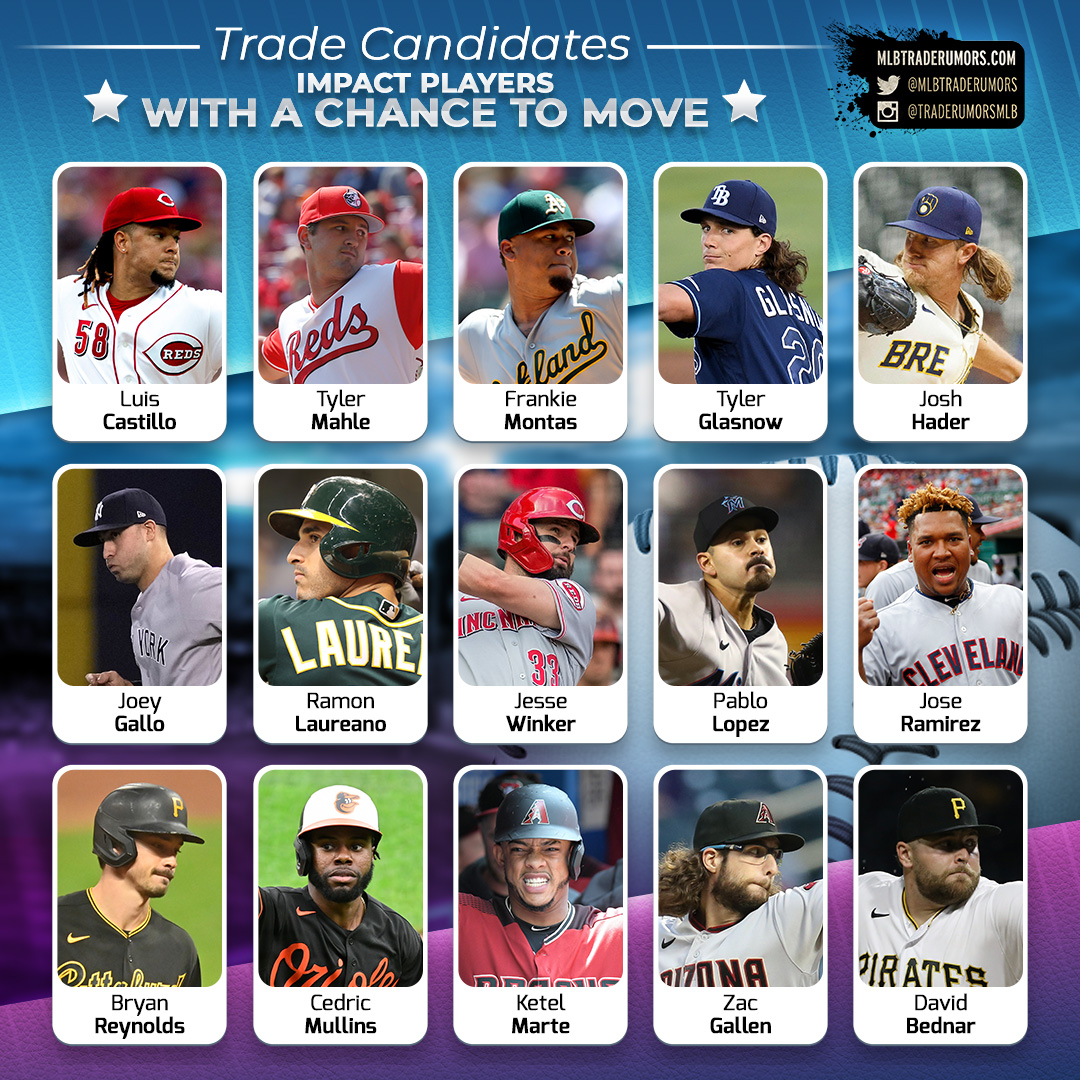
Earlier in the week, MLBTR owner Tim Dierkes published our list of the 14 players we consider to be the likeliest trade candidates following the ongoing MLB lockout. That list was the result of an extensive talk with Tim, myself and Anthony Franco, wherein we considered the possibility of more than 100 players and whether they could (or could not) viably change hands. While that Athletics-heavy list contained who we agreed to be the likeliest, it certainly didn’t represent every plausible trade candidate in our eyes.
As Tim noted within that post, we wound up sorting our list of plausible trade candidates into various buckets/tiers. The top 14 was simply the likeliest, regardless of contract or quality of player, but for the remainder of the exercise, we chose to categorize things based on how impactful a player might be to his new team. This, admittedly, is subjective. We didn’t establish a defined set of concrete parameters in labeling this group “impact” players; rather, we focused on mid-rotation (or better) starting pitchers, high-leverage relievers and hitters with recent All-Star-worthy performances (even if they didn’t necessarily result in an actual All-Star berth). Three wins above replacement in a given season wasn’t a firm cutoff, but we did ask at multiple points whether we a player had recently or could be reasonably expected/projected to turn in a 3-WAR season while sorting them.
Once these players were tiered, we further broke them down by whether they were legitimately plausible candidate to change teams or just someone whom other clubs would be trying to pry away. Basically, none of Tim, Anthony or myself would bat an eye to see Luis Castillo or Frankie Montas traded. Bryan Reynolds or Cedric Mullins, though? We’ll probably hear about teams trying to pry those players loose from their respective clubs (hence their inclusion), but a deal coming together seems like a long shot and would register as a mild surprise (if only because of the asking price and remaining club control).
As Tim explained, some of these players are interconnected. While the Reds have three starters who could plausibly change hands, we don’t necessarily think all three will move. It’s the same with the A’s roster. They could plausibly move multiple players — GM David Forst said amid November reports of a mandate to slash payroll that they’d have to listen on the whole roster — but that doesn’t mean the A’s are going to trade seven or eight players.
Anthony will follow this list up in the near future with a collection of solid regulars who we believe could change hands and/or will be in high demand following the lockout, but for now, here’s our second tier of trade candidates — legitimate impact players who could plausibly change teams but perhaps aren’t as likely to go as those listed by Tim earlier in the week…
Plausible/Decent Chance to Move
Luis Castillo / SP / Reds
The Reds’ offseason transactions since the close of the 2020 season have included a salary dump of Raisel Iglesias, non-tendering another quality reliever (Archie Bradley), trading Tucker Barnhart to Detroit, and placing Wade Miley on waivers rather than picking up a reasonable $10MM option. GM Nick Krall kicked off the 2021-22 offseason by declaring a need to “align our payroll to our resources.” Rumors of trades involving Luis Castillo, Sonny Gray (listed among our 14 likeliest candidates due to his age and larger price tag) and Tyler Mahle naturally followed.
Even if the Reds aren’t actively shopping the 29-year-old Castillo, teams will be calling to inquire, and Krall and his staff will be listening. The Reds probably aren’t going to shop him and simply let him go for the best offer, as they control him through 2023. They could always hold and market him again this summer or next offseason if no enticing offer materializes post-lockout.
Still, Castillo might be the best starting pitcher who could feasibly change hands. He got out to a brutal start in 2021, but over his final 22 starts, Castillo was excellent. He racked up 135 1/3 innings (six-plus innings per start) and notched a 2.73 ERA with a 26% strikeout rate, a 9.4% walk rate and a massive 59.9% ground-ball rate. Castillo’s ugly April/May results skew both his 2021 numbers and his collective numbers from 2019-21, but over the past three seasons he’s still posted a 3.61 ERA while fanning 27% of his opponents.
Maybe he’s not a true “ace,” but Castillo is a playoff-caliber starter for virtually any team. He’s projected to earn $7.6MM in 2022 and would be owed one more arbitration raise in 2023. Essentially, he’ll cost somewhere in the neighborhood of $20MM for the next two seasons — a bargain rate that should be reflected in a huge asking price from the Reds.
Tyler Mahle / SP / Reds
Mahle doesn’t have the name value that Castillo brings to the table, and his track record of success is shorter. Nonetheless, he’s blossomed into a sharp mid-rotation arm over the past two seasons, sporting a 3.72 ERA with a 28.1% strikeout rate and 8.9% walk rate. Unlike Castillo, he’s a fly-ball pitcher, which has at times bitten him at his bandbox of a home stadium; Mahle has given up 30 home runs in 227 2/3 frames dating back to Opening Day 2020, and 24 of them have come at home. He posted a 2.30 ERA away from Great American Ball Park in 2021 and, in his career, has a 5.09 ERA at home versus a 3.72 mark on the road.
A spacious home park would benefit Mahle perhaps even more than your average starter, although his penchant for yielding fly-balls will likely always make him a bit susceptible to the long-ball. Mahle has also been more of a guy who pitches into the sixth rather than completes six or seven frames (5 1/3 innings per start since 2020), but that’s increasingly common in today’s era of aggressive bullpen usage.
Mahle’s shorter track record may give some fans pause, but teams are likely comfortable projecting him as a quality arm based on the past two seasons of missing bats at a high level. And, that shorter track record has left him with a lower price point in arbitration, as he’s projected to earn $5.6MM in 2022. Like Castillo, he’s controlled through 2023, so there’s no immediate urgency to move him — especially given his affordable price tag. Still, teams will be calling, and the Reds can justifiably ask for a strong return.
Frankie Montas / SP / Athletics
Sticking with pitchers who have two remaining years of club control, Montas joins a long list of Athletics who could be traded post-lockout. Amid reports of a mandate to slash payroll, GM David Forst outwardly acknowledged back in November that the A’s will have to listen to offers on the majority of their roster.
Montas, unlike free-agents-to-be Sean Manaea and Chris Bassitt, is controlled through 2023. And unlike Matt Olson and Matt Chapman, his projected $5.6MM salary is a bit easier for the A’s to stomach. That’s why Montas is in this “bucket” of our trade candidate rankings, but even if he’s not as likely to move as some of his teammates, a deal is certainly still plausible.
Though Montas isn’t without red flags — he served an 80-game PED suspension in 2019 and had never reached 100 innings in a big league season prior to 2021 — it’s hard to ignore the quality results. Since 2018, Montas has pitched 401 innings of 3.57 ERA ball with a 24.4% strikeout rate, 7.3% walk rate and 43.7% ground-ball rate. His swinging-strike rate has continued to improve, and this past season’s 26.9% strikeout rate was a career-best. He’ll turn 29 in May, and he’s an upgrade for any team’s rotation.
Tyler Glasnow / SP / Rays
Glasnow is the most talented name on this list and, when healthy, looked the part of a legitimate ace with Tampa Bay. From 2019-21, Glasnow tallied 206 innings with a 2.80 ERA and fielding-independent marks to match. He punched out a ridiculous 36% of his opponents, walked just 7.8 percent of them and kept the ball on the ground at a 45% clip. Among the 114 starting pitchers who totaled at least 200 innings in that time, Glasnow ranks tenth in swinging-strike rate and second to only Shane Bieber in his combined percentage of called and swinging strikes. Only Jacob deGrom and Gerrit Cole had higher strikeout rates.
With that type of profile, two years of team control remaining and a projected $5.8MM salary for the 2022 season, a healthy Glasnow would be a no-brainer for the Rays to keep. Of course, Glasnow is not healthy. He’s likely to miss most, if not all of the upcoming season after undergoing Tommy John surgery last August. Arb-eligible players who miss an entire season due to injury typically sign on for a repeat of their prior year’s salary, meaning that in 2023 Glasnow will likely pitch on the same salary as 2022. Using that same $5.8MM projection, the Rays would be looking at about $11.6MM for one season of Glasnow, when his workload would need to be monitored coming back from major surgery.
Glasnow’s career-high innings total in the Majors is 2018’s 111 2/3, and his career-high for any professional season is when he reached 155 innings between Triple-A and Pittsburgh combined back in 2017. Realistically, the Rays would probably be thrilled to get 100-120 innings from Glasnow in 2023 — and an $11-12MM price tag on that modest total is rather steep for a team with Tampa Bay’s general payroll concerns.
Other clubs would welcome the opportunity to take that chance, however. We’ve seen two-year pacts for Tommy John rehabbers like Drew Smyly ($10MM with the Cubs), Michael Pineda ($10MM with the Twins) and Garrett Richards ($15.5MM with the Padres). Glasnow’s price tag is toward the lower end of that spectrum in terms of dollars, but the cost of trading prospects also has to enter into the equation. For an arm of this caliber, however, there are plenty of teams that would take the plunge.
Glasnow, for his part, recently told Chris Rose that he strongly hopes to remain with the Rays (YouTube link). Perhaps there’s a contract to be worked out that could benefit both parties, but Glasnow himself acknowledged the uncertainty surrounding his status and that president of baseball operations Erik Neander will have to listen to some offers if and when other teams come calling.
Josh Hader / RP / Brewers
Teams have been trying to get their hands on Hader for years, and the Brewers have steadfastly refused all overtures. The reluctance is understandable, as Hader has established himself as arguably the best reliever in the sport. In 282 1/3 career innings, he’s posted a 2.26 ERA and fanned exactly four out of every nine batters faced. No longer being used for multiple innings at a time, Hader posted a career-best 1.23 ERA in 58 2/3 frames this past season. The homer he allowed to Freddie Freeman in the NLDS isn’t a great note on which to close a season, but looking at Hader’s broader playoff track record, he has a 1.88 ERA and 23-to-3 K/BB ratio in 14 1/3 innings.
Trading the game’s most impactful reliever wouldn’t be easy for president of baseball operation David Stearns, but Hader’s value is at its apex. He’s also projected to see his salary spike to $10MM in 2022, with a fourth and final arbitration raise coming in 2023. Hader is dominant, but the typically low-payroll Brewers are flirting with what would be a record $123MM payroll. It’s not accurate to suggest that the presence of a second powerhouse reliever, Devin Williams, makes Hader expendable, but Williams’ excellence would at least slightly soften the blow of a theoretical Hader trade.
Milwaukee could still stand to improve its offense, and moving Hader could both free up some financial resources and simultaneously net some immediate help for the big league lineup. The Brewers don’t have to move Hader now, to be clear. However, they probably wouldn’t move him in-season if they’re contending — meaning it’s now or next winter, when they’d be marketing one year and a $15MM+ salary. That would net far less long-term value. It’s a fine line to walk.
Joey Gallo / OF / Yankees
Gallo popped 13 homers in 58 games following a July trade from Texas to the Bronx, but it’s fair to say the deal didn’t work out as New York had hoped. Gallo’s strikeout rate, which had dipped a bit with the Rangers, spiked to 38.6% as a Yankee. The resulting .160/.303/.404 batting line in 228 plate appearances is one of the more bizarre slashes you’ll ever see from a regular player.
Struggles in New York aside, Gallo was hitting .223/.379/.490 through 388 plate appearances in Texas and had bashed 25 homers in that span — putting him on pace for what would’ve been his third career 40-homer season had he not dropped off with the Yankees.
Gallo has as much power as anyone in baseball, and he’s made himself into a strong defender in the outfield corners (who can handle center from time to time). However, he’s projected to earn $10.2MM in arbitration this season, and it’d be understandable if the Yankees were hesitant at that price based on his post-trade struggles. New York is projected to top $226MM in luxury tax concerns, so moving Gallo could prove beneficial if owner Hal Steinbrenner is again intent on dipping beneath the threshold (wherever that’ll ultimately lie in 2022).
The Yankees have Aaron Judge, Aaron Hicks and Giancarlo Stanton as outfield options, with Estevan Florial serving as a possible reserve. Were they to give Gallo a change of scenery by moving him to a team seeking pop in the outfield, they could always sign a free agent to replenish some of the depth. It’s not clear that the Yankees will shop Gallo once the lockout lifts, but the New York Post’s Joel Sherman wrote about the possibility back in October, reporting within that as many as seven other teams tried to land Gallo at the deadline. If he’s on the block, there’ll be interest.
Longer Shots due to Asking Price and/or Remaining Club Control
Ramon Laureano / CF/ Athletics
Given Forst’s comments and the reports of forthcoming payroll reduction, it’s viable that anyone earning a salary of some note will at least be discussed. Laureano, projected to earn $2.8MM this coming season after his first trip through the arbitration process, also represents one of the few plausible center field options on the market, which should lead to plenty of teams inquiring on his availability.
Trading Laureano is more complicated than moving some of his teammates. He’s currently in the midst of an 80-game PED ban which, beyond raising questions about his performance to date, could come with major service time implications. Laureano still needs to serve 27 games of that suspension, which could impact his path to free agency. He currently has three years and 14 days of service time, meaning he’d need 158 days in 2022 to cross the threshold into four years of service and remain on track to hit the open market post-2024. There are only 187 days in a standard season, making it unlikely he’ll end up accruing the necessary time on the roster to get to that point. (Remember that off-days spent on the MLB roster count as a day of service.)
There’s always the small chance that some other factor impacts this trajectory (e.g. the ongoing labor talks, a potentially shortened 2022 schedule, a grievance filing), but as it stands, Laureano could wind up under team control through 2025 rather than 2024. An extra year of team control both heightens his appeal but also makes it tougher to trade him.
Beyond the service-time considerations, Laureano underwent core muscle surgery after the season, which adds another layer to a complicated scenario. But looking solely at Laureano’s numbers, he’s a difference-maker for a team in need of a center fielder (e.g. Phillies, Marlins, Guardians). A career .263/.335/.465 hitter with 25-homer pop, good speed and plus center field defense isn’t a hard sell.
Jesse Winker / OF / Reds
I explored Winker’s situation at length last week, with the bottom-line point being that it makes little sense to listen to offers on starting pitchers with two years of club control remaining (e.g. Castillo, Mahle, Gray) without doing the same on Winker. The 28-year-old slugger has had some issues with durability, doesn’t hit lefties well (though he’ll still draw his walks against them) and isn’t a great defender. That’s an odd trio of qualities to focus on when talking about someone’s trade candidacy, but the other side of the coin is more compelling: Winker’s production against right-handed pitching is at Bryce Harper/Juan Soto levels of brilliance.
Since 2020, Harper and Soto are the only two qualified hitters in baseball with a better mark than Winker’s 169 wRC+ against righties. In terms of more traditional slash metrics, he’s batting an outrageous .322/.417/.619 when holding the platoon advantage. With all the talent on the Reds’ roster, I think Cincinnati should be in aggressive, win-now mode. Krall’s early comments and their dealings since 2020 suggest otherwise, however, and if you’re going to listen on the other guys with four-to-five years of MLB service — why not listen on Winker as well? Cleveland, Colorado, Philadelphia and so many others are looking for offensive upgrades in the outfield corners.
Pablo Lopez / SP / Marlins
As is a common refrain on this list, the Marlins have no urgency to move Lopez, who’ll turn 26 in March. He was limited to 102 2/3 innings by shoulder issues last season and has yet to top 111 2/3 frames in a Major League season, but Lopez has been pretty darn good when healthy. From 2020-21, in particular, he’s compiled 31 starts and 160 innings of 3.26 ERA ball with a 26.4% strikeout rate and a 6.7% walk rate. He’s in his first trip through arbitration and projected for a highly reasonable $2.5MM salary.
So, why even bother considering a move? The Marlins are still hopeful of landing some help in center field, and they’re also so deep in pitching talent that it borders on comical. The old adage that a team can never have too much pitching always rings in the back of our minds, but the Marlins aren’t short on options beyond Lopez. Sandy Alcantara, Trevor Rogers, Elieser Hernandez, Jesus Luzardo, Sixto Sanchez, Edward Cabrera, Braxton Garrett, Nick Neidert, Cody Poteet and Daniel Castano are all on the 40-man — and top prospect Max Meyer is quickly rising through the minors. Injured top prospect Jake Eder will be back in 2023.
Jose Ramirez / 2B, 3B / Guardians
The favorite subject of so many hypothetical trade scenarios from fans, Ramirez does feel likely to end up traded … at some point. The question is whether now’s the time. Cleveland has him for $11MM this year plus a $13MM option in 2023. Given Ramirez’s elite play, there’s little chance of the Guardians extending him beyond that 2023 season, but there’s also good sense in Cleveland taking another run at the AL Central with Ramirez as a focal point. The pitching is still excellent, and while the lineup clearly needs another bat or two, the 2022 payroll is currently projected at only $49MM. There’s room to add some help for Ramirez and Franmil Reyes, and a deep farm system could also provide some in-house upgrades.
It’s also impossible to look at the situation without accounting for public relations. We’re only a year removed from Cleveland trading Francisco Lindor in a wildly unpopular move, and many fans’ anger with further fueled by the team’s name change. The newly-named Guardians are looking to usher in a “new era” of Cleveland baseball, and trading their best player for a second straight offseason isn’t a great way to foster good will.
If the first half of the season goes poorly, I’d expect Ramirez to be among the most talked-about names at the 2022 trade deadline, and there’d be a much stronger chance he moves at that point. With regard to the offseason, however, there’s just not enough urgency to push something across the line unless Toronto or another on-paper suitor puts forth an over-the-top offer. Even then, fans who’ve already purchased new Guardians gear bearing Ramirez’s name are going to feel rather jilted. It’d be tough for the front office to make this move now.
Bryan Reynolds / OF / Pirates
Reynolds is the best player on a last-place team that’s squarely in the midst of a rebuild so it’s hardly a surprise that he’s been in trade rumors dating back to the summer. Rival teams know the Pirates are open for business, and it’s only natural they’d try to acquire a center fielder capable of posting a .302/.390/.522 slash like the one Reynolds logged in 2021.
On the one hand, there’s an argument that the rebuilding Buccos ought to listen on anyone — and they surely will. But on the other hand, Reynolds is 27 and controlled another four seasons. His trade value won’t diminish substantially if the Pirates hold onto him, giving the fans at least one recognizable and marketable star player. Reynolds is a Super Two player who’s projected to earn an eminently affordable $4.5MM in 2022, so there’s no financial pressure. Everyone has their price in a trade, especially on a team like the Pirates, but for some context, that price reportedly included Mariners uber-prospect Julio Rodriguez (and more) when the two teams last talked. Baseball America currently ranks Rodriguez as the No. 2 prospect in all of baseball.
Cedric Mullins / OF / Orioles
Most of what was written about Reynolds applies to Mullins. The Orioles’ breakout star put together a 30-30 season last year while hitting .291/.360/.518 and is controllable for another four seasons — through age 30. No one expects the Orioles to contend in 2022, but they’ll get a look at top prospects like Adley Rutschman, Grayson Rodriguez and D.L. Hall this year. Reinforcements from the farm are on the way, and it’s feasible that by 2023 (and certainly by 2024), they could be on the cusp of turning a corner. Mullins will be under control, affordable and in his prime at that point.
The Orioles aren’t going to declare anyone on their Major League roster “untouchable,” but Mullins would only be available for a staggeringly strong offer. A Mullins trade doesn’t seem likely, but teams are going to at least try to force GM Mike Elias’ hand.
Ketel Marte / 2B, CF / Diamondbacks
Teams have been trying to pry Marte from the D-backs for more than a year. Arizona reportedly took the extra step of plainly telling rival clubs in early July — weeks before the trade deadline — that Marte wouldn’t be moved. That probably didn’t stop clubs from trying, and teams will be trying again post-lockout. The Marlins, Yankees, Mariners and quite a few others have at least been speculatively linked to Marte, whose team-friendly deal heightens his appeal. Marte will earn $8MM in 2022, and his contract calls for a $10MM team option in 2023 and a $12MM team option in 2024.
Dating back to 2019, Marte boasts a .318/.374/.543 batting line with 48 dingers, 79 doubles, 11 triples and a lowly 14% strikeout rate (versus a 7.6% walk rate). He’s rated poorly in center field, from a defensive standpoint, but is well-regarded defensively at second base. A 28-year-old switch-hitter with power, some speed, plenty of versatility and a grand total of $30MM owed to him over the next three years ($21MM of which isn’t even guaranteed) is wildly appealing. The D-backs, however, have shown little inclination to move him in the past, and assistant GM Amiel Sawdaye echoed that sentiment in November, calling Marte a “cornerstone” player around whom the D-backs can build.
Zac Gallen / SP / Diamondbacks
Twenty-six years old and controlled another four seasons, Gallen is precisely the type of pitcher that pitching-needy teams like the Rangers, Twins, Nationals and so many others would dream of acquiring. A forearm issue slowed him in 2021 and limited his workload, but Gallen has now made 50 starts in the Majors with a 3.46 ERA, a 27.6% strikeout rate and a 9.6% walk rate to show for it. He’s already been traded twice — going from St. Louis to Miami in the Marcell Ozuna deal before being flipped to Arizona in what amounted to a rare prospect-for-prospect swap sending Jazz Chisholm back to the Fish.
The D-backs didn’t even trade Merrill Kelly at this past summer’s deadline when he was a fourth starter with 1.5 cheap years left on his contract. It’s hard to imagine they’ll be excited about the idea of giving up four seasons of Gallen — particularly when his stock is down a bit, owing to last season’s arm issue. Gallen closed out the 2021 season quite well, with a 3.19 ERA and 52-to-15 K/BB ratio in his final 48 frames (eight starts). Sawdaye listed Gallen as a “cornerstone” player right alongside Marte, adding that the D-backs never plan to fully punt on a given season. Their signing of Mark Melancon for two years and $14MM meshes with the notion that this is not a team on the brink of a full-fledged teardown. Teams can try to nab Gallen, but it’d likely require some young MLB-ready talent going back to Arizona. Overall, the odds are low.
David Bednar / RP / Pirates
One of several pieces acquired in last winter’s Joe Musgrove trade, the 27-year-old Bednar stepped up and solidified himself as the Pirates’ likely closer in 2022. Through 60 2/3 innings, Bednar posted a tiny 2.23 ERA with a 32.5% strikeout rate, an 8.0% walk rate and a 41.4% grounder rate. Bednar yielded only five home runs all season (0.74 HR/9) and averaged 97 mph on his heater. He looks the part of a legitimate high-leverage weapon, and he’s controlled for five more years — all the way through 2026.
With such good results, a pre-arbitration salary and so much team control remaining, Bednar probably isn’t going anywhere. (As a bonus, he’s a Pittsburgh-area native.) The Pirates can’t (or at least won’t) simply trade every player who shows some semblance of value, after all. That said, the last thing most rebuilding clubs need is a high-end closer, and bullpen help is always in demand. Bednar will be 29 or 30 by the time the Pirates are realistically turning a corner, and the attrition rate on relievers is higher than anywhere else on the diamond. The argument for capitalizing on his value right now is pretty clear, but as with the rest of this “long shot” list, it’s hard to see a team meeting what would surely be a pretty substantial asking price.
Athletics To Sign Eric Thames To Minor League Deal
The A’s are signing first baseman Eric Thames to a minor league contract, reports Susan Slusser of the San Francisco Chronicle (on Twitter). It’s a homecoming of sorts for the 35-year-old, who is a San Jose native.
Thames has appeared in the big leagues in parts of six seasons. He debuted with the Blue Jays in 2011, then split the following campaign between Toronto and the Mariners. Thames didn’t make it back to the majors in 2013, instead spending the year in Triple-A with the M’s and Orioles. Over the 2013-14 offseason, the left-handed hitter made the jump to South Korea, signing with the NC Dinos of the Korea Baseball Organization.
It was a masterful pick-up by the Dinos, for whom Thames blossomed into an instant superstar. He spent three seasons with the Changwon-based club, popping 37 or more home runs with an OPS north of 1.100 in each. The KBO was a hitter-friendly league, but Thames’ production was outrageous even after putting it into context. That was particularly true in 2015, when the Pepperdine University product hit .381/.497/.790 with 47 homers and 40 stolen bases. That output at the plate was an incredible 116 points above the KBO league average, by measure of wRC+, and he was awarded the MVP that year.
After dominating in the KBO, Thames set his sights on a return to the majors. He was a high-profile target during the 2016-17 offseason, eventually landing a three-year, $16MM guarantee with the Brewers. Milwaukee got a solid return on that investment, as Thames continued to produce at an above-average level (albeit nowhere near his otherworldly KBO numbers) with the Brew Crew.
He hit 31 homers and posted an overall .247/.359/.518 line over 551 plate appearances in his return season. That’d be his most productive year in Milwaukee, although his combined .236/.331/.495 line between 2018-19 still checked in 12 points above average (112 wRC+). Thames increasingly struggled with strikeouts, but he also drew plenty of walks and proved a consistent power threat.
After his contract with the Brewers expired, Thames inked a one-year guarantee with the Nationals that also included a 2021 club option. He stumbled to a .203/.300/.317 mark during the shortened season, and Washington bought him out. Thames made the jump back to Asia — this time to Japan — last winter, signing with the Yomiuri Giants of Nippon Professional Baseball. Unfortunately, he ruptured an Achilles in his first game with the Giants and missed the rest of the season.
Thames now returns to affiliated ball, hoping to earn his way back into the majors. Presumably, he’ll get a chance to report to MLB Spring Training and compete for a spot on an A’s roster that could find itself in flux. Matt Olson is a potential trade candidate, as Oakland is reportedly looking to cut payroll after the lockout. Even if Olson sticks around, Thames could work his way into the designated hitter or corner outfield mix. Mitch Moreland and Jed Lowrie took the bulk of DH playing time last season, but they’re each free agents. Seth Brown and Chad Pinder could be in consideration for DH at-bats, but they look likely to platoon in left field to replace Mark Canha at the moment.
Jeremy Giambi Passes Away
FEBRUARY 10: The Los Angeles County Medical Examiner/Coroner’s Office has ruled Giambi’s death a suicide, reports Matt Kawahara of the San Francisco Chronicle. According to the M.E.’s Office, he died of a gunshot wound to the chest. Barry Zito, Giambi’s former teammate in Oakland, told the Chronicle Giambi was “an incredibly loving human being with a very soft heart and it was evident to us as his teammates that he had some deeper battles going on. I hope this can be a wake-up call for people out there to not go at it alone and for families and friends to trust their intuition when they feel somebody close to them needs help. God bless Jeremy and his family in this difficult time.”
FEBRUARY 9: Former major league outfielder Jeremy Giambi passed away today, agent Joel Wolfe informed reporters (including Susan Slusser of the San Francisco Chronicle). He was 47 years old.
Giambi began his professional career in 1996, when the Royals selected him out of Cal State Fullerton. The lefty-hitting outfielder reached the big leagues as a September call-up just two years later. After appearing in 18 games down the stretch, he ranked among Baseball America’s top 100 prospects entering the 1999 season. Giambi played in a bit more than half of Kansas City’s games that year. That offseason, the A’s — for whom his older brother Jason Giambi was already an established star — acquired him in a deal that sent Brett Laxton to Kansas City.
The younger Giambi would spend the next two and a half seasons in Oakland, developing into a productive hitter. After putting up league average offensive numbers in 2000, the California native emerged as a key on-base threat by 2001. He hit .283/.391/.450 over 443 plate appearances that year, then began the following season with a .274/.390/.471 showing. Midway through the year, he was dealt to the Phillies for John Mabry. Giambi continued to produce in Philadelphia, posting a .244/.435/.538 mark with the Phils.
Philadelphia traded Giambi to the Red Sox over the 2002-03 offseason. He appeared in 50 games with Boston the following season, though his numbers dipped to a .197/.342/.354 line. That proved to be his final big league experience, as subsequent stints in the Dodgers and White Sox farm systems didn’t result in another MLB look.
Giambi is likely best remembered for his run with the A’s. The Oakland organization released a statement (via Twitter): We are heartbroken to learn of the passing of a member of our Green and Gold family, Jeremy Giambi. We offer our condolences to Jeanne, Jason, and his family and friends. MLBTR joins countless others around the game in sending our condolences to Giambi’s family, friends, former teammates and loved ones.
Rangers Expected To Explore Matt Olson Deal Post-Lockout
Whenever the lockout ends, transactions — both on the trade and free agent fronts — figure to pile up in a hurry. Among the likelier names to change hands is star Oakland first baseman Matt Olson, who has been the subject of rumors for several months. That’s only natural after A’s GM David Forst plainly acknowledged that the team has reached a point in its “cycle” where they’ll need to be open to moving established players (though the writing had already been on the wall for some time before that).
The Yankees have been frequently reported as an interested suitor for Olson, and prior to the lockout, Evan Grant of the Dallas Morning News wrote that the Rangers had “already begun investigating” what an Olson acquisition might cost them. Whatever exactly occurred in those pre-lockout talks seemingly wasn’t a huge deterrent, as Grant writes this week that Texas will “absolutely” circle back with the A’s to see if there’s a potential fit.
Perhaps of greater intrigue to fans, however, is that Grant suggests an Olson package would require, at minimum, current big league first baseman Nathaniel Lowe, plus of the organization’s top prospects and a pair of other mid-tier names from down on the farm. As one might expect, it’s a rather broad and subjective set of parameters. Josh Jung and Justin Foscue are both “top prospects” for the Rangers, for instance, but Jung’s value is considerably higher at the moment. It’s hard to see the Rangers parting with Jung, who’s expected to debut in 2022, or either of the top pitching prospects in the system (2021 No. 2 overall pick Jack Leiter and 2018 first-rounder Cole Winn).
Regardless of specific permutations on the prospect side of things, a package headlined by Lowe and two or even three intriguing farmhands would figure to be appealing to A’s brass. Lowe, 26, isn’t on the same level as Olson offensively or defensively, but he’s been an above-average hitter in the big leagues and is controlled another five seasons. He’ll likely be a Super Two player (assuming Super Two designation remains unchanged in current labor talks), thus putting him on a path to arbitration eligibility next offseason. Lowe’s first two or even three arbitration salaries should be relatively affordable, however.
Texas acquired Lowe in a Dec. 2020 trade that sent four prospects to the Rays, and he responded with a solid first year at the plate in his new environs. Through 642 plate appearances, Lowe slashed .264/.357/.415 with 18 home runs, 24 doubles, three triples, eight stolen bases (in eight attempts) and a hearty 12.5% walk rate. Lowe had fanned in 31.8% of his first 245 trips to the plate in Tampa Bay, but he dropped that number to a more manageable 25.8% in Texas. Defensively, he put up sub-par marks in Defensive Runs Saved (-3), Ultimate Zone Rating (-4.2) and Outs Above Average (-3). Scouting reports from Lowe’s prospect days pegged him as a solid defender at first base, however, so there’s likely some room for improvement.
Notably, Grant adds that if Olson isn’t acquired, first base isn’t likely to be a priority for the Rangers. A pursuit of Olson, then, seemingly isn’t about being dissatisfied with the work Lowe has put in, but rather about jumping at the opportunity to grab an elite player with multiple years of club control remaining.
While there’s no guarantee Olson is ultimately moved, it’s an interesting look at a potential framework for a swap. The A’s have, historically speaking, tended to prefer returns that included immediate help for the big league roster when dealing away star players. Lowe would certainly fall under that umbrella, and some immediate production from him could help to soften the blow of losing Olson.
Olson, 28 next month, has emerged as one of the premier first basemen in the game over the past few years, with his 2021 season in particular towering above the rest of the league. In 673 plate appearances, Olson batted .271/.371/.540 (146 wRC+) with 39 home runs, 35 doubles and standout defense at first base. He dramatically reduced his strikeout rate, cutting it from 26.1% (2016-20) all the way to 16.8% — and he did so without sacrificing any of his plate discipline. To the contrary, Olson’s walk rate jumped from 10.8% in 2016-20 to 13.1% this past season.
Trading a player of this caliber is a tough pill for the A’s to swallow but also, as Forst alluded to, a familiar process in the Oakland front office. Olson is due his second arbitration raise once the lockout ends, and MLBTR contributor Matt Swartz projects that he’ll jump from $5MM to $12MM for the 2022 season. Add in a third and final arbitration raise in 2023, and Olson figures to cost upwards of $30MM over the next two seasons combined.
That’s a bargain rate for most clubs, but for a perennially low-payroll A’s team that has seen its best players reach the late stages of arbitration simultaneously, it’s a problematic scenario. Olson, Matt Chapman, Sean Manaea, Chris Bassitt and Frankie Montas are projected to combine for $45.7MM alone; the A’s payroll is set to rise to its second- or third-highest mark ever in 2022 before the team even makes a single addition.
Trading Olson within the division may not be preferable for the A’s, but longtime baseball ops boss Billy Beane and Forst have never shied away from intra-division swaps. Texas and Oakland lined up on a deal just last offseason, swapping out Elvis Andrus and Khris Davis in a financially-motivated arrangement. A year prior, Texas and Oakland matched up in a Mike Minor swap, and the two teams also struck an accord in the 2019-20 offseason when Jurickson Profar went from Texas to Oakland as part of a three-team trade. Suffice it to say, Beane and Rangers president of baseball operations Jon Daniels are comfortable trading within the division, although moving a star of Olson’s caliber perhaps changes that calculus a bit.
If the Rangers were to ultimately pry Olson loose from their divisional foe, one would have to imagine they’d take a run at signing him to a long-term extension. They still have a ways to go before stepping back into the AL West running and aren’t yet expected to contend in 2022, so losing any trade acquisition after just two seasons could be deemed counterproductive. That’s putting the cart well before the horse, however, as Texas will face competition from several other clubs in trying to put together the best offer for Olson. Beyond the Yankees, Olson has been reported as a target for the Braves, should Freddie Freeman sign elsewhere. Others yet will view the situation similarly to the Rangers, feeling that while first base isn’t a dire need, Olson himself is so appealing that he’s worth moving some other pieces around to fit into the puzzle.