
The MLB Trade Rumors Podcast Is Back!
The MLB Trade Rumors Podcast, last heard in 2016 hosted by the esteemed Jeff Todd, has relaunched! Simon Hampton is now your host, and we’re very excited to bring the new show to you every week.
Episode 1 is now live on Spotify, Apple Podcasts and wherever you get your podcasts! Make sure you subscribe as well; use this link to find the show on Spotify and this one for Apple. You can also use the player at this link to listen, if you don’t use Spotify or Apple for podcasts.
This week, host Simon Hampton is joined by Anthony Franco to discuss a wide range of topics around the baseball world:
- An early look at the trade deadline possibilities, particularly focusing on Shohei Ohtani and what it make take for the Angels to listen to offers on the two-way star (3:19)
- Jake Cronenworth signed a seven-year, $80MM extension with the Padres, so what does that mean for San Diego’s chances at extending other players such as Juan Soto, Josh Hader and Blake Snell? (7:31)
- It’s easy to over-react to results in the first week of the season, so at what point is it reasonable to become concerned with a team’s performance? And what about the players? (12:30)
Plus, we answer your questions, including:
- Could the Marlins match up with the Yankees on a trade involving Oswald Peraza? And which of Miami’s pitchers could be in play at the deadline? (16:56)
- Will the Cardinals make a move to bolster their rotation at some stage this season? And if so, which players could be in play? (21:24)
- The Dodgers took a step back this winter, so how aggressive will they be at the deadline this year? And are they clearing payroll space for a crack at Shohei Ohtani? (26:09)
The podcast intro and outro song “So Long” is provided courtesy of the band Showoff. Check out their Facebook page here!
Padres Likely To Explore Extension Talks With Josh Hader, Juan Soto This Spring
The Padres achieved their top priority of the spring over the weekend, agreeing to an 11-year, $350MM deal with Manny Machado to keep him from retesting the free agent market next offseason. That came on the heels of a summer deal for Joe Musgrove and a recent extension with Yu Darvish.
Even after that series of transactions, the Friars have a handful of key players slated to hit the open market within the next two years. Last summer’s marquee deadline acquisitions — Josh Hader and Juan Soto — are both deep into their arbitration seasons. Jon Heyman of the New York Post writes that San Diego is likely to soon be in contact with both players’ camps to discuss possible extension frameworks. Dennis Lin of the Athletic similarly wrote this week the Friars were likely to take a run at extension talks with Soto.
There hasn’t been as much speculation regarding possible Hader negotiations. It’s not a surprise that president of baseball operations A.J. Preller and his front office plan to at least check in with the four-time All-Star, though. Hader is one season away from the open market and joins Blake Snell as the top impending free agents on the San Diego roster.
29 next month, Hader has a chance of securing a record-setting deal for a reliever. He owns a sterling 2.71 ERA with an eye-popping 43.2% strikeout rate over parts of six big league campaigns. No pitcher (minimum 200 innings) has punched out hitters at a higher rate since Hader came into the league. He’s three percentage points clear of second-place finisher Edwin Díaz. Hader also leads the league in SIERA (2.13) and swinging strike percentage (19.2%) over that stretch.
Díaz is second in both those categories as well. The Mets’ closer became the first reliever in league history to top the hundred million dollar mark this offseason, returning to Queens on a five-year, $102MM pact days before free agency opened. Díaz signed that deal in advance of his age-29 campaign and coming off one of the most dominant seasons by a closer in recent memory. He fanned more than half his opponents en route to a 1.31 ERA in 62 innings.
Hader, on the other hand, is coming off arguably the worst season of his career. He allowed more than five earned runs per nine, including a disappointing 7.31 mark in 19 appearances after the Padres acquired him from Milwaukee. Hader was a bit homer-prone early in the season with the Brewers. While he got that under control in San Diego, his walk rate jumped a few percentage points towards year’s end.
Despite that wobbly conclusion, Hader still enters extension negotiations with strong leverage. He’ll play the upcoming season on a hefty $14.1MM contract after avoiding arbitration. The lanky southpaw remains one of the sport’s highest-upside relief weapons. Even in his relative down year, Hader finished sixth among relievers who threw 50+ innings with a 37% strikeout rate. He placed 18th in swinging strike rate and averaged a personal-high 97.4 MPH on his sinker.
Hader’s youth and career résumé still position him as the favorite for the largest contract among relievers in next winter’s class. Díaz’s deal serves as a reference for the kind of money Hader could land if he had a vintage platform season. The New York righty had some ups and downs in the years leading up to 2022 — including a 5.59 ERA in 2019 and a fine but not overwhelming 3.45 mark in ’21 — before reaching new heights last season.
Considering his hefty arbitration salaries and proximity to free agency, Hader isn’t under pressure to sign for below-market rates this spring. He told Heyman he’d “definitely” be open to extension talks but didn’t offer any indication he’d take a hometown discount. “It’s a great place to be, but at the end of the day, business is business,” Hader said.
Locking up Soto would be an even more challenging endeavor, of course. The three-time Silver Slugger is playing this season on a $23MM arbitration contract. He’s likely to approach or top $30MM for his final arbitration season in 2024 and is trending towards free agency over the 2024-25 offseason. Soto would hit the market before his age-26 campaign and is generally expected to command the largest guarantee in league history (although the intervening potential free agency of Shohei Ohtani could first set a new high-water mark).
Soto has already declined an offer for what would’ve been the largest deal in MLB history. The Nationals reportedly offered a 15-year, $440MM pact last summer. Soto passed, leading Washington to pivot to trade discussions that’d eventually culminate in one of the biggest deadline deals ever. Soto’s performance in San Diego after the trade — .238/.388/.390 with more walks than strikeouts through 228 plate appearances — was disappointing by his massive standards but still markedly above average.
It stands to reason the Padres would at least have to beat the $440MM the Nats were prepared to offer in order to convince Soto to bypass a trip to the open market. How high he and his representatives are aiming isn’t clear, though Soto told Heyman his camp is “open to talking” with San Diego brass. However, he also added that “every player wants to get a try at free agency and a chance to decide where they want to go and where is best for their family.”
The Padres project for the third-highest luxury tax payroll in the majors this season, with Roster Resource forecasting them just under $275MM at present. Long-term deals for Machado, Fernando Tatis Jr., Xander Bogaerts, Musgrove, Darvish and Robert Suarez already have upwards of $130MM on the books through 2027. Tatis, Bogaerts and Machado alone will count for nearly $100MM annually between 2028-33. That’s plenty of future money tied up, though it also reinforces how willing owner Peter Seidler and the front office have been to commit to star talent.
Padres Avoid Arbitration With Juan Soto, Josh Hader
The Padres have avoided arbitration with two stars. San Diego and Juan Soto agreed to a $23MM contract, while they inked Josh Hader to a $14.1MM deal.
Aside from Shohei Ohtani — who agreed to a $30MM deal with the Angels at the end of last season — Soto is the highest-profile player in this year’s arbitration class. MLBTR contributor Matt Swartz projected him for the highest salary of any arb-eligible player, forecasting him to land at $21.5MM. Soto comes in a bit above that and secures a little more than a $6MM raise on last season’s $17.1MM salary.
Acquired from Washington in one of the biggest deadline trades in MLB history, Soto posted a .236/.388/.390 line through his first 228 plate appearances with the Friars. That was below his usual otherworldly standards but still excellent output thanks to a massive 19.3% walk percentage and just a 14.9% strikeout rate. Including his first-half numbers in Washington, he hit .242/.401/.452 with 27 homers over 664 plate appearances.
The Friars will be able to control Soto for one additional season before he’d hit free agency after the 2024 campaign. He’s on track to reach the open market in advance of his age-26 season and trending towards a potential record-setting deal. San Diego surely has interest in working out a long-term agreement with the Boras Corporation client. Soto declined a 15-year, $440MM extension offer from Washington before being traded, ostensibly setting the floor in any negotiations with the Friars.
Hader landed with the Padres in a massive deadline deal as well. Acquired from the Brewers in a surprising swap, he struggled to a 7.31 ERA through his first 16 innings in San Diego. A spike in walks played a role in those anomalous struggles, though Hader was also plagued by an unsustainably high .372 batting average on balls in play against him. He’d only managed a 4.24 ERA over 34 innings with Milwaukee before the trade but struck out an eye-popping 41.8% of his opponents for the Brew Crew.
The lanky southpaw has an established multi-year track record as one of the sport’s most dominant late-game arms. He owns a career 2.71 ERA with a 43.2% strikeout percentage over 332 1/3 big league innings. Hader has collected 132 saves along the way and been selected to the All-Star Game four times. He’s rewarded with one of the largest arbitration deals of the winter himself, narrowly topping his $13.6MM projection.
With over five years of MLB service, Hader avoids arbitration for the final time. He’s on track to hit free agency next winter, when he’ll be headed into his age-30 season. With a typically dominant showing in 2023, Hader would have a chance at topping the reliever record $102MM free agent contract signed by Edwin Díaz this offseason.
Jeff Passan of ESPN reported the Soto agreement. Robert Murray of FanSided reported the Hader deal.
Brewers Notes: Stearns, Wong, Turang
The Brewers entered the 2022 season with high expectations on the heels of a 95-win campaign, but Milwaukee came up a bit short of a playoff berth. The Brew Crew finished 86-76 and were eliminated two days before the final game of the regular season.
President of baseball operations David Stearns met with reporters yesterday to discuss the team’s finish (link via Curt Hogg and Todd Rosiak of the Milwaukee Journal-Sentinel). He unsurprisingly expressed disappointment with missing the postseason, for which he took no small share of the blame. Asked about the team’s trade deadline approach — specifically the decision to deal All-Star reliever Josh Hader to the Padres for Taylor Rogers, Dinelson Lamet (who was almost immediately waived) and prospects Esteury Ruiz and Robert Gasser — Stearns acknowledged he didn’t fully appreciate how much of an impact the trade would have in the clubhouse and on the field.
“The Hader trade clearly had an impact on the team,” Stearns said. “It had a more pronounced impact than I thought it would at the time, and the surrounding moves didn’t adequately fortify the team in Josh’s absence.” He stopped short of saying he regretted the move, pointing to the long-term window of club control the team has over Ruiz and Gasser. He nevertheless noted that not making the postseason despite having a lead in the division as late as August 5 leads to “(looking) back and (saying) what more could we have done, what different could we have done.”
Hader himself wasn’t lights-out for San Diego. Through 16 innings as a Padre, the hard-throwing southpaw allowed 14 runs with a 28.2% strikeout rate that is far below his career norm. Yet a key justification for the Milwaukee front office in pulling the trigger on the deal was the assumption Rogers would step in as a productive relief arm himself. Instead, he posted a 5.48 ERA in 23 innings down the stretch, struggling mightily with the home run ball. Home runs were also an issue for Matt Bush, whom the Brewers added in a separate trade with the Rangers and who pitched to a 4.30 mark in 23 frames. Milwaukee’s acquisition of Trevor Rosenthal from the Giants, meanwhile, fell flat when he suffered a lat injury while trying to rehab from a hamstring strain that had him on the injured list at the time of the swap. Overall, the Milwaukee bullpen blew an MLB-worst 16 leads from deadline day forward.
That certainly wasn’t all foreseeable for the front office, but there’s no question the Brewers tried to thread a needle between remaining competitive while adding longer-term talent to the organization. That’s partially because of the franchise’s payroll outlook. Milwaukee has a massive arbitration class this winter, with 18 players eligible for that process. They won’t all be tendered contracts, but stars like Corbin Burnes, Brandon Woodruff and Willy Adames are all projected by MLBTR contributor Matt Swartz for salaries north of $9MM during their penultimate years of club control. Hader, who’s headed into his final year of control, is projected for a $13.6MM salary.
Finances are always a consideration for a Milwaukee franchise that annually runs payrolls slightly below the league average. The hefty arbitration class could be a factor in the team’s decision whether to exercise a club option on second baseman Kolten Wong. Milwaukee holds a $10MM option or a $2MM buyout, leaving them with a net $8MM call as to whether to keep him for a third season. That’s a perfectly reasonable price in a vacuum, as Wong is coming off a .251/.339/.430 showing with 15 home runs across 497 plate appearances. By measure of wRC+, that production was 16 points above that of this year’s league average hitter, the best hitting season of Wong’s career.
Nevertheless, the Brewers have to weigh those strong offensive marks against a bizarrely poor defensive season. Wong is a two-time Gold Glove winner and typically a plus defender, but Statcast pegged him as seven runs below average this year. Defensive Runs Saved estimated him as just one run below par, but all public metrics agreed it was the worst defensive season of his career. Wong himself shared that sentiment, telling Hogg (separate Journal-Sentinel post) “defensively, it just wasn’t even my year” and vowing to work over the offseason to better his glovework. While that’s certainly an encouraging attitude, it’s fair to wonder whether he’ll be able to recapture his peak defensive form at age 32.
Wong also addressed his contract status. While he told Hogg he’d be happy to see his option picked up, he acknowledged Milwaukee’s hefty arbitration class and the presence of former first-round pick Brice Turang in the upper minors. Turang, 23 in November, spent all of last season at Triple-A Nashville. He hit .286/.360/.412 with 13 homers and 34 stolen bases through 603 plate appearances. Regarded as a quality defensive middle infielder, the lefty-swinging Turang will be added to the 40-man roster this offseason and could be a cheaper second base option if the Brewers decided to part with Wong.
While Wong indicated he’s not yet heard from the team one way or the other, he suggested he’d be content to explore his free agent options if it comes to that. “I’ve been a free agent one time already and it’s not the most enjoyable thing,” he told Hogg. “If I got to go through it again, it is what it is. It will be interesting to see where I’d end up landing. Milwaukee was a choice that I kind of had in mind going into free agency as a high pick for me. This next one, I just kind of want to keep an open mind and see how it goes.”
If Wong were sent back into free agency, he’d be arguably the top player in the second base class. Jean Segura, who’s likely to be bought out by the Phillies, and utilityman Brandon Drury are otherwise the best players who’ll be available.
Padres To Use Closer Committee, Give Josh Hader “A Little Break” From Save Chances
Since being acquired by the Padres in a surprising deadline trade, Josh Hader‘s San Diego tenure has gotten off to a rough start. The All-Star has been scorched for six runs over his last three outings and 1 1/3 innings of work, and as a result, Hader has temporarily lost the closer’s job. As Padres manager Bob Melvin told reporters (including The Athletic’s Dennis Lin), the team will deploy a committee for the ninth inning, while giving Hader “a little break” from save situations.
This obviously isn’t the outcome the Padres were hoping for when they gave up a significant prospect package to the Brewers on August 1, in addition to taking on the remainder of Hader’s $11MM salary for the 2022 season. However, it is worth noting that we’re dealing with a very small sample size of 3 1/3 total innings for Hader in a Padres uniform. In three of his five appearances, Hader has allowed two hits and a walk over 2 2/3 scoreless frames — but, in his other two outings, the Giants and Nationals each scored three runs off the right-hander. The result is a 16.20 ERA for Hader since coming to San Diego.
These recent struggles also underline Hader’s dropoff in performance since the start of June. Hader didn’t allow a single earned run over his first 19 appearances of the season, but over his last 19 2/3 innings, his ERA is a whopping 10.07, with three blown saves in 14 chances. For comparison’s sake, Hader only blew three saves total during the 2020-21 seasons.
It is quite possible that Hader might regain his form once he gets a few more games under his belt in San Diego, and in this scenario, it might not be long before he is Melvin’s top choice at closer once again. In the interim, the Padres could turn to any of Robert Suarez, Luis Garcia, Adrian Morejon, or Nick Martinez in save situations, depending on recent usage or specific situations.
Brewers Trade Josh Hader To Padres
After years of rumors, the Brewers have finally traded All-Star closer Josh Hader, sending him to the Padres in a stunning deadline blockbuster. The two teams announced Monday that Hader is on his way to San Diego in exchange for the Padres’ own closer, Taylor Rogers, as well as righty Dinelson Lamet, pitching prospect Robert Gasser and outfield prospect Esteury Ruiz. In order to clear a 40-man roster spot, Milwaukee transferred reliever Miguel Sanchez from the 15-day to the 60-day injured list.
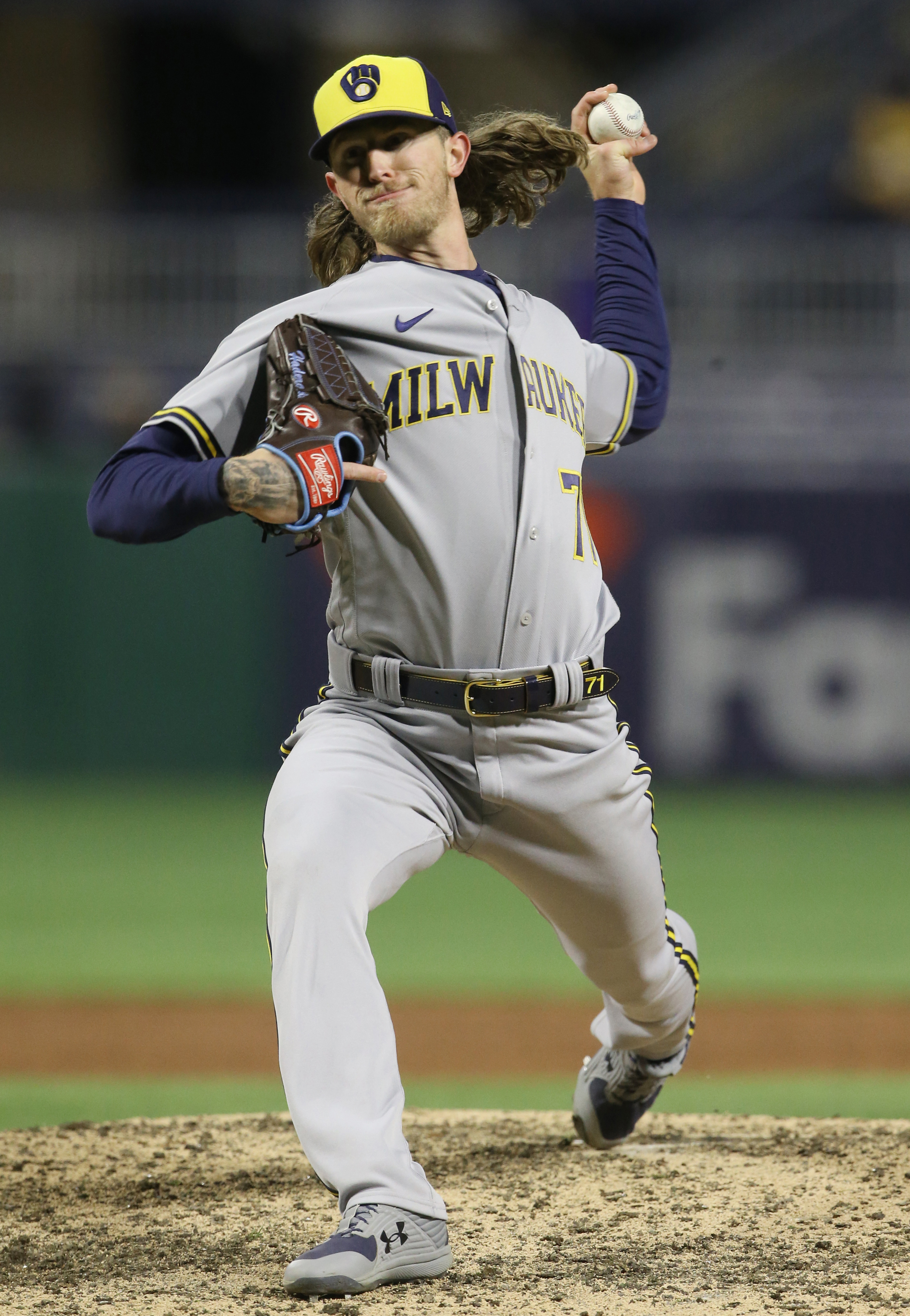
It’s a massive get for the Padres, and while it’s a genuine surprise to see Milwaukee move its closer while holding a three-game lead in the National League Central, the reasoning behind the trade is fairly straightforward. Hader’s $11MM salary figures to jump north of $15MM next season in his final year of club control, and a generally budget-conscious Brewers club may not be willing to dedicate $15-17MM to a single reliever when that represents such a notable portion of the overall payroll.
The Brewers, of course, could have held Hader into the winter and made him available at that point, but the allure of landing Hader for multiple postseason pushes undeniably allowed them to seek a higher price right now. To that end, they’re acquiring a closer of their own in Rogers, who — like Hader — has struggled of late but has an excellent track record spanning several seasons. Milwaukee also adds a high-octane arm in Lamet, albeit one that’s been plagued by injuries, and two of the Padres’ top ten prospects in Gasser and Ruiz, which breathes some much-needed life into a farm system that has generally not been considered among the sport’s strongest.
It’s the sort of trade we’re accustomed to seeing smaller-payroll clubs like the Rays and Guardians make with regularity: cash in a coveted player’s trade value when he has multiple seasons of club control and simultaneously backfill that spot on the roster with other big league help. It’s an immediate downgrade on the roster overall, but this type of simultaneous buy-and-sell tightrope act has been one of the keys to Tampa Bay, Cleveland and even Milwaukee itself remaining competitive despite rarely being able to spend top-of-the-market money.
“The players we are receiving in this trade help ensure that the future of the Milwaukee Brewers remains bright while not compromising our desire and expectation to win today,” Brewers president of baseball operations David Stearns said in a statement announcing the deal. “This mix of present Major League talent and high-level prospects furthers our aim to get as many bites of the apple as possible and, ultimately, to bring a World Series to Milwaukee. Trading good players on good teams is difficult, and that is certainly the case with Josh. We also recognize that to give our organization the best chance for sustained competitiveness, to avoid the extended down periods that so many organizations experience, we must make decisions that are not easy.”
Hader, 28, is sitting on a career-worst 4.24 ERA, though that mark was inflated by an uncharacteristic pair of consecutive meltdowns earlier this month, wherein he was tagged for a staggering nine earned runs in one-third of an inning. Outside that pair of disastrous outings, Hader has a 1.87 ERA in 33 2/3 innings. He didn’t even allow a run this season until June 7 and has punched out a massive 41.8% of his opponents against an 8.5% walk rate.
Dating back to Hader’s 2017 debut, no one in baseball has topped his enormous 44.1% strikeout rate — nor have they come especially close to doing so. (Craig Kimbrel is second at 40.6%.) Hader’s 2.48 ERA in that time is eighth-best among 309 qualified relievers, and no one has topped his 19.5% swinging-strike rate.
The name who trails Hader in that massive swinging-strike rate — now-former teammate Devin Williams — may have something to do with today’s trade as well. The Brewers surely wouldn’t have been as comfortable moving Hader were it not for Williams’ own breakthrough as one of the sport’s most dominant relief pitchers. Armed with a lethal changeup (nicknamed the “Airbender”), Williams ranks fourth in strikeout rate (39.9%), second in swinging-strike rate (18.6%) and second in ERA (1.94) among that same subset of qualified relievers just mentioned with regard to Hader.
There’s certainly an argument to be made that Milwaukee should have simply kept Hader and trotted out that dominant duo throughout the rest of the season and the forthcoming playoff run, but the blend of high-upside, immediate replacements (Rogers, Lamet) and the long-term value of adding a pair of well-regarded prospects to the system proved too alluring for Stearns, GM Matt Arnold and the rest of the Milwaukee staff.
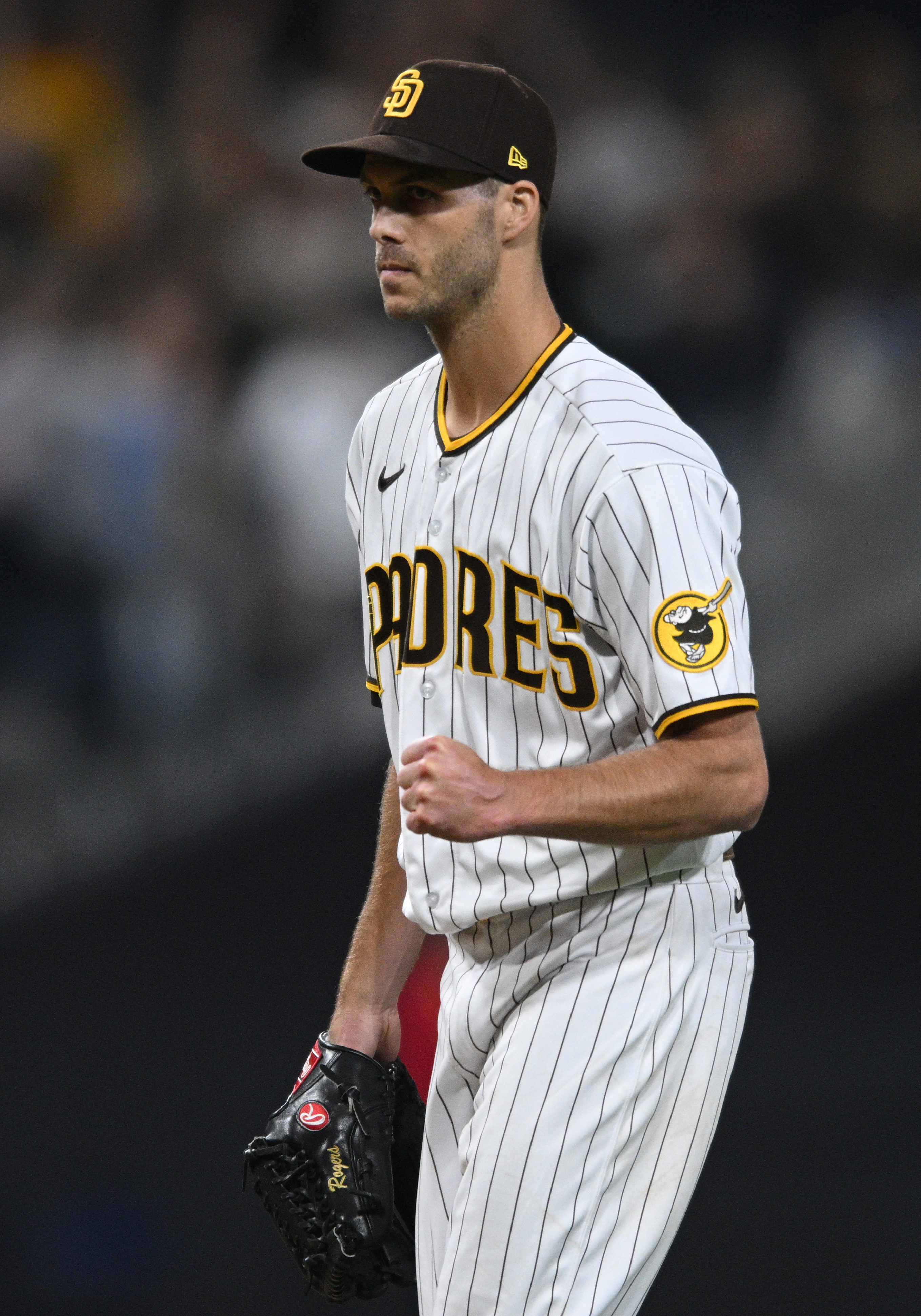
Turning to that collection of newly acquired talent, the Brewers will surely hope that Rogers can shake off the recent slump that has plagued him over the past two months. Rogers, from 2018-21 with the Twins, wasn’t far behind Hader on the list of the sport’s best left-handed relievers. He worked 197 2/3 frames during that time, pitching to a 2.91 ERA with a 31.2% strikeout rate, a 4.9% walk rate and 50 saves. A torn tendon in his pitching hand cut last season short for Rogers, however, and he was shipped from the Twins to San Diego on the eve of Opening Day this year.
Rogers took to his new environs brilliantly, pitching to a dominant 0.44 ERA with a 23-to-4 K/BB ratio through his first 20 1/3 innings. Since that time, however, he’s been clobbered for an 8.14 ERA in a nearly identical sample of 21 innings. Rogers still has an exceptional 25-to-5 K/BB ratio over that ugly stretch, however, and he’s only allowed one home run along the way. He’s been dogged by a sky-high .429 average on balls in play during this slump, but it’s still hard to overlook a stretch that has seen Rogers surrender runs in 13 of his past 22 appearances.
Still, Rogers’ track record is alluring, and perhaps the Brewers have their own idea about how to the lefty can get back on track. He’s a free agent at season’s end, making Rogers a pure rental — but he’s an ultra-affordable one, as the Twins covered all but $700K of his salary in that trade to the Padres.
Lamet, meanwhile, is another huge upside arm on whom the Brewers are buying low. The flamethrowing righty was a Cy Young candidate in the shortened 2020 season but went down with a biceps injury late that season and missed a significant portion of the 2021 campaign due to forearm strains.
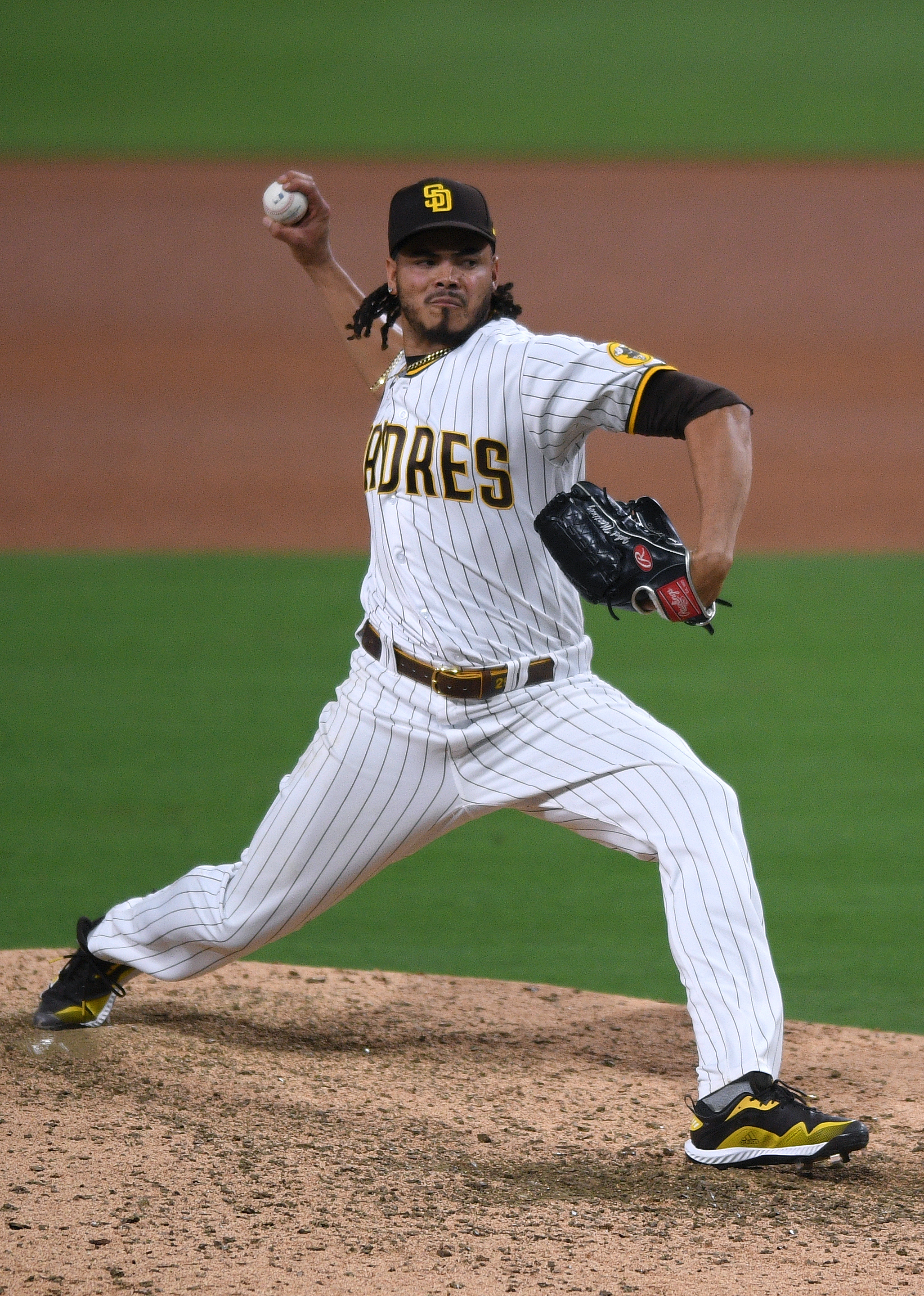
Lamet has yielded 13 earned runs in just 12 1/3 Major League innings this season, but he’s been dominant in Triple-A (0.77 ERA in 11 2/3 frames). His fastball, which averaged 97 mph in 2020, is down to an average of 95.3 mph this year. There are obviously plenty of red flags with Lamet, but if he can recapture anything resembling his 2020 form (2.09 ERA, 34.8% strikeout rate, 7.5% walk rate) while coming out of the Milwaukee bullpen, he’d be a formidable addition to the relief corps both this year and next, as he’s arbitration-eligible once more before free agency in the 2023-24 offseason.
Both Gasser and Ruiz were among the Padres’ top 10 prospects and will now also join the Brewers’ top 10. Gasser, 23, was the No. 71 overall pick in the 2021 draft and has held his own in the rotation with the Padres’ Class-A Advanced affiliate this season. In 90 1/3 innings, he’s notched a 4.18 ERA but a far more impressive 3.27 FIP, thanks largely to a gaudy 30.5% strikeout rate and a sharp 7.4% walk rate. Somewhat amusingly, Gasser doesn’t rely on velocity to find success but rather plus command and a plus breaking ball. Baseball America tabs his fastball in the 90-93 mph range and calls Gasser a high-probability fourth starter — one who could move quickly through the minors. He could be an option in the Milwaukee by late in the 2023 season and certainly by the 2024 campaign.
Ruiz, meanwhile, is an immediate option for the Brewers in center field. He’s already made his big league debut, and while he’s just 6-for-27 through his first few games, he obliterated Double-A pitching (.344/.474/.611 in 232 plate appearances) and Triple-A opposition so far in 2022 (.315/.457/.477 in 142 plate appearances). Ruiz, incredibly, has stolen 60 bases in just 77 minor league games this year and has already picked up the first of what should be quite a few big league steals as well. Add in average or better raw power, and it’s easy to see why Milwaukee was enamored of him — particularly given the team’s need in center field.
Ruiz isn’t a true center fielder and only moved to the outfield on a full-time basis last season after struggling as an infielder, but BA’s scouting report on him notes that he’s already making decent jumps and reads as he learns center field on the fly. Strikeouts were an issue for Ruiz earlier in his career, but he’s punched out at just a 17.4% clip in the minors so far this season and has reportedly made some changes to his approach and swing that have improved upon his bat-to-ball abilities.
Of course, it’s far from common to see a division-leading team part with one of the game’s best players at his position midway through the season, but the entire gambit for the Brewers is an upside play that could net them comparable production in 2022 and considerable long-term value thereafter.
For the Padres, it’s a pure short-term play with the goal of putting together a powerhouse postseason pitching staff. It’s also surely not the only move San Diego president of baseball operations A.J. Preller will make between now and tomorrow’s deadline. He managed to add Hader without having to surrender any of the organization’s very top-end prospects — e.g. Robert Hassell III, C.J. Abrams, Jackson Merrill, James Wood, Luis Campusano — all of whom could be used as firepower to bring in a sizable pitching or outfield upgrade (e.g. Frankie Montas, Juan Soto).
It bears mentioning that the acquisition of Hader likely puts the Padres over the luxury tax threshold, even with Lamet’s salary going back to Milwaukee. That only serves as a further portent for significant dealing from Preller & Co., though. In all likelihood, the Padres are just getting started, and we shouldn’t expect this to be the only move of note for the Brewers either.
Ken Rosenthal of The Athletic first reported that the Brewers were close to a trade of Hader. Jeff Passan of ESPN reported that Hader was going to the Padres in exchange for Rogers, Lamet, Gasser and Ruiz (Twitter links).
Post-Lockout Trade Candidates: Impact Players With A Chance To Move
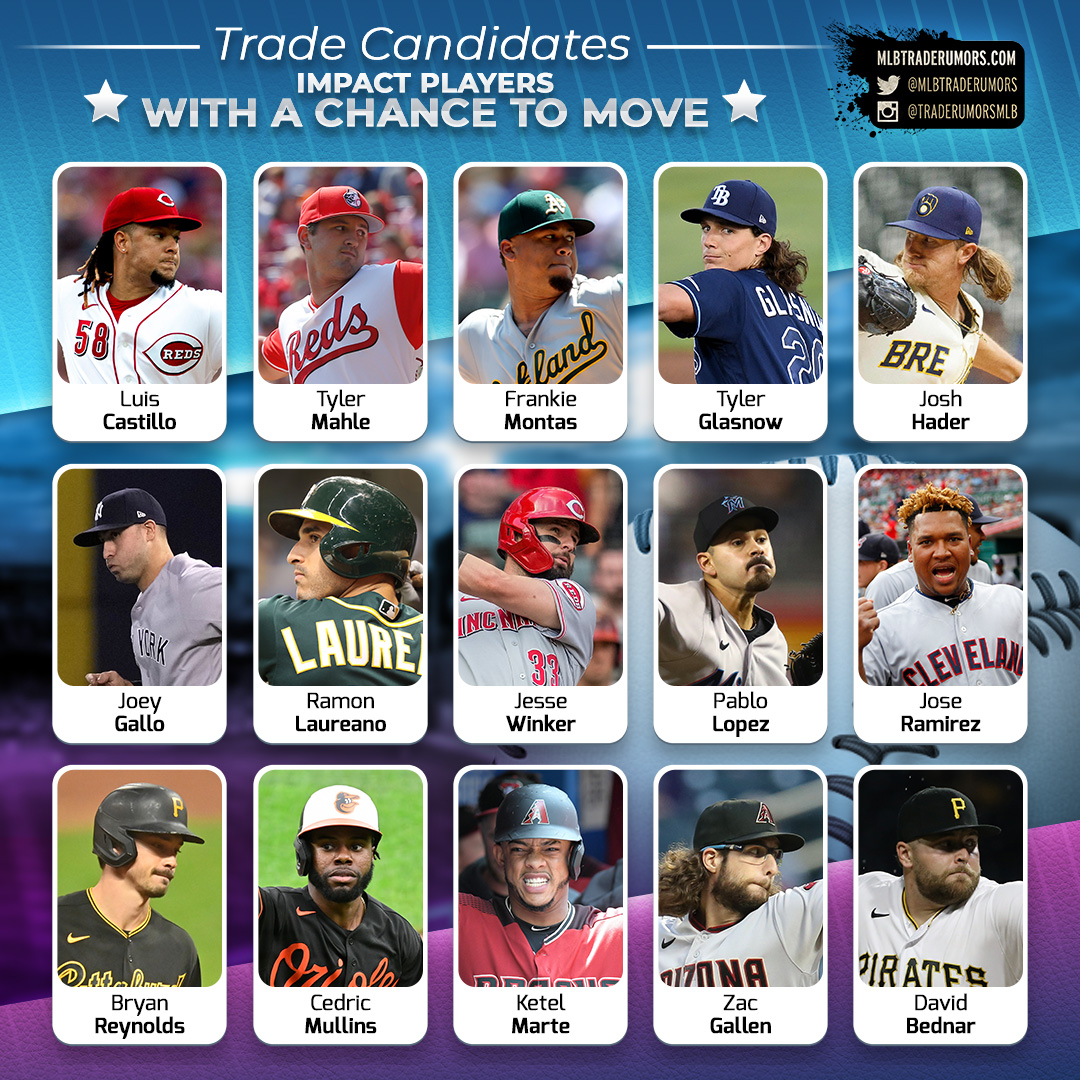
Earlier in the week, MLBTR owner Tim Dierkes published our list of the 14 players we consider to be the likeliest trade candidates following the ongoing MLB lockout. That list was the result of an extensive talk with Tim, myself and Anthony Franco, wherein we considered the possibility of more than 100 players and whether they could (or could not) viably change hands. While that Athletics-heavy list contained who we agreed to be the likeliest, it certainly didn’t represent every plausible trade candidate in our eyes.
As Tim noted within that post, we wound up sorting our list of plausible trade candidates into various buckets/tiers. The top 14 was simply the likeliest, regardless of contract or quality of player, but for the remainder of the exercise, we chose to categorize things based on how impactful a player might be to his new team. This, admittedly, is subjective. We didn’t establish a defined set of concrete parameters in labeling this group “impact” players; rather, we focused on mid-rotation (or better) starting pitchers, high-leverage relievers and hitters with recent All-Star-worthy performances (even if they didn’t necessarily result in an actual All-Star berth). Three wins above replacement in a given season wasn’t a firm cutoff, but we did ask at multiple points whether we a player had recently or could be reasonably expected/projected to turn in a 3-WAR season while sorting them.
Once these players were tiered, we further broke them down by whether they were legitimately plausible candidate to change teams or just someone whom other clubs would be trying to pry away. Basically, none of Tim, Anthony or myself would bat an eye to see Luis Castillo or Frankie Montas traded. Bryan Reynolds or Cedric Mullins, though? We’ll probably hear about teams trying to pry those players loose from their respective clubs (hence their inclusion), but a deal coming together seems like a long shot and would register as a mild surprise (if only because of the asking price and remaining club control).
As Tim explained, some of these players are interconnected. While the Reds have three starters who could plausibly change hands, we don’t necessarily think all three will move. It’s the same with the A’s roster. They could plausibly move multiple players — GM David Forst said amid November reports of a mandate to slash payroll that they’d have to listen on the whole roster — but that doesn’t mean the A’s are going to trade seven or eight players.
Anthony will follow this list up in the near future with a collection of solid regulars who we believe could change hands and/or will be in high demand following the lockout, but for now, here’s our second tier of trade candidates — legitimate impact players who could plausibly change teams but perhaps aren’t as likely to go as those listed by Tim earlier in the week…
Plausible/Decent Chance to Move
Luis Castillo / SP / Reds
The Reds’ offseason transactions since the close of the 2020 season have included a salary dump of Raisel Iglesias, non-tendering another quality reliever (Archie Bradley), trading Tucker Barnhart to Detroit, and placing Wade Miley on waivers rather than picking up a reasonable $10MM option. GM Nick Krall kicked off the 2021-22 offseason by declaring a need to “align our payroll to our resources.” Rumors of trades involving Luis Castillo, Sonny Gray (listed among our 14 likeliest candidates due to his age and larger price tag) and Tyler Mahle naturally followed.
Even if the Reds aren’t actively shopping the 29-year-old Castillo, teams will be calling to inquire, and Krall and his staff will be listening. The Reds probably aren’t going to shop him and simply let him go for the best offer, as they control him through 2023. They could always hold and market him again this summer or next offseason if no enticing offer materializes post-lockout.
Still, Castillo might be the best starting pitcher who could feasibly change hands. He got out to a brutal start in 2021, but over his final 22 starts, Castillo was excellent. He racked up 135 1/3 innings (six-plus innings per start) and notched a 2.73 ERA with a 26% strikeout rate, a 9.4% walk rate and a massive 59.9% ground-ball rate. Castillo’s ugly April/May results skew both his 2021 numbers and his collective numbers from 2019-21, but over the past three seasons he’s still posted a 3.61 ERA while fanning 27% of his opponents.
Maybe he’s not a true “ace,” but Castillo is a playoff-caliber starter for virtually any team. He’s projected to earn $7.6MM in 2022 and would be owed one more arbitration raise in 2023. Essentially, he’ll cost somewhere in the neighborhood of $20MM for the next two seasons — a bargain rate that should be reflected in a huge asking price from the Reds.
Tyler Mahle / SP / Reds
Mahle doesn’t have the name value that Castillo brings to the table, and his track record of success is shorter. Nonetheless, he’s blossomed into a sharp mid-rotation arm over the past two seasons, sporting a 3.72 ERA with a 28.1% strikeout rate and 8.9% walk rate. Unlike Castillo, he’s a fly-ball pitcher, which has at times bitten him at his bandbox of a home stadium; Mahle has given up 30 home runs in 227 2/3 frames dating back to Opening Day 2020, and 24 of them have come at home. He posted a 2.30 ERA away from Great American Ball Park in 2021 and, in his career, has a 5.09 ERA at home versus a 3.72 mark on the road.
A spacious home park would benefit Mahle perhaps even more than your average starter, although his penchant for yielding fly-balls will likely always make him a bit susceptible to the long-ball. Mahle has also been more of a guy who pitches into the sixth rather than completes six or seven frames (5 1/3 innings per start since 2020), but that’s increasingly common in today’s era of aggressive bullpen usage.
Mahle’s shorter track record may give some fans pause, but teams are likely comfortable projecting him as a quality arm based on the past two seasons of missing bats at a high level. And, that shorter track record has left him with a lower price point in arbitration, as he’s projected to earn $5.6MM in 2022. Like Castillo, he’s controlled through 2023, so there’s no immediate urgency to move him — especially given his affordable price tag. Still, teams will be calling, and the Reds can justifiably ask for a strong return.
Frankie Montas / SP / Athletics
Sticking with pitchers who have two remaining years of club control, Montas joins a long list of Athletics who could be traded post-lockout. Amid reports of a mandate to slash payroll, GM David Forst outwardly acknowledged back in November that the A’s will have to listen to offers on the majority of their roster.
Montas, unlike free-agents-to-be Sean Manaea and Chris Bassitt, is controlled through 2023. And unlike Matt Olson and Matt Chapman, his projected $5.6MM salary is a bit easier for the A’s to stomach. That’s why Montas is in this “bucket” of our trade candidate rankings, but even if he’s not as likely to move as some of his teammates, a deal is certainly still plausible.
Though Montas isn’t without red flags — he served an 80-game PED suspension in 2019 and had never reached 100 innings in a big league season prior to 2021 — it’s hard to ignore the quality results. Since 2018, Montas has pitched 401 innings of 3.57 ERA ball with a 24.4% strikeout rate, 7.3% walk rate and 43.7% ground-ball rate. His swinging-strike rate has continued to improve, and this past season’s 26.9% strikeout rate was a career-best. He’ll turn 29 in May, and he’s an upgrade for any team’s rotation.
Tyler Glasnow / SP / Rays
Glasnow is the most talented name on this list and, when healthy, looked the part of a legitimate ace with Tampa Bay. From 2019-21, Glasnow tallied 206 innings with a 2.80 ERA and fielding-independent marks to match. He punched out a ridiculous 36% of his opponents, walked just 7.8 percent of them and kept the ball on the ground at a 45% clip. Among the 114 starting pitchers who totaled at least 200 innings in that time, Glasnow ranks tenth in swinging-strike rate and second to only Shane Bieber in his combined percentage of called and swinging strikes. Only Jacob deGrom and Gerrit Cole had higher strikeout rates.
With that type of profile, two years of team control remaining and a projected $5.8MM salary for the 2022 season, a healthy Glasnow would be a no-brainer for the Rays to keep. Of course, Glasnow is not healthy. He’s likely to miss most, if not all of the upcoming season after undergoing Tommy John surgery last August. Arb-eligible players who miss an entire season due to injury typically sign on for a repeat of their prior year’s salary, meaning that in 2023 Glasnow will likely pitch on the same salary as 2022. Using that same $5.8MM projection, the Rays would be looking at about $11.6MM for one season of Glasnow, when his workload would need to be monitored coming back from major surgery.
Glasnow’s career-high innings total in the Majors is 2018’s 111 2/3, and his career-high for any professional season is when he reached 155 innings between Triple-A and Pittsburgh combined back in 2017. Realistically, the Rays would probably be thrilled to get 100-120 innings from Glasnow in 2023 — and an $11-12MM price tag on that modest total is rather steep for a team with Tampa Bay’s general payroll concerns.
Other clubs would welcome the opportunity to take that chance, however. We’ve seen two-year pacts for Tommy John rehabbers like Drew Smyly ($10MM with the Cubs), Michael Pineda ($10MM with the Twins) and Garrett Richards ($15.5MM with the Padres). Glasnow’s price tag is toward the lower end of that spectrum in terms of dollars, but the cost of trading prospects also has to enter into the equation. For an arm of this caliber, however, there are plenty of teams that would take the plunge.
Glasnow, for his part, recently told Chris Rose that he strongly hopes to remain with the Rays (YouTube link). Perhaps there’s a contract to be worked out that could benefit both parties, but Glasnow himself acknowledged the uncertainty surrounding his status and that president of baseball operations Erik Neander will have to listen to some offers if and when other teams come calling.
Josh Hader / RP / Brewers
Teams have been trying to get their hands on Hader for years, and the Brewers have steadfastly refused all overtures. The reluctance is understandable, as Hader has established himself as arguably the best reliever in the sport. In 282 1/3 career innings, he’s posted a 2.26 ERA and fanned exactly four out of every nine batters faced. No longer being used for multiple innings at a time, Hader posted a career-best 1.23 ERA in 58 2/3 frames this past season. The homer he allowed to Freddie Freeman in the NLDS isn’t a great note on which to close a season, but looking at Hader’s broader playoff track record, he has a 1.88 ERA and 23-to-3 K/BB ratio in 14 1/3 innings.
Trading the game’s most impactful reliever wouldn’t be easy for president of baseball operation David Stearns, but Hader’s value is at its apex. He’s also projected to see his salary spike to $10MM in 2022, with a fourth and final arbitration raise coming in 2023. Hader is dominant, but the typically low-payroll Brewers are flirting with what would be a record $123MM payroll. It’s not accurate to suggest that the presence of a second powerhouse reliever, Devin Williams, makes Hader expendable, but Williams’ excellence would at least slightly soften the blow of a theoretical Hader trade.
Milwaukee could still stand to improve its offense, and moving Hader could both free up some financial resources and simultaneously net some immediate help for the big league lineup. The Brewers don’t have to move Hader now, to be clear. However, they probably wouldn’t move him in-season if they’re contending — meaning it’s now or next winter, when they’d be marketing one year and a $15MM+ salary. That would net far less long-term value. It’s a fine line to walk.
Joey Gallo / OF / Yankees
Gallo popped 13 homers in 58 games following a July trade from Texas to the Bronx, but it’s fair to say the deal didn’t work out as New York had hoped. Gallo’s strikeout rate, which had dipped a bit with the Rangers, spiked to 38.6% as a Yankee. The resulting .160/.303/.404 batting line in 228 plate appearances is one of the more bizarre slashes you’ll ever see from a regular player.
Struggles in New York aside, Gallo was hitting .223/.379/.490 through 388 plate appearances in Texas and had bashed 25 homers in that span — putting him on pace for what would’ve been his third career 40-homer season had he not dropped off with the Yankees.
Gallo has as much power as anyone in baseball, and he’s made himself into a strong defender in the outfield corners (who can handle center from time to time). However, he’s projected to earn $10.2MM in arbitration this season, and it’d be understandable if the Yankees were hesitant at that price based on his post-trade struggles. New York is projected to top $226MM in luxury tax concerns, so moving Gallo could prove beneficial if owner Hal Steinbrenner is again intent on dipping beneath the threshold (wherever that’ll ultimately lie in 2022).
The Yankees have Aaron Judge, Aaron Hicks and Giancarlo Stanton as outfield options, with Estevan Florial serving as a possible reserve. Were they to give Gallo a change of scenery by moving him to a team seeking pop in the outfield, they could always sign a free agent to replenish some of the depth. It’s not clear that the Yankees will shop Gallo once the lockout lifts, but the New York Post’s Joel Sherman wrote about the possibility back in October, reporting within that as many as seven other teams tried to land Gallo at the deadline. If he’s on the block, there’ll be interest.
Longer Shots due to Asking Price and/or Remaining Club Control
Ramon Laureano / CF/ Athletics
Given Forst’s comments and the reports of forthcoming payroll reduction, it’s viable that anyone earning a salary of some note will at least be discussed. Laureano, projected to earn $2.8MM this coming season after his first trip through the arbitration process, also represents one of the few plausible center field options on the market, which should lead to plenty of teams inquiring on his availability.
Trading Laureano is more complicated than moving some of his teammates. He’s currently in the midst of an 80-game PED ban which, beyond raising questions about his performance to date, could come with major service time implications. Laureano still needs to serve 27 games of that suspension, which could impact his path to free agency. He currently has three years and 14 days of service time, meaning he’d need 158 days in 2022 to cross the threshold into four years of service and remain on track to hit the open market post-2024. There are only 187 days in a standard season, making it unlikely he’ll end up accruing the necessary time on the roster to get to that point. (Remember that off-days spent on the MLB roster count as a day of service.)
There’s always the small chance that some other factor impacts this trajectory (e.g. the ongoing labor talks, a potentially shortened 2022 schedule, a grievance filing), but as it stands, Laureano could wind up under team control through 2025 rather than 2024. An extra year of team control both heightens his appeal but also makes it tougher to trade him.
Beyond the service-time considerations, Laureano underwent core muscle surgery after the season, which adds another layer to a complicated scenario. But looking solely at Laureano’s numbers, he’s a difference-maker for a team in need of a center fielder (e.g. Phillies, Marlins, Guardians). A career .263/.335/.465 hitter with 25-homer pop, good speed and plus center field defense isn’t a hard sell.
Jesse Winker / OF / Reds
I explored Winker’s situation at length last week, with the bottom-line point being that it makes little sense to listen to offers on starting pitchers with two years of club control remaining (e.g. Castillo, Mahle, Gray) without doing the same on Winker. The 28-year-old slugger has had some issues with durability, doesn’t hit lefties well (though he’ll still draw his walks against them) and isn’t a great defender. That’s an odd trio of qualities to focus on when talking about someone’s trade candidacy, but the other side of the coin is more compelling: Winker’s production against right-handed pitching is at Bryce Harper/Juan Soto levels of brilliance.
Since 2020, Harper and Soto are the only two qualified hitters in baseball with a better mark than Winker’s 169 wRC+ against righties. In terms of more traditional slash metrics, he’s batting an outrageous .322/.417/.619 when holding the platoon advantage. With all the talent on the Reds’ roster, I think Cincinnati should be in aggressive, win-now mode. Krall’s early comments and their dealings since 2020 suggest otherwise, however, and if you’re going to listen on the other guys with four-to-five years of MLB service — why not listen on Winker as well? Cleveland, Colorado, Philadelphia and so many others are looking for offensive upgrades in the outfield corners.
Pablo Lopez / SP / Marlins
As is a common refrain on this list, the Marlins have no urgency to move Lopez, who’ll turn 26 in March. He was limited to 102 2/3 innings by shoulder issues last season and has yet to top 111 2/3 frames in a Major League season, but Lopez has been pretty darn good when healthy. From 2020-21, in particular, he’s compiled 31 starts and 160 innings of 3.26 ERA ball with a 26.4% strikeout rate and a 6.7% walk rate. He’s in his first trip through arbitration and projected for a highly reasonable $2.5MM salary.
So, why even bother considering a move? The Marlins are still hopeful of landing some help in center field, and they’re also so deep in pitching talent that it borders on comical. The old adage that a team can never have too much pitching always rings in the back of our minds, but the Marlins aren’t short on options beyond Lopez. Sandy Alcantara, Trevor Rogers, Elieser Hernandez, Jesus Luzardo, Sixto Sanchez, Edward Cabrera, Braxton Garrett, Nick Neidert, Cody Poteet and Daniel Castano are all on the 40-man — and top prospect Max Meyer is quickly rising through the minors. Injured top prospect Jake Eder will be back in 2023.
Jose Ramirez / 2B, 3B / Guardians
The favorite subject of so many hypothetical trade scenarios from fans, Ramirez does feel likely to end up traded … at some point. The question is whether now’s the time. Cleveland has him for $11MM this year plus a $13MM option in 2023. Given Ramirez’s elite play, there’s little chance of the Guardians extending him beyond that 2023 season, but there’s also good sense in Cleveland taking another run at the AL Central with Ramirez as a focal point. The pitching is still excellent, and while the lineup clearly needs another bat or two, the 2022 payroll is currently projected at only $49MM. There’s room to add some help for Ramirez and Franmil Reyes, and a deep farm system could also provide some in-house upgrades.
It’s also impossible to look at the situation without accounting for public relations. We’re only a year removed from Cleveland trading Francisco Lindor in a wildly unpopular move, and many fans’ anger with further fueled by the team’s name change. The newly-named Guardians are looking to usher in a “new era” of Cleveland baseball, and trading their best player for a second straight offseason isn’t a great way to foster good will.
If the first half of the season goes poorly, I’d expect Ramirez to be among the most talked-about names at the 2022 trade deadline, and there’d be a much stronger chance he moves at that point. With regard to the offseason, however, there’s just not enough urgency to push something across the line unless Toronto or another on-paper suitor puts forth an over-the-top offer. Even then, fans who’ve already purchased new Guardians gear bearing Ramirez’s name are going to feel rather jilted. It’d be tough for the front office to make this move now.
Bryan Reynolds / OF / Pirates
Reynolds is the best player on a last-place team that’s squarely in the midst of a rebuild so it’s hardly a surprise that he’s been in trade rumors dating back to the summer. Rival teams know the Pirates are open for business, and it’s only natural they’d try to acquire a center fielder capable of posting a .302/.390/.522 slash like the one Reynolds logged in 2021.
On the one hand, there’s an argument that the rebuilding Buccos ought to listen on anyone — and they surely will. But on the other hand, Reynolds is 27 and controlled another four seasons. His trade value won’t diminish substantially if the Pirates hold onto him, giving the fans at least one recognizable and marketable star player. Reynolds is a Super Two player who’s projected to earn an eminently affordable $4.5MM in 2022, so there’s no financial pressure. Everyone has their price in a trade, especially on a team like the Pirates, but for some context, that price reportedly included Mariners uber-prospect Julio Rodriguez (and more) when the two teams last talked. Baseball America currently ranks Rodriguez as the No. 2 prospect in all of baseball.
Cedric Mullins / OF / Orioles
Most of what was written about Reynolds applies to Mullins. The Orioles’ breakout star put together a 30-30 season last year while hitting .291/.360/.518 and is controllable for another four seasons — through age 30. No one expects the Orioles to contend in 2022, but they’ll get a look at top prospects like Adley Rutschman, Grayson Rodriguez and D.L. Hall this year. Reinforcements from the farm are on the way, and it’s feasible that by 2023 (and certainly by 2024), they could be on the cusp of turning a corner. Mullins will be under control, affordable and in his prime at that point.
The Orioles aren’t going to declare anyone on their Major League roster “untouchable,” but Mullins would only be available for a staggeringly strong offer. A Mullins trade doesn’t seem likely, but teams are going to at least try to force GM Mike Elias’ hand.
Ketel Marte / 2B, CF / Diamondbacks
Teams have been trying to pry Marte from the D-backs for more than a year. Arizona reportedly took the extra step of plainly telling rival clubs in early July — weeks before the trade deadline — that Marte wouldn’t be moved. That probably didn’t stop clubs from trying, and teams will be trying again post-lockout. The Marlins, Yankees, Mariners and quite a few others have at least been speculatively linked to Marte, whose team-friendly deal heightens his appeal. Marte will earn $8MM in 2022, and his contract calls for a $10MM team option in 2023 and a $12MM team option in 2024.
Dating back to 2019, Marte boasts a .318/.374/.543 batting line with 48 dingers, 79 doubles, 11 triples and a lowly 14% strikeout rate (versus a 7.6% walk rate). He’s rated poorly in center field, from a defensive standpoint, but is well-regarded defensively at second base. A 28-year-old switch-hitter with power, some speed, plenty of versatility and a grand total of $30MM owed to him over the next three years ($21MM of which isn’t even guaranteed) is wildly appealing. The D-backs, however, have shown little inclination to move him in the past, and assistant GM Amiel Sawdaye echoed that sentiment in November, calling Marte a “cornerstone” player around whom the D-backs can build.
Zac Gallen / SP / Diamondbacks
Twenty-six years old and controlled another four seasons, Gallen is precisely the type of pitcher that pitching-needy teams like the Rangers, Twins, Nationals and so many others would dream of acquiring. A forearm issue slowed him in 2021 and limited his workload, but Gallen has now made 50 starts in the Majors with a 3.46 ERA, a 27.6% strikeout rate and a 9.6% walk rate to show for it. He’s already been traded twice — going from St. Louis to Miami in the Marcell Ozuna deal before being flipped to Arizona in what amounted to a rare prospect-for-prospect swap sending Jazz Chisholm back to the Fish.
The D-backs didn’t even trade Merrill Kelly at this past summer’s deadline when he was a fourth starter with 1.5 cheap years left on his contract. It’s hard to imagine they’ll be excited about the idea of giving up four seasons of Gallen — particularly when his stock is down a bit, owing to last season’s arm issue. Gallen closed out the 2021 season quite well, with a 3.19 ERA and 52-to-15 K/BB ratio in his final 48 frames (eight starts). Sawdaye listed Gallen as a “cornerstone” player right alongside Marte, adding that the D-backs never plan to fully punt on a given season. Their signing of Mark Melancon for two years and $14MM meshes with the notion that this is not a team on the brink of a full-fledged teardown. Teams can try to nab Gallen, but it’d likely require some young MLB-ready talent going back to Arizona. Overall, the odds are low.
David Bednar / RP / Pirates
One of several pieces acquired in last winter’s Joe Musgrove trade, the 27-year-old Bednar stepped up and solidified himself as the Pirates’ likely closer in 2022. Through 60 2/3 innings, Bednar posted a tiny 2.23 ERA with a 32.5% strikeout rate, an 8.0% walk rate and a 41.4% grounder rate. Bednar yielded only five home runs all season (0.74 HR/9) and averaged 97 mph on his heater. He looks the part of a legitimate high-leverage weapon, and he’s controlled for five more years — all the way through 2026.
With such good results, a pre-arbitration salary and so much team control remaining, Bednar probably isn’t going anywhere. (As a bonus, he’s a Pittsburgh-area native.) The Pirates can’t (or at least won’t) simply trade every player who shows some semblance of value, after all. That said, the last thing most rebuilding clubs need is a high-end closer, and bullpen help is always in demand. Bednar will be 29 or 30 by the time the Pirates are realistically turning a corner, and the attrition rate on relievers is higher than anywhere else on the diamond. The argument for capitalizing on his value right now is pretty clear, but as with the rest of this “long shot” list, it’s hard to see a team meeting what would surely be a pretty substantial asking price.
NL Notes: Brewers, Tellez, Naquin, Smith
Corbin Burnes and Josh Hader combined on Major League Baseball’s record-setting ninth official no-hitter of the season, as the Brewers recorded a 3-0 victory over the Indians. Burnes struck out 14 Cleveland batters over eight dominant innings, though since Burnes amassed 115 pitches, Hader was brought in to finish things off with a perfect ninth inning. It was the second no-hitter in Brewers franchise history, since Juan Nieves’ gem on April 15, 1987.
Baseball’s “Year Of The No-Hitter” hasn’t been kind to the Indians, who have now set a record by being no-hit three times in a single season. Zach Plesac has been the Tribe’s starting pitcher for all three of those games, and Plesac matches Jim Perry as the only hurler in baseball history to be on the mound opposite three no-hitters in his career (let alone in a single season).
The latest from around the senior circuit…
- It wasn’t a perfect night for the Brewers, as first baseman Rowdy Tellez left the game prior to the bottom of the second inning due to a knee injury. Manager Craig Counsell told reporters (including Tom Haudricourt of the Milwaukee Journal Sentinel) that Tellez has been bothered by the nagging injury for some time, and he will undergo an MRI tomorrow to determine the extent of the problem. Acquired in a trade with the Blue Jays in early July, Tellez hit .265/.325/.464 with seven home runs over his first 166 plate appearances in a Milwaukee uniform. Tellez has become the Brew Crew’s top first base option, though if he has to miss time on the injured list, the team can turn to a combination of Daniel Vogelbach, Eduardo Escobar, and Jace Peterson at first base.
- A sixth-inning collision between Reds teammates Tyler Naquin and Jose Barrero resulted in Naquin leaving the game with bruised ribs. Naquin and Barrero were both in pursuit of a short fly ball from the Cardinals’ Dylan Carlson, but the ball eluded the duo in painful fashion, resulting in an RBI double for Carlson. In positive news, Reds manager David Bell told reporters (including C. Trent Rosecrans of The Athletic) that there weren’t any concerns that either Naquin or Barrero suffered a concussion. The Reds don’t play on Monday, so it seems likely that Naquin will get two full days off to recuperate, and it remains to be seen if the injured list will ultimately be required.
- Caleb Smith lost the appeal of his 10-game suspension, and began serving that suspension today. The Diamondbacks southpaw was hit with the 10-game ban after umpires discovered a foreign substance on his glove during an August 18 game. Smith strongly protested his ejection from the game and subsequent suspension, though his appeal didn’t result in a change of the league’s initial decision. Smith has a 5.04 ERA/4.68 SIERA over 105 innings this season, moving between Arizona’s rotation and bullpen amidst a lot of control problems.
Brewers Activate Josh Hader, Transfer John Axford To 60-Day Injured List
The Brewers activated closer Josh Hader from the Covid-19-related injured list Thursday, clearing roster space by optioning lefty Hoby Milner to Triple-A Nashville and transferring righty John Axford to the 60-day injured list, per a club announcement.
Hader, 27, is in the midst of yet another dominant season on the mound, having pitched to a career-low 1.83 ERA with a 45 percent strikeout rate that leads all qualified relief pitchers and a 9.4 percent walk that’s down more than three percent from his shaky levels in 2020. Devin Williams has been getting save chances in Hader’s absence, but Hader figures to again serve as manager Craig Counsell‘s go-to option in such situations now.
The news on Axford was to be expected. The Brewers already announced earlier this month that the 38-year-old right-hander sustained a season-ending elbow injury during his first big league appearance since 2018. Unfortunately, Axford indeed sustained an injury to his ulnar collateral ligament, Tom Haudricourt of the Milwaukee Journal-Sentinel reported this morning, and he’s weighing what the injury means for his career at this point. President of baseball operations David Stearns indicated that Axford is likely looking at a “reconstruction” surgery (i.e. Tommy John).
“It’s really unfortunate,” said Stearns. “We feel awful for John. I think he was very excited to come to this team. He was excited to pitch in a pennant race, hopefully pitch in the playoffs again. Unfortunately, it didn’t work out.”
Given the timing of the injury, a Tommy John procedure would very likely wipe out all of Axford’s 2022 season as well. If he did attempt a comeback, he’d be doing so in 2023 for what would be his age-40 season.
Brewers Place Lauer, Hader, Hiura On Covid List
Aug. 4: The Brewers announced yet another positive test: lefty Eric Lauer. He’ll head to the Covid list and be subject to a 10-day quarantine, at minimum. That move opens roster space to add righty Sal Romano, whom the Brewers claimed off waivers from the Yankees this week.
Lauer, acquired alongside Luis Urias in the trade that sent Trent Grisham and Zach Davies to San Diego, has quietly enjoyed a strong season in Milwaukee. He’s made 15 appearances — 11 starts, four bullpen outings — and notched a 3.50 ERA with a 22.9 percent strikeout rate and an 8.9 percent walk rate. He’s been brilliant as of late, too, making even a brief departure a tough blow to the Brewers. Over Lauer’s past seven outings (six starts, one relief appearance), he’s pitched to a 1.98 ERA with a 31-to-13 K/BB ratio through 36 1/3 frames.
Aug. 3: Milwaukee has also placed infielder Keston Hiura on the COVID-19 list, the team announced.
Aug. 2, 4:50pm: Hader indeed tested positive, tweets Adam McCalvy of MLB.com. He’ll be out a minimum of 10 days.
3:38pm: The Brewers have placed lefty Josh Hader on the Covid-19-related injured list, per a club announcement. Newly added righty John Axford has been selected to the Major League roster in a corresponding move. The team did not specify whether Hader has tested positive or was a close contact. Individuals who test positive are subject to a 10-day quarantine, while close contacts are subject to seven-day absences.
It’s been another dominant season for the 21-year-old Hader, who has pitched to a sterling 1.83 ERA while striking out 45 percent of his opponents against a 9.4 percent walk rate through 39 1/3 innings thus far in 2021. Hader is the latest in a growing number of Brewers to hit the Covid IL, joining bullpen-mates Hunter Strickland, Jandel Gustave and Jake Cousins as well as right fielder Christian Yelich.
With Hader sidelined for a yet-unknown period of time, right-hander Devin Williams figures to step in as the primary option in save situations for manager Craig Counsell. Brent Suter, Brad Boxberger and the recently acquired John Curtiss will be among the first names up for setup work.