
Rockies Sign Kyle Freeland To Extension
The Rockies have hammered out another extension, announcing agreement with Kyle Freeland on a five-year contract. The deal reportedly guarantees the MSM Sports Management client $64.5MM and comes with a vesting player option for the 2027 campaign. If Freeland tosses 170 innings in 2026, he’ll trigger a $17MM player option for a sixth season.
Freeland had been controllable via arbitration through 2023, so the deal buys out at least three free agent seasons. The southpaw will earn $7MM this year, $10.5MM in 2023, $15MM in 2024, then $16MM in both 2025 and ’26. Were Freeland to finish in the top five in Cy Young award balloting in either of the next two years, he’d earn the right to opt out after the 2024 campaign.
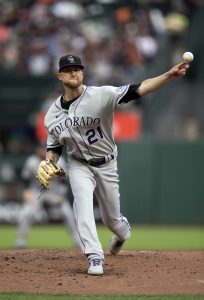
The deal evidently came together quickly, as Freeland told Nick Groke of the Athletic just last week there’d been “no movement” on an extension and that the club hadn’t put forth an offer. Within a few days, he and the team agreed to a long-term deal that figures to keep him around for at least an additional three seasons. It’s a particularly nice development for Freeland, a Denver native and career-long member of the organization.
Colorado selected Freeland with the eighth overall pick of the 2014 draft out of the University of Evansville. He was regarded at the time as a possible mid-rotation starter who could move through the minors quickly based on his polished strike-throwing ability. That projection more or less proved to be the case, as he was in the majors two and a half years later after performing well in the minors.
Freeland stepped immediately into the Colorado rotation, starting 28 of his 33 appearances as a rookie. He posted a 4.10 ERA in 156 innings that season, overcoming a mediocre 15.6% strikeout rate with an excellent 53.9% ground-ball percentage. The southpaw followed that up with a stellar sophomore campaign that has been the best season of his career to date. He made 33 starts and tossed 202 1/3 innings in 2017, posting a 2.85 ERA despite starting 15 games at the most hitter-friendly ballpark in the league. That mark still stands as the lowest single-season ERA for a qualified starter in Rockies’ history, offering plenty of evidence that Freeland could thrive despite the environmental challenges inherent for a Colorado pitcher.
Four years later, the Rox are presumably still placing a lot of emphasis on that showing. Freeland struggled mightily in 2019, allowing a 6.73 ERA. Colorado even optioned him to Triple-A Albuquerque for a month and a half that year. Over the past two seasons, he’s been solid but unspectacular, posting a matching 4.33 ERA in both 2020 and 2021.
Freeland’s general profile — few strikeouts or whiffs offset by plenty of grounders and plus control — hasn’t much changed throughout his time in the majors. Yet since his excellent 2018 showing, he owns a 5.32 ERA in 304 2/3 innings (including two starts thus far in 2022). Colorado surely considers the 2019 season an outlier, but even going back to the start of 2020, Freeland’s 200 1/3 innings of 4.58 ERA/4.65 FIP ball are more fine than exceptional.
The Rockies clearly believe the 28-year-old (29 next month) is capable of a return to something more closely approximating his early-career form. It’s the continuation of a pattern for general manager Bill Schmidt and his staff, who have worked diligently to keep many of the team’s veterans around for the long haul. Within the past eight months, Colorado has worked out multi-year extensions with Antonio Senzatela, Elias Díaz, C.J. Cron, Ryan McMahon and now Freeland. Those players join marquee free agent pickup Kris Bryant and staff ace Germán Márquez as the long-term core in Denver.
Márquez, Senzatela and Freeland are each under club control through at least 2024, leading a rotation the Rox envision as the backbone of the club. Senzatela’s October extension — a five-year, $50.5MM guarantee that contains a 2027 club option — is the most recent deal for a starter with between four and five years of service time. Freeland’s contract tops that of his teammate even though he’s nearly two years older and has been less effective over the past couple seasons. Freeland and Senzatela are similar pitchers stylistically, but the former has been a bit more home run prone and had an ERA about two tenths of a run higher (4.33 for Freeland, 4.11 for Senzatela) between 2020-21.
That’s not to say Senzatela fared poorly. His deal was generally regarded as a player-friendly pact at the time it was signed. Setting aside Jacob deGrom, the previous pitcher to sign an extension in that bucket was Cubs righty Kyle Hendricks. He signed a four-year, $55.5MM pact in March 2019. Like Freeland, Hendricks was headed into his age-29 season and thrived on his control and ground-ball propensity. The Cubs’ starter had posted five straight sub-4.00 ERA campaigns to open his big league career, though, making him a safer long-term bet than either of Colorado’s pitchers.
The Hendricks comparison makes the Rockies’ decision to commit $64.5MM to Freeland puzzling, although it’s not especially surprising. Colorado brass has shown repeatedly they value their own players more than many outside the organization might. While it has been some time since Freeland’s excellent first two seasons, he has shown himself capable of thriving despite the unique challenges the Rockies face at Coors Field. That’s no doubt of appeal to team brass, and the extension comes with the ancillary benefit of avoiding the hassle of an arbitration hearing.
Prior to today’s agreement, the team and player were set for a hearing next month to determine his 2022 salary. Freeland had filed at $7.8MM; the Rockies had countered at $6.425MM. They’ll settle a bit shy of the midpoint for this season and price in a raise for what would’ve been his final year of arbitration-eligibility before paying $15-16MM annually for what would’ve been his three free agent seasons.
The Rockies’ 2022 payroll isn’t much affected by today’s extension, but they’ll add another notable salary to the books for next season and beyond. Colorado’s 2023 player tab now checks in around $110MM, per Jason Martinez of Roster Resource, while Freeland ($15MM), Bryant ($28MM), McMahon ($12MM) and Senzatela ($12MM) all have notable 2024 salaries. Márquez has a $16MM club option that year. The Rockies have never eclipsed $150MM in Opening Day payroll, but they might be headed towards that mark in the next couple seasons. They’ll hope to build around the core in which they’ve invested in an ever-competitive NL West.
Jeff Passan of ESPN first reported the Rockies and Freeland had agreed to a five-year, $64.5MM deal, as well as the sixth-year option. Jon Heyman of the New York Post reported it was a $17MM vesting option, which Danielle Allentuck of the Colorado Springs Gazette reported Freeland needs 170 innings pitched in 2026 to trigger. Ken Rosenthal of the Athletic reported Freeland could opt out after 2024 with a top-five Cy Young finish in either of the next two seasons. Thomas Harding of MLB.com was first with the full breakdown of terms.
Image courtesy of USA Today Sports.
NL West Notes: Upton, D’backs, Freeland, Dodgers
The Diamondbacks have “considered” a reunion with Justin Upton, The New York Post’s Jon Heyman writes, though it isn’t yet clear what the 34-year-old outfielder is himself planning for his next step. Upton has given some thought to retiring altogether after the Angels released the veteran last week.
If Upton does continue his career, a return to the D’Backs would represent a nice full-circle moment. Arizona selected Upton with the first overall pick of the 2005 draft, and Upton spent his first six Major League seasons with the Diamondbacks. That tenure included two All-Star appearances for Upton and arguably the finest year of his entire career, as he hit .289/.369/.529 with 31 home runs in 2011 and finished fourth in NL MVP voting.
Upton has been roughly a replacement-level player over his last three seasons with the Angels, but since signing him would cost the Diamondbacks only a prorated minimum salary, it might be a worthwhile flier for a team that has gotten off to a brutal start at the plate. The right-handed hitting Upton represents some lineup balance since many of Arizona’s top outfield choices (David Peralta, Daulton Varsho, Pavin Smith, Jake McCarthy) are all left-handed, plus DH Seth Beer is also a lefty bat.
More from around the NL West…
- Kyle Freeland‘s arbitration hearing is set for May 24, and Freeland tells The Athletic’s Nick Groke that the Rockies hasn’t yet discussed a long-term extension. The left-hander is scheduled to reach free agency after the 2023 season, and while Freeland has battled his share of injuries and inconsistency, he has been a generally solid pitcher over his five-plus MLB seasons — a career 4.28 ERA and 48.7% grounder rate over 663 innings, all with Colorado. Rockies GM Bill Schmidt sounded open to the idea of eventually discussing an extension, saying “Nothing’s out of the question but we need to see what happens. We love [Freeland] and we hope he’s here for a long time.”
- Dodgers manager Dave Roberts updated reporters (including MLB.com’s Juan Toribio) on the health status of some injured pitchers. Tommy Kahnle may be the closest to a return, as after missing the entire 2021 season rehabbing from Tommy John surgery, Kahnle is on a rehab assignment in the minors and might be able to join the Dodgers before the end of April. Caleb Ferguson is also recovering from TJ surgery and is tentatively slated for a return in the middle of May, as Ferguson had some elbow soreness during Spring Training. Victor Gonzalez developed inflammation in his throwing elbow at the end of spring camp and has a tentative recovery timetable of 3-4 weeks.
West Notes: Angels, Detmers, Mariners, Lewis, Elias, Rockies, Freeland
Reid Detmers will open the season in the Angels six-man rotation, per Jeff Fletcher of the SoCal News group (via Twitter). Detmers made five starts in 2021 to mixed results, but the Angels have high hopes that the 22-year-old will develop into a rotation staple. For now, he’ll join Shohei Ohtani, Noah Syndergaard, Patrick Sandoval, Michael Lorenzen, and Jose Suarez in manager Joe Maddon’s rotation. There’s a fair amount of injury concern in the group, but it’s also one of the higher ceiling units the Angels have started with in the rotation during Maddon’s tenure. As with most seasons, the Angels hopes for contention will hinge largely on the success of this group. Elsewhere out west…
- Neither Kyle Lewis nor Roenis Elias will be ready to make the Mariners’ opening day roster, per Ryan Divish of the Seattle Times. Elias is coming back from Tommy John surgery, and he hasn’t appeared in a big league game since September of the 2019 season. As for Lewis, the Mariners are taking their time bringing back the 2019 Rookie of the Year. The next step for Lewis’ rehab will be to begin serving as the designated hitter in minor league games, notes Divish, with manager Scott Servais pegging Lewis’ return as being about a month behind the rest of the squad.
- Kyle Freeland will get the ball on opening day for the Rockies, per Danielle Allentuck of The Gazette. It will be his second time as the Rockies’ opening day starter, having done so in 2019 as well. No Rockies starter has ever made three opening day starts for the club. The 28-year-old has put together 191 1/3 innings of 4.33 ERA/4.64 FIP over the past two seasons after a disastrous 2019 campaign.
The Best Minor League Deals Of 2021 (So Far): Pitchers
We took a look last week at some of the minor league pacts that have paid the most dividends, focusing in on position players in both leagues. Unsurprisingly, given the lack of offense throughout baseball as a whole at the moment, there are even more success stories on the pitching side of the coin. Some of these are products of small sample size, particularly for the many relievers on the list, but at least for our initial check-in on this subject, the early returns have been strong.
- Ian Kennedy, RHP, Rangers: We’re nearing Memorial Day weekend, and Kennedy is tied for the American League lead in saves — just as everyone expected! The 36-year-old righty isn’t just scraping by and narrowly escaping in a bunch of three-run leads, though. He’s tallied 19 1/3 innings and allowed just four runs, all while recording a terrific 31.1 percent strikeout rate and a tiny 5.4 percent walk rate. If Texas remains near the bottom of the AL West standings, he’ll be an appealing trade target for bullpen-needy clubs.
- Drew Steckenrider, RHP, Mariners: A quality setup man with the 2017-18 Marlins, Steckenrider’s time in Miami was derailed by injuries — most notably a 2019 flexor strain. He looks to be back on track in his new surroundings, however, having tossed 18 1/3 innings of 2.45 ERA ball with a 29.2 percent strikeout rate and an 11.1 percent walk rate. The walks are a bit elevated, but he’s helped to combat that with a career-best 54 percent ground-ball mark. The Mariners (or another club) could control Steckenrider through 2023 via arbitration as well, which only adds to the value.
- Jimmy Nelson, RHP, Dodgers: The Dodgers just placed Nelson on the injured list due to a forearm issue, so there are (once again) some obvious health question marks with Nelson. There’s no ignoring how effective he’s been thus far, however. Nelson’s 39.1 percent strikeout rate is the ninth-best among all MLB relievers, and he’s paired that with a pristine 2.41 ERA. Like Shaw, he’s walked too many batters (13 percent), but the former Brewers ace has shown high-leverage, late-inning potential with L.A.
- Bryan Shaw, RHP, Indians: Shaw was an iron man in the Cleveland ‘pen but flopped in Colorado after signing a three-year, $27MM contract going into 2018. Back in his old stomping grounds, he’s tallied 19 innings with a pristine 1.42 ERA. The 33-year-old has issued 13 walks, so he’ll need to cut back on the free passes if he hopes to continue this success, but Shaw’s strikeout and ground-ball percentages are among the best of his career (29.3 percent, 57.5 percent, respectively).
- Lucas Luetge, LHP, Yankees: Luetge’s last MLB appearance prior to his Yankees debut came with the 2015 Mariners. The now-34-year-old southpaw signed minor league deals with five organizations before making it back to the show, which is remarkable in and of itself. That he’s been one of the Yankees’ best relievers, however, makes his story all the more incredible. Luetge, who entered 2021 with all of 89 MLB frames under his belt, has a 2.95 ERA and a 19-to-3 K/BB ratio in 21 1/3 innings for the Yankees thus far. Considering the injuries to Zack Britton and Darren O’Day, Luetge’s unexpected contributions have been a godsend. If he can keep this up, he’ll be arbitration-eligible this winter and controllable through the 2024 season.
- Hyeon-jong Yang, LHP, Rangers: Yang, a former KBO MVP, could’ve returned to that league on a guaranteed deal but refused to give up on his aspirations of playing in the Majors, even if it meant taking a non-guaranteed pact. He’s 21 1/3 innings into the realization of that lifelong goal, and the Rangers are no doubt pleased with their decision. Yang, 33, opened the season with the Rangers’ alternate site group but had his contract selected in late April. He now owns a 3.38 ERA, and while his pedestrian strikeout and walk rates might point to some possible regression, he’s induced plenty of weak contact (average 87.4 mph exit velocity, just a 13.1 percent line-drive rate). An 11.2 percent swinging-strike rate suggests there could be more K’s to come, as well.
- Chi Chi Gonzalez, RHP, Rockies: Gonzalez’s numbers don’t stand out that much, but he’s eating innings and delivering roughly league-average run-prevention numbers when adjusting for his home park (102 ERA+, 99 ERA-). Through nine appearances, seven of them starts, Gonzalez is carrying a 4.54 ERA. He’s totaled 41 2/3 innings for a Rockies club that has gone the whole season without lefty Kyle Freeland. Gonzalez has rattled off consecutive quality starts and helped the Rox get through the first two months of the season. The secondary marks aren’t great, but average innings have value — especially in 2021 when teams are so conscientious about their pitchers’ workloads.
- Nabil Crismatt, RHP, Padres: Crismatt had just 8 1/3 innings of MLB experience (all with the 2020 Cardinals) when he arrived in Padres camp this spring. He’s more than doubled that total in 2021 already, pitching 17 2/3 innings of 2.55 ERA ball with a hefty 52.2 percent grounder rate. Crismatt is an oddity in today’s game, sitting under 89 mph with a fastball that is only seldom used due to the fact that he throws his changeup at a whopping 46.5 percent clip. It’s weird, but so far — it’s worked.
- Anthony Bender, RHP, Marlins: A 26-year-old rookie who never pitched above Double-A with the Royals or Brewers before joining the Marlins on a minor league deal this winter, Bender is sitting 97.4 mph with his heater and has tossed 8 2/3 shutout innings to open his career. He’s whiffed 36.7 percent of his opponents against a 3.3 percent walk rate. Small sample? Sure, but Bender also rattled off 8 1/3 shutout frames during Spring Training, too. Not bad for a guy who posted a 5.48 ERA with the independent American Association’s Milwaukee Milkmen in 2020.
- Heath Hembree, RHP, Reds: After a rough 2020 season, Hembree has bounced back early in 2021. His 4.15 ERA through 13 frames is nothing special, but his strikeout rate is sitting at a career-high 33.3 percent after plummeting in 2020. His 6.3 percent walk rate is a career-best, and his 13.1 percent swinging-strike rate isn’t far off from his peak years in Boston. Hembree’s velocity is also up to 95.2 mph after dipping to 93.9 mph in 2019-20. It’s early, but those are some encouraging indicators.
- Zack Littell, RHP, Giants: Littell hasn’t spent much time with the Giants yet, but he’s chucked 10 2/3 innings and held opponents to just one run on eight hits and three walks with nine punchouts. His 94.8 mph average fastball velocity is a career-high, as is his 48.3 percent grounder rate. The former Twins righty only has a year of big league service and could be controllable for several years if he figures it out in San Francisco.
- Deolis Guerra, RHP, Athletics: It’s hard to believe Guerra just turned 32, given that he was one of the pieces traded from the Mets to the Twins way back in 2008’s Johan Santana trade. He’s bounced around the league in journeyman style but is enjoying a nice run with the A’s to kick off the ’21 season. In 20 2/3 frames, Guerra has a 3.92 ERA with a pedestrian K-BB% but intriguing levels of weak contact induced.
- JT Chargois, RHP, Mariners: Like Littell, Chargois hasn’t seen much time in the bigs yet, but he’s sporting a 9-to-1 K/BB ratio in 8 2/3 innings for Seattle. He’s had multiple chances with the Twins and Dodgers in recent years but never found much consistency. Chargois also mustered only a 5.81 ERA pitching for Japan’s Rakuten Golden Eagles in 2020. Still, it’s a nice start to his 2021 season.
- Brad Boxberger, RHP, Brewers: The right-hander, who’ll turn 33 this week, has hurled 17 1/3 innings so far in Milwaukee and pitched to a 4.15 ERA but with a more impressive 17-to-3 K/BB mark. As with many relievers early in a given season, the bulk of the damage against Boxberger came in one appearance (against the Cardinals). He’s been unscored upon in 16 of his 19 outings so far in 2021.
- Ervin Santana, RHP, Royals: The Royals love their reunions more than any team in baseball, and Santana is somewhat improbably back to “smelling baseball,” as he likes to say, for a second stint in Kansas City. He’s only allowed four runs in 15 1/3 innings (2.35 ERA), but he’s also only picked up eight strikeouts against four walks. His fastball is sitting 93 mph again after living at 89-90 in 2018-19, but the red flags are plentiful: 13.1 percent strikeout rate, 91 percent strand rate, .213 BABIP, 45 percent opponents’ hard-hit rate.
- Paolo Espino, RHP, Nationals: The Nats quietly re-signed the now 34-year-old Espino before the calendar even flipped to November last year. So far, it’s been a worthwhile reunion, as he’s held opponents to four runs on nine hits and a walk with eight strikeouts in 14 innings (2.57 ERA). Espino won’t keep this up if he can’t miss some more bats and/or induce far more grounders, however. He’s currently benefiting from a .175 BABIP and an 83.3 percent strand rate, while his 26.6 percent grounder rate will make it to limit home runs. Still, the Nats have 14 innings of decent results to show for the deal.
As with the position players, some of these strong starts will fade. There are a few at the back of the list that look particularly difficult to sustain, but there also look to be some genuine bargains unearthed among this group. Some will likely result in trades (Kennedy), but it’d make for a fun story to follow should any of the controllable arms (e.g. Bender, Crismatt) ultimately emerge as long-term pieces for the clubs who gave them their best career opportunities to date.
Rockies To Activate Antonio Senzatela From Injured List
The Rockies are planning to reinstate Antonio Senzatela from the injured list, manager Bud Black told reporters (including Thomas Harding of MLB.com) yesterday. The righty will start this evening’s game against the Padres.
Senzatela went on the IL May 1 with a right groin strain, so he’ll return after spending the minimum ten days on the shelf. He has managed only a 5.76 ERA/4.67 SIERA over his first six starts. The 26-year-old throws a lot of strikes and induces plenty of ground balls, but he’s one of the league’s worst at missing bats. Senzatela’s 13.1% strikeout rate ranks 131st out of 136 starters with at least 20 innings pitched this season.
Black also provided updates on a handful of other health situations involving the club (via Harding). Lefty Kyle Freeland, a longtime rotation fixture, hasn’t pitched this season after suffering a shoulder strain in March. He’s scheduled to throw four exhibition innings at the team’s Spring Training facility in Arizona this week, but a timeline for his return to the majors is still unclear. Infielder Brendan Rodgers will join Freeland in Scottsdale as he rehabs from a left hamstring strain. Colorado’s presumptive regular second baseman, Rodgers has also yet to make his regular season debut after going down in March.
First baseman C.J. Cron has missed the past three games because of lower back soreness. Black told Harding the club is still evaluating whether he’ll need a stint on the injured list. Signed to a minor-league deal over the winter, Cron has emerged as the Rockies’ most productive hitter in the early going. He’s off to a .290/.394/.495 start with five homers over 109 plate appearances. As a low-cost impending free agent on a 12-22 team, Cron will be one of the sport’s most obvious summer trade candidates if he continues to mash. The Rockies have turned to Matt Adams and Connor Joe with Cron unavailable the past few days.
Injury Notes: Jays, Fried, Astros, Freeland
A few health updates from around the game…
- Center fielder George Springer‘s Blue Jays debut is on hold yet again. As of Sunday, manager Charlie Montoyo was optimistic Springer would debut tonight, but that wasn’t the case. Springer is “not ready yet,” Montoyo said (Twitter links via Ben Nicholson-Smith of Sportsnet), though he did take batting practice and run the bases on Tuesday. Montoyo added that “[Springer] feels great except the running.” The former Astro has been trying to work back since suffering a right quad strain three weeks ago. In better news for the Blue Jays, ace Hyun Jin Ryu is recovering well from the right glute strain he incurred Sunday and shouldn’t miss a start, Nicholson-Smith relays.
- The Braves are “likely” to activate left-hander Max Fried from the 10-day injured list next Tuesday or Wednesday, Mark Bowman of MLB.com tweets. If true, it’ll go down as roughly a three-week stay on the IL for Fried, who suffered a right hamstring strain during his most recent start on April 13. Once he returns, the 2020 NL Cy Young contender will try to rebound from a ghastly three-start, 11-inning stretch in which hitters victimized him for 15 runs (14 earned) on 23 hits and five walks.
- Tuesday brought some positive and negative health-related developments for the Astros’ pitching staff. The good news: Southpaw Framber Valdez is making tremendous progress from a left ring finger injury and could rejoin their rotation sometime in June, Jake Kaplan of The Athletic relays. Valdez turned in a stellar performance in 2020, but he hasn’t gotten a chance to follow up on it this year. As for the bad news, righty reliever Pedro Baez has halted his throwing program on account of lingering shoulder soreness. The Astros transferred Baez from the 10-day injured list to the 60-day IL on Monday, meaning he won’t make his first appearance with the club until June 9 at the earliest. Houston signed the former Dodger to a two-year, $12.5MM guarantee over the winter.
- Rockies lefty Kyle Freeland said Tuesday that he will “absolutely” pitch in the majors this season, per Patrick Saunders of the Denver Post (Twitter links). Freeland, a little over a month removed from suffering a strained pitching shoulder, had an “outstanding” bullpen session on Tuesday and could throw a sim game next week, according to manager Bud Black. However, there’s still no clear timetable for a potential 2021 debut for Freeland, who finished third on the Rockies in innings (70 2/3) and recorded a 4.33 ERA/4.95 SIERA with a 51.5 percent groundball rate last season.
NL West Injury Notes: Dodgers, Rockies, Giants
Brusdar Graterol‘s placement on the 60-day injured list was either a procedural move or incorrect, depending on who you ask, but the Dodgers‘ right-hander does plan on returning to the field in less than 60 days. His delayed debut this season is “related to COVID from the past,” per Jorge Castillo of the LA Times. It’s a peculiar situation surrounding the flame-throwing Venezuelan. He’s not hurt, simply behind. He didn’t begin throwing this spring until late in March, and he’s still working himself into game shape. Let’s make the rounds to see how other arms are progressing out west…
- Kyle Freeland is working his way back from a shoulder injury suffered near the end of spring training, and there’s no timetable for his return. That said, he does appear to be making progress, per Patrick Saunders of the Denver Post. Specifics remain scarce, but the presumption seems to be that Freeland’s injury won’t threaten his season. The Rockies are able to start the season with a four man rotation, but they’ll soon need to add another arm to the mix beyond German Marquez, Antonio Senzatela, Jon Gray, and Austin Gomber. Newly-signed Jhoulys Chacin could be a candidate for bulk innings. Keep an eye on Antonio Santos in the long-term. The 24-year-old righty made his debut last season after just eight starts in Double-A. He may not be the first name called this season, but he’s likely to find his way back to the Majors at some point in 2021.
- The Giants released a number of injury updates, per MLB.com’s Maria I. Guardado (via Twitter). Jaylin Davis will be out for four to six weeks as he rehabs left knee tendinitis. John Brebbia and Tyler Beede are both throwing twice-weekly bullpens as they prepare to come back from Tommy John surgery. Dedniel Nunez underwent his own Tommy John surgery this past Tuesday, and he will begin his rehab process this week. Lastly, Alex Wood threw a sim game as he tries to return from a lower back strain. Wood was expected to play a big role in the Giants rotation picture this season, and they still hope that’s the case.
Kyle Freeland Suffers Shoulder Strain
March 25: Freeland will not require surgery, manager Bud Black announced Thursday, calling the initial reports from the team’s medical staff “encouraging” (link via Saunders). That said, Black also declined to provide a timeline, revealing only that Freeland will have more imaging performed “in a couple of weeks,” at which point the Rockies hope to be able to offer a more definitive timeline. Freeland will open the season on the injured list.
March 23: Rockies left-hander Kyle Freeland exited his outing against the Athletics on Tuesday with a strained pitching shoulder, per Patrick Saunders of the Denver Post. Freeland left the mound in pain after throwing a pitch to the A’s Mark Canha, as Thomas Harding of MLB.com tweets.
There is no word on how serious Freeland’s injury is, but it does look like one that could sideline him for at least the beginning of the regular season. A healthy Freeland would follow No. 1 starter German Marquez in the Rockies’ rotation, having thrown 70 2/3 innings of 4.33 ERA/4.95 SIERA ball last year. Those aren’t great numbers – especially compared to a 2018 effort in which Freeland put up a 2.85 ERA/4.35 SIERA in 202 1/3 innings and finished fourth in National League Cy Young voting – but they were markedly better than the 6.73 ERA/5.19 SIERA he recorded over 104 1/3 frames in 2019. The 27-year-old has followed last season’s bounce-back performance with seven scoreless innings and six strikeouts against one walk this spring.
If Freeland isn’t available to start the season, the Rockies will open with Marquez, Jon Gray, Austin Gomber and Antonio Senzatela as their top four. Ryan Castellani, Antonio Santos and Jose Mujica are also on their 40-man roster, but Dereck Rodriguez and Chi Chi Gonzalez are in the mix as NRIs.
West Notes: Rockies, Freeland, Angels, Suzuki, Ohtani
Denver native Kyle Freeland was a revelation for the Rockies in his sophomore season, posting a 2.85 ERA/3.67 FIP over 202 1/3 innings. Two years later, however, and the Rockies have yet to discuss an extension with their homegrown star, writes the Athletic’s Nick Groke. Freeland’s 2018 was an almost as a magical affair, so starved is the Rockies franchise for a cornerstone rotation piece. The bubble burst in 2019, of course, as his run prevention numbers ballooned to a 6.73 ERA/5.99 FIP. He found a middle ground over 70 2/3 innings in 2020, logging a 4.33 ERA/4.65 FIP with a 15.1 percent strikeout rate, 7.6 percent walk rate, and 51.5 percent groundball rate. Freeland agreed to a $5.025MM deal for 2021 on Friday, and he has two more seasons of arbitration before reaching free agency. Given the range of outcomes Freeland has already seen across four seasons, he’s likely to go year-to-year until reaching free agency after 2023. Let’s stay out west and check in with the Angels…
- Kurt Suzuki had offers for more money, but he signed with the Angels for $1.5MM, per the Athletic’s Fabian Ardaya (via Twitter). Suzuki was with the Braves when Angels’ GM Perry Minasian was an executive there, which certainly could have helped smooth negotiations. But Suzuki’s ties to California don’t end there. Had Suzuki any reservations, he surely could have reached out to Anthony Rendon, who bonded with Suzuki’s son while the two were teammates in Washington, writes Robert Collias of The Maui News. Not to mention, Suzuki’s a native of Hawaii, he won a College World Series playing for Cal State Fullerton, and he began his career playing in the bay for the A’s. At 37-years-old, Suzuki’s not going to be a 130-start catcher, and injuries have hampered his ability to control the run game, but he’s been an above-average bat by measure of wRC+ in each of the last four seasons. Not to mention, having been the trusted receiver of Max Scherzer and Anibal Sanchez the past two seasons, Suzuki no doubt has plenty of sage advice to impart to the Angels’ less experiences backstops about how to manage a ballgame.
- The Angels came to terms with five of their six arbitration-eligible players before yesterday’s filing deadline, but they’re heading to a hearing with star two-way player Shohei Ohtani. As if arbitration hearings aren’t complicated enough, Ohtani’s two-way abilities coupled with his injury history make him a particularly thorny case. Ohtani requested a $3.3MM salary, while the Angels countered at $2.5MM, per Jeff Fletcher of the Orange County Register. New GM Perry Minasian says the Angels will be a “file-and-go” team, also known as “file-and-trial,” meaning they don’t plan to continue negotiations after the filing deadline. Of course, even teams with this philosophy occasionally reach an agreement between the filing date and hearing.
Players Avoiding Arbitration: 1/15/21
The deadline to exchange arbitration figures is today at 1pm ET. As of this morning, there were 125 arbitration-eligible players who’d yet to agree to terms on their contract for the upcoming 2021 season. Arbitration is muddier than ever before thanks to the shortened 2020 schedule, which most believe will lead to record number of arb hearings this winter. Be that as it may, it’s still reasonable to expect dozens of contractual agreements to filter in over the next couple of hours.
We’ll highlight some of the more high-profile cases in separate posts with more in-depth breakdowns, but the majority of today’s dealings will be smaller-scale increases that don’t radically alter a team’s payroll or a player’s trade candidacy. As such, we’ll just run through most of today’s agreements in this post.
I’ve embedded MLBTR’s 2021 Arbitration Tracker in the post (those in the mobile app or viewing on mobile web will want to turn their phones sideways). Our tracker can be sorted by team, by service time and/or by Super Two status, allowing users to check the status on whichever groups of players they like. You can also check out Matt Swartz’s projected arbitration salaries for this year’s class, and we’ll do a quick sentence on each player’s agreement at the bottom of this post as well, with the most recent agreements sitting atop the list.
Today’s Agreements (chronologically, newest to oldest)
- Rockies outfielder Raimel Tapia avoided arbitration with a $1.95MM deal, Jon Heyman of MLB Network tweets. The team also reached an agreement for $805K with reliever Robert Stephenson, per Joel Sherman of the New York Post.
- The Tigers have deals with infielder Jeimer Candelario ($2.85MM), outfielder JaCoby Jones ($2.65MM) and righty Jose Cisnero ($970K), Chris McCosky of the Detroit News relays.
- The Yankees and reliever Chad Green settled for $2.15MM, Mark Feinsand of MLB.com reports.
- The Marlins and lefty Richard Bleier have a deal for $1.425MM, Mark Feinsand of MLB.com tweets.
- The Dodgers reached a $3.6MM settlement with lefty Julio Urias, Jorge Castillo of the Los Angeles Times reports.
- The Angels announced a deal with righty Dylan Bundy for $8.325MM.
- The Tigers and southpaw Matthew Boyd have settled for $6.5MM, Chris McCosky of the Detroit News tweets.
- The Yankees have deals with catcher Gary Sanchez ($6.35MM), first baseman Luke Voit ($4.7MM), third baseman Gio Urshela ($4.65MM), shortstop Gleyber Torres ($4MM) and outfielder Clint Frazier ($2.1MM), per Jon Heyman of MLB Network and Ken Davidoff of the New York Post.
- The Rays and outfielder Manuel Margot avoided arbitration with a $3.4MM agreement, per Marc Topkin of the Tampa Bay Times.
- The Padres and outfielder Tommy Pham have a deal for $8.9MM, according to Robert Murray of FanSided. Reliever Dan Altavilla settled for $850K, AJ Cassavell of MLB.com tweets.
- The Angels and righty Felix Pena have come to terms for $1.1MM, Maria Torres of the Los Angeles Times reports.
- The Red Sox and third baseman Rafael Devers have reached a $4.575MM agreement, per Jon Heyman of MLB Network.
- The Mets and outfielder Brandon Nimmo have come to a $4.7MM agreement, Anthony DiComo of MLB.com tweets.
- The Reds and righty Luis Castillo have settled for $4.2MM, Robert Murray of FanSided relays.
- The Rays reached a $2.25MM agreement with infielder Joey Wendle and a $1.175MM settlement with righty Yonny Chirinos, Marc Topkin of the Tampa Bay Times tweets.
- The Cardinals and flamethrowing reliever Jordan Hicks have an agreement for $862,500, according to Heyman.
- The White Sox and ace Lucas Giolito avoided arbitration with a $4.15MM agreement, James Fegan of The Athletic reports.
- The Pirates and righty Joe Musgrove have reached an agreement for $4.45MM, Jon Heyman of MLB Network tweets. They also made deals with second/baseman outfielder Adam Frazier ($4.3MM), third baseman Colin Moran ($2.8MM) righty Chad Kuhl ($2.13MM) and lefty Steven Brault ($2.05MM), per reports from Jason Mackey of the Pittsburgh Post-Gazette and Adam Berry of MLB.com.
- Hard-throwing right-hander Reyes Moronta agreed to a $695K deal with the Giants after missing the 2020 season due to shoulder surgery, tweets Robert Murray of Fansided.
- The Tigers agreed to a $2.1MM deal with infielder Niko Goodrum, tweets Robert Murray of Fansided. They also inked lefty Daniel Norris for a $3.475MM salary, tweets Evan Petzold of the Detroit Free Press.
- The Pirates agreed to a $1.3MM deal with catcher Jacob Stallings and a $1.1MM deal with righty Chris Stratton, per Robert Murray of Fansided (Twitter links).
- Athletics right-hander Lou Trivino agreed to a $912,500 salary for the 2021 season, tweets Robert Murray of Fansided.
- Right-hander Richard Rodriguez and the Pirates agreed to a $1.7MM deal, tweets Jason Mackey of the Pittsburgh Post-Gazette.
- Catcher Jorge Alfaro and the Marlins agreed to a $2.05MM deal, tweets Craig Mish of SportsGrid.
- The Reds agreed to a $2.2MM deal with right-hander Tyler Mahle, tweets Fansided’s Robert Murray. Cincinnati also signed lefty Amir Garrett for $1.5MM, tweets Mark Feinsand of MLB.com.
- The Indians agreed to a $2.4MM deal with newly acquired shortstop Amed Rosario and a $975K deal with righty Phil Maton, tweets Zack Meisel of The Athletic.
- The Tigers and righty Buck Farmer settled at $1.85MM, tweets Evan Petzold of the Detroit Free Press.
- The Marlins agreed to a $1.9MM deal with right-handed reliever Yimi Garcia, tweets MLB Network’s Jon Heyman.