
Previewing Upcoming Qualifying Offer Decisions
The World Series concludes this weekend, and the offseason gets underway almost immediately thereafter. Teams and players have to decide whether to exercise contractual options within five days of the Series ending, while clubs also must determine whether to issue their impending free agents a qualifying offer before free agency officially opens. MLBTR’s Mark Polishuk took a preliminary look at the qualifying offer class in August (position players/pitchers).
With another few months of play in the books, we’ll take a final run at previewing the class. As a refresher, the qualifying offer is a one-year offer that’s calculated by averaging the salaries of the 125 highest-paid players in the majors in a given season. That value has been set at $19.65MM for this offseason. If a player rejects the offer, he sets out into free agency. The player’s previous team would receive draft pick compensation if he signs elsewhere, while a team that signs another club’s qualified free agent would forfeit a draft choice (or choices) and possibly international signing bonus space.
Draft pick compensation and forfeiture differs depending on a team’s revenue sharing status and whether they exceeded the luxury tax threshold this year. MLBTR’s Tim Dierkes looked yesterday at what picks each team would lose were they to sign a qualified free agent; conversely, Mark Polishuk covered the draft pick compensation clubs would land if one of their qualified free agents departed.
Locks
- Chris Bassitt (Mets)
- Xander Bogaerts (Red Sox)
- Willson Contreras (Cubs)
- Jacob deGrom (Mets)
- Edwin Díaz (Mets)
- Aaron Judge (Yankees)
- Brandon Nimmo (Mets)
- Carlos Rodón (Giants)
- Dansby Swanson (Braves)
- Trea Turner (Dodgers)
There’s not a whole lot to say about this group. These are 10 of the best impending free agents. Bogaerts, deGrom, Judge, Rodón, Swanson and Turner are all going to top nine figures. Díaz, Nimmo and maybe Contreras could get to $100MM. Bassitt doesn’t have quite that earning power, since he’ll turn 34 in February. That caps the length of the contract he can expect, but the veteran righty is arguably the fourth-best starting pitcher on the market. He’s likely to land an annual salary similar to the value of the QO over a multi-year term.
Possible Candidates
- Tyler Anderson (Dodgers)
A stable back-of-the-rotation strike-thrower, Anderson inked an $8MM guarantee with the Dodgers last year. The veteran southpaw responded with a career season, posting a sparkling 2.57 ERA across 178 2/3 innings. He walked fewer than 5% of opposing hitters and averaged almost six innings per appearance, an incredible source of stability in a rotation that dealt with a fair share of injuries.
Headed into his age-33 season, Anderson is now in position for easily the best payday of his career. The question is whether that might come in the form of the QO. The Dodgers certainly have the budget for an investment of that size, and they’re never shy about stockpiling pitching depth. Yet it’s fair to wonder whether Anderson projects markedly differently than he did last winter when he was coming off a combined 4.49 ERA from 2020-21. He benefited from a career-low .256 batting average on balls in play this year, and his 19.5% strikeout rate is a near-match for his 2021 mark. His fastball still averages under 91 MPH, and while he turned to his changeup more often this past season than he has previously, he didn’t dramatically overhaul his repertoire. Anderson’s a solid pitcher with a knack for getting opponents to chase and make weak contact, but he doesn’t brandish the kind of power arsenal that’d immediately endear him to teams.
- Nathan Eovaldi (Red Sox)
Eovaldi is wrapping up a four-year deal he signed with the Red Sox on the heels of his incredible 2018 postseason. The right-hander had a tough 2019 season but has followed up with three generally solid years since then. Eovaldi has posted an ERA between 3.72 and 3.87 since 2020, consistent mid-rotation production. That’s in line with what he’s done for much of his career.
Despite possessing big velocity, Eovaldi’s more of a control artist than a bat-missing weapon at the top of the starting staff. He’s incredibly walked less than 5% of opposing hitters in each of the last three years, with a cumulative 4.4% mark that’s the second-lowest among 94 pitchers with 250+ innings over that stretch. He posts above-average swinging strike rates but not elite numbers in that regard, and he tends to give up a fair number of home runs.
One can argue Eovaldi’s the fourth or fifth-best free agent starter available, although he spent time on the injured list this year with separate back and shoulder concerns en route to just 109 1/3 innings. His typical 97+ MPH heater sat at a slightly diminished (but still strong) 95.7 MPH this year. Eovaldi has two Tommy John surgeries on his ledger and has some durability question marks, but a strong one-year risk could be palatable for a big-spending team that has virtually no certainty in the rotation. At the same time, the Sox would receive only a compensatory pick after the fourth round if he rejects a QO and departs, thanks to their paying the luxury tax in 2022. That’s of marginal value, so Boston’s only really incentivized to make a QO if they hope he accepts.
- Mitch Haniger (Mariners)
Despite playing his home games in one of the league’s more pitcher-friendly environments, Haniger popped 39 home runs in 2021. That was a career-best power spike, but it demonstrated the kind of offensive potential he has when healthy. The right-handed slugger posted well above-average hitting marks in 2017-18 before an average ’19 campaign and a 2020 season wiped out by injury. His 2022 showing was more in the latter bucket, as he lost a chunk of the summer to a high ankle sprain and posted a .246/.308/.429 line in 247 trips to the plate.
Haniger’s a middle-of-the-order caliber bat who plays an adequate corner outfield, and he should find a multi-year deal going into his age-32 campaign if the Mariners don’t make him a QO. On the heels of this platform season, he’d have to seriously consider accepting the QO if offered. Seattle has a fair bit of near-term financial flexibility to make that bet, but they also have a number of in-house outfielders who can step in more affordably if Haniger walks.
- Andrew Heaney (Dodgers)
The Dodgers rolled the dice on Heaney after a home run-filled 2021 season, signing him for $8.5MM. The southpaw didn’t provide much volume, missing extended stretches of the year fighting shoulder discomfort. When he was healthy enough to take the mound, the 31-year-old was brilliant. Heaney posted a 3.10 ERA and struck out an incredible 35.5% of opposing hitters through 72 2/3 innings. He got a swinging strike on a whopping 16.8% of his offerings, the highest rate of any pitcher with 70+ innings pitched. Heaney put up ace-caliber numbers when he took the hill, but he pitched less than half the season and is only a year removed from a 5.83 ERA over 30 outings with the Angels and Yankees.
Unlike a few other pitchers on this list, one can easily point to a huge change with Heaney that could’ve spurred his breakout. He started throwing a slider for the first time since 2017, turning to it as his go-to secondary offering while ditching his curveball and scaling way back on his changeup usage. The new breaking ball was fantastic, holding opponents to a .170 batting average with one of the highest whiff rates in the league.
That leads to a tough decision for L.A. The Dodgers have shown as much willingness as any team to take short-term risks on high-upside players, including Heaney himself last winter. There’s a difference between an $8.5MM gamble and one pushing $20MM, but he could be next in the line of Kevin Gausman and Carlos Rodón breakout types if he can stay healthy.
- Martín Pérez (Rangers)
A former top prospect, Pérez has bounced around the league but consistently put up below-average results after some early-career success. He returned to his original organization last offseason, inking a $4MM deal with the Rangers after a pair of rough seasons in Boston. That proved to be one of the better buy-low moves of the winter, as Pérez made 32 starts and soaked up 196 1/3 innings. He posted a 2.89 ERA, a top 25 mark among hurlers with 100+ innings. Despite pitching in the majors for over a decade, he’s only entering his age-32 season.
If the Rangers are confident Pérez can come close to replicating his 2022 production, then a QO would be an easy call. Yet it’s fair to wonder how sustainable the southpaw’s success is. He posted an ERA north of 4.00 every year between 2014-21. He didn’t experience any kind of velocity bump, nor did his strikeout and walk profile change. Pérez only punched out 20.6% of opponents on a meager 8.4% swinging strike rate. He did induce ground-balls at a quality 51.4% clip, but he’s previously posted strong grounder rates without finding much success keeping runs off the board. Pérez made some small tweaks to his repertoire, using his sinker more against right-handed batters while leaning a bit more heavily on his cutter against lefties. Without a massive overhaul or velocity spike, though, it’s hard to know how much of his improved results truly represent a step forward.
- Anthony Rizzo (Yankees)
Rizzo inked a two-year, $32MM guarantee to return to the Yankees in Spring Training. The deal allowed him to opt out of the final $16MM after this season, and the first baseman now looks as if he’ll do so. After a couple fine but unspectacular years, Rizzo bounced back with a 32-homer showing for the first time since 2017. He only hit .224, but that’s largely due to a career-worst .216 batting average on balls in play. Few hitters in baseball were shifted against more often, and the upcoming limitations on shifting should help him find a few more base knocks. Even if the shift ban doesn’t lead to a jump in performance, his .224/.338/.480 mark through 548 plate appearances checked in 32 points above the league average by measure of wRC+.
Heading into his age-33 campaign, Rizzo’s likely limited to two or maybe three-year offers. Those should be at annual rates at least approaching the value of the qualifying offer. It seems unlikely Rizzo would accept a QO. After all, in order to be eligible for the qualifying offer, he’d first have to decline a $16MM salary for next year. Perhaps he’d be content to take the accompanying $3.65MM pay bump before re-testing free agency after 2023, but he’d presumably prefer a new multi-year arrangement. Even if he does accept the QO, the Yankees could find that a reasonable investment, as Rizzo’s high-contact lefty bat plays well in their ballpark and in a lineup that otherwise skews toward the right side.
- Jameson Taillon (Yankees)
Taillon has spent the past two years in the Bronx after coming over from the Pirates via trade. New York rolled the dice at the time, surrendering a few solid prospects for a pitcher who’d missed the 2020 season after undergoing the second Tommy John surgery of his career. Taillon rewarded their faith, posting the #3/4 starter-type numbers he had throughout his time in Pittsburgh. Over the past two years, the right-hander owns a 4.08 ERA through 61 starts in a hitter-friendly environment. He’s punched out a slightly below-average 21.9% of opponents but only walked 5.7% of batters faced, holding the opposition to a .242/.290/.426 line.
Heading into his age-31 season, Taillon is one of the better options in a class full of mid-rotation starters. He averages around 94 MPH with his fastball, throws plenty of strikes and has flashed the ability to both miss bats and keep the ball on the ground at times in his career. Taillon never became the ace some may have expected when he was drafted second overall back in 2010, but he’s a rock-solid league average starter. Clubs may have some trepidation long-term about the two Tommy John procedures in his past, but the only injured list stint he’s required in the last two years was a two-week absence in September 2021 for an ankle issue. The Yankees do have a number of rotation options, but there’s enough uncertainty with players like Luis Severino, Domingo Germán and Clarke Schmidt they’d seem content to welcome Taillon back if he accepts the QO.
- Taijuan Walker (Mets)
Walker’s going to decline a $6MM player option in favor of a $3MM buyout, leaving the Mets to decide whether to follow up with a QO. Signed over the 2020-21 offseason, the right-hander had a somewhat disappointing first season in Queens, posting a 4.47 ERA. He rebounded with a strong 3.49 mark in 157 1/3 innings this past season, taking the ball 29 times despite a minor early-season IL stint due to shoulder bursitis. He didn’t overpower opponents, striking out a slightly below-average 20.3% of batters faced, but he consistently threw strikes and got ground-balls at an above-average 46.2% clip.
Heading into his age-30 season, Walker looks the part of a useful mid-rotation starter. He battled some injury issues early in his career but has mostly been healthy the last two years. He averages a bit under 94 MPH on his fastball, is effective against hitters from both sides of the plate and is coming off arguably the best season of his career. Walker gives up a decent amount of hard contact, but that’s perhaps not as concerning for a Mets team that plays its home games in a pitcher-friendly ballpark as it would be to some other clubs. The Mets have a number of impending free agents in the rotation and as high a spending ceiling as any team in the game, so they could be content to absorb a heavy one-year salary for Walker.
Longshots
- Mike Clevinger (Padres)
Entering the season, Clevinger looked like one of the higher-upside options in the class. He was coming off a 2021 campaign lost to Tommy John surgery, but he’d been excellent for the Indians and Padres from 2017-20. This year didn’t go well, though. Clevinger’s stuff was notably down from his pre-surgery form, and his results were below-average across the board. He finished the season with two abysmal playoff starts, and the Padres are probably content to let him sign elsewhere.
- Zach Eflin (Phillies)
Eflin had a solid case for a three-year deal midway through the first half. The typically effective right-hander then lost two months with a right knee injury, an unfortunate continuation of knee troubles that have plagued him since before he began his career. Eflin has undergone multiple knee surgeries in the past, and while he didn’t need to go under the knife this year, the absence kept him to working in shorter stints out of the bullpen for the stretch run and the playoffs. Coming off that platform season, it’s hard to see the Phillies offering a salary approaching $20MM.
- Clayton Kershaw (Dodgers)
Kershaw’s an easy QO candidate in a vacuum. He’s still one of the game’s best pitchers on a rate basis, and a $19.65MM salary is a bargain for even the 126 1/3 innings of 2.28 ERA ball he gave the Dodgers this past season. Yet that was also true last winter, when the future Hall of Famer was coming off a 3.55 mark across 121 2/3 frames. The Dodgers opted against a QO — not because they were against guaranteeing him a lofty one-year salary, but because they wanted to give Kershaw more than the 10 days allotted to QO recipients to determine his next steps, as president of baseball operations Andrew Friedman later explained. Friedman has already implied they’ll do the same this winter.
- Sean Manaea (Padres)
San Diego acquired Manaea from the A’s in Spring Training, hoping to solidify an already strong rotation with a durable source of mid-rotation innings. The southpaw mostly delivered on that for the first half, posting a 4.11 ERA through the All-Star Break. His final couple months were a disaster, though. Manaea was barraged for a 6.44 ERA in the second half, coughing up 15 homers along the way. The Friars gave him just one postseason start, and he failed to make it out of the second inning while giving up five runs in a loss to the Phillies. Before these past few months, Manaea had a consistently solid track record, and his 2022 strikeout and walk rates are in line with his career marks. He should be a popular bounceback candidate in free agency, but as with Clevinger, it feels like the Padres are set to move on.
- Jurickson Profar (Padres)
Profar can opt out of the final year and $7.5MM on his deal with San Diego. He’ll do so and beat that modest figure on the heels of a useful .243/.331/.391 showing over 658 plate appearances. Profar has put up slightly above-average offensive numbers in two of the past three seasons, but he’s now limited to left field after throwing issues pushed him off second base. Without much defensive value or a carrying tool at the plate, he’s not going to command a salary approaching the value of the QO in free agency.
- Ross Stripling (Blue Jays)
Stripling had a strong 2022 season as a swing option for the Blue Jays. He started 24 of 32 appearances, tallying 134 1/3 innings of 3.01 ERA ball. The veteran righty doesn’t throw particularly hard, but he missed bats on a decent 11% of his offerings and only walked 3.7% of opponents. Stripling proved a surprisingly key piece of the Jays starting staff, but he’s headed into his age-33 season and had a ghastly 5.14 ERA from 2020-21. Toronto could well look to bring him back, but his career track record doesn’t support a salary in the QO range.
- Michael Wacha (Red Sox)
Wacha put up a 3.32 ERA across 127 1/3 innings for the Red Sox this year, making good after inking a $7MM free agent guarantee. The righty didn’t dramatically overhaul his approach, though, posting lower strikeout and swinging strike numbers than he did during 2020-21 campaigns in which he combined for a 5.39 ERA over 37 outings. Wacha’s a solid strike-thrower and has given himself a shot at a multi-year deal, but it wasn’t the kind of resounding breakout that should position him for a salary pushing $20MM. Even for a Red Sox team that needs to overhaul its rotation, that’d be an eyebrow-raising investment, and it’s hard to imagine Wacha turning the QO down if offered.
Ineligible
- José Abreu (White Sox)
- Josh Bell (Padres)
- Andrew Benintendi (Yankees)
- Carlos Correa (Twins)
- Noah Syndergaard (Phillies)
- Justin Verlander (Astros)
All six of these players would’ve been at least plausible qualifying offer candidates, but they’re ineligible to receive one under the terms of the collective bargaining agreement. Teams can’t qualify any player who has previously received a QO in his career, nor are they allowed to tag a player they acquired midseason. The ‘previous QO provision’ rules out Abreu, Correa and Verlander; Bell and Benintendi were traded midseason. Syndergaard is ineligible on both accounts.
Rangers Expected To Pursue Carlos Rodón In Free Agency
The Rangers will be looking to add some pitching this offseason and evidently aren’t ruling out a run at the top of the market. Andrew Baggarly of The Athletic reports that the club is planning a “hard push” for left-hander Carlos Rodón.
Rodón, 30 in December, isn’t technically a free agent just yet. Prior to the 2022 campaign, he signed a two-year, $44MM deal with the Giants. However, that deal allows Rodón to opt-out after the first year of the deal, which he is widely expected to do. The only reason he had to settle for a short-term deal in the first place was because of health concerns.
Rodón only threw 42 1/3 innings combined over 2019 and 2020 due to various injuries. In 2021, he was healthy enough to get to 132 2/3 frames on the year, but seemed to run out of gas as the season went along. Due to those durability concerns, he settled for a short pact with the Giants, but one that would allow him to return to the open market as long as he pitched a minimum of 110 innings.
That plan has gone exactly as envisioned for the southpaw, as he stayed healthy all year, making 31 starts and logging a personal-best 178 innings. The added quantity didn’t subtract from the quality either. He registered a 2.88 ERA with a 33.4% strikeout rate, 7.3% walk rate and 34.1% ground ball rate. He was worth 6.2 wins above replacement in the eyes of FanGraphs, the second-highest such tally among all MLB pitchers this year, trailing only Aaron Nola. Based on that excellent campaign, he’s sure to opt out of the $22.5MM remaining on his deal and return to the open market.
While that strong showing means Rodón will become a free agent, it also means he will get paid. He figures to be at the top of the free agent starting pitching market, alongside fellow opt-out holders Jacob deGrom and Justin Verlander. Those other two hurlers are older than Rodón and will be limited to shorter contracts with high average annual values, something akin to the Max Scherzer contract from last year. Rodón, on the other hand, will be more analogous to Robbie Ray and Kevin Gausman. Ray and Gausman were both free agents a year ago, with Ray going into his age-30 season like Rodón, while Gausman was going into his age-31 campaign. Rodón has a case that he’s as good as, or perhaps better than, both of them. Here are their platform years…
- Rodón: 178 innings, 33.4% strikeout rate, 7.3% walk rate, 34.1% ground ball rate, 6.5% HR/FB, 2.88 ERA, 2.83 SIERA, 2.25 FIP, 6.2 fWAR.
- Ray: 193 1/3 innings, 32.1% strikeout rate, 6.7% walk rate, 37.2% ground ball rate, 15.9% HR/FB, 2.84 ERA, 3.21 SIERA, 3.69 FIP, 3.9 fWAR.
- Gausman: 192 innings, 29.3% strikeout rate, 6.5% walk rate, 41.9% ground ball rate, 11.3% HR/FB, 2.81 ERA, 3.42 SIERA, 3.00 FIP, 4.8 fWAR.
Rodón issues slightly more walks but also got more strikeouts and allowed far fewer home runs. Though the ERAs are very close, advanced metrics prefer Rodón’s profile and give him the nod. Teams interested in signing Rodón won’t look just at his most recent season, of course, with his past injuries still counting for something. However, Ray and Gausman also had warts on their respective resumes, with Ray not pitching so well over 2018-2020 and Gausman struggling in 2019.
Ray was given a qualifying offer a year ago but Gausman was ineligible as he had already received one in his career. Both pitchers ended up receiving fairly similar contracts, as Ray signed with the Mariners for $115MM over five years, while Gausman signed with the Blue Jays for $110MM, also over five years. Like Ray, Rodón will receive and reject a qualifying offer, though it shouldn’t have a significant effect on his market.
For the Rangers, they spent big on free agency last year, giving huge deals to Corey Seager and Marcus Semien. Though those two players had fine seasons, the team still disappointed, largely due to their pitching. The team’s starters registered a 4.63 ERA, ranking them 25th out of the 30 MLB teams. Advanced metrics like FIP and SIERA weren’t much kinder, coming in at 4.42 and 4.36, respectively. That’s part of the reason why the club ended up going 68-94 on the year.
One of the few pitchers to perform well for the Rangers this year was Martín Pérez, though he’s slated for free agency. There’s apparently some mutual interest in a reunion for next year, though nothing is set in stone there yet. That leaves the Rangers with a rotation consisting of Jon Gray, Dane Dunning and a few holes. There are some internal candidates to fill those holes, though none of them had strong campaigns in 2022. Glenn Otto, Cole Ragans, Taylor Hearn and Spencer Howard each made at least eight starts for the Rangers in 2022, though all three of them posted ERAs around 5.00 or higher.
Improving the rotation for 2023 is a fairly sensible move for the Rangers as they look to put together a more competitive squad going forward. General manager Chris Young has indicated that the club will increase payroll this year, which will apparently allow them to consider spending at the very top of the free agent pitching market. The club ran out an Opening Day payroll of $142MM in 2022, per Cot’s Baseball Contracts. Their outlay for 2023 is currently at $99MM, per Roster Resource, though that figure doesn’t include salaries for arbitration-eligible players or a $6MM option for Jose LeClerc. That LeClerc option and the arb class should get the Rangers up to around $115MM or so, leaving almost $30MM to work with before they get to their 2022 number. How much they actually have to spend will depend how much higher the payroll is expected to climb this year.
The Rangers will surely have competition for Rodón’s services, with just about every team with designs on contention looking to upgrade their starting rotation. Since he will be one of the best hurlers available, he figures to be quite popular this winter. The Giants have already expressed an interest in keeping him in San Francisco, for instance. Whether the Rangers ultimately sign him specifically or not, it is likely exciting news for fans of the club that they are willing to pair last year’s spending spree on position players by being similarly aggressive on the pitching front this year.
Zaidi: Giants To Pursue Starting Pitcher, Hire GM This Offseason
The Giants entered the 2022 campaign with high hopes after winning 107 games last year, but the team’s efforts to compete for a playoff spot fell short. San Francisco finished with a .500 record and now turns its attention to next season. There’s no question the Giants will attempt to reload and make another push for contention this winter.
San Francisco president of baseball operations Farhan Zaidi met with the media this afternoon to discuss the team’s goals for the upcoming offseason (links via Evan Webeck of the Bay Area News Group and John Shea of the San Francisco Chronicle). Zaidi indicated the club would bolster its starting rotation, which could see the departure of ace Carlos Rodón. The star southpaw signed a two-year guarantee last offseason, but he triggered an opt out provision in the deal by exceeding 110 innings this summer.
There’s no question Rodón will bypass the second season of that contract, as he and his representatives at the Boras Corporation are going to search for a longer-term deal. The 29-year-old avoided the injured list and threw 178 innings of 2.88 ERA ball, striking batters out at an elite 33.4% clip. He’s sure to pick up some Cy Young votes for a second straight season and could top the $110MM – $115MM guarantees secured by the likes of Robbie Ray and Kevin Gausman last winter.
Zaidi noted he “fully expects” Rodón to opt out but again suggested there’s mutual interest in keeping him in the Bay Area. “I’m sure we’re going to be talking to Scott Boras about bringing him back. The feedback from Carlos and from Scott is he enjoyed being here, he enjoyed pitching in our park,” the Giants president told reporters. Locking up Rodón this time around would certainly require the largest investment the club has made in a free agent hurler since Zaidi took over. San Francisco hasn’t gone beyond the $44MM guarantee they awarded Rodón last winter for any pitcher during his leadership tenure. Anthony DeSclafani, who signed a three-year, $36MM deal last offseason, is the only pitcher to whom this front office has guaranteed three years.
On the issue of contract length, Zaidi indicated he wouldn’t categorically rule out a long-term investment. He generally indicated the front office expects to have some leeway from ownership regarding payroll. If Rodón doesn’t return, then San Francisco is likely to bring in another rotation piece from the outside. “I would anticipate us being in the market for at least one starter. Maybe it is just one. But at least one.”
That pitcher would join Logan Webb, Alex Wood, Alex Cobb and DeSclafani in the season-opening starting five. Webb had a second consecutive very strong season and looks like a top-end starter. Wood and Cobb each look like above-average starters at their best, and Cobb in particular is coming off a strong first year in SF. Each of Wood and Cobb has had a litany of injuries throughout their careers, however, while DeSclafani was limited to just five appearances in 2022 by an ankle injury that necessitated surgery.
San Francisco got solid fill-in work from right-hander Jakob Junis, who took on a larger than expected role in the wake of DeSclafani’s injury. Over 23 appearances (17 starts), Junis posted a 4.42 ERA with a 20.5% strikeout rate and a tiny 5.2% walk percentage. That earned him a spot on next year’s roster for his final season of arbitration eligibility, but Zaidi said today the club prefers him in a long relief role. While he’d certainly be capable of stepping back into the rotation if needed, he won’t be given that job out of the gate.
One pitcher whom Zaidi suggested could get an early rotation look is top prospect Kyle Harrison. The 21-year-old southpaw pitched to a 2.71 ERA with an incredible 39.8% strikeout rate in 113 frames split between High-A and Double-A. Along the way, he cemented himself as one of the most promising minor league arms in the sport. The former third-rounder did walk a higher than ideal 10.5% of opponents, but he’s shown plenty of promise with regards to missing bats. While Harrison doesn’t have to be added to the 40-man roster until the end of the 2023 campaign, Zaidi name-checked him as a potential rotation option “relatively early in the season.” He’s not likely to break camp with the team but could be an option midseason if he shows well in the upper minors.
On the position player side, the Giants have made clear they plan to get younger and look for more athletic players capable of improving a defense that was MLB’s third-worst at turning balls in play into outs. That’d seem to point towards parting ways with the corner infield tandem of Brandon Belt and Evan Longoria. Belt is an impending free agent, while the Giants hold a $13MM option on Longoria’s services versus a $5MM buyout.
Zaidi kept the window open today to retaining both players. He suggested Longoria, in particular, could benefit from a reduced role that didn’t require playing the vast majority of games at third base. While Zaidi didn’t specifically address the option decision, it’s hard to envision San Francisco bringing Longoria back at that price — particularly after they re-signed Wilmer Flores to a two-year deal last month. Still, it seems the front office is open to the possibility of keeping him around on a lower-cost deal in free agency on the heels of a .244/.315/.451 showing across 89 games.
Amidst what’s likely to be a fair bit of roster turnover, Zaidi also plans to tab a new top lieutenant. Previous general manager Scott Harris departed to take over baseball operations with the Tigers. San Francisco has proceeded without a GM for the past few weeks, but Zaidi said today that finding a replacement for Harris is a priority. He expressed his hope a new GM hire will be finalized by the General Manager’s meetings, which typically take place in mid-November. Zaidi will retain overall control of the roster, but the new GM will be his second-in-command and a pivotal piece of the front office.
Giants Notes: Zaidi, Rodón, Pederson, Wood
The Giants won 107 games last season, earning the NL West crown and ending an eight-year streak of division titles for the Dodgers. Expectations were high for another strong season here in 2022, though the club has fallen short. They are currently 68-74, placing them 30 1/2 games behind the Dodgers in the division and 10 games out of a Wild Card spot. Although some changes will surely be coming to the roster, it seems like there will be continuity elsewhere.
“We are fully behind Farhan and (manager) Gabe (Kapler) and the coaching staff,” chairman Greg Johnson said, per Andrew Baggarly of The Athletic. “We recognize that you have a team that did get older and that presents some challenges, and a farm system that I would say hasn’t progressed as quickly as we’d like to see. There’s been some injuries to key people and COVID has set back the timeline on development in some cases. But the general direction, the tone, the work ethic, the dedication that these guys put in every day, and the morale we see even in a tough year, we’re very much committed to Farhan and his team.” When Johnson was asked if he could see Zaidi sticking around beyond the end of his contract, which runs through 2023, he said that he could.
It would appear that Zaidi and his team will get at least 2023, but likely longer, to try and find better results. That will likely lead to an aggressive offseason, with Zaidi already expressing that “everything is on the table,” in comments earlier this month, “including going out and being aggressive at the top end of the free agent market.” Talking about it and doing it are different things, of course, though the club is reportedly considering Aaron Judge and some marquee shortstops this winter.
Those kinds of moves won’t come cheap, but the conditions are there for the Giants to pull the trigger. The club ran out an Opening Day payroll of $155MM this year, per Cot’s Baseball Contracts, though was in the $200MM range before Zaidi came aboard. When asked about whether the club would consider that of spending again, Johnson said, “If it was $175 (million) or $180 (million) or higher than that, we’re willing to do that. There’s going to be years when you have three or four (prospects) coming up ready to roll, and that may put some relief on payroll. Or you have years when you’ll have to fill some spots and pay extra. That’s the flexible approach that we’re taking. There’s no fixed line.”
The club currently has about $96MM committed to 2023, in the estimation of Jason Martinez of Roster Resource. That doesn’t include raises for arbitration-eligible players like Mike Yastrzemski and Logan Webb, but it does include the $22.5MM salary that Carlos Rodón is set to earn next year. However, he is almost certainly going to exercise the opt-out in his deal and return to free agency based on his excellent season. Through 162 2/3 innings, he has a 2.93 ERA, 32.5% strikeout rate, 7.4% walk rate and 35.1% ground ball rate (stats coming into today). Though there have been durability concerns around the southpaw, he’s stayed healthy this year and gone 30 innings longer than last year, when he seemingly ran out of gas.
With Rodón off the books, the Giants will have tremendous amounts of payroll space, though that will obviously make the team worse. It’s possible the club could look to bring him back with another contract, which is something that seems to be on the table. “I know he’s mentioned he’s been happy here and would have interest in coming back. That’s always a big part of the equation, whether players have an interest in coming back, and he does,” Zaidi told Alex Pavlovic of NBC Sports Bay Area. “He’s certainly a guy that we’d love to see back. He’s done a great job for us.”
A pitcher of Rodón’s caliber will likely require a nine-figure deal of some kind, just like signing Judge or one of the top available shortstops. While fans of the club are surely excited about the possibility of those bold strikes, the team will also have to consider other moves, such as retaining Joc Pederson. The club signed him to a one-year, $6MM deal that has turned into one of the bright spots this year in San Fran. Pederson has hit 22 home runs so far this year and slashed .268/.349/.521, leading to a career-high wRC+ of 141. Zaidi tells Pavlovic that it’s possible they will work out an extension in the next few weeks, before Pederson returns to free agency. “We’ve expressed interest and there’s still some time until the end of the season and free agency hits, so we’ll just continue to see if there’s a match out there,” Zaidi says.
One Giant who will be back next year is lefty Alex Wood, as he still has one year left on the two-year deal signed just under a year ago. That came on the heels of a one-year deal for 2021 that saw Wood throw 138 2/3 innings with an ERA of 3.83. He hasn’t been able to replicate that here in 2022, however, registering a 5.10 ERA through 130 2/3 innings. Wood could theoretically finish strong over the season’s final weeks and improve the final tally, though it’s possible he may not get the chance. He’s been on the IL since early September due to a left shoulder impingement and will decide this weekend whether he can return, per Susan Slusser of the San Francisco Chronicle. A return to form for Wood would be huge for the 2023 Giants, especially if they can’t convince Rodón to return.
Previewing Upcoming Opt-Out Decisions And Player Options
With the offseason approaching, so is the time for players and teams to decide upon any 2023 options in their contracts. MLBTR has taken a look through various option decisions in recent weeks: first with players whose deals contain vesting provisions, then a respective look at the team options in both the American and National Leagues.
Today, we’ll turn our attention to the players’ side. A number of players could hit free agency this winter either by triggering an opt-out clause in their current deal or bypassing a player option for the 2023 campaign. We’ll take a run through those decisions, many of which will have implications at the very top of the free agent market.
Note: All stats referenced are through play Sunday
Elite Potential Free Agents
- Nolan Arenado, Cardinals 3B (can opt out of final five years and $144MM)
Arenado was already on a Hall of Fame trajectory before 2022, but he’s bolstering his case with the best season of his career. Through 500 plate appearances, he owns a .306/.370/.567 line with 27 home runs. He’s had seasons with that kind of slash line in years past, but they came with the caveat that he’d played half his games at Coors Field. That’s no longer a factor, and it’s easily his best offensive output once one adjusts for the ballpark. Arenado’s 162 wRC+ is the fourth-best mark among qualified hitters.
That kind of offensive production alone would get him in the MVP discussion, but Arenado’s obviously valuable for far more than his bat. One of the best defensive third basemen in MLB history, he’s continued to post elite marks with the glove even as he’s entered his 30s. Arenado is among the top handful of players in the game. While walking away from $144MM wouldn’t be an easy decision, it’d seem the prudent one from a strict financial perspective. Freddie Freeman received six years and $162MM from the Dodgers (albeit with deferrals that reduced the net present value closer to the $148MM range) headed into his age-32 season. Freeman was coming off a 135 wRC+ platform showing, and he plays a less valuable position. Arenado and his camp could make a strong argument the Freeman contract should represent his floor, and it’s not outlandish to seek a six-year deal at the $35MM annual range Anthony Rendon received from the Angels (which would bring the guarantee to $210MM).
On paper, Arenado’s opt-out decision looks like a slam dunk. There’s at least some amount of uncertainty, though, as he forewent an opt-out opportunity last offseason and told Derrick Goold of the Post-Dispatch it was “always the plan” to remain in St. Louis long term. Passing on free agency coming off a .255/.312/.494 showing in 2021 is a lot easier than doing so after a career-best year that should make him an MVP finalist. Maybe he’s comfortable enough with the Cardinals he’ll return, but he’d probably be leaving a lot of money on the table to do so. At the very least, he looks to have a case for a renegotiation of his contract with the Cards, which is slated to pay him just $15MM in the final season (2027).
- Carlos Correa, Twins SS (can opt out of final two years and $70.2MM this offseason; deal also contains post-2023 opt-out if Correa opts in this winter)
Regarded by many (MLBTR included) as the top free agent in last winter’s class, Correa reportedly turned down at least one ten-year offer early in the offseason in search of a guarantee that rivaled the $341MM Francisco Lindor had received from the Mets last April. That proposal seemingly never came, and Correa reversed course in Spring Training. He signed a shocking three-year deal with the Twins that guaranteed him the largest annual salary ($35.1MM) for a free agent position player and afforded the opportunity to retest the market in either of the next two offseasons via opt-out.
Conventional wisdom was that Correa was sure to trigger his first opt-out and make another run at a long-term deal in a winter unaffected by a lockout. That still seems likely, although he hasn’t resoundingly made the case for teams to be more willing to approach the Lindor range that they had been. He’s having a similar offensive season as he did during his final year with the Astros. After posting a .279/.366/.485 showing his last year in Houston, Correa is hitting .276/.355/.439 over 440 plate appearances with Minnesota. His raw power production is down, but that’s not quite as alarming when considering the leaguewide slugging percentage has dropped from .411 to .395. Perhaps of greater concern is that the elite defensive marks that garnered Correa a Gold Glove last season are unanimously down, ranging anywhere from below-average (-2 Outs Above Average) to solid (+4 Defensive Runs Saved, +1 Ultimate Zone Rating).
There’s no question Correa’s an excellent player having a very good season. Yet he’s not likely to wind up a top five finisher in MVP balloting as he did in 2021. He’d top a $200MM guarantee on the open market, but he’s unlikely to reach the kind of money he anticipated last offseason. Could he return to Minnesota (where he’s by all accounts very happy) for one more year and look to trigger his post-2023 opt-out after hopefully putting up MVP-caliber numbers? That feels unlikely, but he’s already bet on himself once and would only be entering his age-29 season if he put off opting out for a year.
- Xander Bogaerts, Red Sox SS (can opt out of final three years and $60MM)
Bogaerts has been the Red Sox’s everyday shortstop since 2014, but his time in Boston could be nearing its end. He and the club didn’t make progress in extension talks this spring, and he’s a lock to opt out and top $60MM on the open market barring a catastrophic injury. One of the game’s top offensive shortstops, Bogaerts is amidst another strong season. He carries a .303/.372/.448 line through 508 plate appearances. His slugging output is below where it was from 2018-21, but he consistently gets on base and has a strong pre-2022 track record from a power perspective.
One can quibble about certain aspects of Boagerts’ profile. In addition to this year’s slugging dip, he’s traditionally rated as a below-average defender. Even with generally solid defensive metrics this season, clubs will probably have some question whether he’ll eventually need to move to second or third base. Those are nitpicks for whether Bogaerts would be a worthwhile investment in the $180MM – $200MM range, though. A 30-year-old shortstop with an elite durability track record and a .299/.370/.478 line since the start of 2020, he’s certainly going to shatter $60MM even if the market takes a relatively pessimistic view of his long-term projection.
- Jacob deGrom, Mets RHP (can opt of final year and $33.5MM this offseason)
There’s no suspense with this one, as deGrom has publicly maintained his plan to opt out for months. That’s in spite of elbow/shoulder injuries that kept him from throwing a major league pitch between July 2021 and this August. With only one guaranteed year remaining on his deal (plus a 2024 club option that’d go into effect if he doesn’t opt out this winter), that’s been a pretty easy call. To the extent there may have been any lingering doubts, deGrom has silenced them with his first five starts since returning from the injured list. He’s looked like his vintage self, averaging 99.3 MPH on his fastball while posting a laughable 46:2 strikeout-to-walk ratio through 29 1/3 innings. On an inning-for-inning basis, he’s the best starting pitcher on the planet.
deGrom’s free agent case will be fascinating. Even if he finishes the season healthy, he’ll have gone three consecutive years without topping 15 starts or 100 innings (although he’s obviously not at fault for the shortened 2020 schedule). What kind of volume a signing team can expect is an open question, particularly as he enters his age-35 season. Yet the upside of a healthy deGrom is through the roof. He’ll receive a multi-year deal that beats the $33.5MM remaining on his current contract. Can he top teammate Max Scherzer’s $43.333MM AAV over a three or even four-year term? Time will tell.
- Justin Verlander, Astros RHP ($25MM option for 2023)
While we’re on the topic of upper-echelon starting pitchers who are basically certain to opt out, let’s turn to Verlander. The future Hall of Famer triggered a $25MM option for next season by throwing 130 innings, but that’s largely a moot point. Verlander told Ken Rosenthal of the Athletic last week he was likely to opt out if things went as planned down the stretch. It’d have been surprising if he were even considering exercising the option.
Verlander has returned from 2020 Tommy John surgery to lead the major leagues with a 1.84 ERA. He’s striking out 26.5% of opponents and has a strong argument for a third career Cy Young award. He’s also a proven playoff performer and a prototypical ace who eats about as many innings as anyone else in the game. Even heading into his age-40 season, Verlander can try to beat the Scherzer AAV on a multi-year contract.
Verlander did injure his calf in his most recent start, resulting in a placement on the injured list just this afternoon. The Astros announced that an MRI of his calf revealed “fascial disruption, but no muscle fiber disruption” — an extremely specific diagnosis but one that both Verlander and GM James Click touted as good news. Click expressed hope the injury will be short-term, and Verlander suggested that had he sustained damage to the muscle fibers themselves, he’d likely have missed the remainder of the regular season and perhaps part of the postseason.
The manner to which Verlander rebounds will obviously be key in his opt-out scenario, but if he misses only a couple weeks’ time and returns strong for his final regular-season and postseason starts, this opt-out is an easy call.
- Carlos Rodón, Giants LHP ($22.5MM option for 2023)
We’ll wrap up the trifecta with Rodón, who’s also going to have an easy decision, barring injury. While there was some trepidation about Rodón’s breakout 2021 season — both due to his inconsistent track record before last season and some shoulder soreness and a velocity drop last August — he’s doubled down and looks to have cemented himself among the game’s top ten starters. Rodón has avoided the injured list thus far, and he’s striking out 32.1% of opponents while posting a 2.81 ERA through 25 starts. By topping 110 innings, he earned the right to opt out after this season.
Heading into his age-30 campaign, he should land the nine-figure deal that eluded him last offseason. Between his youth and last two years of production, Rodón has an argument for the largest guarantee of any free agent starter. He won’t get paid at the deGrom or Verlander level on an annual basis, but he could push for six years and look to top $150MM.
Quality Regulars Likely To Opt Out
- Anthony Rizzo, Yankees 1B ($16MM option for 2023)
Rizzo’s market last offseason seemed a bit underwhelming. The veteran first baseman was coming off two fine but unspectacular seasons, and it looked as if his best days might be behind him with his mid-30s approaching. Rizzo still made plenty of contact and hit the ball hard, but he’d gotten quite pull-oriented and had rough ball-in-play results against an increasing number of defensive shifts. He signed a two-year deal with the Yankees that paid him matching $16MM salaries and allowed him to opt out after this season.
That now looks like an easy call, as Rizzo has bounced back with a year more reminiscent of his peak days with the Cubs. He carries a .223/.337/.480 line and is going to top 30 homers for the first time since 2017. He’s still getting dismal results on balls in play and doesn’t have a particularly impressive batting average, but even that looks as if might turn around next year. It’s widely expected MLB will institute limits on shifting next spring. Few players would stand to benefit more than Rizzo, who’s facing a shift on a whopping 83.5% of his plate appearances according to Statcast. His age and lack of defensive versatility will limit the length of any deal, but he’ll probably beat the $16MM salary over at least a two-year term, even if the Yankees tag him with a qualifying offer.
- Jurickson Profar, Padres LF ($8.5MM option, $1MM buyout)
The Padres’ signing Profar to a three-year, $21MM deal that allowed him multiple opt-out chances was one of the more eyebrow-raising moves of the 2020-21 offseason. The switch-hitter was coming off a solid 2020 campaign, but that shortened schedule was the first in which he’d posted above-average production. It looked like a misstep when he struggled last year and unsurprisingly forewent his first opt-out clause, but Profar has rewarded the organization’s faith with a career-best showing in 2022.
Through 530 plate appearances, he’s hitting .241/.339/.387 with 12 homers. He’s walking at a robust 12.3% clip while only going down on strikes 15.1% of the time. He looks like a solid regular, and headed into his age-30 season, Profar’s a candidate for another multi-year deal this time around. After major throwing issues as an infielder early in his career, he’s played exclusively left field this year. Profar isn’t a prototypical corner outfield masher, but his plate discipline and bat-to-ball skills should allow him to top the guaranteed money remaining on his current deal.
Starting Pitchers With High Buyouts
- Taijuan Walker, Mets RHP ($6MM option, $3MM buyout)
Walker signed a $20MM guarantee with the Mets over the 2020-21 offseason. The deal was front-loaded but came with a $6MM player option or a $3MM buyout for 2023. Adding a player option allowed the Mets to soften the contract’s luxury tax hit. Because player options are treated as guaranteed money, it technically qualified as a three-year, $20MM deal with a $6.67MM average annual value for CBT purposes. Yet the $3MM gap between the option value and the buyout meant Walker was a virtual lock to opt out, barring injury that made him unable to pitch next season. The Associated Press reports the option has various escalators that could push its value as high as $8.5MM if Walker throws 175 innings this year, but even that figure is modest enough he’s going to decline.
Walker should opt out in search of a multi-year deal, as he’s been a valuable mid-rotation arm for New York. Over 117 1/3 frames, he owns a 3.38 ERA despite a modest 18.3% strikeout rate. His blend of plus control and solid ground-ball rates makes him a candidate for a three-year pact as he heads into his age-30 season. The Mets will have an interesting decision on whether to tag him with a qualifying offer.
- Jake Odorizzi, Braves RHP ($12.5MM option, $6.25MM buyout)
Like Walker, Odorizzi signed late in the 2020-21 offseason on a deal that locked in the first two seasons and gave the player a third-year option. Odorizzi’s contract with the Astros was similarly structured to facilitate a third-year buyout while diminishing the AAV for luxury tax purposes, although he’s deciding on a bit more money. The option was initially valued at $6.5MM with a $3.25MM buyout, but the Associated Press provided a breakdown of various escalators. The option value would jump by $2MM apiece if Odorizzi reached 20, 25 and 30 appearances between 2021-22 in which he either started the game or worked four-plus innings of relief. The buyout value would spike by $1MM apiece for hitting each of those thresholds.
Odorizzi has already made 41 such appearances over the past two years, so he’s long since maxed out both thresholds. He’ll therefore be deciding between a $12.5MM option to return to the Braves or taking a $6.25MM buyout and heading to free agency. With only a $6.25MM difference between the option value and the buyout, Odorizzi looks like a borderline opt-out case. He owns a 3.90 ERA across 85 1/3 innings this season, although his 18.3% strikeout rate is a few points below league average. He’ll be 33 by next Opening Day, and he didn’t find as robust interest as most expected he would during his last trip through free agency. He’s a quality strike-thrower and a perfectly fine back-of-the-rotation starter, but it’s now been three years since he’s missed bats at an above-average rate, and he was traded this summer in a one-for-one swap for an underperforming reliever (Will Smith).
Easy Calls To Return
- Chris Sale, Red Sox LHP (can opt out of final two years and $55MM)
Sale has the right to pass on the final two years of his extension with the Red Sox this winter, but he certainly won’t do so. He’s made just 11 starts over the past three seasons due to various injuries, including a 2020 Tommy John surgery and a trio of fractures (rib, finger and wrist) this year. Sale has still flashed mid-rotation or better upside in the limited time he’s been on the field, but there’s too much uncertainty with his health to land anywhere near $55MM were he to test the market.
- Eric Hosmer, Red Sox 1B (can opt out of final three years and $39MM)
Hosmer’s opt-in decision is a no-brainer. Since signing a $144MM contract with the Padres heading into 2018, he’s posted a league average .264/.325/.409 slash line. Paired with his lack of defensive versatility and mixed reviews on his glovework (public metrics have never been as fond of Hosmer as his four Gold Gloves would suggest), he’d probably be limited to one-year offers were he a free agent. The Padres will remain on the hook for virtually all of the money, as they agreed to pay down Hosmer’s deal to the league minimum salary to facilitate his trade to the Red Sox.
- Jorge Soler, Marlins LF (can opt out of final two years and $24MM; deal also contains post-2023 opt-out if Soler opts in this year)
Soler parlayed a big second half and huge batted ball metrics into a three-year deal with Miami last offseason. His massive raw power hasn’t translated into especially strong results since he’s become a Marlin, however. He’s been a below-average hitter, and it’s now been three years since he was a middle-of-the-order caliber player over a full season. Paired with a limited defensive profile that keeps him in the corner outfield or at designated hitter, he’s been right around replacement level this season. He’s not opting out this year, but a big showing in 2023 could allow him to reconsider the possibility next winter.
- AJ Pollock, White Sox LF ($11MM option, $5MM buyout)
The White Sox acquired Pollock just before the start of the season, sending Craig Kimbrel to the Dodgers in a surprising one-for-one swap. The hope was that they’d addressed a notable hole in the corner outfield, but Pollock’s production has cratered in Chicago. Just a season removed from a .297/.355/.536 showing in L.A., he’s stumbled to a .237/.284/.363 line through 401 plate appearances with the ChiSox. Even with a fairly modest $6MM gap between the option’s present value and the buyout, Pollock is likely to bypass a trip to free agency after a replacement-level platform season.
The present $11MM option value isn’t fixed, as Pollock’s contract contains escalators that could boost it a bit further. Originally set at $10MM, he’d lock in an extra $1MM for hitting each of 400, 450, 500, 550 and 600 plate appearances this season. He’s already surpassed 400 trips, and the 450 mark is well within range with 34 games remaining. Consistent playing time down the stretch would allow him to reach 500 plate appearances as well, although it’s hard to envision him getting to 550. The most likely outcome is that the option price ends up at $12MM, but anywhere between $11-13MM is viable.
- Jonathan Schoop, Tigers 2B ($7.5MM option)
Schoop signed a two-year, $15MM extension amidst a productive 2021 season in Detroit. While a defensible enough decision for the Tigers at the time, that hasn’t panned out. The veteran second baseman has a .235 on-base percentage that’s easily the worst in the majors among players with 400+ plate appearances. He’s posted otherworldly defensive marks this season and could well collect a Gold Glove, but the complete lack of production at the dish should make him a lock to exercise his option.
- Charlie Blackmon, Rockies DH/RF ($12MM option)
Blackmon exercised a 2022 option last season, and he went on the record at the time as saying he’d trigger the 2023 provision as well. There’s no intrigue as to his decision — he’ll be back in Colorado next year — the only question is how much he’ll make. The ’23 option came with a $10MM base value, but ESPN reported it’d escalate by $500K apiece if Blackmon reached 400, 425, 450, 475, 500, and 525 plate appearances in 2022. It’d jump another $1MM apiece at 550 and 575 trips.
The veteran outfielder enters play Tuesday with 490 plate appearances, so he’s already pushed the value to $12MM. Barring injury, he’s a lock to hit at least the 525 PA mark, and he’s quite likely to get all the way to 575. Colorado has 33 games remaining, and Blackmon is only 85 plate appearances (2.76 per game) from maxing out the plate appearance threshold at $15MM. The deal also contained escalators based on MVP finishes which Blackmon will not hit.
Relievers
- Nick Martinez, Padres RHP (can opt out of final three years and $19.5MM this offseason, $1.5MM buyout; deal also contains opt-out chances after 2023 and 2024 if Martinez opts in)
Martinez signed a four-year, $25.5MM guarantee with San Diego this past winter. That deal contained opt-out chances after each of the first three seasons for the former NPB hurler, but it seems unlikely Martinez will take his first opportunity to return to the open market. He has a strong 3.02 ERA over 92 1/3 innings during his return season in the big leagues, but he’s worked as a swingman for a San Diego team that has quite a bit of rotation depth. Martinez has excelled as a reliever, pitching to a 1.35 ERA while holding opponents to a .208/.258/.295 line in 40 innings. That’s come with a modest 21.5% strikeout rate, though, and he doesn’t brandish the power arsenal teams tend to prioritize late in games.
Entering his age-32 season, Martinez probably wouldn’t find a better deal that the opt-out laden three years and $18MM (after factoring in the buyout price) he’d be bypassing to return to the open market. The Friars have to be happy with their investment considering his excellence out of the bullpen, but the surprisingly strong deal they gave him in the first place makes it hard to see him doing much better elsewhere even on the heels of a quality first season.
- Andrew Chafin, Tigers LHP ($6.5MM option)
Detroit signed the ever-reliable Chafin late last offseason, and they’ve been rewarded with another excellent year. Through 43 1/3 innings, he’s posted a 2.91 ERA while striking out more than 30% of opponents with an excellent 52.3% ground-ball rate. The market probably undervalued Chafin last winter; it’d be hard to do so again after another very good season. In a vacuum, declining the option and topping $6.5MM in free agency seems likely.
That said, the Tigers decision to not trade Chafin at this summer’s deadline was tied to a belief he could stick around. Evan Petzold of the Detroit Free-Press reported shortly before the deadline that Detroit’s proximity to Chafin’s Ohio home could lead him to return in 2023 if he weren’t moved before August 2. That led to a disconnect in his trade value, with the Tigers confident they still possessed a year and a half of his services while other clubs viewed him as an impending free agent. From a strict financial perspective, opting out is the prudent call. Yet the family considerations Petzold noted would make the decision more complicated if Chafin’s priority isn’t simply to maximize his earnings.
- Robert Suárez, Padres RHP ($5MM option, $1MM buyout)
San Diego added Suárez, who’d never previously pitched in the majors, on the heels of an excellent career closing in Japan. He had a nightmare outing on Opening Day where he dished out free passes to all three batters he faced, but he’s been quite effective since that point. Excluding his first appearance, Suárez owns a 2.36 ERA with a strong 29% strikeout rate in 34 1/3 innings. He’s still had spotty control, but he’s averaging north of 97 MPH on his fastball. He’d only need to beat $4MM on the open market, and something around that rate over a multi-year term feels attainable heading into his age-32 season. A rough final couple months could change the calculus, but Suárez seems likely to retest free agency at the moment.
Forecasting The 2022-23 Qualifying Offers: Pitchers
Yesterday, we took a look at the pending free agent position players who could be candidates to receive a qualifying offer this winter. Now, let’s turn our attention to what free agent pitchers might be in line for a QO, with the caveat that players can only receive one qualifying offer in their careers, and a player must spend the entire 2022 season with his team to be eligible.
Easy Calls: Chris Bassitt (Mets), Jacob deGrom (Mets), Edwin Diaz (Mets), Nathan Eovaldi (Red Sox), Carlos Rodon (Giants)
DeGrom has already said that he is opting out of the final guaranteed season of his contract, leaving $30.5MM on the table in 2023 to seek out a longer-term pact. Rodon is also sure to opt out of the final year (and $22.5MM) of his two-year contact with San Francisco, as Rodon earned his opt-out by triggering a vesting option at the 110-innings threshold.
Even with Eovaldi’s injury history, retaining him for one year at roughly $19MM seems like a pretty good outcome for the Red Sox, particularly given all the other question marks in Boston’s rotation. So there’s little risk for the Sox in issuing Eovaldi a QO, though it would seem like Eovaldi will probably reject it.
Face-of-the-Franchise Veterans: Clayton Kershaw (Dodgers), Adam Wainwright (Cardinals)
With Kershaw considering retirement last winter, the Dodgers opted against issuing him a qualifying offer as a free agent, as a nod towards giving the longtime ace all the time he needed to make a decision on his future. It stands to reason that the Dodgers will take the same path this winter, unless Kershaw gives them advance notice of his plans for 2023….though in that scenario, the two sides might just work out an extension before free agency even officially opens.
The same could be true of Wainwright, who has signed one-year contracts to rejoin the Cardinals in each of the last four offseasons. In three of those cases, Wainwright inked his new deal either just after the start of the free agent period or before it altogether, so it’s safe to assume the two sides will work out a new pact without the QO coming into play. Of course, this assumes that Wainwright will come back for an 18th Major League season, but even as his 41st birthday approaches, the right-hander is still going strong.
Easy Contract-Option Calls: Carlos Carrasco (Mets), Sonny Gray (Twins), Aaron Nola (Phillies)
These starters could be free agents if their club options are declined, and thus are technically qualifying-offer candidates. However, the trio are all virtual locks to have their options exercised, and their respective options are all worth less than the projected cost of the qualifying offer.
Borderline Cases: Tyler Anderson (Dodgers), Mike Clevinger (Padres), Zach Eflin (Phillies), Sean Manaea (Padres), Martin Perez (Rangers), Jameson Taillon (Yankees), Taijuan Walker (Mets)
Walker is yet another Mets entry on this list, as he is very likely to decline his $6MM player option for 2023 and instead take a $3MM buyout into free agency. Advanced metrics paint a less-flattering picture of Walker’s performance than his bottom-line numbers, and he has battled both injury and consistency problems over his career, though Walker has been relatively healthy in his two seasons in New York. It would seem likely that the Mets will issue Walker a QO, and 2022 has been enough of a platform year for the righty that he will probably turn the qualifying offer down.
The Padres are another team with multiple QO candidates, as while Joe Musgrove was kept off the open market with a $100MM extension, Manaea and Clevinger remain. Due in part to two particularly disastrous outings against the Dodgers, Manaea’s ERA is an ungainly 4.76 over 119 innings. Clevinger has a solid 3.47 ERA in his return from Tommy John surgery, but that is only over 70 innings, due to both his TJ rehab as well as a triceps strain and a week on the COVID-related IL.
Right now, Manaea and Clevinger could possibly be candidates to accept a qualifying offer, if they don’t feel they have enough of a platform to maximize their free agent market. Solid performances over the final month and a half of the season would make it an easier decision for either pitcher to reject a QO, and easier for the Padres to decide whether or not to issue the offers. San Diego could be facing a third consecutive year of luxury-tax overage in 2023, especially if Manaea and/or Clevinger are on the books for a $19MM-ish salary.
Eflin is another player who needs to post some solid numbers down the stretch, but first and foremost, the Philadelphia right-hander just needs to get healthy. Eflin has been on the IL since late June due to a kneecap bruise, and his continued knee soreness is a red flag for a pitcher who has undergone multiple knee surgeries in the past. When healthy, Eflin has been a quietly solid pitcher for the Phillies over the last five seasons, yet his lingering knee problems are certainly a concern. There is the interesting wrinkle of a $15MM mutual option between Eflin and the Phils for 2023, and while mutual options are rarely exercised by both parties, this could be a rare situation where it would make sense for both the player and the team. Paying $15MM for Eflin would also represent some risk for the Phillies, but it would be less than the value of a qualifying offer.
After a great start to the season, Taillon’s numbers have come back to earth a bit, with a 3.95 ERA over 120 2/3 innings. A below-average strikeout pitcher, Taillon has relied on excellent control and spin rates on his fastball and curve to limit damage, and he also doesn’t allow too much hard contact. Perhaps most importantly given Taillon’s injury history, he has been healthy in 2022, which should make offseason suitors more open to giving him a longer-term contract. For now, it seems probable that the Yankees would issue Taillon a QO rather than let him potentially walk away for nothing in free agency.
The idea of Anderson or Perez as QO candidates would’ve seemed quite farfetched heading into the season, yet the two veteran left-handers are each enjoying career years that resulted in All-Star appearances. Their underwhelming career histories could prevent the Dodgers and Rangers from issuing qualifying offers, since either pitcher would likely take the big payday, and $19MM is a lot to invest in basically one season of evidence (even for a Dodgers team that is comfortable blowing past luxury tax thresholds).
However, it would certainly make sense for either club to pursue re-signings, even if a qualifying offer isn’t involved. The Rangers have already been vocal about their desire to retain Perez, so it is quite possible he signs an extension before even hitting the open market.
2022-23 MLB Free Agent Power Rankings: August Edition
A lot has changed since the last edition of MLBTR’s Free Agent Power Rankings. Joe Musgrove, formerly the No. 5 entrant on the list, has since signed a five-year extension with his hometown Padres, keeping him from reaching the market. Willson Contreras, the No. 9 entrant on that edition of the list, was somewhat stunningly not traded at the deadline, meaning he’ll be subject to draft-pick compensation. Jacob deGrom had yet to pitch at that point in the season but has now made a dominant pair of outings in his 2022 debut. More broadly, several players on the list or on the “honorable mention” portion of the list have altered their stock with strong play or faded.
Here’s a look at where things stand, with a reminder that this list is based on what the MLBTR team believes to be each player’s earning power in free agency — not necessarily a ranking of the “best” free agents or who’ll hold up the best over the life of a major free-agent contract.
1. Aaron Judge, OF, Yankees (Last ranked: 1): While plenty has changed since the May 25 version of these rankings, it’s business as usual for Judge, who boldly turned down a seven-year, $213.5MM extension offer back in Spring Training and now looks prescient for doing so. Judge was hitting .314/.386/.692 at the time of our last rankings and has followed that with a remarkably consistent .292/.390/.654 line in 64 games since. Judge is on pace to top Roger Maris’ 61 home runs from the 1961 season, leading the Majors not only in long balls (44) but also runs scored (93), RBIs (98), slugging percentage (.677), OPS (1.068) and wRC+ (196). He’s leading the AL with 122 hits and has even stolen a career-high 11 bases (without being caught).
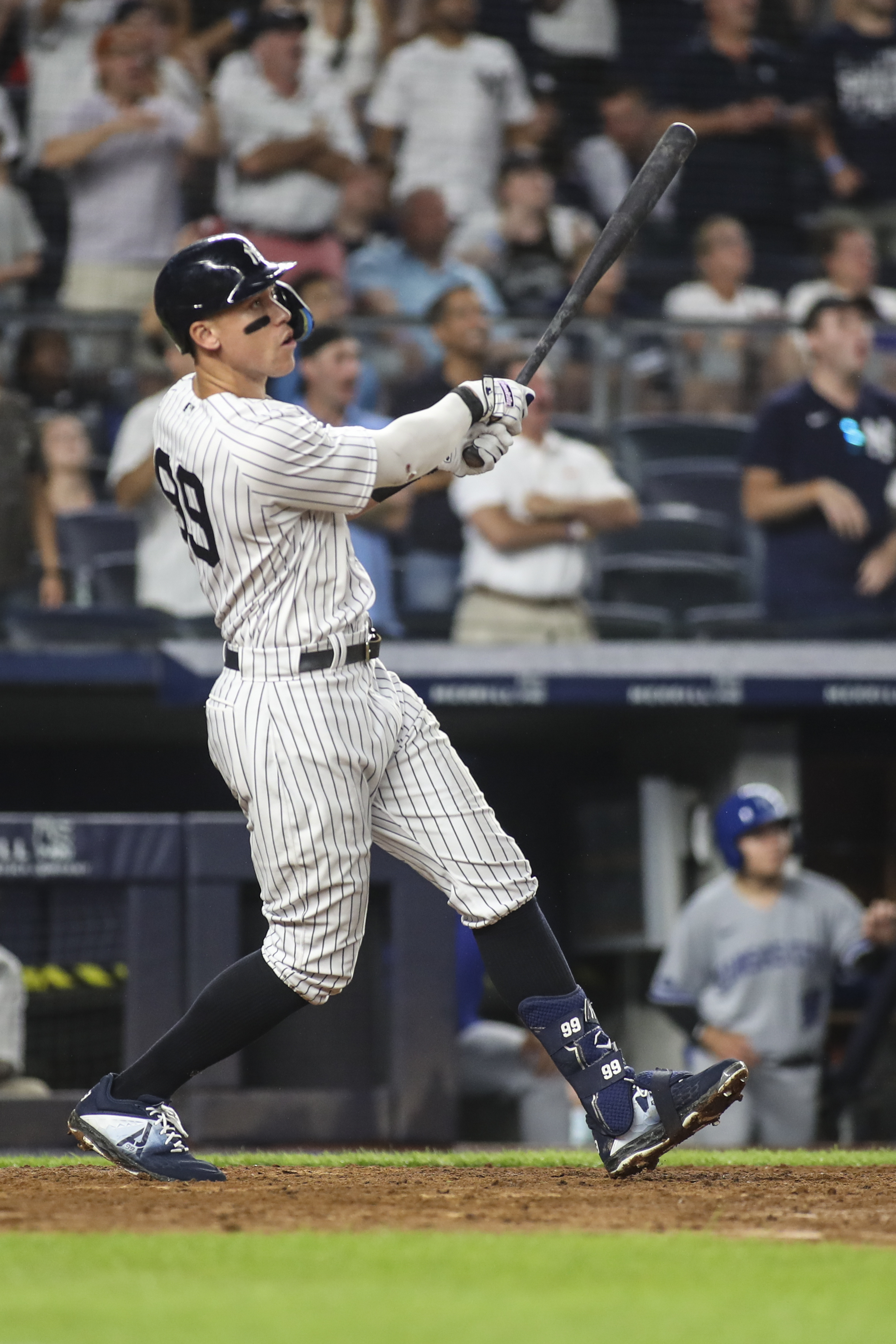
Judge has been the best hitter on the planet since Opening Day, and as things currently stand, the only person who could conceivably stand in his way of winning his first AL MVP trophy would be Angels sensation Shohei Ohtani. However, great as Ohtani has been again in 2022, his offense isn’t quite what it was last year (and isn’t anywhere close to Judge’s league-leading dominance). From a pure WAR perspective, Judge has been so good this year that his value with the bat has eclipsed Ohtani’s combined value at the plate and on the mound.
Regardless, Judge is now poised to reach free agency on the heels of the finest season of his already brilliant big league career. He’ll play the 2023 season at age 31, which is about the only strike against him in free agency. Judge will receive and reject a qualifying offer from the Yankees, and even though he’d be 38 by the end of an eight-year deal, that seems plenty plausible. He could very well command the largest annual salary any position player has ever received, too, and a $300MM overall contract doesn’t seem out of the question. This is what it looks like to bet on yourself and win — in resounding, overwhelming fashion, no less.
2. Trea Turner, SS, Dodgers (LR: 3): There’s not much on the baseball field that Turner doesn’t do well. The 29-year-old is the sport’s fastest player, by measure of Statcast’s Average Sprint Speed, and he’s hitting .305/.345/.499 as of this writing. The 28 home runs he popped in 2021 might very well go down as a career-high, but Turner should finish this year around 25 dingers and has twice in the past hit 19 long balls (including in a 2019 season where he played in just 122 games).
That injury shortened ’19 campaign was the only one in the past half decade in which Turner spent significant time on the shelf. Over the past five years, he’s a .303/.358/.493 hitter who’s made a pair of All-Star teams, won a batting title and taken home a World Series ring.
By the end of a long-term deal, Turner will probably move off shortstop, but he’s a solid option there for now who’d be plenty capable of sliding over to second base at some point. Over the past three seasons, he’s been 43% better than league-average with the bat, by measure of wRC+, and this will be his fourth season of at least four wins above replacement in the past five years — with the 60-game 2020 season, when he boasted 2.8 fWAR and bWAR alike, being the lone exception.
If Turner had been born a day later, next year would technically be considered his age-29 season, but he’ll be 30 on June 30, and the July 1 cutoff is (for whatever reason) generally seen as the arbitrary turning point for a player’s age in a given year. A seven-year deal for Turner would run through age-37, and an eight-year deal through age-38. He’ll have to contend with a qualifying offer and another deep class of shortstops, but Turner is one of baseball’s most well-rounded players and figures to be compensated in line with the game’s 10 to 20 best position players.
3. Nolan Arenado, 3B, Cardinals (LR: 6): It’s difficult to directly compare Arenado’s 2022 season and the 2019 season that propelled Anthony Rendon to a seven-year, $245MM contract, given that Rendon’s Herculean ’19 effort came during the juiced-ball season. Offense is down league-wide now, yet Arenado stacks up favorably in terms of batting average, on-base percentage and slugging percentage. Metrics like wRC+ and OPS+, which weight for both home park and league environment, feel that Arenado’s 2022 production at the plate has actually been slightly better.
Defensively, Arenado is nearly peerless at his position. Since making his MLB debut in 2013, Arenado ranks second among all players, regardless of position, with 151 Defensive Runs Saved, trailing only Andrelton Simmons. He’s third to Francisco Lindor and Nick Ahmed in Statcast’s Outs Above Average, which tracks defensive data dating back to 2016. Arenado’s numbers aren’t inflated by early-career marks, either. He remains elite this season, ranking third in all of MLB in DRS and second in OAA. Defensive metrics and the eye test agree, as Arenado has been a human highlight reel at the hot corner for his decade-long career.
The age gap between 2022 Arenado (31) and 2019 Rendon (29) can’t be ignored. However, that should be more reflected in the length of a theoretical Arenado contract than in the annual value. It’s also, of course, worth noting that Arenado is technically under contract through 2027. He’s guaranteed $144MM in that time but has the right to opt out of the contract after the current season. Arenado forwent an opt-out clause after the 2021 season, but his 2022 campaign is the best of his career.
Even if he’s capped at a five-year deal in free agency, he should be able to trounce the current $28.8MM annual value remaining on his deal by as much as $5-7MM — and a six-year deal doesn’t seem impossible to imagine coming off such a brilliant effort. (Freddie Freeman scored a six-year deal beginning with his age-32 season, so there’s recent precedent.) Perhaps Arenado and the Cardinals will work out a compromise, and it’s always possible he decides he’s happy in St. Louis and just passes on the opt-out entirely. If he does want to test the market again, however, there could be another $20-60MM in earning power for him on top of his current deal.
4. Carlos Correa, SS, Twins (LR: 2): The 2022 season might not have gone quite as well as either Correa or the Twins hoped, but he’s still enjoying a sound all-around year, hitting .265/.343/.433 (22% better than league average, by measure of wRC+). He got out to a slow start in April and has slumped following the All-Star break, but for a three-month stretch from late April to late July, Correa hit .308/.375/.509. Provided the current slump doesn’t last too long, Correa stands a decent chance to be around 30% better than average at the plate for the second straight season and third time in four years.
Last year’s all-world defensive ratings have taken a dip thus far in 2022 — surprising for a player who has generally been a consistent source of elite glovework. He’s made five throwing errors this season, tied for his most since 2016, but Correa has been plenty sure-handed, booting just two balls hit to him. He’s spent the year throwing to Miguel Sano and a pair of makeshift first baseman who’ve converted from other positions (Luis Arraez, Jose Miranda), so perhaps some of the throwing miscues can be forgiven by a team with a better defensive outlook at first base.
If those first couple paragraphs feel like they’re filled with caveats — well, they are. The simple fact is that Correa hasn’t had as strong a season as he did in 2021 and probably shouldn’t be expected to command the type of contract many (MLBTR included) thought to be possible last offseason. That said, Correa still hasn’t even turned 28 — the age at which he’ll play nearly all of the 2023 season. His youth alone gives him the chance to command the longest contract of any free agent this winter; even a 10-year deal would run through age-37.
That type of contract may not be on the table without a huge finish, but Correa is still a plus defender and well above-average hitter with age on his side. It’s perhaps narrowly more plausible that he could opt into a second year with the Twins, take another $35.1MM salary and hope to hit free agency on the heels of a stronger platform in 2023, but his current earning power is still among the best in this year’s free-agent class.
5. Xander Bogaerts, SS, Red Sox (LR: 4): When the last version of our list was published, Bogaerts had homered just four times in 174 plate appearances while posting a below-average .135 ISO (slugging minus batting average). It was easy enough to overlook as little more than small-sample noise at the time, but Bogaerts has hit just five home runs in 267 plate appearances since that time and now has nine long balls and a tepid .141 ISO in 441 trips to the plate. That’s the worst power output we’ve seen from Bogaerts since 2017 by an overwhelming margin. From 2018-21, he belted 90 homers in 2106 plate appearances while turning in a stout .224 ISO.
Bogaerts is still hitting .311/.383/.452 on the season, but he’s also sporting a career-high .382 average on balls in play that he’s not going to sustain — particularly not when his average exit velocity, barrel rate and hard-hit rate are at their lowest or near-lowest levels since 2017.
There’s still no doubt that Bogaerts will opt out of the remaining three years and $60MM on his contract, but he’d be higher on this list if not for his power stroke going MIA. Couple that with ongoing questions about his defense — some teams are surely going to see Bogaerts as a player who needs to move off shortstop, perhaps as soon as 2023 — and the current free-agent outlook is a bit murkier than expected.
Nevertheless, Bogaerts has a long track record of excellent offense and well above-average power output. With a strong finish to the season, particularly in the power department, he should have no problem commanding a notable nine-figure deal — and something in excess of $200MM can’t be ruled out.
6. Jacob deGrom, RHP, Mets (LR: 7): The No. 6 ranking here for deGrom factors in something of a best-case scenario, but this list is based on earning power, after all. If deGrom gets hurt again or struggles down the stretch, it’s possible he’ll drop off the list entirely. The latter of those two scenarios seems unlikely, though, as deGrom hasn’t “struggled” since 2017. He’s been dominant through his first two starts of the 2022 season, averaging 99.2 mph with his fastball and holding opponents to three runs on four hits and a walk with 18 punchouts through 10 2/3 innings.
Dating back to 2018, deGrom has a comical 1.95 ERA in 591 2/3 innings with a 34.9% strikeout rate against a 5.3% walk rate. When healthy, deGrom is simply unmatched in terms of starting pitching dominance over that period. He ranks second among all Major League pitchers with 24 wins above replacement dating back to 2018, per FanGraphs, despite the fact that he’s made only 93 starts in that time. Max Scherzer tops the list but has started 24 more games and logged 143 2/3 more innings — about an extra 75% of a season’s worth of work.
If deGrom finishes the season with no red flags, the bidding should be furious. He’ll turn 35 next June, making him nearly three full years younger than Scherzer was when he secured his record-setting three-year, $130MM deal from the Mets. DeGrom could justifiably look to top that AAV on a multi-year deal, and he’s too good for the bidding to stop at two years. The biggest question surrounding deGrom is just how many years someone will be willing to guarantee. A three-year pact in excess of Scherzer’s seems doable, and a fourth year ought to be on the table as well.
7. Dansby Swanson, SS, Braves (LR: Not Ranked): Long a plus defender at shortstop, Swanson is having another strong year with the glove and a career year with the bat. He’s followed up a career-high 27 home runs in 2021 with a .292/.348/.461 showing through 463 trips to the plate. He’s been the beneficiary of a .375 average on balls in play that he surely won’t sustain over a larger sample, but Swanson is also making hard contact at a career-best 44.7% clip and elevating the ball more than he has in years past.
A greater walk rate than his current 7.3% clip or lower strikeout rate than his 26.3% mark would raise Swanson’s floor, but his glove alone will make him an above-average regular and he’s well on his way to his second straight 25-homer season. Add in that Swanson will play all of next season at 29 years old, and a nine-figure deal seems likely. Both Trevor Story and Javier Baez landed six-year, $140MM pacts last winter at the same age. Swanson will have to contend with a qualifying offer and with some more decorated shortstop options ahead of him on the market, but he’ll be in high demand all the same.
8. Carlos Rodon, LHP, Giants (LR: 8): Rodon was the best pitcher in baseball through late July in 2021, but he was capped to five innings per appearance (at most) down the stretch as he battled shoulder fatigue and diminished velocity. For a pitcher with Rodon’s injury history, that limited interest in him to the point that he took a two-year, $44MM deal with a chance to opt out following the 2022 season — provided he reached 110 frames.
Rodon has not only reached 110 innings — he’s shot past it with career-best velocity (95.8 mph average fastball) and another sub-3.00 ERA (2.95 through 128 1/3 frames thus far). Rodon is averaging just shy of six innings per outing and boasts a 31.2% strikeout rate against a 7.6% walk rate. He’s reached double-digit strikeouts in six of his 22 starts and held opponents to three or fewer runs in 18 of 22 tries.
Rodon’s fastball in his past eight starts is down about one mile per hour over his average from his first 14 starts, but it’s still been a healthy 95.1 mph in that stretch. That said, he threw a complete game on July 9, worked seven shutout innings on July 31, and averaged a resurgent 96 mph with his heater in his most recent outing. At least so far, Rodon doesn’t appear to be fading at all. If he can avoid the type of late swoon he experienced in 2021, he ought to find four- and five-year offers at superior annual values to this contract’s $22MM AAV. He’ll receive a qualifying offer and surely reject it, which isn’t ideal, but he has the best combination of age (30 all of next season) and 2022 performance of any starter on this year’s market.
9. Justin Verlander, RHP, Astros (LR: Not Ranked): Simply returning to make a full season’s worth of starts would’ve been a feat for a 39-year-old who had pitched just six innings since the end of the 2019 season due to Tommy John surgery. Verlander, of course, is no ordinary 39-year-old, and he’s not only returned but positioned himself as a front-runner for the AL Cy Young Award.
It’s a jaw-dropping feat, even for one of this generation’s best. Verlander has a 1.73 ERA with a 25.5% strikeout rate against a minuscule 4.6% walk rate. He’s averaging nearly 6 2/3 innings per start, sitting 95.1 mph with his heater — his second-best mark since way back in 2011 — and has thrown a quality start in 16 of his 20 appearances this year. Verlander hasn’t yielded more than one earned run in a start since June 18 and has held opponents to one or zero earned runs in a stunning 15 of 20 starts.
He’ll turn 40 in February, but Verlander has a legitimate case to break Max Scherzer’s $43.33MM AAV, particularly if he’s looking at a two-year deal. He’s said he wants to pitch into his mid-40s and looks as good as ever, though, so we shouldn’t discount the possibility that a team shrugs and goes to three guaranteed years for this generation’s most prolific workhorse. Verlander unlocked a $25MM player option when he reached 130 innings pitched, but he should be able to crush that in free agency even if he prefers to work out an extension with Houston.
10. Edwin Diaz, RHP, Mets (LR: Not Ranked): It’s been six years since Mark Melancon (four years, $62MM), Kenley Jansen (five years, $80MM) and Aroldis Chapman (five years, $85MM) each set new records for relief contracts in the same offseason. Diaz, the most dominant reliever in baseball this season, will have a chance to topple that Chapman record when he heads into free agency in advance of his age-29 season.
After a nightmarish first season in Queens, Diaz has righted the ship and become a spectacle in the best kind of way. He’s averaging 99.1 mph on his heater this season, has punched out 52.9% of his opponents and has an entrance more befitting of a professional wrestler than a Major League closer.
Diaz’s Baseball Savant profile looks like a video game cheat code. He’s leading the Majors in expected ERA, expected wOBA, expected batting average, expected slugging percentage, strikeout rate, whiff rate and ranks in the 99th percentile in average exit velocity, opponents’ chase rate, opponents’ barrel rate and fastball velocity. Diaz last allowed an earned run on June 18, and in 18 innings since that time he’s posted a 38-to-1 K/BB ratio while yielding just seven hits.
The 2022 version of Edwin Diaz might be the best reliever we’ve seen since Mariano Rivera. He’ll be hit with a qualifying offer, but it’s doubtful the teams pursuing him are going to even care about that. It’d be a surprise if Diaz doesn’t set a new contract record for relief pitchers this winter, and he could be baseball’s first nine-figure reliever.
Honorable Mentions: Brandon Nimmo, Willson Contreras, Jose Abreu, Josh Bell, Chris Bassitt, Nathan Eovaldi, Andrew Benintendi
Vesting Options Update: Flexen, Maldonado, Carrasco, Andrus
Major league contracts cannot be made conditional on player performance metrics, but it is permissible for clubs and teams to agree to options dependent upon playing time. Things such as innings pitched, plate appearances or (less frequently) games started or finished are all possible goals that could allow a player to trigger either additional guarantees or the right to opt out of an otherwise guaranteed contract. It’s also permissible to tie vesting provisions to a player’s finish in award voting, as we’ll see with the final player on this list.
This year, there are seven players whose 2023 contract status is tied directly to their playing time and/or awards finishes on the season. With a couple months left in the schedule, it’s worth checking in to see how they’re progressing towards those thresholds.
Already Vested
Carlos Rodón, SP, Giants
Rodón already reached the 110-inning threshold necessary to trigger his vesting provision last month. That affords him the right to opt out of the final year and $22.5MM remaining on his deal with San Francisco, and the Boras Corporation client is sure to do just that. Rodón has backed up his 2021 breakout with another elite season. He carries a 2.95 ERA across 128 1/3 innings, striking out an elite 31.2% of batters faced while sitting in the 95-96 MPH range with his fastball. The 29-year-old should receive the long-term deal that eluded him last winter, as he’s now pushing 50 starts of ace-level performance over the past two seasons and has put last summer’s shoulder soreness further in the rearview mirror.
Justin Verlander, SP, Astros
As with Rodón, Verlander has already hit his vesting threshold. The future Hall of Famer needed to hit 130 innings on the season to kick in a $25MM player option for next year, a milestone he reached last week. Barring injury, he’s going to pass up on that sum and test the open market. Despite being in his age-39 season, the nine-time All-Star has returned to the top of the Houston rotation after losing virtually all of 2020-21 to Tommy John surgery recovery. He owns an MLB-best 1.73 ERA across 130 frames, positioning himself as a strong contender for a third career Cy Young award. Verlander’s swing-and-miss rates aren’t quite at his pre-surgery peak, but that shouldn’t be much of a concern given his track record and continued dominance without an elite strikeout rate. The ISE Baseball client could look to top former teammate Max Scherzer’s $43.333MM average annual salary and shoot for an all-time record — particularly if he’s willing to accept two guaranteed years instead of holding out for a three-year deal that takes him through his age-42 season.
Should Be Imminently Reached
Chris Flexen, SP, Mariners
Flexen signed a two-year, $4.75MM guarantee upon coming over from the Korea Baseball Organization during the 2020-21 offseason. The deal contained a $4MM club option for the 2023 campaign but afforded Flexen the opportunity to override that with an $8MM salary based on his number of innings pitched. (MLBTR recently confirmed that Flexen’s vesting provision would guarantee his 2023 salary but does not afford him an opt-out clause after this season). The righty could reach that marker by tallying either 150 innings in 2022 or 300 combined frames from 2021-22.
As MLBTR’s Darragh McDonald noted yesterday, Flexen is soon to reach the latter threshold. He worked 179 2/3 frames last season, leaving him with 120 1/3 innings to tally this year. Through 21 starts, the 28-year-old has worked 117 frames. He needs just 3 1/3 more innings and should officially hit the threshold during his next start (or within two starts at the latest) barring an immediate season-ending injury. The Mariners, for their part, should be perfectly content to keep Flexen around for a reasonable $8MM. He’s been a durable source of roughly league average innings, posting an ERA of 3.73 since landing in the Pacific Northwest. Flexen doesn’t miss many bats, but he’s avoided the injured list and thrown plenty of strikes. He’s a perfectly fine back-of-the-rotation arm for a team with a spacious home ballpark and a strong defense behind him, and Seattle’s 2023 payroll slate is plenty reasonable.
Martín Maldonado, C, Astros
Last April, the Astros preemptively kept Maldonado from getting to the open market after the 2021 season. They signed him to a $5MM pact for 2022, and the deal contained a matching vesting provision for the following year. Chandler Rome of the Houston Chronicle was among those to report that Maldonado would lock in the $5MM salary for 2023 if he appeared in 90 games during the ’22 campaign.
Heading into play Tuesday, Maldonado has gotten into 82 contests. The 35-year-old (36 next week) has continued to pick up the bulk of the playing time even after Houston acquired Christian Vázquez from the Red Sox just before the trade deadline. Maldonado has been behind the dish for four of Houston’s six games since August 2, with Vázquez picking up the other two starts. Maldonado should get to the 90-game threshold with ease (again, barring imminent injury), likely within about two weeks.
Vázquez is ticketed for free agency after the season, so Maldonado should hold onto his primary catching job next year. It’s possible the Astros bring in a 1B complement, particularly with prospect Korey Lee struggling at Triple-A, but it seems they’ll be content to turn things over to Maldonado for a fourth straight season. The veteran has always been one of the game’s worst hitters, and that’s continued this season. He owns a .183/.244/.357 line across 278 plate appearances. He’s hitting for a bit more power than usual but posting one of his worst years from an on-base perspective. He’s also rated as a below-average defender this year in the estimation of public metrics like Defensive Runs Saved and Statcast’s pitch framing.
The Astros have maintained that Maldonado’s game-calling acumen and ability to handle a pitching staff is elite, however. That’s not going to show up on his statistical ledger, but the organization has backed up those assertions by continuing to pencil Maldonado into the lineup on most days. They’ve got no shortage of offensive firepower elsewhere around the diamond. Maldonado’s poor numbers haven’t stopped the team from racing to 30 games above .500, and they’ve had arguably baseball’s top pitching staff. One can debate how much credit Maldonado deserves for that, but he’s probably bringing some amount of on-field value that’s not quantifiable.
Attainable But Borderline
Carlos Carrasco, SP, Mets
Carrasco has a $14MM club option for next season on a contract extension he initially signed with Cleveland over the 2018-19 offseason. That option becomes guaranteed if he throws 170 innings in 2022 and is expected to be healthy for the following season, according to an Associated Press report. Carrasco can’t officially lock in the latter designation until the end of the year, as he’ll presumably need to pass a physical at the start of the offseason.
He can work towards the first goal, however. Carrasco enters play Tuesday with 117 2/3 innings across 21 starts. That leaves him 52 1/3 frames short with a little less than two months to go. The 35-year-old has averaged around 5.6 innings per start to this point in the season. At that rate, he’ll need to make between nine and ten more outings, which he’s right on track to hit by the end of the year. New York has 52 games left in the regular season, putting them on pace to go through a five-man rotation about ten more times. Even a brief injured list stint would probably prevent Carrasco from getting to 170 frames, but he’s on pace thus far.
Of course, it’s not a guarantee he’d hit free agency at the end of the year if he doesn’t trigger the vesting threshold. The Mets would still retain his services via club option, and it’s possible they’d exercise it anyhow. They’re over $280MM in 2022 payroll, so a $14MM salary isn’t all that burdensome. After an injury-plagued first season in Queens, the well-respected Carrasco has bounced back with a nice year. He owns a 3.82 ERA with slightly better than average strikeout, walk and ground-ball rates. If he finishes the year healthy and remains generally productive, the Mets probably keep him around regardless.
Elvis Andrus, SS, Athletics
The A’s, on the other hand, aren’t likely to want anything to do with Andrus’ option. The veteran shortstop’s extension with the Rangers contained a $15MM club option for 2023. That’d become a player option if Andrus were both traded (as he was, from Texas to Oakland) and tallies 550 plate appearances in 2022.
Andrus has hit 366 times thus far, leaving him 184 plate appearances shy of the marker. The A’s have 52 games remaining, so Andrus needs to tally around 3.54 plate appearances per game from here on out. He’s averaged 3.66 PA’s per game through the season’s first few months, so he’s on pace to reach the mark. If Andrus continued at his current pace, he’d reach approximately 556 plate appearances at year’s end. If the A’s are intent on avoiding that situation, they could mix in a couple more off days over the next two months to prevent him from getting there.
Deliberately curbing playing time to prevent a player from reaching a vesting threshold would be grounds for a grievance filing against the team. The rebuilding A’s could point to a desire to get 23-year-old Nick Allen more regular run at shortstop as an on-field justification, even as Allen has struggled mightily through his early stint in the major leagues. If Andrus misses the vesting threshold by just a handful of plate appearances, it’s certain to raise some eyebrows around the league and in the offices of the MLBPA. There’s little question Andrus — owner of a serviceable .241/.303/.372 line on the season — is one of the nine best position players on the last-place club. Yet he wouldn’t receive $15MM on the open market and would definitely trigger the option if it vests, likely counting for more than a quarter of the A’s bottom-of-the-barrel player payroll next season if that occurs.
Not Happening
Justin Turner, 3B/DH, Dodgers
The Dodgers re-signed the ever-productive Turner to a two-year, $34MM guarantee during the 2020-21 offseason. The deal contains a $16MM club option for 2023 that would vest at $20MM if Turner finishes in the top ten in MVP balloting this season. It’d vest at $17.5MM if he finishes between 11th and 15th in MVP balloting (report via Bob Nightengale of USA Today).
Turner overcame a very slow start with an excellent month of July that pushed his season line up to .257/.332/.405 through 355 plate appearances. He’s having a solid year, but it’s his worst season since he landed in Southern California back in 2014. Turner certainly isn’t going to get legitimate MVP support. Would the Dodgers exercise the option regardless as he heads into his age-38 season? That feels unlikely, but perhaps Turner could play his way into it with a strong stretch run and postseason after returning from an abdominal strain that currently has him on the injured list.
Giants Do Not Trade Carlos Rodon, Joc Pederson Prior To Deadline
5:00pm: There was no last-minute trade of either Rodon or outfielder Joc Pederson, tweets Andrew Baggarly of The Athletic. Both remain with the Giants and are now ineligible to be traded with the deadline passed. The Giants can still issue a qualifying offer to both players, with Rodon standing out as a particularly obvious candidate to receive one.
2:20pm: The Yankees have also checked in on Rodon, though they’re seen as a “long shot,” Jon Heyman of the New York Post tweets.
Jayson Stark of The Athletic adds that Rodon’s $22.5MM player option has indeed been a complicating factor in talks to this point, given the aforementioned downside it presents an acquiring club.
1:20pm: The Giants are in discussions with teams about Carlos Rodón, tweets Susan Slusser of the San Francisco Chronicle. Slusser suggests they’re not motivated to sell low, however, indicating they’d only accept an offer for “full value.” Slusser lists the Phillies, Twins, and Cardinals as interested parties. At 51-52, the Giants sit 4.5 games out for a wild card spot and have 16.6% playoff odds as calculated by FanGraphs.
Rodon dominated through his first 16 starts last year for the White Sox, but then seemed to wear down and was handled carefully the rest of the year. The White Sox chose not to issue a qualifying offer, and Rodon went into free agency as a high-risk, high-reward pitcher. After the lockout, the Giants gave Rodon a two-year, $44MM deal that allows him to opt out of the remaining $22.5MM for ’23 if he reaches 110 innings, a condition the lefty has already met.
So far, Rodon has silenced any concern about his health, as he’s tossed 123 innings without a dropoff in velocity or production, resulting in his second consecutive All-Star nod. Over his last five starts, Rodon has punched out over 36% of batters faced, whiffing ten in each of his last two.
As with any opt-out clause, Rodon will exercise it if he thinks he can top the remaining $22.5MM. Barring a significant injury, it seems likely Rodon will indeed explore free agency again unless he’s extended by a new team. The Mariners and Yankees, respectively, have landed the top two starters on the trade market in Luis Castillo and Frankie Montas. Back-end options Jose Quintana and Jake Odorizzi are off the board as well.
A healthy Rodon is a potential Game 1 or 2 playoff starter, and can impact a playoff race. However, he is owed over $7.5MM for the remainder of the season, plus the downside risk of his opt-out clause and the chance of a repeat of last year’s late fade. He’ll need a suitor with financial flexibility and tolerance for risk. If the Giants don’t find an offer to their liking, they can still tender a qualifying offer to Rodon after the season.
Giants “Listening” To Trade Offers For Veteran Players
9:19PM: “Pretty much anyone not Logan Webb” could be discussed by the Giants in trade talks, as per Joel Sherman of the New York Post.
8:17PM: The Giants have gone 11-22 over their last 33 games, dropping them below the .500 mark and putting them four games outside of the NL wild card race. While the club was reportedly resistant on being deadline sellers as recently as three days ago, the Giants “now listening on their veterans” in trade talks, according to the New York Post’s Jon Heyman (Twitter link). MLB.com’s Mark Feinsand also tweeted that according to a rival executive, San Francisco was seemingly “ready to sell.”
Assuming that the Giants are indeed poised to become sellers to some extent, they immediately become an intriguing team to watch prior to Tuesday’s 5pm CT trade deadline. President of baseball operations Farhan Zaidi has taken a measured approach to selloffs in the past, even during the 2019 and 2020 deadlines when the Giants had a lot more impetus to fully tear down an aging and expensive roster. A major overhaul certainly doesn’t seem in the works this time around, as since the Giants are less than a season removed from winning 107 games, Zaidi certainly must feel his group can return to contention in 2023 (or could even regroup for a late playoff push this year).
Pending free agents are the most obvious trade candidates, and Carlos Rodon would immediately be a major new entry in the pitching market if the Giants made him available. The left-hander is in the midst of an outstanding season, and recently unlocked a vesting option that allows Rodon to opt out of his contract following the season. Rodon is owed $22.5MM in 2023, but since he can surely land a much more lucrative and longer-term pact in free agency, he looks like a sure bet to exercise his opt-out clause.
The White Sox decided against issuing a qualifying offer to Rodon last winter, and thus he is still eligible for the QO tag this offseason now that we know the qualifying offer system will still be in place. The Giants can recoup a compensatory draft pick in exchange for Rodon’s services if he does sign elsewhere, and thus if any rivals teams are interested in Rodon at the deadline, they’ll have to offer San Francisco something of greater value than that compensatory pick. Speculatively, that could be a player closer to the big leagues, since someone who can provide more immediate help might be preferable for a Giants team that plans to win next year.
As for other free agents, Wilmer Flores, Dominic Leone, and Joc Pederson would all garner interest, though Pederson was just placed on the seven-day concussion IL. A team would be taking some risk in acquiring Pederson given the unpredictable nature of concussion-related symptoms, and of course the Giants’ return in a Pederson trade would be impacted by this uncertainty.
Evan Longoria is also on the injured list, as a right hamstring strain has continued an injury-plagued year for the veteran third baseman. The Giants hold a $13MM club option on Longoria for 2023 that doesn’t look too likely to be exercised at this point, though Longoria has also stated that he might retire after the season. Since Longoria has already started fielding drills is expected back in the first week or two of August, another team could take a flier on a veteran who has still quite well when healthy. Longtime Giant Brandon Belt is also a free agent after the year, though a trade doesn’t seem too likely since Belt has also battled injuries and is having only an okay year at the plate. Belt can also decline any trade due to his rights as a 10-and-5 veteran.