
Latest On Tigers’ Offseason Targets
The Tigers have a lot of upgrades to make following a 96-loss season, and the club is exploring several veteran options on the free agent market. Evan Petzold of the Detroit Free Press reports that such players as Seth Lugo, Adam Frazier, Brian Anderson, and Edwin Rios have all drawn interest from the Tigers, and Wil Myers is also on the radar, but “the Tigers aren’t viewed as a frontrunner for Myers.” As for players who have already landed elsewhere, Detroit also had interest in Jace Peterson before he signed with the Athletics during the Winter Meetings.
Signing any of the available players would add some experience to the lineup and address at least one position on a roster with plenty of uncertainty. Third base is open after Jeimer Candelario was non-tendered, and Tigers manager A.J. Hinch told Petzold and other reporters during the Winter Meetings that second base playing time may also be available, depending on where Jonathan Schoop is utilized. Hinch suggested that Schoop could also see time at first base or third base, apart from just the keystone.
Realistically, Schoop is more likely to spend most of his time on the right side of the diamond, given that his big league third base experience consists of 133 2/3 innings with the Orioles back in 2014, and a single inning at the hot corner in 2021. Schoop (like many Detroit hitters) is also coming off a dismal year at the plate, and since he is only under contract through 2023, might not be in the long-term plans of new president of baseball operations Scott Harris.
Frazier has mostly played second base throughout his career, but he has also bounced around to both corner outfield positions, and a smattering of games at third base, shortstop, and center field. Signing Frazier would allow the Tigers some flexibility in planning the lineup, as Frazier or Schoop or rookie Ryan Kreidler could be shuffled around the infield as matchups dictate, and Frazier could also chip in as part of the outfield mix.
Of course, Frazier also didn’t hit much in 2022, batting .238/.301/.311 with three homers over 602 plate appearances with the Mariners. Since the start of the 2020 season, Frazier has a 95 wRC+ and a .266/.329/.362 slash line over 1471 PA with the Pirates, Padres, and Mariners, and much of his production in that stretch was concentrated within a fantastic three-month stretch with Pittsburgh early in the 2021 campaign (which helped Frazier earn an All-Star nod).
Despite these struggles, Frazier is looking for a two-year contract, according to Petzold. An argument can be made that Frazier (who turns 31 later this week) might still be worth such a commitment since he is a strong defender, and he has consistently been one of baseball’s tougher hitters to strike out. While Frazier’s extreme contact doesn’t result in many hard-hit balls, the potential is there for Frazier to become a very productive hitter if he can just barrel the ball with more consistency. Given how the Tigers had one of the highest strikeout rates of any team in baseball in 2022, simply getting a contact hitter of any ilk might also help Detroit’s offensive woes.
Anderson and Rios were respectively non-tendered by the Marlins and Dodgers, and while both players have experience at other positions (Anderson mostly in right field, Rios at first base), the Tigers would probably view either as candidates to take over from Candelario at third base. Like Frazier, these two are also looking to bounce back from underwhelming seasons, as Anderson and Rios both missed time to injury.
After posting solid numbers in 2018-20, it seemed like Anderson was on his way to becoming a building block in Miami before injuries cut into his playing time in each of the last two seasons. Anderson hit .266/.350/.436 (115 wRC+) over 1419 PA from 2018-20, but those numbers dropped to a 93 wRC+ and a .233/.321/.359 slash line over 647 PA in 2021-22.
Rios is an intriguing wild card option, as he owns a career 112 wRC+ but only over 291 career PA in the majors. The Dodgers used Rios as a part-time player for four seasons, and while it is quite possible he might’ve earned more playing time on a less star-studded team, Los Angeles seemingly never saw Rios as more than a spare part. Injuries also played a factor, as Rios missed most of the 2021 campaign due to shoulder surgery, and a hamstring tear last season resulted in a trip to the 60-day injured list.
While it doesn’t seem like Myers will be arriving in Detroit, he is an on-paper fit for playing time as a right fielder, DH, and first baseman. Spencer Torkelson will naturally get every opportunity for regular at-bats at first base next season, but Schoop might also get some first-base time, and Miguel Cabrera and Austin Meadows will get DH at-bats. A player like Myers would be an option for right field when Meadows is getting a DH day, plus Myers could also shift over to left field.
The Tigers are the latest of many teams linked to Lugo’s market, and Detroit is one of the clubs with interest in Lugo as a starting pitcher. The right-hander has worked exclusively as a reliever in three of the last four seasons with the Mets, and he hasn’t been a true full-time starter since 2017. However, Lugo has kept his arm relatively loose as a swingman and multi-inning reliever, and naturally a move back to rotation work could be very lucrative as he enters free agency for the first time.
Given how the Tigers were crushed by pitching injuries in 2022, the club can offer plenty of opportunity to Lugo as it looks to rebuild its rotation. With so much interest in his services, it isn’t hard to imagine that Lugo could land a two-year contract, as a team could view him as a starting candidate for 2023 and (if things don’t go well) at worst a reliever for 2024. If Lugo succeeds as a starter and the Tigers’ younger arms all return healthy down the road, such a crowded-rotation scenario counts as a nice problem to have for the team in the future.
Detroit already brought back Matt Boyd on a one-year contract, with Boyd also looking for a move back to starting pitching. The Tigers’ current rotation lines up as Eduardo Rodriguez, Matt Manning, Spencer Turnbull, and Boyd, with Joey Wentz, Tyler Alexander, Alex Faedo, and Beau Brieske all in competition for that fifth starter’s job.
In the bigger picture, none of Detroit’s free agent targets look to receive more than a one- or perhaps a two-year deal at most. This speaks to Harris’ apparent strategy (or ownership’s preference) of avoiding any big immediate expenditures, as the Tigers flopped after last winter’s major spending spree. The plan for 2023 might be for Harris and the Tigers to patch holes with some veteran additions, and then see how the roster — both the younger core and veteran stars like Rodriguez or Javier Baez — can collectively regroup after the disastrous 2022 season.
Mariners Looking For Left-Handed Hitting Second Baseman
Over a year ago, Mariners president of baseball operations Jerry Dipoto publicly declared that the club would not be supplanting J.P. Crawford at shortstop. That was despite a huge class of free agent shortstops that existed at that time, including Carlos Correa, Corey Seager, Trevor Story, Marcus Semien and Javier Baez.
Coming into this offseason, Dipoto stuck to his guns but said that his “great preference” would be to land a shortstop to play second base. This year features another strong class of free agent shortstops, with Correa on the market again, this time alongside Trea Turner, Xander Bogaerts and Dansby Swanson. However, they may be getting priced out of the bidding, as Ken Rosenthal of The Athletic writes that the expected prices of those shortstops are making it likelier that the M’s pursue a left-handed hitting second baseman to platoon with Dylan Moore.
The Mariners already had such a player in 2022, acquiring Adam Frazier from the Padres going into the year. He only had one year of club control remaining at the time and is now a free agent. The Mariners could always bring him back, but his bat took a step back this year. After hitting .305/.368/.411 in 2021 for a wRC+ of 113, he hit just .238/.301/.311 for a wRC+ of 81. Given that dip in production, the club might look for other options.
The other free agent options aren’t terribly exciting. Robinson Cano missed all of 2021 due to a PED suspension, had a worse season than Frazier and is now 40 years old. Switch-hitters Cesar Hernandez and Jonathan Villar also both had worse years than Frazier in 2022. Perhaps the best fit would be Jace Peterson, who has hit .238/.337/.373 over the past three seasons for a wRC+ of 98. His defensive grades are strong overall though that’s mostly due to excellent work at third base, with his numbers more middling elsewhere.
Given Dipoto’s penchant for the trade market has earned him the nickname “Trader Jerry,” perhaps that is the most likely route the club would take to address the keystone. Rosenthal speculates Kolten Wong as a fit, which is a match that has already been reported in recent weeks. However, Rosenthal also suggests they could target cheaper and more controllable players, since Wong will make $10MM in 2023 and then become a free agent.
Rosenthal suggests the Rays would make for a good trading partner, since they have Jonathan Aranda, Taylor Walls, Vidal Brujan and Brandon Lowe in their cluttered infield mix. All four of those players would come with risk in different ways. Lowe dealt with various injuries in 2022 and only got into 65 games on the season, with diminished production when he was on the field. After hitting .247/.340/.523 for a wRC+ of 137 last year, he slipped to .221/.308/.383 this year, still above average but a much lower 104 wRC+. He’ll make $5.25MM next year and then $8.75MM in 2024, with two club options after that at $10.5MM and $11.5MM. The Rays are usually not afraid to make deals of their experienced players but trading Lowe now would be selling low, no pun intended.
As for Walls, Aranda and Brujan, all three carry the risk of not being established major leaguers. Walls has the most experience of the bunch, with 196 MLB games under his belt. However, he’s seemed overmatched in that time so far, hitting just .182/.281/.288 with defensive metrics split on how to view his work in the field. Brujan has 62 MLB games on his track record but his batting line is even worse, coming in at .150/.207/.231. Aranda’s played just 32 games so far and hit .192/.276/.321. All three players have stronger numbers in the minors but haven’t been able to bring them up to the bigs just yet.
If the Mariners don’t find anything to their liking in those mentioned names, they could perhaps turn their attentions to other speculative trade targets such as Cavan Biggio, Nolan Gorman, Tony Kemp or Nick Madrigal.
Mariners Notes: Raleigh, Haniger, Santana, Frazier, Flexen
After 18 tense innings, the Seattle Mariners finally fell to the Houston Astros yesterday in the American League Division Series, having returned to playoff baseball for the first time since the 2001 season. The Mariners, who had been projected by ESPN to finish the 2022 season a hair over .500 with an 82-80 record, showed that 2021 was no fluke, following up their 90-win 2021 campaign by winning another 90 games en route to a Wild Card berth.
Following the game, backstop Cal Raleigh announced to reports that he had been playing with a broken thumb and a torn ligament in his left hand, per Adam Jude of the Seattle Times. Raleigh had been playing through the thumb injury since early September, but he had not revealed the extent of the injury prior to Saturday’s game. Raleigh announced to reporters that he would see a specialist in the upcoming days to determine a course of action for recovery, per Bob Condotta of the Seattle Times.
The second-year catcher had followed up his rookie campaign with a strong .211/.284/.489 slash line in 2022, hitting 27 home runs in 370 at-bats and finishing the season with the eighth-highest wRC+ among all catchers (121), nestled between Sean Murphy and Travis d’Arnaud. An integral cog to the Mariners’ offense, Raleigh was one of four players (minimum 350 at-bats) that had an OPS above .700. Raleigh followed up his impressing regular season with a strong Wild Card showing against the Blue Jays, going 4-for-8 with a homer and a double, but was quieted by the Astros’ pitching, collecting only 1 hit in 14 at-bats while striking out 5 times.
In the wake of yesterday’s defeat, the Mariners’ front office will turn their heads toward the 2023 season and free agency. Long-time Mariner Mitch Haniger, trade-deadline addition Carlos Santana, and Adam Frazier will all be free agents following the World Series.
Haniger entered the 2022 season looking to follow up on his successful 2021 campaign, .253/.318/.486 in 157 games, and reestablish himself as an everyday player prior to entering free agency after missing part of the 2019 season and the entire 2020 season with various surgeries. The outfielder and Mariners avoided arbitration by agreeing to a one-year, $7.75MM contract in early April.
However, Haniger would only make appearances in nine games before suffering a right high ankle sprain that kept him on the injured list from late April to early August. Upon his return, Haniger hit a solid .254/.322/.418 in the final 48 games of the regular season (100 at-bats).
The Mariners’ decision regarding Haniger, who turns 32 in December, will be quite complicated. The Mariners boast a crowded outfield headlined by AL Rookie of the Year favorite Julio Rodriguez, with former top prospect Jarred Kelenic, Dylan Moore, former AL Rookie of the Year Kyle Lewis, and Taylor Trammell. Nevertheless, Lewis has struggled to produce at a high level since suffering a right meniscus tear in 2021, and Kelenic and Trammell have both struggled to adjust to Major League pitching.
For his part, Haniger has indicated that he would prefer to remain in Seattle. Following up by saying that he hopes “to be back in a Mariners uniform for sure,” per Daniel Kramer of MLB.com.
Santana, who joined the Mariners from the Royals at the trade deadline, continued to struggle in Seattle, slashing a combined .202/.316/.376 across 131 games. The 36-year-old split his time between DH and first base, accruing 3 Outs Above Average for his work at first. It remains to be seen if the Mariners will opt for a one-player ‘old school’ approach at the DH position, or if they will cycle players through the role during the season.
Frazier followed up his All-Star 2021 campaign with a weaker .238/.301/.311 slash line across 156 games in the 2022 season. The veteran, who was dealt to the Padres during the 2021 season, was traded to the Mariners in exchange for reliever Raymond Kerr and outfielder Corey Rosier prior to the start of the 2022 season. Moore, who was previously mentioned as outfield depth, has also manned all four infield positions and could see an increase in infield work if Frazier is not resigned.
Transitioning to the bump, with five quality starters under contract, starter-turned-reliever Chris Flexen‘s position with the Mariners will be an interesting story to watch unfold. Flexen began the 2022 season as a starter, pitching to a solid 4.02 ERA in 121 innings before being bumped to the bullpen where he worked to a 1.62 ERA in 16 2/3 innings.
It remains to be seen if the Mariners will opt to keep Flexen in the bullpen, utilize a 6-man rotation, or potentially trade Flexen to improve their offense.
As previously mentioned the Mariners only had 4 players finish with an OPS north of .700 (minimum 350 at-bats). As a team, the Mariners finished with the third-lowest batting average (.230), an average on-base percentage (.315), and an average slugging percentage (.390).
Additionally, if they opt to trade Flexen for offense, the Mariners boast three prospects No. 2 Emerson Hancock, No. 5 Bryce Miller, and No. 7 Taylor Dollard, who have all had strong seasons at Double-A Arkansas.
The Mariners Shouldn’t Ignore The Free Agent Shortstop Market This Year
This past offseason featured a super class of free agent shortstops: Corey Seager, Carlos Correa, Javier Baez, Trevor Story and Marcus Semien. However, very early in the offseason, just one week after the World Series ended, Mariners president of baseball operations Jerry Dipoto made it publicly known they were unlikely be big players in this arena. Incumbent shortstop J.P. Crawford had been told he was going to stay at that position for the club, regardless of what the rumors said. While that theoretically left the door open for one of those shortstops to be signed to play another position such as second base, that didn’t come to pass.
In order to address their middle infield, they made a much more modest move. In late November, just prior to the lockout, the Mariners acquired Adam Frazier from the Padres. Frazier wasn’t as exciting of a pickup as one of those free agents would have been, but he was a sensible addition nonetheless. His left-handed bat meant that he and switch-hitting Abraham Toro could have formed a second base platoon. Frazier also can play the outfield, which he could have done in the event Toro established himself as an everyday option at the keystone. The M’s saved their big free agent splash for the rotation, signing Robbie Ray to a five-year, $115MM deal.
Now two-thirds of the way through the season, it’s fair to wonder if this approach has paid off. Frazier has largely had a disappointing season, failing to build on his strong 2021. He hit .305/.368/.411 last year for a wRC+ of 114, indicating his overall offensive production was 14% above league average. This year, however, he’s slumped to a line of .246/.309/.315, wRC+ of 85. Toro’s been even worse, with a batting line of .180/.239/.322 on the year for a wRC+ of 61. On the year overall, Seattle second basemen have produced 0.7 fWAR, a mark that ranks 22nd among major league teams.
As for the shortstop position, Crawford has gotten the vast majority of the time there, with Dylan Moore getting a handful of starts throughout the season. Crawford got out to a blistering start, hitting .360/.449/.573 through the end of April with three home runs. He hasn’t been able to maintain that, however, hitting .231/.301/.304, adding just two more homers in that span. That leaves his overall batting line at .257/.333/.358, good enough for a 105 wRC+ that’s still above average, though it’s been sliding for over three months straight at this point.
There are also questions about his defense here in 2022, with the advanced metrics in disagreement on his 2022 work. Defensive Runs Saved has him at plus-three so far this year, a dip from last year’s eight, though he could potentially close some of the gap in the season’s final few months. Ultimate Zone Rating has him at 1.3, an improvement over last year’s 0.8 but behind the pace of the 2.5 he earned in the shortened 2020 season. Outs Above Average is the most bearish, giving Crawford -7 so far this year, after giving him zero last year and six in 2020. Combined, Mariner shortstops have produced 1.6 fWAR on the season, a mark that’s 17th in the majors.
Subpar production from both middle infield positions surely isn’t ideal, but it hasn’t decimated the team’s chances. The Mariners are 59-51, currently holding the final American League Wild Card spot, but with the Orioles and Guardians just a couple games back and both Sox clubs just behind them. The M’s are looking to make the playoffs for the first time since 2001 and break the longest active postseason drought in the league, though we may not know whether they succeed or not until the final days of the season.
Whether they break that drought or not, Seattle might want to think about being more involved in the shortstop market this winter. The Mariners committed to Crawford on a $46.15MM extension just before opening day, so he’s certainly going to keep a regular role. There’s a case to be made for exploring the shortstop market and considering moving Crawford across the bag, however. There’s another strong shortstop class this winter, with Correa likely to opt-out of his contract with the Twins and re-enter the open market. Xander Bogaerts is widely expected to opt-out as well. Then there’s also Trea Turner and Dansby Swanson, who are each in their final season of club control. Frazier is also heading into free agency, which will subtract from a middle infield mix that is already weak.
None of those players will be cheap, but Seattle should give some thought to paying out. For one thing, if they miss out on those four, the fifth-best option is probably Jose Iglesias, who’s having a fine season but is undoubtedly on a lower tier than those other guys. For another thing, the Mariners have the payroll space to pull this off. The club ran an Opening Day payroll of $104MM this year, according to Cot’s Baseball Contracts. That’s a far cry from the club’s highest spending, as they were in the $140-160MM range from 2016-2019. Next year’s payroll is only at about $67MM, in the estimation of Roster Resource. That doesn’t include salaries for arbitration-eligible players, but that won’t add a tremendous amount. Luis Castillo is likely the only player of the bunch to get a significant salary next year, probably getting into eight figures after making $7.35MM this year.
They also shouldn’t have too many other holes to address. All six of their rotation candidates can be controlled again in 2023, with Ray and Marco Gonzales under contract, Castillo having one more arb year, and George Kirby and Logan Gilbert still pre-arb. The Mariners have a $4MM club option for Chris Flexen‘s 2023 services, though that will vest to $8MM and become guaranteed if he throws 300 innings combined between last year and this year. He’s currently at 296 2/3, making him a virtual lock to stick with Seattle next year, barring injury.
Elsewhere on the roster, Ty France and Eugenio Suarez should still have the corners covered. Catchers Cal Raleigh and Luis Torrens are both still around next year, with Tom Murphy potentially returning to health and coming back as well. Despite possibly losing Mitch Haniger to free agency, the outfield will still have a deep mix that includes Julio Rodriguez, Jesse Winker, Jarred Kelenic, Kyle Lewis, Sam Haggerty, Derek Hill and Taylor Trammell. Dylan Moore can be retained via arbitration for more utility duty. The relief corps can all be retained via arbitration except for Ken Giles, who’s barely pitched this year but can be brought back via a $9.5MM club option if the team wants.
Taking all that into consideration, the middle infield seems like the clearest way to upgrade the team for 2023. Two of this year’s super class of shortstops (Story and Semien) ended up signing to be second baseman, which is one way the M’s could go, though that requires buy-in from the player. It’s unclear if any of Bogaerts, Turner, Swanson or Correa would be interested in such an arrangement. It might be wise for them to soften their stance on Crawford’s permanence at the shortstop position, since they have the money and the roster to go after a marquee shortstop this winter.
Roster Notes: Rangers, Cubs, Pirates
The Rangers announced a pair of interlocking roster moves today, optioning Spencer Howard to Triple-A and recalling outfielder Zach Reks. Howard has been shelled in 6 2/3 innings of work this season, working to a 12.15 ERA, but the demotion is reportedly more about building him up as a “full-fledged” starter, per Jeff Wilson of Rangerstoday.com (via Twitter). Whatever the reason for the move, the Rangers will surely want to see a more productive couple of appearances in Triple-A out of Howard.
Reks, meanwhile, steps right into the starting lineup, starting today’s ballgame in left field. It will be Reks first appearance with the Rangers after being acquired from the Dodgers this past November. In other roster moves…
- The Cubs have optioned Mark Leiter Jr. to Triple-A, activating Locke St. John in his place, per Meghan Montemurro of the Chicago Tribune (via Twitter). Leiter Jr. appeared in four games for the Cubs, starting three, but yielding nine earned runs over 10 1/3 innings. St. John, meanwhile, was recently added to the 40-man roster to satisfy a condition of the minor league contract he signed over the winter. For now, he’ll join Daniel Norris and Sean Newcomb in a full Chicago bullpen.
- The Pirates have reinstated Cole Tucker from the COVID Injured List and optioned Tucupita Marcano to Double-A in order to give the infielder regular playing time, per Kevin Gorman of Tribune-Review Sports (via Twitter). Marcano, still just 22, was promoted to fill the void in the short-term. He was the key piece in last season’s trade that sent Adam Frazier to the Padres.
Latest On Mariners’ Infield Pursuits
It’s already been a fairly active offseason for the Mariners, who before the league-implemented lockout by signing reigning Cy Young winner Robbie Ray to a five-year contract and acquiring second baseman/left fielder Adam Frazier in a trade with the Padres. Whenever the transaction freeze lifts, the M’s are expected to resume that aggressive approach as they look to capitalize on a top-ranked farm system and take the next step from last year’s 90-win showing to their first playoff berth in two decades.
The checklist, in some ways, looks similar to early in the offseason. Even with Ray on board, Seattle is likely to add some veteran innings to the back of the rotation. The big right-handed bat sought by president of baseball operations Jerry Dipoto has not yet been acquired. As such, it’s hardly a surprise that the M’s have been linked extensively to all three of Kris Bryant, Trevor Story and Seiya Suzuki in recent weeks.
Perhaps more interesting is the idea that the Mariners could potentially add two of those names to the fold. Ryan Divish of the Seattle Times suggests that it’s at least possible for Seattle to add both Bryant and Story, adding not to “underestimate the possibility” that Frazier could be traded before ever playing a game for the Mariners.
That’s a new and yet-unexplored topic by and large, so it’s worth taking a bit of time to unpack — after establishing a few points up front. For starters, it’s certainly possible that even if Seattle were to pull off an unlikely stunner and sign both Bryant and Story, Frazier could still be deployed as a multi-position super utility player. That’d cut into the available playing time for switch-hitting Abraham Toro, but Toro could conceivably rotate between multiple infield positions (third base, second base and perhaps even first base) and designated hitter himself. He also has minor league options remaining.
Secondly, it should be emphasized that there’s no indication in the report that a blockbuster addition of both Bryant and Story is at all likely, nor does Divish suggest that Frazier will be actively shopped by the Mariners. Some would question the logic of acquiring Frazier in the first place if the end result were only for him to be traded just a couple months later. However, in the (very) hypothetical event that scenario plays out, it surely wouldn’t have been the plan at the time of the deal. Any further activity involving Frazier would quite likely stem from the Mariners unexpectedly landing some big-ticket items they originally didn’t anticipate being possible. And, as Divish notes, a Frazier deal would likely only come together if he were to bring back some form of immediate big league help (perhaps pairing him with some minor league talent).
While Frazier’s time with the Padres didn’t go as either player or team hoped, the 2021 season was nevertheless a strong one for the 30-year-old veteran. In 639 trips to the plate, Frazier slashed .305/.368/.411 — good for a 114 wRC+ — adding in five home runs, five triples and career-highs in doubles (36) and steals (10). His 10.8% strikeout rate was also the lowest of his career by a good margin.
That said, Frazier is a free agent after the 2022 season and is projected by MLBTR contributor Matt Swartz to earn a $7.2MM salary this year. It’s certainly plausible that the Mariners, with a deep outfield mix and the more cost-effective Toro as an option at both second and third base, might not relish the idea of relegating Frazier to a rather pricey bench piece — if they were able to add a pair of bats. Furthermore, a team with a need at second base (e.g. White Sox) or in the outfield (e.g. Guardians) could potentially show interest were Frazier’s trade market to be rekindled. Dipoto has already made clear he has no intention of trading his top prospects this offseason, but some mid-range talents plus a win-now piece like Frazier could theoretically net some needed pitching help from a trade partner.
Again, it’s safest to assume this is all a long shot and that Frazier will end up playing a notable role with the Mariners this coming season. But with no end in sight to the lockout, it’s also hard not to think about some outside-the-box possibilities and what might lie ahead when baseball returns to brighter days. A second Frazier swap or the Mariners shocking the baseball world with a pair of big-name additions might feel like a reach, but with just $87MM in projected 2022 payroll and only $37MM in 2023, the money is there for Dipoto & Co. to at least consider some ambitious possibilities.
Mariners Acquire Adam Frazier From Padres
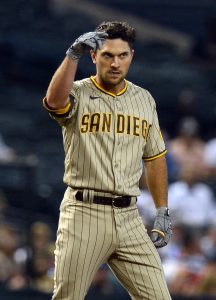
The San Diego Padres and Seattle Mariners have agreed to a three-player trade. The Padres will send All-Star second baseman Adam Frazier to Seattle for left-handed reliever Ray Kerr and outfielder Corey Rosier, reports ESPN’s Jeff Passan (via Twitter). Both teams have announced the deal, making it official.
Frazier certainly fits the mold of the type of offensive contributor that GM Jerry Dipoto tends to covet. Case and point, the Mariners were said to be interested in Frazier at the trade deadline before he ultimately landed in San Diego.
The soon-to-be 30-year-old is a contact-first bat and well-rounded player who can cover second base on a regular basis or move to the outfield. Though his defensive versatility is a plus, his bat plays best if he’s manning the keystone. Right now, that’s where he is most likely to get the bulk of his playing time. He will share the middle infield with J.P. Crawford, while Abraham Toro and Ty France fill out the infield as Dylan Moore moves into a super utility role.
Frazier was an All-Star last season with the Pirates before slowing down in San Diego. Still, he posted 4.0 rWAR and an overall slash line of .305/.368/.411 over 639 plate appearances between the Pirates and Padres. Frazier is projected to make around $7.2MM in arbitration in what will be his final season before free agency, so he rates as a relatively low-risk, low-cost acquisition for the Mariners.
While a solid contributor, it would be difficult to rank him as a true “difference-maker.” His lack of pop (.131 career ISO) makes him more of a line mover than a run creator, though he will lengthen the Mariners’ lineup and make life difficult on opposing pitchers by putting the ball in play and vying for a high batting average.
Truth be told, he’s a fairly similar player in form and function to his new double play partner in Crawford: sure-handed defenders, light on power and patience, who run well and excel at putting bat-to-ball. Don’t be surprised to see Frazier near the top of the Mariners’ batting order on a regular basis, regardless of where they put his glove.
In terms of his approach, Frazier walked in just 7.5 percent of his plate appearances, below the league-average 8.5 percent walk rate. At the same time, he struck out in a mere 10.8 percent of his plate appearances, a much stronger rate than the 22.3 percent league average. In short, Frazier puts pressure on defenses, while minimizing mistakes on the other end. He’s a quality contributor and the type of player that will give manager Scott Servais plenty of options on both ends.
In exchange for one season of Frazier, the Mariners are sending a hard-throwing southpaw reliever in Kerr and a young outfielder in Rosier. Neither have appeared on prospect lists, though Kerr did appear in Fangraphs‘ supplemental “Arm Strength Relief Sorts” section. Wrote Fangraphs, “Kerr is a late-bloomer who came into big velo ahead of the pandemic. He can dunk a basketball and has superlative weight room exploits as well as rare lefty velo, inconsistently up to 99. His splitter flashes plus and the Mariners have worked with his slider enough to create viable sweep on the pitch but it was a 30 the last I saw it. The strike-throwing and secondary consistency are present issues, too.”
At 27 years old without a Major League appearance, Kerr could be considered a non-prospect, though his ability to hit triple-digits on the radar gun provides some intrigue as a potential power arm out of the bullpen. He was signed as a non-drafted free agent back in 2017, beginning his career as a two-way player, though he has focused on pitching in recent years. The athletic ability is clearly there, the question being whether it can be channeled to turn him from a “thrower” to a “pitcher,” as the saying goes.
Last season, Kerr tossed 39 2/3 innings across 36 appearances in Double-A and Triple-A with a combined 3.18 ERA, inspiring 36.8 percent strikeout rate, and 9.8 percent walk rate. For a Padres team that’s prioritizing pitching depth this offseason, Kerr is a solid gamble to add to the 40-man roster.
Rosier, 22, was a 12th round pick in last year’s amateur draft, signing for a $125K bonus. The Maryland native played his college ball at UNC Greensboro, and he was the #249th ranked prospect in the draft, per Baseball America. He played most of last season in Low-A Modesto, slashing an impressive .390/.461/.585 in 141 plate appearances. He projects as an extra outfielder with the ability to play centerfield. At the plate, his limited power is his biggest shortcoming.
Kerr and Rosier aren’t prospects at the level of Tucupita Marcano, Jack Suwinski, and Michell Miliano, the prospect San Diego sent to Pittsburgh to acquire Frazier at the deadline. That said, there’s no reason to think they’d get back fair value. Kerr fits a need and Rosier helps backfill the farm system at a lower level.
The more motivating factor in this deal for San Diego is financial. Frazier’s deal wasn’t exorbitant, but for a team with limited payroll flexibility, clearing Frazier’s deal from the payroll helps. With Jake Cronenworth, Ha-Seong Kim and Jurickson Profar all under contract, the Padres are set with second base/utility types, where Frazier best profiles. With the financial savings, President of Baseball Ops A.J. Preller can look to re-invest into the pitching staff or in finding an impact bat for an outfield corner.
Padres Acquire Adam Frazier
The Padres have acquired one of the most sought-after players on the trade market, picking up second baseman Adam Frazier in a four-player swap with the Pirates. Infielder/outfielder Tucupita Marcano, outfielder Jack Suwinski, and right-hander Michell Miliano are the prospects heading to Pittsburgh in the deal, and the Pirates are also sending $1.4MM along with Frazier to San Diego. The deal became official Monday afternoon.
It’s the first big move of deadline season for Padres general manager A.J. Preller, who is no stranger to splashy moves and is pushing to get his team first to the NL West title and then deeper into October. While a number of pitching injuries would very well result in some arms being added between now and July 30, Preller recently indicated that a bat was also on his shopping list.
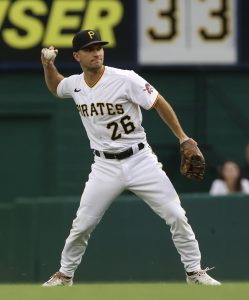
Frazier is enjoying the best season of his seven-year MLB career, hitting .324/.388/.448 with four home runs over 428 plate appearances for the Bucs in 2021. There is some possibility for regression, as Frazier’s .359 BABIP has helped make up for some very low hard-contact numbers, and his .337 xwOBA is well below his .368 wOBA. However, even that xwOBA is still above average, and Frazier somewhat makes up for that lack of hard contact by making a lot of contact in general — fitting the Padres’ model as a player who rarely strikes out.
Frazier is a left-handed hitter, and while the Padres generally lean more to the right side of the plate, Frazier might supplant another left-handed hitting regular in Eric Hosmer. The hot-hitting Jake Cronenworth could slide from second base to take over from Hosmer as the regular first baseman, opening the door for Frazier to become the new everyday second baseman. Since Frazier also has experience as a corner outfielder, he could move into the grass to spell Tommy Pham or Wil Myers, giving San Diego even more positional flexibility.
Since Frazier also has one more year of arbitration eligibility remaining, he’ll be able to help the Padres for both this year’s playoff race and throughout the 2022 season. Frazier was earning $4.3MM this season, so the $1.4MM sent from Pittsburgh will cover most of his remaining salary for 2021, which helps the Padres stay under the $210MM luxury tax threshold.
There was little doubt that the rebuilding Pirates were going to move Frazier by the deadline, given that his strong season only enhanced his trade value. Pittsburgh fans expecting multiple top-100 type prospects may be disappointed by the return, though it’s worth noting that Frazier has been more solid than outstanding during his career, with an even 100 OPS+ and wRC+ over his first six big league seasons. Nevertheless, the Bucs did add three notable prospects to add to GM Ben Cherington’s overhaul of the farm system.
Marcano is the only member of the prospect trio with any MLB experience, appearing in 25 games for San Diego this season and posting a .485 OPS over 50 plate appearances. An international signing from Venezuela in 2016, the 21-year-old Marcano is ranked by MLB Pipeline as the fifth-best prospect in the Padres’ deep farm system, while Baseball America has him in the eighth spot.
The Pirates valued Marcano highly enough that they were willing to include the $1.4MM to the Padres, Rosenthal reports, while other Frazier bidders like the Mariners weren’t asking for any money back in a proposed trade. Heyman adds that the Padres weren’t willing to discuss Marcano back when San Diego and Pittsburgh worked out the Joe Musgrove trade last winter.
There’s plenty to like about the versatile Marcano, who has played mostly second base during his pro career but has also seen a lot of time at third base, shortstop, and both corner outfield slots. At worst, Marcano seems like he’ll have a future as a utilityman, and he could well become a regular due to his excellent contact skills at the plate. Marcano does lack some power, and while he possesses plus speed, BA’s scouting report notes that he will need to improve his baserunning instincts. Marcano skipped Double-A entirely and made his Triple-A debut this year, hitting .272/.367/.444 with six home runs in 199 PA.
Neither Suwinski or Miliano appeared in the top-30 Padres prospect rankings for either Pipeline or Baseball America, but both youngsters have put themselves on the map in 2021. Suwinski was a 15th-round pick for the Pirates in 2016, and hadn’t hit much in his first pro seasons before exploring for a .269/.398/.551 slash line and 15 home runs over 267 PA at Double-A San Antonio. As noted by BA’s Matt Eddy, Suwinski has been doing this despite hitting in a pitcher-friendly home ballpark, though he’ll be moving to another pitcher-friendly location in the Pirates’ Double-A affiliate in Altoona. Suwinski has experience at all three outfield positions, and is just a few days away from his 23rd birthday.
The 21-year-old Miliano has a 6.11 ERA over 94 1/3 innings in San Diego’s farm system, getting to high-A ball this season. Miliano has given up a lot of hits (84) and, troublingly, almost as many walks (78) over his four seasons, but the Pirates were surely intrigued by his ability to miss bats. The right-hander has a 31.74% strikeout rate in the minors, and that number includes an absurd 44.44% rate over 25 2/3 innings at A-level Lake Elsinore this year.
ESPN.com’s Jeff Passan (Twitter link) was the first to report that the Padres had acquired Frazier. FanSided’s Robert Murray reported that the Pirates were getting three prospects, with The Athletic’s Ken Rosenthal and Dennis Lin identifying Marcano and Suwinski and ESPN.com’s Kiley McDaniel identifying Miliano. Kevin Acee of the San Diego Union-Tribune tweeted that the Padres were getting cash back in the trade, with MLB Network’s Jon Heyman specifying the $1.4MM figure.
Photo courtesy of USA Today Sports Images
Mariners Interested In Adam Frazier
The Mariners are known to be on the lookout for infield upgrades, and Ken Rosenthal of The Athletic reports (via Twitter) that Seattle is currently in active pursuit of infielders who are controlled beyond the 2021 season — including Pittsburgh’s Adam Frazier. The Pirates are obvious sellers, and the widespread expectation is that Frazier will likely be traded between now and next Friday’s 4pm ET deadline.
Frazier, 29, is in the midst of the finest season of his solid career. His 413 plate appearances are the fourth-most in Major League Baseball, and he’s turned in a robust .327/.390/.453 batting line with four home runs, 27 doubles, four triples and five stolen bases. Frazier’s 10.9 percent strikeout rate is the fifth-lowest among 137 qualified big league hitters. He’s also tied for the game’s fifth-best contact rate (88.4 percent) and has the game’s seventh-lowest swinging-strike rate (5.4 percent).
It’s true that Frazier has benefited to an extent from some good fortune on balls in play; this year’s .363 BABIP is a career-high. However, even with some regression in that department, Frazier would likely still be enjoying a career year by virtue of that career-low strikeout rate. Statcast pegs his “expected” batting average at .297, after all, and he’s still walking at a respectable eight percent clip while swinging and missing less than ever before. He may not sustain this level of output, but he’s made his rough 2020 season look particularly fluky.
Frazier’s value goes beyond his contributions at the plate, too. His defense at second base has drawn plus ratings in Defensive Runs Saved and Outs Above Average for his career, and he’s also an above-average left fielder by virtually any measure.
The Mariners surely see Frazier as a potential upgrade at second base, where they’ve received a collective .198/.267/.345 output so far in 2021. That’s a disastrous output no matter how you frame it, but it’s actually been far worse as of late; that combined effort includes 69 very strong plate appearances from Ty France, who’s slashed .293/.391/.483 while playing second base. France, however, has been playing more first base lately. Non-France Mariners second basemen in 2021 are hitting just .178/.239/.317 on the season.
As such, it’s no surprise to see Frazier among the Mariners’ targets. He’s playing the year on a $4.3MM salary and is controlled through 2022 via arbitration. That’s a key distinction for the Mariners, who are seven games back in the AL West and four and a half games back of a Wild Card spot. They’re aiming to stock up for a bit of a long-shot postseason run in 2021, but adding players who can help next year when their young core is more established (and likely after some offseason spending) is sensible.
It stands to reason that if Seattle is looking into Frazier, then general manager Jerry Dipoto has also gauged the asking price on Royals All-Star Whit Merrifield, who has again seen his name surface on the summer rumor mill. Dipoto is never afraid to make deals and will likely be checking in on a number of controllable, longer-shot trade candidates as the deadline approaches.
White Sox Interested In Adam Frazier
The White Sox are “taking a close look” at Pirates second baseman Adam Frazier, reports Jon Heyman of MLB Network (Twitter link). The 29-year-old is amidst a stellar campaign that earned him his first career All-Star nod last night.
Chicago surely isn’t alone in taking an interest in Frazier, who has a .326/.393/.468 line (139 wRC+) through 346 plate appearances this season. He broke into the majors in 2016 and immediately settled in as a fairly productive, high-contact bat. Over his first three-plus seasons, Frazier’s ability to put the ball in play resulted in league average offense (.279/.342/.420), despite lacking impact power. He slumped to a .230/.297/.364 mark during last year’s shortened season but has more than rebounded during this season’s first half.
In actuality, Frazier’s true talent level probably hasn’t bounced around as much as those numbers would suggest. Because he specializes in making contact, his production is more dependent than most players on ball-in-play results. Last season, Frazier’s BABIP fell to .246; this year, it’s sitting at a sky-high .361. Over the course of his career, Frazier has a more ordinary .312 BABIP, and it’s fair to presume it’ll settle in around that mark moving forward.
Frazier has made some modest process improvements this season. His contact rate is up nearly four percentage points, to a career-high 88.6%. He’s traded in some grounders for a few extra line drives. But Frazier hasn’t started hitting the ball with dramatically more authority. His hard contact rate is in the 4th percentile leaguewide, while his barrel rate (essentially how often a batter hits the ball hard at an optimal launch angle for power) is in the 3rd percentile, per Statcast. All in all, Frazier likely isn’t all that different than the player he was entering 2021.
That’s not to say he’s not a quality player. As mentioned, Frazier has an established track record of solid work at the plate. He’s a career .282/.345/.422 hitter, six percentage points better than league average by measure of weighted runs created. Advanced defensive metrics have suggested he’s an average or better gloveman at second base, and he’s rated highly as a corner outfielder when asked to man the grass.
In addition to his solid play on the field, Frazier’s an eminently affordable target for contending clubs. He’s making just $4.3MM this season (exactly half of that remains due from now through the end of the year) and is controllable next year via arbitration. He’ll certainly be in line for a nice raise given his production this season, but even a salary in the $8MM – 9MM range in 2022 would be more than reasonable for a player of his caliber.
A year and a half of Frazier’s services would hold a lot more value to a contender than it would for the rebuilding Pirates. Pittsburgh isn’t making the playoffs this season, and they’re not expected to next year either. There’s little reason for the Pirates not to take offers on Frazier (as they did over the offseason) and he looks like a virtual lock to wind up elsewhere before the July 30 trade deadline.
It’s not hard to see the appeal for the White Sox. Second baseman Nick Madrigal is out for the season after undergoing hamstring surgery, and the Sox have been relying on Leury García and Danny Mendick since he went down. Prospect Jake Burger has gotten work at second in the minors and was called up to make his MLB debut today. It’s unclear, though, whether Chicago would feel comfortable turning to Burger, whose more natural position is third base, at the keystone during a pennant race.
The White Sox have also been tied to Eduardo Escobar over the past couple weeks. An Escobar trade remains a possibility (and, as Heyman notes, would surely require a lesser prospect package than the one required to land Frazier), but other teams have jumped into the bidding for the Diamondbacks infielder in recent days.