
Jed Hoyer: Cubs Planning To Look For Pitching At Deadline
Cubs president of baseball operations Jed Hoyer joined the New York Post’s Jon Heyman and Joel Sherman for an interview on the latest edition of The Show podcast (YouTube link), and discussed a number of topics about both his team and baseball at large. Though we’re still several weeks away from the July 31 trade deadline, Hoyer did address his first-place team’s likeliest need.
“I think we’re going to be looking for pitching, both rotation and in the bullpen,” Hoyer said. “I don’t think that’s a secret. That’s not a knock on the guys we have. But I think in today’s game, you’ve got to keep building depth.”
Justin Steele pitched in just four games before his season was prematurely ended by a UCL revision surgery, thus robbing Wrigleyville of one of its top arms for almost the entirety of the 2025 campaign. Javier Assad hasn’t pitched at all this season due to a pair of oblique injuries, and since he only started playing catch a couple of weeks ago, it would seem that a return prior to the All-Star break might not be in the cards. Shota Imanaga hasn’t pitched since May 4 due to a hamstring strain, and Hoyer said “the hope is” Imanaga will be able to return to the rotation before the end of June.
Without their two top pitchers and another hurler in Assad that expected to at least compete for a back-end rotation job, Chicago has done well to hold its own on the rotation front even with such a depleted set of starters. Hoyer made a point of praising his in-house starters and his team’s defense for helping the run-prevention efforts, yet bringing at least one starting pitcher into the fold seems like a logical way to reinforce the roster heading into the pennant drive.
As one might expect, Hoyer didn’t share any hints about how big of a splash the Cubs are looking to make at the deadline, and still couched his comments within the framework of “if” the front office chose to make any additions by July 31. It could be that Hoyer may not know the answer to such questions himself at the moment, as the Cubs’ trade pursuits may hinge on Imanaga’s assumed healthy status by July 31, Assad’s progress, or any other injuries or pitchers who are under- or overachieving in the coming weeks.
Hoyer also said that Porter Hodge is expected to return from his own oblique injury before June is out, which will bring another high-leverage candidate back to help the relief corps. As Hoyer put it, however, bullpens are “always a work in progress…I don’t think you ever get to a point of feeling comfortable or feeling like it’s a set thing.” With this in mind, the pen will be a focus both on July 31, and “we’ll keep on making small transactions [before the deadline] as well to get marginally better.”
On the flip side of the equation, Hoyer doesn’t see the Cubs doing much to alter its impressive core of position players on the trade front. The Cubs have been one of baseball’s best hitting teams, with the powerful offense helping make up for any of the pitching staff’s shortcomings.
“Barring injury, there are probably some small things [we’ll consider] on the offensive side, but really I think that our position-playing group has been really good….The depth we have, top to bottom, I think we’re getting production both offensively and defensively from all our spots. That’s made a huge difference. As I think about it, pitching is the likely direction we would take if we were adding [at the deadline],” Hoyer said.
In terms of other topics, Hoyer said he wouldn’t comment publicly on either the existence of any extensions talks between the Cubs and Kyle Tucker, or even any talks between himself and the team on a new deal, as Hoyer’s current contract is up after the 2025 season. Hoyer repeated past comments about how he hoped Tucker would stay in Chicago over the long term, and how much he has enjoyed his own 14-season tenure in the organization as first a general manager and then the head of the baseball operations department.
Hoyer did go into a little more detail about what might now be the most impactful trade of his five-year run as PBO — the July 2021 deadline deal that brought Pete Crow-Armstrong to the then-rebuilding Cubs from the Mets for Javier Baez, Trevor Williams, and some cash considerations. New York took Crow-Armstrong 19th overall in the 2020 draft so it wasn’t as if PCA was an unknown quantity, yet a shoulder surgery limited the outfielder to only six games in his first pro season.
The Mets weren’t willing to discuss moving more highly-touted prospects at the time, as Hoyer said such players as Francisco Alvarez, Matt Allan, and Brett Baty were “off the table” in trade talks. Mark Vientos “was a guy that was kind of discussed a little bit but it was clear they didn’t want to part with him,” Hoyer noted, so discussions turned towards elsewhere on New York’s minor league depth chart.
Crow-Armstrong “was sort of out of sight, out of mind, I believe,” Hoyer said. “Looking back, I think his injury didn’t allow him to perform, and therefore I think he became a guy [the Mets] were willing to trade in that deal. So I think it was good fortune for us that they did take some really good players off the table, and most of those guys are helping the Mets right now, but Pete’s injury allowed that to happen and it worked out really well for us.”
While Hoyer felt Crow-Armstrong was going to improve as a hitter during his second full Major League season, even the executive admitted to being a little surprised at the extent of the breakout. PCA has been one of the very best all-around players in the sport, delivering 17 homers, 21 stolen bases, and a .277/.313/.559 slash line over 275 plate appearances while also playing Gold Glove-level defense in center field.
Cubs Remain Open To In-Season Extension Talks With Pete Crow-Armstrong
The Cubs made an effort to lock up center fielder Pete Crow-Armstrong during Spring Training. At the time, an MLB.com report indicated that Chicago made an offer that could have maxed out around $75MM had all the option years been exercised — though the actual guarantee would have checked in lower than that.
Last week, Jon Heyman of The New York Post reported that the Cubs offered a guarantee in the $60-70MM range before the season started. Crow-Armstrong obviously wasn’t persuaded by that, and his asking price has surely only increased after a monster start to the year. Most extensions are concentrated during Spring Training or within the opening two to three weeks of the regular season. Players often prefer to table discussions to avoid potential distractions during the summer months.
Heyman nevertheless wrote last week that the Cubs were making “in-season overtures” to Crow-Armstrong’s camp. He indicated the team was willing to up its offer from the spring. President of baseball operations Jed Hoyer predictably didn’t comment on the team’s new price range but told Patrick Mooney of The Athletic on Tuesday that the front office is willing to keep negotiations going. “Not talking during the season, to me, that’s a player-focused thing,” Hoyer told Mooney. “I’m not playing. I’ve got time to negotiate if they want.”
While Hoyer didn’t go into detail about the current state of conversations, he spoke about the reporting from April. Hoyer stated that the sides “hadn’t talked in a couple weeks when (word of the offer) leaked out” and added that “the number that came out about that wasn’t right.” MLB.com had initially reported that the offer was in the $75MM range before correcting that that number represented the approximate maximum value, including what was presumably at least one club option year.
Crow-Armstrong is playing at a level that’d put him in the MVP conversation if he keeps it up all year. He took a .280/.310/.565 slash line across 229 plate appearances into tonight’s game. He has swiped 14 bases in 17 attempts while already establishing a new career high with 14 home runs. He’s added 13 doubles and three triples and is tied for fourth in MLB (behind Aaron Judge, Shohei Ohtani and teammate Seiya Suzuki) with 30 extra-base hits.
That would play at any position. It’s particularly remarkable from a player whose primary asset is his glove. Crow-Armstrong has been viewed as an elite defensive center fielder throughout his professional career. His early MLB results have supported that evaluation. The 23-year-old leads all outfielders with nine Outs Above Average, according to Statcast. He tied for sixth by that metric during his 2024 rookie campaign.
There’s probably still some trepidation about Crow-Armstrong’s offensive approach. He’s among the most aggressive hitters in MLB. He has walked in fewer than 4% of his plate appearances. This season’s success has come despite a middling .310 on-base percentage. The approach was certainly an issue during his debut campaign, as he hit .237/.286/.384 last year.
Crow-Armstrong entered this season with 170 days of major league service, putting him two days shy of one full service year. He’s a lock to qualify for early arbitration as a Super Two player at the end of the ’26 season. He will not reach free agency for another five years after this one, however. If the sides were to negotiate a deal that goes into effect next year, he’d be in the 1-2 year service class.
As Front Office subscribers can see with MLBTR’s Contract Tracker, Jackson Merrill established a new standard for players in that bracket with this spring’s $135MM deal. Merrill probably took something of a hometown discount, but he also had a higher established offensive baseline than Crow-Armstrong does. Merrill hit 24 homers with a .292/.326/.500 slash over a full season as a 21-year-old rookie. He’s also a plus center fielder, albeit not quite the caliber of defender that Crow-Armstrong is. Merrill is an aggressive hitter in his own right, but he’s had sustained offensive success essentially from the moment he reached the big leagues.
Though Crow-Armstrong may have a comparable or even slightly higher ceiling, he’s not as established. During Spring Training, the Cubs seemingly valued him in the next tier of young hitters. An offer in the $60-70MM range would have aligned with recent deals for Lawrence Butler and Ezequiel Tovar. Crow-Armstrong has clearly played himself above that group within the past couple months, but there’s a broad range between them and Merrill.
Cubs, Pete Crow-Armstrong Discussed Contract Extension
TODAY: The Cubs and Crow-Armstrong have ceased negotiations for now, the Athletic’s Patrick Mooney writes. As per Mooney’s framing, the talks seemed somewhat exploratory in nature, and perhaps more to “lay some groundwork for the future” rather than to complete an extension immediately. There was also some conflict with Feinsand’s report in terms of the $75MM ceiling of the possible extension, as Mooney writes that “team and league sources characterized the outline of that report…as inaccurate.”
APRIL 12: The Cubs recently reached out to center fielder Pete Crow-Armstrong‘s camp with an extension offer, according to a report from MLB.com’s Mark Feinsand. Feinsand relays that the deal would’ve maxed out in the $75MM range if all option years involved in the deal had been exercised, though it would not have reached that figure in terms of total guarantee. The exact structure of the offer is not known and, while Feinsand writes that the sides did not work out a deal, it’s unclear whether talks between the two sides have ended for the time being or could continue going forward.
That Chicago would have interest in extending Crow-Armstrong’s stay in Chicago beyond his years of control is hardly surprising. The longtime top prospect came over from the Mets in the Javier Baez trade at the 2021 trade deadline, and he flew through the minor leagues after arriving in Chicago to make his big league debut late in the 2023 season. Crow-Armstrong’s offense has not been anything special during his time in the majors so far, with a 79 wRC+ overall and an 87 wRC+ in 123 games last year, but he’s more than made up for that lackluster performance at the plate with phenomenal work in the field and on the bases. Crow-Armstrong went an excellent 27-for-30 on the basepaths last year, including 22 straight steals without being caught.
In the field, meanwhile, his +14 Outs Above Average and +11 Defensive Runs Saved were the fifth- and seventh-best figures among all outfielders, while his +16 Fielding Run Value was surpassed among fielders at all positions by only Giants catcher Patrick Bailey. Those defensive accolades become even more impressive when considering that Crow-Armstrong played just 112 games in center field, meaning he put up those huge numbers despite getting less than three-quarters of a full season’s worth of reps. Overall, that defensive and baserunning ability was good for 2.7 fWAR last year despite him being 13% below league average as a hitter.
The fact that Crow-Armstrong has flashed a three-win floor when prorated out over a full season has to be enticing to the Cubs even before considering his solid work on offense in the second half last year, when he slashed .260/.309/.442 with a 108 wRC+ and nine homers over the season’s final three months. If the 23-year-old were ever able to reach that sort of offensive production on a consistent basis, he’d likely blossom into the sort of perennial All-Star Chicago is surely hoping for. That all makes trying to extend Crow-Armstrong, as many other clubs have done with youngsters like Lawrence Butler and Ezequiel Tovar, a sensible goal for the organization.
With that being said, offering Crow-Armstrong a hefty contract under the expectation that he will fulfill that offensive ceiling would be very risky. He certainly wouldn’t be the first extremely talented hitter with five-tool potential to fail to reach that ceiling in the big leagues, and Billy Hamilton‘s career serves as a reminder of the fact that a player can’t expect to find success purely off elite defensive and baserunning even if they play a position as defensively important as center field. That surely contributed to a recent poll of MLBTR readers winding up split nearly down the middle on whether or not the Cubs should pursue an extension with the youngster, with just under 52% of respondents voting no.
Chicago’s solution for the wide gap between Crow-Armstrong’s current offensive abilities and his demonstrated potential seems to have been to err on the side of caution. An extension that guarantees Crow-Armstrong significantly less than $75MM would fall below the standard set by many other recent early-career extensions including the aforementioned Butler and Tovar deals as well as deals signed by players like Jackson Chourio and Kristian Campbell just after or before their big league debuts. It’s hard to properly evaluate the deal the Cubs offered Crow-Armstrong without knowing more about the structure; after all, even the deal between Detroit and infielder Colt Keith maxes out in a similar range ($82MM) as the one reported for Crow-Armstrong despite guaranteeing him just $28.6425MM.
Given that even mediocre hitters with the sort of elite defense that Crow-Armstrong possesses like Harrison Bader and Kevin Kiermaier have been paid handsomely in free agency with one-year deals that often fall into the $10MM range, it makes sense that Crow-Armstrong would likely require a healthier guarantee than the one Keith received from the Tigers in order to sign on the dotted line. Evidently, the offer the Cubs presented his camp with did not pass muster, though with the youngster not presently set to hit free agency until after the 2030 season there’s still plenty of time for the two sides to work out a deal that extends his stay in Chicago past those initial years of team control.
Poll: Should The Cubs Extend Pete Crow-Armstrong?
The Cubs’ teardown of their last core that saw them part ways with Kyle Schwarber, Yu Darvish, Jon Lester, Anthony Rizzo, Kris Bryant, Javier Baez, and Craig Kimbrel over the course of nine months. That slate of moves, to this point, has offered little in terms of major league production. There are some promising prospects from trades in that teardown, such as Owen Caissie (Darvish) and Kevin Alcantara (Rizzo) knocking on the door of the big leagues, but some of the pieces acquired in the trades of Darvish, Rizzo, Bryant, and Kimbrel have already departed the organization (e.g. Nick Madrigal, Alexander Canario).
So far, the primary exception is the trade that sent Baez (and right-hander Trevor Williams) to the Mets for center field prospect Pete Crow-Armstrong. The former first-round pick’s premium defense and speed gave him a high floor, and he continued to elevate his stock en route to billing as a consensus top-50 prospect in the sport.
In a league that’s seen an increasing number of young talents locked up long-term before reaching arbitration, Crow-Armstrong’s pedigree has long led Cubs fans to wonder if Chicago could follow in the footsteps of Arizona, Atlanta, and their brethren on the south side and lock up their young center fielder early in his career. It seems as though both the club’s front office and Crow-Armstrong himself could consider such an arrangement. The Athletic’s Sahadev Sharma wrote last week that the front office “would be open” to bringing an offer to Crow-Armstrong. For his part, the youngster told Sharma he’s “always open to that conversation” as well.
Both the highs and the lows of Crow-Armstrong’s profile were on full display in 2024. He hit just .237/.286/.384 (87 wRC+) in 410 trips to the plate across 123 games… and his 2.7 fWAR in center field was still tied with Jacob Young of the Nationals for the eighth-highest figure of any player at the position last year thanks to his top-flight defensive and baserunning abilities. Crow-Armstrong went an excellent 27-for-30 on the basepaths, including 22 straight steals without being caught. In the field, his +14 Outs Above Average and +11 Defensive Runs Saved were the fifth- and seventh-best figures among outfielders, while his +16 Fielding Run Value was surpassed among fielders at all positions by only Giants catcher Patrick Bailey. Those defensive accolades become even more impressive when considering that Crow-Armstrong played just 112 games in center field.
Impressive as his rookie season was in many ways, it’s undeniable that Crow-Armstrong’s bat left something to be desired. Among 31 center fielders to get at least 400 plate appearances last year, his aforementioned 87 wRC+ ranks just 20th and puts him well behind the production of similarly gifted center fielders like Daulton Varsho, Michael Harris II, and Brenton Doyle. If the Cubs believe Crow-Armstrong will remain a below-average hitter, it’d be difficult to justify extending him when he’s already under team control through his age-28 season.
There were some signs of positive growth throughout the year, however. From July onward, Crow-Armstrong slashed .260/.309/.442 with a wRC+ of 108. His strikeout (21.6%) and walk (5.6%) rates were both slightly improved in that time, but most of that offensive boost came from a power outburst. Crow-Armstrong entered July with just one home run but crushed nine more over his final 72 games. While Crow-Armstrong’s .085 ISO through the end of June would put him in line with Andres Gimenez and Luis Arraez, his .185 ISO from July onward was more in line with hitters like Jackson Chourio, William Contreras, and Jazz Chisholm Jr. The increased power is reflected in more advanced metrics, as well. Crow-Armstrong’s barrel rate (4.3%) and hard-hit rate (29.8%) were both lackluster early in the season but from July onward increased to 8.9% and 40.3%, respectively.
Perhaps Harris, who signed an eight-year, $72MM extension with the Braves back in 2022, could be the most useful comp for Crow-Armstrong given his strong work in center field and up-and-down offensive production throughout his career to this point. Harris was in the midst of a dominant rookie season where he slashed .297/.339/.514 (137 wRC+) at the time of his deal with Atlanta and was also a year younger than Crow-Armstrong is now, but lacked his pedigree as a former first-round pick and top-20 prospect while also providing far less defensive value than Crow-Armstrong does.
Lawrence Butler just signed a seven-year, $65.5MM extension but did so with more than a year of service. Glove-first position players with some offensive ceiling who signed long-term deals in recent years include Ke’Bryan Hayes (eight years, $70MM) and Ezequiel Tovar (seven years, $63.5MM). Most of those deals were signed when the player had five remaining years of club control, however. Crow-Armstrong has six.
If you were in the Cubs’ shoes, would you try to lock up Crow-Armstrong long-term despite his lack of consistent offensive track record? Or would you wait to see how he develops in 2025 and beyond, even at the risk that he substantially boosts his earning power with a breakout campaign? Have your say in the poll below:
Should the Cubs extend Pete Crow-Armstrong?
-
No, wait to see how he develops and risk a breakout raising his asking price. 52% (2,634)
-
Yes, offer him an extension despite questions about his bat. 48% (2,445)
Total votes: 5,079
Cubs Promote Luis Vazquez
May 21: The Cubs have now officially promoted Vazquez, with Maddie Lee of the Chicago Sun-Times among those to relay the full slate of moves on X. Swanson was also activated off the injured list while Mastrobuoni and Pete Crow-Armstrong were optioned in corresponding moves.
May 19: The Cubs are promoting infield prospect Luis Vazquez to the majors, according to ESPN’s Jorge Castillo (who also happens to be Vazquez’s cousin). The 24-year-old Vazquez will be making his MLB debut whenever he appears in his first game.
Since the Cubs’ next game isn’t until Tuesday, Vazquez’s call-up seems tied to Nico Hoerner‘s health status. Hoerner hasn’t played since last Monday due to a balky hamstring, and while the Cubs were hopeful Hoerner would be able to play Tuesday, it could be that the team decided that an official injured list stint was necessary to get Hoerner fully recovered. Dansby Swanson is also already on the IL recovering from a knee sprain and was expected to be activated on Tuesday, so it is possible Vazquez could be joining the Cubs if there has been some unknown setback in Swanson’s recovery.
Whatever the case, the door has been opened for Vazquez to get his first shot at the big leagues. A 14th-round pick for the Cubs in the 2017 draft, Vazquez didn’t do much at the plate until last season, when he batted a combined .271/.361/.456 with 20 home runs over 528 plate appearances almost evenly split between Double-A and Triple-A. The hot hitting has continued into this season, as Vazquez has slashed .270/.369/.409 with three homers across his 164 PA with Triple-A Iowa.
This breakout year led the Cubs to put Vazquez on their 40-man roster last November in advance of the Rule 5 Draft, and for some extra attention from the pundits — MLB Pipeline has Vazquez ranked as the 13th-best prospect in Chicago’s farm system, while Baseball America has him 14th. As per Pipeline’s scouting report, Vazquez was able to straighten out his swing and make better contact after learning to lower his hands at the plate, thus unlocking some extra power potential. Between these improvements and Vazquez’s highly-touted defense, both Pipeline and BA think Vazquez now has a path to a Major League role as a versatile bench player.
Vazquez’s glovework and throwing arm each merit 60s on the 20-80 scouting scale, and as Pipeline puts it, “he’s so good at short that Chicago rarely has deployed him at other positions.” Vazquez does have some experience at second and third base and shouldn’t have much trouble at either position given his shortstop capability, making him an interesting utility option for the Cubs on at least a temporary basis. Miles Mastrobuoni and Nick Madrigal have been filling the middle infield roles with Swanson and Hoerner out, and if both players are indeed back on Tuesday, Mastrobuoni could find himself relegated back to Triple-A to create room for Vazquez’s promotion.
Cubs To Place Cody Bellinger On IL With Fractured Rib, Recall Pete Crow-Armstrong
3:55pm: Bellinger technically has two cracked ribs, Counsell tells Jesse Rogers of MLB.com, though there’s still no timeline for his absence.
3:25pm: The Cubs are going to place outfielder Cody Bellinger on the injured list due to a fractured rib, per Robert Murray of FanSided, relaying words from manager Craig Counsell on 670 The Score. Fellow outfielder Pete Crow-Armstrong will be recalled in a corresponding move.
Bellinger crashed into the wall at Wrigley Field last night while attempting to make a catch and was later removed. The club announced that he had a right rib contusion with Counsell saying after the game that the initial x-rays came back negative. It would appear that further testing has revealed a fracture and Bellinger will require a stint on the injured list to heal up.
It’s unclear at this point exactly how much time Bellinger will need to heal this fracture but the club will likely provide more information today or in the coming days. Either way, it’s an unfortunate blow for the club as Bellinger was just starting to heat up at the plate.
He hit .167/.270/.296 through his first 14 contests but his line in his past eight games was .333/.412/.700. Instead of building on that momentum, he’ll now have to sit out while dealing with this rib injury for some unknown amount of time.
For the Cubs, they already have several pitchers on the injured list and today’s news will leave them doubly shorthanded in the outfield. Seiya Suzuki went on the IL last week due to an oblique strain and is looking at an absence of about a month or so.
Those injuries will open the door for Crow-Armstrong to get another shot in the majors. He’s long been considered an excellent defender but with less certainty about his offense. He got his first taste of the majors late last year but hit just .000/.176/.000 through his first 19 plate appearances. He’s also been struggling in Triple-A so far this year, with a line of .203/.241/.392 in 83 plate appearances down there.
Despite the lack of offense lately, Crow-Armstrong might get a decent run of playing time in center while Bellinger is out. As mentioned, he should at least provide the Cubs with strong glovework, but the hitting will be more of a question mark. Ideally, he could get back to the form he showed prior to his promotion last year, when he hit .283/.365/.511 between Double-A and Triple-A. Some combination of Ian Happ, Mike Tauchman and Alexander Canario will also be in the mix for outfield playing time, with Patrick Wisdom heading out to the grass on some occasions as well.
For Bellinger personally, this injury will possibly put a dent in his plans to return to the open market in search of the long-term contract he didn’t find this winter. Though he hit .307/.356/.525 for the Cubs last year while also providing strong outfield defense, it seems that teams around the league were still hesitant about his injury-induced struggles in previous seasons. He required shoulder surgery after the 2020 season and hit just .193/.256/.355 over the two subsequent campaigns.
Even though his results were good last year, he also spent some time on the injured list due to a left knee contusion. Even when he returned from the IL, the Cubs kept him at first base for a while to limit the wear and tear on him, as opposed to running him out to the more demanding position of center field.
The bounceback in 2023 wasn’t enough to get Bellinger the mega deal he was likely hoping to secure, and he instead returned to the Cubs on a three-year deal that allows him to opt out after each season. After inking that deal, the ideal scenario would have seen Bellinger stay healthy and productive for the whole year, therefore casting aside some of the doubts about his health and long-term viability. Each day that he spends on the injured list this year will limit his ability to shift the narrative before deciding whether to trigger his opt-out at the end of the season.
Cubs Designate Anthony Kay For Assignment
The Cubs have designated left-hander Anthony Kay for assignment, per Meghan Montemurro of the Chicago Tribune. His 40-man roster spot will go to prospect Pete Crow-Armstrong, whose promotion was reported earlier today. Outfielder Alexander Canario was optioned to open an active roster spot.
Kay, 28, has made 13 appearances for the Cubs this season but with an earned run average of 6.35 in that sample. His eight strikeouts were a match for his eight walks, leading to subpar 14.8% rates in both categories. He’s spent more time in Triple-A this year and has had better results there. In 37 1/3 innings, he has a 4.10 ERA, 31.1% strikeout rate and 52.4% ground ball rate, though his 13.7% walk rate is still quite high.
Since the trade deadline has long passed, the Cubs will have to put Kay on waivers in the coming days. They already passed him through unclaimed back in January, before adding him back to the roster in June. That was his first outright, meaning he didn’t have the right to elect free agency at that time. But if he were to pass through unclaimed a second time, he would then have the right to reject another such assignment.
Kay was once a prospect of note, having gone from the Mets to the Blue Jays alongside Simeon Woods Richardson in the 2019 Marcus Stroman trade. He hasn’t been able to put it together yet, with a career ERA of 5.60 in 82 innings. If any club were intrigued by his past prospect stock or his strikeout stuff in the minors this year, the southpaw comes with five years of control, but he will be out of options next year.
Cubs To Promote Pete Crow-Armstrong
The Cubs are calling up top outfield prospect Pete Crow-Armstrong, reports Jeff Passan of ESPN. He’s expected to be activated prior to tomorrow’s game. The Cubs will need to make a 40-man roster move in order to formally select Crow-Armstrong’s contract.
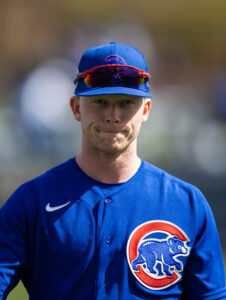
Selected by the Mets with the No. 19 overall pick back in 2020, the now-21-year-old Crow-Armstrong was the headline prospect in the 2021 trade sending Javier Baez and Trevor Williams from Chicago to New York. Crow-Armstrong was already a prospect of note at the time, but his stock has skyrocketed since that swap; he currently ranks 12th on the leaguewide top-100 prospect lists at both Baseball America and MLB.com, while The Athletic’s Keith Law tabbed him 18th and FanGraphs’ Eric Longenhagen pegs him 23rd.
While he’s long drawn praise as a 70- or even 80-grade defender in center field (on the 20-80 scale), Crow-Armstrong has grown into more power since being traded to the Cubs and now has the look of a potential five-tool center fielder. He’s split the current season between Double-A and Triple-A, turning in a combined .283/.365/.511 batting line with 20 home runs, 26 doubles, seven triples and 37 steals (in 47 tries).
Crow-Armstrong has whiffed a bit more often than the Cubs would prefer to see, punching out at a 25.8% rate against a higher-than-average (but far from elite) 9.2% walk rate. He’s also a 21-year-old facing much older and more experienced competition, so there’s likely some hope that he can continue to polish those bat-to-ball skills and refine his pitch selection as he ages.
The big picture hope for Crow-Armstrong is that he can become the Cubs’ everyday center fielder, holding down that position for the six-plus seasons which they’ll control him via arbitration. In the short-term, however, “PCA” will give the team an alternative to the struggling Mike Tauchman, who’s batting just .163/.295/.188 in 95 plate appearances over the past month. Cody Bellinger, of course, can handle center field as well, but he’s spent a fair bit of time at first base and designated hitter since returning from a knee injury earlier this summer. Crow-Armstrong can potentially allow him to continue doing so while still upgrading the outfield defense and perhaps providing some more offense than they’re currently receiving from Tauchman.
Even if he doesn’t play everyday, Crow-Armstrong adds a dynamic defender and plus threat on the basepaths who can be used late in games. That includes both in the regular season and potentially into October. While Crow-Armstrong wasn’t on the 40-man roster when the playoff eligibility deadline passed, he was still in the organization at that point, meaning the Cubs can petition the league to add him to the playoff roster in place of an injured player. Teams do this every year, and there’s no reason to think he won’t be able to suit up during postseason play.
In terms of service time considerations, Crow-Armstrong will remain under club control for six full seasons (plus the handful of days he’ll accrue late in the current year). Barring any future optional assignments that impact the trajectory, he’ll be controllable through the 2029 season and eligible for arbitration following the 2026 campaign.
Also of note for the Cubs is that the looming promotion to the big leagues won’t impact Crow-Armstrong’s rookie status for the 2024 season. He’ll surely be on every major top-100 prospect ranking heading into the 2024 season, meaning he’ll remain eligible for the new collective bargaining agreement’s “prospect promotion incentives,” which could net the Cubs bonus draft picks based on how he fares in future award voting.
Big Hype Prospects: Holliday, Merrill, Jobe, Chourio, Crow-Armstrong
Big Jackson Prospects is back with another edition starring members of the new Jackson Four.
Five Big Hype Prospects
Jackson Holliday, 19, SS, BAL (AAA)
(A/A+/AA) 490 PA, 10 HR, 23 SB, .333/.451/.517
Holliday is the top-performing minor leaguer among players with more than 400 plate appearances. His 168 wRC+ is all the more impressive when considering his age relative to his competition. The question now on everyone’s lips – will he make his Major League debut this year? To me, that will depend on how he does in the next few weeks. One factor is outside of his control: will the Orioles have an injury to open a playoff roster spot for him? He’s likelier to get a taste of the Majors if he’s expected to contribute to the playoff push.
To date, Holliday has relied on hard, low-angle contact and high BABIPs to fuel his offensive success. Such an approach tends to be less effective in the Majors. At Triple-A, we’ll get our first public look at his exit velocities. I’ve heard some rumors but haven’t gotten my hands on the actual data yet.
Jackson Merrill, 20, SS, SDP (AA)
(A+/AA) 488 PA, 15 HR, 15 SB, .283/.331/.454
Merrill is having a nice time of it in Double-A. He was reportedly considered for a promotion to the Majors about 10 days back. The Padres seemingly decided against the aggressive move. As it stands, he’s positioned himself to skip a return engagement in Double-A next season. As to where he fits in the Padres long-term plans, he might need to wait for Ha-Seong Kim and Jake Cronenworth to open the door at second base. The FanGraphs prospect crew described Merrill as “Michael Brantley, except at shortstop,” and that’s exactly how he’s trending.
Jackson Jobe, 20, SP, DET (A+)
(A+) 30 IP, 12.30 K/9, 0.90 BB/9, 3.90 ERA
Jobe is a spin-rate boss with four average or better offerings. His weapons have allowed him to live in the strike zone in the low minors. A test in Double-A to open 2024 should help with the development of his command. Encouragingly, the Tigers are using Jobe like a traditional starter down the stretch. Since reaching High-A, he’s faced 20 or more batters in four of six outings. Compare that to other top pitching prospects around the league. Jobe hasn’t pitched much since he was drafted in 2021. It’s possible we see him finish out his season in the Arizona Fall League.
Jackson Chourio, 19, OF, MIL (AA)
(AA) 509 PA, 21 HR, 37 SB, .282/.336/.471
One of the few upper-echelon prospects younger than Holliday, Chourio has spent the entire season in Double-A where he’s held his own against much older competition. He’s been particularly effective of late, delivering four home runs and a .998 OPS in his last 45 plate appearances. Anyone hoping to see him promoted into the NL Central playoff race shouldn’t hold their breath. His defensive skills remain a work in progress. While he has the raw tools to stick in center field, his reads are still inconsistent. Were his glove ahead of his bat, he’d have a better case for a cheeky late-season promotion.
Pete Crow-Armstrong, 21, OF, CHC (AAA)
(AA/AAA) 474 PA, 18 HR, 35 SB, .278/.364/.499
Unlike Chourio, Crow-Armstrong’s impressive defensive ability must be weighing heavy on the playoff-aspiring Cubs. Though they’ve gotten good results from Mike Tauchman, that feels more like found money than a sustainable source of production. A promotion for Crow-Armstrong would be a lock if not for one bugaboo – a 30.3% strikeout rate in Triple-A. There’s considerable swing-and-miss to PCA’s game. He has pop, emerging discipline, and plenty of speed to make up for his lack of contact. There are some roster considerations working against Crow-Armstrong since he’s not Rule 5 eligible until after 2024. If the Central battle remains close come mid-month, I expect to see him.
Three More
Ronny Mauricio, NYM (22): In just 11 plate appearances, Mauricio has already delivered the Mets hardest-hit ball of 2023. There’s no question the switch-hitter shoots lasers. The issue is whether or not he makes enough contact to sustain a regular role. Though athletic, he’s not known for his defensive ability.
Emmet Sheehan, LAD (23): In the wake of today’s news, Sheehan has elevated importance for a Dodgers club with only two veteran starters. In limited action, he hasn’t had confidence in his changeup. He needs that to be his moneymaker. Below-average command hints at a relief future.
Masyn Winn, STL (21): When we covered Winn at the time of his promotion, we noted the bat didn’t seem ready despite a broad base of skills. He’s struggled to a 6 wRC+ in 49 plate appearances. Winn appears to be making a classic first-timer mistake – selling out for any contact at the expense of quality contact. He still has a dozen ways to grow into an average or better player.
Did I miss a detail or nuance? DM me on Twitter @BaseballATeam to suggest corrections.
MLB Announces Futures Game Rosters
Major League Baseball announced rosters for the 2023 Futures Game this evening. The contest — a seven-inning exhibition between some of the sport’s most talented minor leaguers — kicks off All-Star festivities in Seattle on Saturday, July 8.
As Jonathan Mayo of MLB.com notes, 28 of the 50 players on the roster are included on MLB Pipeline’s recent Top 100 prospects list. Six of Pipeline’s top ten will participate. The full rosters (MLB Pipeline prospect rank included, if applicable):
American League
- Clayton Beeter, Yankees RHP (AAA)
- Lawrence Butler, A’s OF (AA)
- Junior Caminero, Rays INF (AA), #17 prospect
- Jonathan Cannon, White Sox RHP (High-A)
- Joey Cantillo, Guardians LHP (AAA)
- Jonatan Clase, Mariners OF (AA)
- Shane Drohan, Red Sox LHP (AAA)
- David Festa, Twins RHP (AA)
- Harry Ford, Mariners C (High-A), #29 prospect
- Drew Gilbert, Astros OF (AA), #76 prospect
- Jackson Holliday, Orioles INF (High-A), #1 prospect
- Spencer Jones, Yankees OF (High-A)
- Colt Keith, Tigers INF (AA), #43 prospect
- Heston Kjerstad, Orioles OF (AAA), #40 prospect
- Will Klein, Royals RHP (AAA)
- Justyn-Henry Malloy, Tigers INF (AAA)
- Kyle Manzardo, Rays INF (AAA), #42 prospect
- Marcelo Mayer, Red Sox INF (AA), #5 prospect
- Kyren Paris, Angels INF (AA)
- Edgar Quero, Angels C (AA), #72 prospect
- Sem Robberse, Blue Jays RHP (AA)
- Tyler Soderstrom, A’s C (AAA), #37 prospect
- Owen White, Rangers RHP (AAA), #48 prospect
- Nick Yorke, Red Sox INF (AA), #91 prospect
- Yosver Zulueta, Blue Jays RHP (AAA)
National League
- Mick Abel, Phillies RHP (AA), #46 prospect
- Ryan Bliss, Diamondbacks INF (AA)
- Jackson Chourio, Brewers OF (AA), #3 prospect
- Justin Crawford, Phillies OF (Low-A), #90 prospect
- Pete Crow-Armstrong, Cubs OF (AA), #10 prospect
- Yanquiel Fernandez, Rockies OF (AA), #97 prospect
- Kyle Harrison, Giants LHP (AAA), #14 prospect
- Tink Hence, Cardinals RHP (High-A), #66 prospect
- Brady House, Nationals INF (High-A), #75 prospect
- Jordan Lawlar, Diamondbacks INF (AA), #7 prospect
- Noelvi Marte, Reds INF (AA), #19 prospect
- J.P. Massey, Pirates RHP (High-A)
- Jackson Merrill, Padres INF (High-A), #12 prospect
- Jacob Misiorowski, Brewers RHP (High-A), #93 prospect
- Patrick Monteverde, Marlins LHP (AA)
- B.J. Murray, Cubs INF (AA)
- Nasim Nunez, Marlins INF (AA)
- Jeferson Quero, Brewers C (AA), #79 prospect
- Endy Rodriguez, Pirates INF/C (AAA), #39 prospect
- Dalton Rushing, Dodgers C (High-A), #51 prospect
- Victor Scott II, Cardinals OF (High-A)
- Spencer Shwellenbach, Braves RHP (Low-A)
- Mike Vasil, Mets RHP (AAA)
- Carson Whisenhunt, Giants LHP (AA)
- James Wood, Nationals OF (AA), #6 prospect