
Blue Jays Interested In Raisel Iglesias
The Blue Jays are active in their hunt for pitching and have shown interest in Angels closer Raisel Iglesias, reports Ben Nicholson-Smith of Sportsnet.
The fact that the Blue Jays are interested in Iglesias is not surprising. For one thing, they are known to be on the hunt for bullpen upgrades, having already been connected to relievers such as Michael Fulmer and acquiring Zach Pop and Anthony Bass earlier today. The team’s relievers as a whole have been middling this year, with a 3.89 ERA that’s 15th in the majors, a 4.20 FIP that’s 25th, 3.96 xFIP that’s 15th and a 3.64 SIERA that’s also 15th. For a team with postseason aspirations, there’s certainly room for improvement there.
Iglesias is also a fairly logical hurler for them to covet, as he’s been one of the best closers in baseball over the past six years. Since the start of the 2017 season, he has 150 saves, trailing only Kenley Jansen and Edwin Diaz in that timeframe. In that same window, Iglesias has a 2.99 ERA, 32% strikeout rate and 7.1% walk rate.
However, it would be surprising to see the Angels consider a move, given that they just signed him to a four-year, $58MM deal about eight months ago. Still, with a 43-59 record and a lost season, perhaps the Angels would consider shedding some payroll by subtracting from their bullpen.
Major League Baseball Issues 12 Suspensions For Angels – Mariners Brawl
Major League Baseball has handed down 12 suspensions arising from yesterday’s bench-clearing brawl between the Angels and Mariners. The league also handed out undisclosed fines. Nine of the individuals disciplined are from the Angels, while the Mariners lose a trio of players. The discipline is as follows:
Angels
- Interim manager Phil Nevin: Ten games
- Third baseman Anthony Rendon: Five games
- Assistant pitching coach Dom Chiti: Five games
- Right-hander Andrew Wantz: Three games
- Right-hander Ryan Tepera: Two games
- Right-hander Raisel Iglesias: Two games
- Bench coach Ray Montgomery: Two games
- Interpreter Manny del Campo: Two games
- Catching coach Bill Haselman: One game
Mariners
- Outfielder Jesse Winker: Seven games
- Shortstop J.P. Crawford: Five games
- Outfielder Julio Rodríguez: Two games
The fight occurred during yesterday afternoon’s contest (video link). Wantz, who opened the game for the Halos, threw a pitch behind Rodríguez in the first inning. That came on the heels of the Angels taking umbrage to an up-and-in offering from Erik Swanson to Mike Trout the night before, and it resulted in warnings from the umpiring crew. Wantz nevertheless hit Winker with the first pitch of the following inning. The Seattle left fielder initially seemed as if he’d simply take first base, but he wound up making his way towards the Angels’ dugout. That kicked off a few minutes of fighting that eventually resulted in the ejections of Wantz, Winker, Crawford, Rodríguez, Nevin, Tepera, Iglesias and Seattle manager Scott Servais.
Wantz’s suspension is for “intentionally throwing at Winker while warnings were in place,” according to MLB. Nevin has been suspended for Wantz’s pitches, while everyone else involved was banned for their roles in the melee itself.
Players are afforded an appellate right for on-field discipline. MLB announced that Wantz has already foregone his appeal and will begin serving his suspension today. The league didn’t indicate that any other players had done that, so they’ll remain on the roster while their suspensions are being heard. Rendon is on the injured list after undergoing season-ending wrist surgery two weeks ago. His suspension won’t take effect until he’s back on the active roster — meaning he’ll presumably miss the first five games of the 2023 season.
Coaches do not have the right to appeal their suspensions. Nevin, Chiti and del Campo will begin serving their bans tonight; Montgomery and Haselman will be out once Chiti returns five games from now.
Notably, players suspended for on-field rules violations cannot be replaced on the active roster. Ryan Divish of the Seattle Times tweets that the Mariners will be permitted to stagger any bans for their suspended players so as not to have the position player group decimated at the same time — it’s unclear if a similar setup will be in place for the Halos’ bullpen — but the teams will both be playing short-handed for a while once the appeals process is sorted out. While the Angels were dealt significantly more suspensions in terms of quantity, Seattle will feel the bigger hit in on-field production (assuming the suspensions aren’t overturned on appeal) with the subtraction of a trio of regulars from the lineup.
Angels Sign Raisel Iglesias To Four-Year Deal
The Angels are keeping their closer in the fold, announcing the re-signing of Raisel Iglesias on a four-year, $58MM deal. The Magnus Sports client will make $10MM in 2022, followed by successive $16MM salaries from 2023-25.

Iglesias is the top free agent reliever on this winter’s market, a fact reflected in the reported four-year guarantee. Only one reliever (Liam Hendriks and Drew Pomeranz, respectively) has landed a four-year pact in each of the past two offseasons.
Iglesias earns his place among that group after posting one of the stronger seasons by any late-game option around the league. The Angels acquired the right-hander from the Reds last offseason in a move that required little more than assuming his $9.125MM salary for 2021. That proved to be an absolute bargain, as Iglesias acclimated well to his new home in Orange County. Assigned the Angels’ ninth-inning role, he tossed 70 innings of 2.57 ERA ball, successfully locking down 34 of 39 save attempts.
That marked Iglesias’ fifth season (out of six since he transitioned to the bullpen in 2016) of sub-3.00 ERA work. The Cuba native has rather quietly been one of the sport’s most consistent, reliable relief arms. That’s in spite of the fact that Iglesias has spent the majority of his career in Cincinnati, which sports one of the game’s most hitter-friendly ballparks.
Impressive as Iglesias’ run prevention numbers are, his underlying metrics may be even better. The right-hander has punched out a strong 29.7% of batters faced over the course of his career, and he’s coming off a personal-best 37.7% strikeout rate. That’s the eighth-highest mark of the 138 relievers with 50+ innings pitched, while his massive 20.6% swinging strike rate trailed only Josh Hader among that same group.
While many relievers can struggle to harness high-octane stuff, Iglesias has had no such problems. His walk rates in each of the past three seasons have been far lower than average, and this past season’s 4.4% figure was among the ten lowest among relievers. Iglesias’ 33.3 percentage point gap between his strikeout and walk rates ranked third, as did his 2.06 SIERA.
The only real drawback in Iglesias’ game has been the longball. He’s generally a fly-ball pitcher, and that’s led to some issues keeping the ball in the yard. Iglesias has allowed homers at a higher than average clip in three of the past four years, including a 1.41 HR/9 mark in 2021. That’s a small red flag, but Iglesias is so effective at preventing baserunners that he often mitigates the damage done via the home run. Opponents reached base at just a .243 clip in 2021.
Iglesias’ reported contract terms land right in line with expectations. Entering the offseason, MLBTR forecasted a four-year, $56MM guarantee that Iglesias moderately tops. That came after he rejected Los Angeles’ $18.4MM qualifying offer, a decision that proved wise given the solid multi-year contract he managed. The Angels won’t directly forfeit a draft choice for re-signing their own free agent, although they are passing on the right to collect the compensation pick they’d have received had Iglesias signed elsewhere.
That’s a worthwhile trade-off for the win-now Angels, who’ll hope for continued excellence from Iglesias at the back end of the bullpen. He becomes the second and more expensive multi-year relief investment of the offseason for Los Angeles, who also signed southpaw Aaron Loup to a two-year deal. They’ll try to anchor a bullpen that was below-average in 2021, even including Iglesias’ stellar numbers.
The deal’s financial breakdown has yet to be reported, but it becomes another significant deal on the Angels’ books. Iglesias’ $10MM salary brings the club’s estimated 2022 commitments around $172MM, per Jason Martinez of Roster Resource. The deal’s $14.5MM luxury tax hit (which is based on average annual value as opposed to actual payment schedule) puts the Angels’ projected CBT number above $185MM.
The luxury tax thresholds in the next collective bargaining agreement have yet to be determined, but the Angels haven’t exceeded the threshold in more than a decade. They’ve never opened a season with a player payroll higher than last year’s $181MM mark, per Cot’s Baseball Contracts. Whether owner Arte Moreno is willing to push beyond that in 2022 remains to be seen, but there figures to be plenty of urgency to put a strong supporting cast around the Angels’ star core. Los Angeles could also have to deal with a tougher division than they have in years past, as the Rangers and Mariners have been among the most active teams this offseason.
Ken Rosenthal of the Athletic was first to report the Angels were nearing agreement with Iglesias on a four-year deal. Jeff Passan of ESPN was first to report the deal had been agreed upon. Jon Morosi of MLB.com reported the $58MM guarantee. Jeff Fletcher of the Orange County Register was first with the financial breakdown.
Image courtesy of USA Today Sports.
Raisel Iglesias To Reject Qualifying Offer
Closer Raisel Iglesias will reject the Angels’ one-year, $18.4MM qualifying offer, tweets Ken Rosenthal of The Athletic. He’s still free to negotiate with the Angels on a new contract, of course, but will continue to pursue a multi-year arrangement in free agency.

That Iglesias would reject the qualifying offer comes as no surprise. The 31-year-old righty (32 in January) is coming off arguably the best season of his career and is the clear top reliever on this year’s market. MLBTR projected Iglesias to secure a four-year pact worth $56MM on our recent ranking of the offseason’s top 50 free agents, and a strong three-year deal, at minimum, seems quite likely even with draft compensation now attached to the righty.
A look at virtually any relief pitching leaderboard will show Iglesias among the leaders in most key numbers. The former Reds stopper finished eighth among 144 qualified relievers with a 37.7% strikeout rate and also posted the ninth-best walk rate at 4.4%. Only two qualified relievers, Josh Hader and Liam Hendriks, topped Iglesias’ huge 33.3 K-BB%. Beyond that, Iglesias’ 20.6% swinging-strike rate trailed only Hader, and his 2.06 SIERA was second only to Hendriks. No reliever in baseball posted a better swinging-plus-called-strike rate than Iglesias’ 36.8% mark.
Statcast finds Igleisas similarly dominant, rating him in the 85th percentile or better in terms of hard-hit percentage, average exit velocity and expected opponents’ batting average, slugging percentage and wOBA.
In terms of more traditional numbers, Iglesias tied for the fourth-most saves in Major League Baseball at 34 and finished 23rd among relievers with 70 innings pitched. That’s due largely to the Halos using him as a one-inning option, but Iglesias showed during his time with Cincinnati that he’s plenty capable of recording four-, five- and six-out saves when needed. His 2.57 ERA ranked “only” 29th among 144 qualified relievers, but as evidenced by the aforementioned SIERA, most fielding-independent marks feel he was better than that baseline ERA.
Simply put, Iglesias is a workhorse reliever who misses bats and limits walks at levels that place him alongside elite names like Hader and Hendriks. He’s appeared in at least 65 games and tallied at least 67 innings in each of his four full seasons as a reliever, dating back to 2017. Iglesias had a pair of month-long stays on the injured list due to minor shoulder troubles back in 2015-16, when the Reds were still debating whether he fit best as a starter or reliever, but since moving to the ‘pen full time, he’s had only a single 10-day stint on the IL for a minor biceps issue.
If there’s one flaw in Iglesias’ game, it’s the occasional home run. His average of 1.41 homers per nine frames this year was surely higher than the Angels would’ve hoped, but his minuscule walk rate and paltry .207 opponents’ batting average and .243 opponents’ OBP meant that the majority of those round-trippers came with the bases empty. It’s not exactly a career-long issue, either, as Iglesias yielded just one homer in 23 frames during the shortened 2020 season (0.39 HR/9) and has averaged a more manageable 1.10 homers per nine innings in his seven-year MLB career.
Iglesias is the only reliever on this year’s market to receive a qualifying offer, but he’s superior enough in terms of age, track record and strikeout-to-walk profile that it shouldn’t prove to be a major hindrance to his market. Kenley Jansen, Kendall Graveman and Corey Knebel are among the names in the next tier, but Iglesias should be a lock to score the biggest contract of any relief pitcher this offseason.
Photo courtesy of Imagn/USA Today Sports.
14 Players Receive Qualifying Offers
Today was the last day for teams to issue qualifying offers to eligible free agents, as teams had to make their decisions by 4pm CT. With the deadline now behind us, here are the players who were issued the one-year, $18.4MM offers…
- Brandon Belt, Giants (link)
- Nick Castellanos, Reds (link)
- Michael Conforto, Mets (link)
- Carlos Correa, Astros (link)
- Freddie Freeman, Braves (link)
- Raisel Iglesias, Angels (link)
- Robbie Ray, Blue Jays (link)
- Eduardo Rodriguez, Red Sox (link)
- Corey Seager, Dodgers (link)
- Marcus Semien, Blue Jays (link)
- Trevor Story, Rockies (link)
- Noah Syndergaard, Mets (link)
- Chris Taylor, Dodgers (link)
- Justin Verlander, Astros (link)
This is the highest number of qualifying offers issued since the 2015-16 offseason, when a record 20 players received the QOs. Only six players received qualifying offers last winter, which was the lowest ever issued in an offseason, yet not really surprising given the pandemic’s impact on the 2020 season and league revenues.
These 14 players now have until November 17 to decide whether or not to accept the offer. If they accept, they’ll receive $18.4MM next season, and can’t be traded until June 15, 2022. They also won’t be eligible to receive a qualifying offer in any future trips to free agency (players are also ineligible for the qualifying offer if they haven’t spent at least one full season with their current team). Since the qualifying offer system was introduced in the 2012-13 offseason, 10 of the 96 players to receive a QO have taken the deal.
If a player rejects the qualifying offer, draft pick compensation is now attached to their market, unless they re-sign with their former team. Teams who sign a QO free agent will have to surrender at least one draft pick, and potentially some international bonus pool money depending on their status as revenue-sharing recipients or whether or not they exceeded the luxury tax threshold. (Here is the list of what every team would have to give up to sign a QO free agent.)
If a QO free agent signs elsewhere, that player’s former team receives a compensatory draft pick based on this criteria….
- A draft pick after Competitive Balance Round B will be awarded if the team losing the free agent did not receive revenue sharing or if the free agent in question signed a contract worth less than $50MM in guaranteed money.
- A draft pick after Round 1 will be awarded if the team losing the free agent received revenue sharing and the free agent in question signed for more than $50MM.
- A draft pick after Round 4 will be awarded if the team losing the free agent paid luxury tax penalties in the preceding season.
As always, several factors are weighed by both teams and players about whether or not to issue or accept qualifying offers. This winter provides yet another wrinkle — this could be the final year of the current qualifying offer system due to the expiration of the current Collective Bargaining Agreement on December 1. It is widely expected that the owners could lock out the players if a new deal isn’t reached by that date. In the event of a lockout, MLB would institute a roster freeze on all transactional business involving Major League players, thus bringing the free agent market to a halt.
With this deadline looming, it is possible we could see some QO recipients (those less certain of landing big multi-year contracts) choose to accept the one-year deal in order to guarantee themselves some financial and contractual security prior to a possible lockout. By that same token, this could make teams warier about extending the qualifying offer to certain players due to a larger suspicion that they would accept…or perhaps a player’s willingness to accept could make a team more inclined to issue a QO to a so-called borderline case.
Free Agent Notes: Correa, Iglesias, Rodriguez
The upcoming free agent shortstop market has been talked about for awhile now, and we’re still a few months off from seeing how the whole thing plays out. Perhaps the most coveted of the soon-to-be available shortstops is the Astros’ Carlos Correa. One potential match for Correa’s services will be the Tigers, tweets MLB Network’s Jon Heyman.
The Tigers are an up-and-coming team with plenty of financial flexibility, and it’s certainly interesting to think about Correa once again teaming up with his former skipper A.J. Hinch. As hard as it is to imagine Correa leaving Houston, they do have prospect Jeremy Pena waiting in the wings, making an exit at least feasible. The Tigers, meanwhile, have one of the most open shortstop situations in the game, with incumbent Niko Goodrum easily able to shift into a super-utility role.
Angels’ closer Raisel Iglesias figures to be another in-demand free agent this winter. His priority, however, is re-signing with the Angels, writes Jeff Fletcher of the Orange-County Register. Iglesias made the most of his first season with the Angels, tossing 69 innings in 64 appearances with a 2.61 ERA/2.87 FIP. He has notched 34 saves, a mark that will look attractive to contenders this offseason.
In terms of rotations arms, there are few with the upside of the Red Sox’ Eduardo Rodriguez. Rodriguez and the Red Sox spoke about a possible extension earlier in the year, but there wasn’t much progress made and the two sides ultimately decided to table talks until the offseason, per Alex Speier of the Boston Globe. After complications from COVID-19 cost Rodriguez all of 2020, he has returned to his usual stable workload, making 31 starts for the playoff hopefuls.
Rodriguez hasn’t quite pitched to his pre-2020 level, though his 4.77 ERA may be a touch inflated. A 3.33 FIP suggests the 28-year-old hasn’t lost a step. He’s tossed 156 2/3 innings with an above-average 27.4 percent strikeout rate, 7.0 percent walk rate, 44.2 percent groundball rate, all numbers that will look good on Rodriguez’s free agent resume this winter.
2021-22 Qualifying Offer Candidates
With the trade deadline in the rearview mirror and a little more than six weeks remaining in the regular season, plenty of front offices are turning their attention towards the upcoming offseason. The first notable decision for many clubs will be to decide whether to tag one or more of their top impending free agents with a qualifying offer.
As a reminder, the qualifying offer is a one-year contract offer teams can make to certain impending free agents. The precise value of the QO has yet to be calculated, but it’s determined as the average salary of the game’s 125 highest-paid players. Last season, the QO value was set at $18.9MM. If the player accepts the offer, he returns to his current team on that one-year deal. If he rejects, his previous team would receive draft pick compensation should he sign elsewhere.
Last season, six players (George Springer, Trevor Bauer, J.T. Realmuto, DJ LeMahieu, Kevin Gausman and Marcus Stroman) received qualifying offers. Gausman and Stroman accepted the QO, while Realmuto and LeMahieu re-signed with their current clubs as free agents. The Reds and Astros received compensatory picks (used on Jay Allen and Chayce McDermott, respectively) when Bauer and Springer departed.
The collective bargaining agreement prohibits a player from being tagged with a qualifying offer multiple times in his career. (A list of every active big leaguer who has previously received a QO is available here). Similarly, in order to be eligible, the player must have spent the entire preceding season on the same team. Players traded midseason cannot be tagged with a QO.
With the majority of the 2021 season in the books, we can take a look at the upcoming free agent class to predict which players might wind up receiving qualifying offer this winter.
Locks
- Carlos Correa, Freddie Freeman, Clayton Kershaw, Robbie Ray, Carlos Rodón, Corey Seager, Marcus Semien, Trevor Story
This group is fairly straightforward, as there’s very little chance any of these players would accept a qualifying offer. Correa, Seager and Freeman all have MVP-caliber upside and are locks to pull in long-term deals this winter. Semien didn’t receive a QO from the A’s after a down year in 2020, took a pillow contract with the Jays for almost the value of the QO ($18MM), and has essentially replicated his 2019 form that earned him a third place finish in AL MVP voting. He should find a big multi-year deal this time around.
Story is having a bit of a down year, but there’s no doubt the Rockies will make him a qualifying offer after not trading him at the deadline. Nick Groke of the Athletic wrote this week that Colorado hasn’t given up hope of convincing him to sign a long-term extension, but that seems unlikely given Story’s own bewilderment he wasn’t moved to a contender this summer. Whether Story is willing to return to Denver or not, he’ll receive a QO.
Kershaw, Ray and Rodón will be among the top pitchers on the market. Kershaw has spent the past couple months on the injured list due to forearm soreness, but he’s expected back in September and is in the midst of another fantastic season. So long as he’s healthy, he’s a lock for a QO. Ray and Rodón both had to settle for one-year deals after poor 2020 seasons, but they’ve each been among the best pitchers in the American League this year.
Likely
- Michael Conforto, Jon Gray, Yusei Kikuchi, Eduardo Rodríguez, Noah Syndergaard, Chris Taylor, Justin Verlander
Over the past two seasons, Taylor has somewhat quietly been one of the game’s top 25 qualified hitters by measure of wRC+ and he’s versatile enough to cover any non-catcher position on the diamond. He’s not a true everyday player at any one spot and he’s making contact at a career-worst rate this season, so he falls just short of being an absolute lock for a QO. But the Dodgers would be as willing as any team to shoulder a significant one-year salary were Taylor to accept, and his body of work should be sufficient to warrant a multi-year deal regardless.
The Mets’ players in this group are two of the more interesting free agents in the class. Conforto entered the season looking like a lock for a QO and seemingly having a chance at landing nine figures with a strong platform year. He missed a month with injury, though, and hasn’t made anywhere near his typical level of impact at the plate. He’s shown some life over the past few weeks, and between his track record and age (28), Conforto still seems a good bet to land a long-term deal.
Syndergaard was a top-of-the-rotation starter at his peak, but he hasn’t pitched since 2019 because of Tommy John surgery. He’s eyeing a September return — likely in relief, given his dwindling time to build up arm strength — and his late-season form will obviously be critical to his market. The Mets should run one of the higher payrolls in the league, and Syndergaard has the upside to be an ace if healthy, so New York still seems more likely than not to make the offer.
Similarly, Verlander has essentially missed two full seasons because of his own Tommy John procedure. That’s a scary development for a pitcher who’ll be 39 on Opening Day 2022, but he was still every bit an ace when we last saw him in 2018-19. The Astros are a win-now club that runs high payrolls, so Verlander accepting a QO wouldn’t be the worst thing in the world. If he declines and signs elsewhere, Houston would recoup some much-needed draft compensation after losing their past two first-round picks as punishment for the sign-stealing scandal.
Colorado reportedly showed even less interest in trading Gray than they did with Story at the deadline. There’s apparently mutual interest about working out a multi-year extension, and the QO could serve as a temporary measure to keep Gray in Denver while the Rockies and Gray’s representatives work on a long-term deal.
Rodríguez has bounced back to take the ball every fifth day this year after a scary bout with myocarditis cost him all of 2020. His ERA’s pushing 5.00, but his peripherals are far better than that bottom line run prevention and the southpaw has an established track record of mid-rotation production.
The Mariners are facing a difficult decision regarding Kikuchi, as MLBTR’s Steve Adams explored last month. Seattle must decide whether to exercise a package deal of four successive club options at $16.5MM apiece (essentially a four-year, $66MM extension) this winter. If the Mariners don’t exercise their four-year option, Kikuchi has a $13MM player option to return to Seattle for 2022. If both parties decline their ends, the 30-year-old would hit free agency this offseason, although the M’s could then tag Kikuchi with a qualifying offer.
Given that Kikuchi will only be a free agent if he passes on a $13MM player option, the Mariners would likely make him a QO worth a few million dollars more if it comes to that — either with the expectation he’ll decline in search of a longer-term deal, or with the hope he accepts and Seattle can keep him in the fold next season without committing themselves to the additional three years of guaranteed money.
Possible
The Giants have plenty of payroll space this offseason and seem likely to try to keep most of this season’s core together. Belt has been one of the sport’s most productive offensive players on a rate basis over the past two years. But he’s also 33 years old, has a long injury history and is striking out at the highest rate of his career.
San Francisco bought low on DeSclafani over the winter after he had a tough 2020 season with the Reds. He’s bounced back to post a very strong 3.26 ERA, although his peripherals are closer to average and he’s benefitted from opponents’ .257 batting average on balls in play. The Giants will likely see 4/5 of their starting rotation hit free agency this winter, so they could be eager to bring DeSclafani back, even if that comes via a lofty 2022 salary.
Morton has had another productive season in his first year as a Brave, but his previous two teams (the Astros in 2018 and the Rays in 2020) let him reach free agency without making a qualifying offer despite his consistently strong track record. That’s presumably due to concerns about his past injury history and age. He’ll turn 38 this winter and might check his potential earning power by limiting himself to teams in the Southeastern part of the country — as he reportedly did last offseason. That could inspire the Braves to pass on a QO, but Morton continually reels off above-average performances, and this is an Atlanta front office that has been eager to dole out hefty single-year salaries for key veteran upgrades in recent years.
Iglesias looks like the top impending free agent reliever (assuming the White Sox exercise their option over Craig Kimbrel). He’s sporting an ERA under 3.00 for the fifth time in his six seasons since moving to the bullpen, and he’s never had a single-season SIERA above 3.55. Home runs have been an issue, but Iglesias gets above-average results year in and year out and has some of the best strikeout and walk numbers in the game in 2021.
Long Shots
The Giants hold a $22MM club option (with a $3MM buyout) over Posey’s services for next season. If the front office is willing to commit him a significant salary, they’ll just exercise the option rather than going the QO route. Indeed, they’re reportedly planning to do exactly that (or to potentially pursue a multi-year extension with the franchise icon). Either way, there’s no real reason to involve the qualifying offer here.
Canha would be a very plausible qualifying offer candidate on many teams. He’s been a well above-average hitter and overall performer three years running and is generally one of the game’s more underrated players. The A’s, though, didn’t make a QO to either of Semien or Liam Hendriks last season. Canha’s a Bay Area native, and his age (33 in February) will cap the length of offers he receives from other clubs. Given that, it’s not hard to envision him accepting a QO if offered. The A’s, who perennially run low payrolls and will have a loaded class of arbitration-eligible players this winter, don’t seem likely to take that risk.
Wainwright has had a fantastic 2021 season, and the Cardinals figure to be motivated to keep the franchise icon in St. Louis in some capacity. But that also looked to be true after his strong 2020 campaign, and Wainwright only wound up landing a one-year, $8MM deal. He’d be well-deserved in demanding a raise over that sum to return next season, but it remains to be seen if the Cardinals would be willing to chance more than doubling his salary — particularly if they feel Wainwright’s motivated to remain in St. Louis rather than pursue the highest possible offers in free agency.
Kluber signed an $11MM deal with the Yankees last offseason after back-to-back seasons wrecked by injury. He pitched well through ten starts but has been out since late May with a shoulder strain. Kluber’s nearing a return to action, but his missing nearly three months only adds to prior concerns about his ability to handle a significant workload at this stage of his career.
Kim, García and Wood are all having strong 2021 seasons and could plausibly land solid multi-year deals this winter. Each has enough question marks that their teams don’t seem especially likely to offer a salary in the range of the qualifying offer, though. Kim doesn’t miss many bats; García has had extreme highs and lows throughout his career; Wood has a checkered injury history. García’s contract contains a $12MM club option that vests into a mutual option if he reaches 492 plate appearances this season. If that option doesn’t vest, the Brewers would obviously have no incentive to decline the option only to make a qualifying offer at a higher price point.
Opt-Out Clauses
Each of Arenado (six years, $179MM), Castellanos (two years, $34MM) and Martinez (one year, $19.35MM) has significant guaranteed money remaining on their contracts but can opt out of those deals this winter. Arenado and Castellanos would be locks to reject qualifying offers if they trigger their opt-out provisions, since they’d be foregoing bigger guarantees to test the market.
Martinez’s player option is of similar enough value to the projected value of the qualifying offer that he could plausibly trigger the opt-out but then accept a QO. Even if that proved to be the case, the Red Sox would probably be happy to keep him in the middle of the lineup for another season.
Ineligible
- Javier Báez (midseason trade), Kris Bryant (midseason trade), Alex Cobb (previous QO), Nelson Cruz (previous QO/midseason trade), Danny Duffy (midseason trade), Eduardo Escobar (midseason trade), Kevin Gausman (previous QO), Kendall Graveman (midseason trade), Zack Greinke (previous QO), Kenley Jansen (previous QO), Starling Marte (midseason trade), Anthony Rizzo (midseason trade), Max Scherzer (previous QO/midseason trade), Kyle Schwarber (midseason trade), Marcus Stroman (previous QO)
Angels Make Raisel Iglesias Available In Trade Talks
The Angels have added another entry to an already wild relief market, as MLB Network’s Jon Heyman reports that Los Angeles has made closer Raisel Iglesias available in trade negotiations.
It would be the second trade in eight months for Iglesias, who was somewhat surprisingly acquired by the Angels last December as Cincinnati was looking to unload the $9.15MM salary owed to the closer in the final year of his contract. In terms of both 2021 success and overall track record, Iglesias is quite possibly the best closer on the market now that Craig Kimbrel has been dealt, so teams who missed out on Kimbrel could now turn Anaheim’s way.
It isn’t yet clear that Iglesias will actually be moved, of course, and the Angels might just be doing their due diligence in seeing if they can score a big offer for the veteran right-hander. But just the fact that the Halos are listening on Iglesias represents some change of direction for the 51-51 Angels, who are six games out of a wild card spot and 11.5 games back of the AL West lead. With Jared Walsh now on the injured list and some continued uncertainty about when Mike Trout will be able to return from the IL, it could be that Los Angeles is already looking ahead to 2022.
If the Angels were indeed still planning to make a big push this year, it can be argued that with their overall shaky bullpen, Iglesias might be one of the last players they’d look to trade. Iglesias has enjoyed an outstanding season, with a 3.23 ERA and only a 1.95 SIERA over 47 1/3 innings, and his 38.6% strikeout rate and 4.3% walk rate are both among the league’s best. The 31-year-old is making a strong case for himself in free agency this winter, and he can add to that platform by perhaps helping a contender achieve some playoff success.
NL Central Notes: Carpenter, Alvarez, Cubs, Lindor, Reds, Eckstein
After struggling in both 2019 and 2020, Matt Carpenter has reshaped his offseason training routine in advance of what he considers to be a make-or-break year or perhaps even his final year in the big leagues, Carpenter tells Rick Hummel of the St. Louis Post-Dispatch. Carpenter’s contract with the Cardinals is up after the 2021 season, unless he records at least 550 plate appearances to trigger an $18.5MM vesting option for 2022. “As far as guarantees, this is the last guaranteed trip to spring training, period, for me. Maybe for any baseball team, let alone St. Louis,” Carpenter said. “I think about that, and that’s why I say it’s such an important season for me personally. And that’s not even to say whether I want to play past this season. I just want to finish strong.”
Carpenter is entering his age-35 season, and he is likely correct in guessing that another tough year will greatly lessen his chances at anything beyond a low-cost MLB contract or even a minor league deal next winter. Carpenter finished ninth in NL MVP voting as recently as 2018, but has since hit .216/.332/.372 over 661 plate appearances in 2019-20. Between the Cardinals’ COVID-19 outbreak and the compressed schedule of make-up games once they returned to play, Carpenter didn’t feel the 2020 season was “a fair representation, hitting or pitching, good or bad” for the entire club. Still, Carpenter knows he needs to get on track, saying “the last two seasons, in my eyes, our offense has been about a bat short….I have basically been the one bat missing. I put a lot of the responsibility for the offensive woes the past two seasons on myself.”
More from the NL Central…
- As rumors swirl about Kris Bryant trade talks between the Cubs and Mets, Mike Puma of the New York Post reports (via Twitter) that Chicago has a particular interest in Mets catching prospect Francisco Alvarez. Currently ranked by MLB Pipeline as the 58th-best prospect in all of baseball, it isn’t surprising that the Cubs (and probably many other teams) would like to have Alvarez in their farm system, particularly if Willson Contreras might also soon be dealt away from Wrigleyville. In regards to a Bryant trade, it seems unlikely that New York would deal Alvarez for just one year of Bryant’s service. Even with James McCann now signed to a four-year deal, Alvarez might still be the Mets’ catcher of the future since he is only 19 years old, so the Mets surely have their eyes on grooming Alvarez to be ready by the time McCann’s contract is up.
- “The Reds were not involved in making any push to acquire Francisco Lindor” before the Indians dealt Lindor to the Mets on Tuesday, MLB.com’s Mark Sheldon writes. Acquiring Lindor to fill their hole at shortstop would’ve been quite the pivot for the Reds, whose offseason focus to this point has largely been on cutting salary, between trading Raisel Iglesias to the Angels, non-tendering Archie Bradley, and being open to trade offers for many high-priced stars. This isn’t to say that Cincinnati might not yet sign a shortstop from amongst the well-known free agent names still on the market, but Lindor was likely a bridge too far, given the prospect cost to pry him away from Cleveland and the likelihood that the Reds wouldn’t be able to sign Lindor to an extension beyond the 2021 season.
- David Eckstein is leaving the Pirates after two years as a special assistant to the baseball operations department, according to Alex Stumpf of DK Pittsburgh Sports (Twitter link). Eckstein made the move in order to spend more time with his family. The former 10-league MLB veteran is best remembered for his role in helping both the 2002 Angels and 2006 Cardinals win the World Series, even capturing Series MVP honors with St. Louis.
Reds Trade Raisel Iglesias To Angels
DEC. 10: Infielder Leo Rivas is the PTBNL headed to the Reds, the Angels announced. The 23-year-old Rivas ranked as the Angels’ 25th-best prospect at MLB.com, which writes that the switch hitter has consistently “shown the ability to get on base, run and defend” throughout his minor league career. He owns a .252/.380/.362 line with 87 stolen bases in 1728 plate appearances in the minors. Rivas reached the High-A level in 2019. The Angels, meanwhile, are getting $900K in cash, Mark Feinsand of MLB.com tweets.
DEC. 7: In an out-of-the-blue move, the Angels have acquired closer Raisel Iglesias and cash from the Reds in exchange for right-hander Noe Ramirez and a player to be named later, per announcements from both teams.
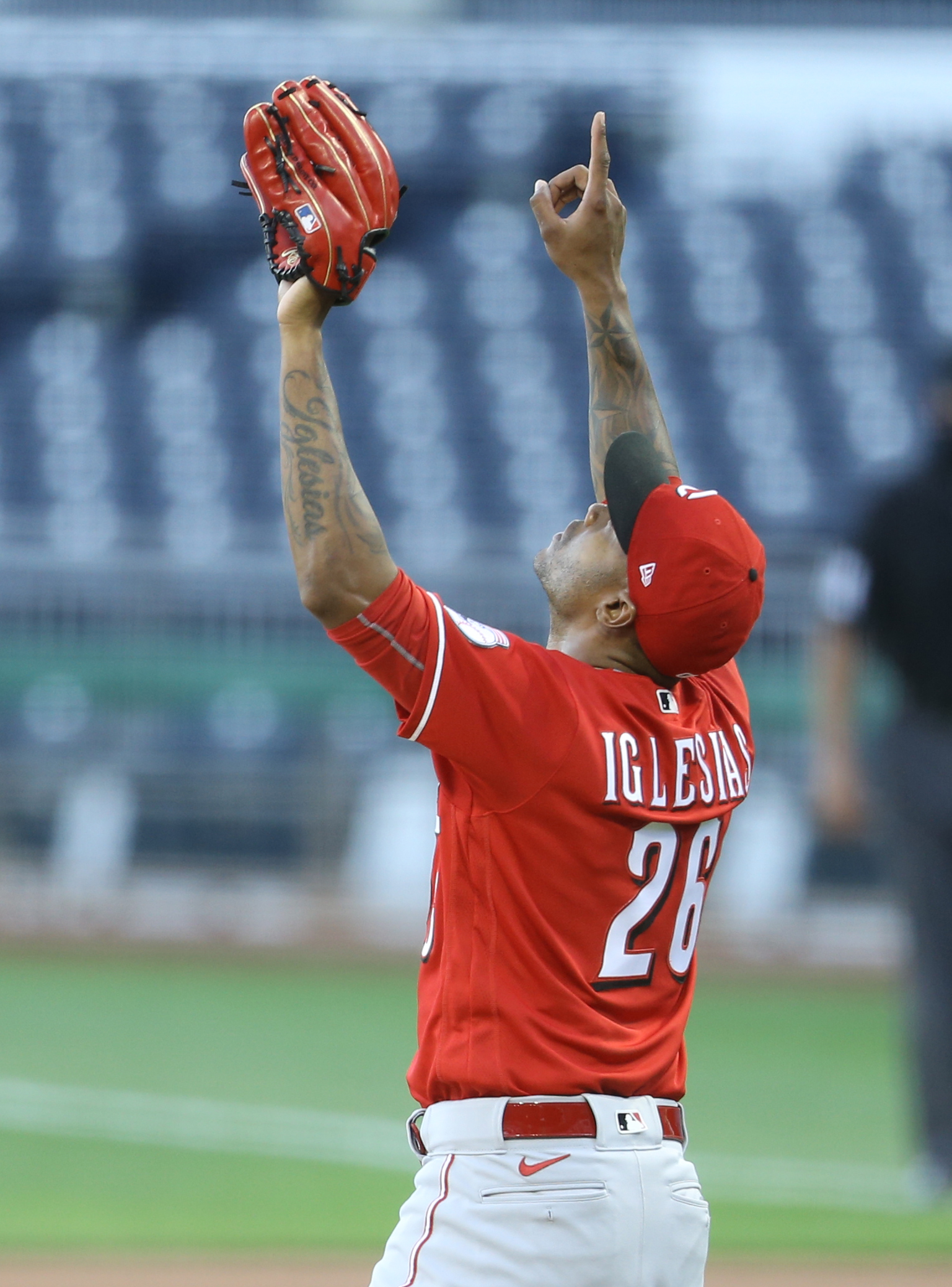
It’s the latest indication that the Reds are looking to cut costs. In addition to their surprising decision to non-tender Archie Bradley last week, the Reds have also reportedly been open to moving right-hander Sonny Gray, who is owed two years and $20MM on his contract. Iglesias is signed for $9.125MM this coming season and will be a free agent following the 2021 season.
This is the second notable trade for the Angels under new general manager Perry Minasian, who last week acquired shortstop Jose Iglesias from the Orioles in exchange for a pair of minor league pitchers. Iglesias will give the Halos a more clearly defined closing option after non-tendering a slate of five relievers, including Hansel Robles and Keynan Middleton, last Tuesday.
Iglesias, 31 in January, has been the Reds’ primary closer for the past four seasons. He had something of a down year in 2019 but saw both his velocity and his bottom-line results rebound in 2020. This past season, Iglesias tallied 23 innings of 2.74 ERA ball with a terrific 31-to-5 K/BB ratio, eight saves and a 41.5 percent grounder rate. Since taking over the ninth inning following countryman Aroldis Chapman‘s trade to the Yankees, Iglesias has been highly effective, pitching to a combined 2.95 ERA with 100 saves, 11.0 K/9, 3.0 BB/9, 1.13 HR/9 and a 37.5 percent ground-ball rate.
A return of Ramirez and a PTBNL suggests that from the Reds’ vantage point, this move was primarily a means of jettisoning Iglesias’ salary. Ramirez is two weeks older than Iglesias with a fraction of the track record. He’s pitched to a respectable 3.76 ERA over the past two seasons but done so with more questionable peripherals and primarily in low-leverage spots. Ramirez’s fastball sat at a career-low 88.8 mph in 2020 as his K/9 mark dropped to a career-low 6.0.
To his credit, Ramirez did have a nice year in 2019, when he gave the Angels 67 2/3 innings of 3.99 ERA and 3.72 FIP ball with averages of 10.5 K/9 and 2.7 BB/9. Statcast rated him in the 75th percentile or better in terms of average exit velocity, hard-hit rate, barrel rate, curveball spin and overall swinging-strike rate. It was a solid season, to be sure, but even that career-best year pales in comparison to the best efforts put forth by Iglesias.
Perhaps the Reds are hopeful that Ramirez can regain that form, and it’s certainly worth pointing out that he’s controllable through the 2023 season. However, Ramirez looked like a non-tender candidate just one week ago, and trading an established closer of Iglesias’ stature for a low-leverage reliever in need of a rebound looks like little more than a salary dump. If the PTBNL involved in the deal proves to unexpectedly be a prospect of note, the swap might look better, but the Reds have now jettisoned Iglesias and Bradley from an already problematic bullpen.
With Iglesias out of the picture, the Reds’ projected payroll drops from closer to $130MM to a bit more than $120MM. Lefty Amir Garrett and righty Lucas Sims are the in-house favorites to assume some of Iglesias’ high-leverage spots, particularly with Michael Lorenzen expected to move into the starting rotation. The Reds could still add some arms from outside the organization, but based on their activity to this point in the winter, it doesn’t seem likely that any additions will be especially high-profile in nature.