
The Awkward Tenure & Uncertain Future Of A Steady Dodgers Slugger
Any guesses as to which Dodgers player has hit the most total dingers since the start of the 2015 season? That’d be outfielder Joc Pederson, with a tally of 123.
Sure, he has since been bypassed in more recent seasons by younger slugger Cody Bellinger and the suddenly emergent Max Muncy. And several other excellent players have delivered more WAR to the L.A. franchise over the years. But Joc has been a consistent source of prodigious power for the Dodgers since he first emerged in the majors.
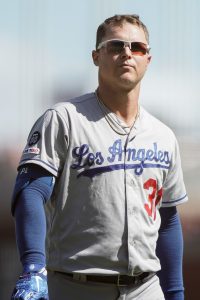
There’s a major caveat here, of course. Last year, all of Pederson’s 36 home runs came against right-handed pitching. He stepped into the box only fifty times against southpaws, managing only a putrid .224/.240/.265 batting line. That’s only marginally better than his .188/.263/.310 lifetime mark against same-handed hurlers. But against righties? Pederson owns a stellar 131 wRC+ in his MLB career.
That excellent output against righties is of obvious value to the Dodgers, but hardly assured Pederson’s place on the roster. He’s set to earn $7.75MM in his final season of arbitration eligibility — a bit spendy given the team’s other players and roster plans. The Dodgers worked hard to deal him this past offseason, reportedly holding talks with the White Sox before finally agreeing to a deal with the Angels … one that ultimately fell apart for other reasons (more details on that collapse here).
This wasn’t the first time we heard trade chatter on Joc … far from it, in fact. Pederson’s status in Los Angeles has never really been assured — even when he was flying up the prospect charts and emerging as a high-end young MLB talent. A former 11th-round draft pick, Pederson was batted around in trade talks long before he reached the majors and the chatter never stopped thereafter.
The Dodgers wouldn’t include Pederson in trade talks involving Jon Lester (link), Cole Hamels (link), David Price (link), and Shelby Miller (link). At one point Pederson was asked about in talks involving Marlins star Jose Fernandez. There was talk of a deal even after a rough 2017 season during which he was temporarily demoted. He was connected to the Braves last winter.
It seems now that the Dodgers might’ve been better served cashing in on Pederson’s trade value when it peaked. But it’s far from a total whiff. He has provided 10.9 rWAR and 13.1 fWAR to the Los Angeles club in 705 games. Strikeouts were the concern when he was younger, but they haven’t prevented him from achieving a lifetime 120 wRC+. The real issue has been the intense platoon needs, though that probably bothers this organization less than any other.
Throughout this lengthy run of success, the Dodgers have moved through quite a number of different players. They’ve leaned on some huge stars and many role players. One of the steadiest forces has been Pederson’s prodigious output against right-handed pitching. And he has risen to the occasion in the postseason, turning in a cumulative .239/.326/.487 slash with seven long balls in 133 plate appearances.
The waiting game that all teams are presently experiencing is even more awkward for Pederson and the Dodgers. It was already weird for him to return to camp after the collapsed trade. Now, as he closes in on his 28th birthday, it’s still possible the California native has already played his last game in a Dodgers uniform after a decade in the organization. If the 2020 season does indeed get underway, Pederson is sure to get plenty of plate appearances against right-handed pitching, but not much opportunity to prove to potential future suitors that he can be trusted to hit lefties.
Photo courtesy of USA Today Sports Images.
What Happens To The Mookie Betts Trade If The Season Is Canceled?
If the 2020 MLB season is canceled due to the coronavirus pandemic, players will receive service time equal to the amount they accrued in 2019. That’s a win for any player who received a full year in ’19, as they’d remain on track for free agency as expected. That includes Mookie Betts, George Springer, J.T. Realmuto, Trevor Bauer, and everyone else expected to be in the 2020-21 free agent class.
A canceled season would sting for someone like Dodgers second baseman Gavin Lux, who picked up 28 days of Major League service as a rookie last year but was likely to get a full season in 2020. Lux’s free agency would have arrived after the 2025 season, but if this season is canceled, he’ll project to become a free agent after ’26. And then there are others who didn’t get any MLB service in ’19 but were expected to in ’20, such as Wander Franco, Jo Adell, and Nate Pearson.
It’s worth considering how the balance would shift in recent major trades if there’s no 2020 season. The Betts trade, where the Dodgers’ main acquisition was a star rental player, dramatically shifts toward the Red Sox.
Pre-coronavirus expectations of the Mookie Betts trade:
- Dodgers get one year of Mookie Betts, three years of David Price, $48MM from the Red Sox and can make Betts a qualifying offer after the season
- Red Sox get five years of Alex Verdugo, six years of Jeter Downs and six years of Connor Wong
Canceled season results of the Mookie Betts trade:
- Dodgers get zero years of Mookie Betts, two years of David Price, $32MM from Red Sox and can make Betts a qualifying offer
- Red Sox get four years of Alex Verdugo, six years of Jeter Downs and six years of Connor Wong
The Red Sox had been scheduled to pay $48MM to the Dodgers in 18 equal installments, starting tomorrow. However, MLBTR has confirmed that all cash considerations will be adjusted proportionally to the salary reductions that end up occurring in 2020. So if the Dodgers don’t wind up paying Price in 2020, the Red Sox won’t send money to them. My $32MM figure assumes the 2021 season is played in full.
Price remains a useful pitcher, so it’s not as if the Red Sox gave up nothing of value. And while they’d still pay the Dodgers $32MM in 2021-22, that’s only half what they’d have originally owed Price for his age 35-36 seasons. The Sox might have accepted that arrangement with nothing in return from the Dodgers, but they still get to keep Verdugo, Downs, and Wong. Though a canceled season would mean the Red Sox would lose the chance to reset under the luxury tax in 2020, that will be less challenging in ’21 given the Price trade and the fact that Jackie Bradley Jr. ($11MM) will be coming off the books.
The Dodgers, meanwhile, would find themselves without Betts, Verdugo, or Joc Pederson for the 2021 season (unless they re-sign Pederson as a free agent). They’d lose a crucial year of control of Cody Bellinger, who would likely settle back in as the regular right fielder. That would leave A.J. Pollock as the regular center fielder. The Dodgers would have an even bigger question mark in left, where Pederson, Verdugo, and Pollock combined to take more than half of the innings in 2019. Chris Taylor and Matt Beaty would be the main in-house candidates, so the Dodgers would likely have to make an outfield acquisition.
Betts could still wind up playing meaningful games for the Dodgers if the 2020 season is canceled, as they’d be a top contender for him in what could be a strange free agency period. It would hardly be a shock to see the entire free agent market suffer due to teams’ lost revenue in 2020, forcing Betts to settle for less than he expected prior to the pandemic.
Could the Dodgers receive some sort of recourse on the Betts trade if the season is canceled? I polled MLBTR writers Steve Adams, Jeff Todd, and Connor Byrne, and none of them find that likely. As Steve put it, “If there’s an alteration to the Betts deal, that just seems like opening Pandora’s box. Every team in the league would be clamoring for compensation because almost everyone would be getting screwed to some extent.” Whether it’s the Reds acquiring Trevor Bauer last summer with an eye toward 2020, the Diamondbacks losing one of their two years of Starling Marte, or the Rangers losing a year of Corey Kluber, many teams are dealing with a similar situation.
For more on this topic, check out my new video discussion with Jeff Todd:
Which Players Will Reach 10-And-5 Rights This Year?
As players continue to bounce around the league with greater frequency for a variety of reasons — teams leaning increasingly toward shorter-term deals, financial incentive to reach free agency, etc. — the number of players gaining 10-and-5 rights have diminished in recent years. For those unfamiliar or those who need a reminder, 10-and-5 rights are granted to a player who has accrued 10 years of MLB service time, including five consecutive years with his current team. These players are given veto power over any potential trade involving them.
It’s rare that a player invokes his 10-and-5 rights, although we’ve seen them come into play in the past. Adam Jones utilized his 10-and-5 provision to block a deal to the Phillies two summer ago, and Brandon Phillips quashed a pair of trades that would’ve sent him out of Cincinnati before he finally acquiesced on a deal sending him to Atlanta.
In other cases, such as Coco Crisp‘s trade from Oakland back to Cleveland in 2016, players are willing to waive that veto power for the right deal and/or some additional financial incentive. Those rights were a major factor in the Rays’ decision to trade Evan Longoria when they did; had he opened the 2018 season with Tampa Bay, he’d have gained full no-trade power just two days into the year.
As a reminder, players will receive a year of service time even if no games are played in 2020. And if a season is played, the service time will be prorated to match the truncated nature of the season. In other words, current big leaguers are going to get their year of service unless they’re optioned to the minors or released.
With all that said, some 10-and-5 rights looming on the horizon (I’ve omitted players such as Buster Posey, whose contracts already included full no-trade protection)…
- Kenley Jansen: Jansen’s five-year, $80MM contract with the Dodgers didn’t include a no-trade clause, although it does pay him a $1MM assignment bonus in the event of a trade. Jansen has nine years, 73 days (9.073) of MLB service time, so he’ll clear 10 years of service in 2020 with or without a season. As such, he’ll have full no-trade power next winter, when he’d have one year and $20MM remaining on his contract.
- Jason Heyward: Heyward is getting to the elusive 10-and-5 status in a bit of a different manner. He’s already reached 10 years of service, and once this year elapses, he’ll have spent five years in a Cubs uniform. His contract allows him to block deals to a dozen teams of his choosing in 2020, but he’ll gain full no-trade power next winter. His contract would be cumbersome to move in the first place, given the four years and $86MM remaining on his deal at the moment.
- Johnny Cueto: Like Heyward, Cueto already has the requisite decade of MLB service, but he’s only spent four years with his current team. Next offseason, Cueto will have spent five seasons as a Giant, giving him veto power if the club wants to trade the sixth season of that deal and the subsequent club option. He’s owed $21MM in 2021 and a $5MM buyout on his 2022 club option.
- Freddie Freeman: There’s no real reason to think the Braves would be entertaining the notion of trading a player who has long been considered the face of the franchise (even if Ronald Acuna Jr. is now taking over that title), but Freeman’s eight-year, $135MM contract didn’t contain any no-trade protection and he currently has 9.033 years of service. He’s owed $22MM in 2021, the final season of his current contract, but an extension seems likelier than a trade.
Prospect Faceoff: May v. Sanchez
There is no question that Marlins right-hander Sixto Sanchez and Dodgers righty Dustin May are among the most promising pitching prospects in baseball. Outlets such as MLB.com, Baseball America and FanGraphs each rank them as two of the 50 best prospects in the game. The only site that puts much of a gap between the two is FanGraphs, which has May at No. 14 and Sanchez 48th. They’re otherwise neck and neck – MLB.com places Sanchez 22nd and May 23rd, while BA also gives Sanchez a bit of an edge (16th to May’s 20th).
As we continue comparing the two, it’s worth taking a look at their professional careers to this point. Now 22 years old, the 6-foot-6, 180-pound May joined the Dodgers as a third-round pick in 2016. His quality repertoire consisting of a fastball that can reach the upper 90s, a cutter and a curveball has helped him mow down the competition so far. He got to the Triple-A level for the first time last season and thrived over 27 1/3 innings, notching a 2.30 ERA with 7.9 K/9, 2.96 BB/9 and a 60 percent groundball rate. That’s obviously not a large sample of work (just five starts), but it was enough to convince the Dodgers to promote May to the majors on the final day of July.
How much time May will spend with the Dodgers in 2020 (if there is a season) remains to be seen, but the man known as “Gingergaard” made a compelling case that he’s a major league-caliber hurler during his initial MLB action. May totaled 14 appearances (four starts) and logged a 3.63 ERA/2.90 FIP with 8.31 K/9, a stunningly low 1.3 BB/9 and a respectable 44.4 percent grounder rate across 34 2/3 innings. Maybe he won’t realize his potential this year, but May has “All-Star, mid-rotation” upside, FanGraphs’ Eric Longenhagen wrote in February.
The Dominican-born Sanchez, 21, has been a much-needed ray of hope for the Marlins since he joined the franchise in a blockbuster trade in February 2019. Sanchez was the headlining prospect the Marlins received from the division-rival Phillies for star catcher J.T. Realmuto, and continued to boost his stock in his first year with the Miami organization. He carved up the competition during his first try in Double-A, where he recorded a 2.53 ERA/2.69 FIP, struck out almost a hitter per inning, walked fewer than two per nine and induced grounders at a 47.9 percent clip in 103 frames. Sanchez can throw very hard, even reaching triple digits on occasion, though Longenhagen cautions that his “fastball plays beneath its velocity right now because it has sub-optimal underlying components.” There are also concerns about Sanchez’s injury history, but thanks in part to great secondary offerings and plus command, there’s front-of-the-rotation potential if he stays healthy.
Sanchez and May certainly count as a pair of the most exciting young pitchers in the game. But if you can only take one, which one would you choose? (Poll link for app users)
Dustin May or Sixto Sanchez?
-
May 68% (2,864)
-
Sanchez 32% (1,370)
Total votes: 4,234
Why Did The Dodgers Trade Yordan Alvarez?
A monster debut by Astros DH Yordan Alvarez earned him the AL Rookie of the Year award in 2019, but why did the Dodgers let him go in the first place? Jeff Todd retraces a 2016 trade that seemed minor at the time.
GM Trade History: Dodgers’ Andrew Friedman
It’s not always fair to judge baseball operations leaders for free agent signings. In many cases, the biggest contracts are negotiated to varying extents by ownership. The same can hold true of major extensions. It’s just tough to know from the outside.
There’s obviously involvement from above in trade scenarios as well. But, when it comes to exchanging rights to some players for others, it stands to reason the role of the general manager is all the more clear.
In any event, for what it’s worth, it seemed an opportune moment to take a look back at the trade track records of some of the general managers around the game. We’ve already covered the Diamondbacks’ Mike Hazen, former Astros GM Jeff Luhnow, the Brewers’ David Stearns, the Angels’ Billy Eppler, the Rockies’ Jeff Bridich, the White Sox’ Rick Hahn, the Tigers’ Al Avila, the Braves’ Alex Anthopoulos, the Padres’ A.J. Preller, the Blue Jays’ Ross Atkins, the Mariners’ Jerry Dipoto and the Phillies’ Matt Klentak. It’s time to head to Los Angeles to check in on the work Andrew Friedman has done since the Dodgers hired the former Tampa Bay GM after the 2014 season. Friedman’s no longer a GM – he has an even more prestigious title as president of baseball operations, and has overseen a perennial powerhouse (albeit one that has fallen short of World Series glory) throughout his reign.
Here’s a rundown of Friedman’s key LA trades, which are in chronological order and exclude minor moves (full details at transaction link):
2014-15 Offseason
- Acquired RHP Joel Peralta and LHP Adam Liberatore from Rays for RHPs Jose Dominguez and Greg Harris
- Acquired RHP Mike Bolsinger from Diamondbacks for cash considerations
- Acquired RHP Juan Nicasio from Rockies for OF Noel Cuevas
- Acquired OF Chris Heisey from Reds for RHP Matt Magill
- Acquired C Yasmani Grandal and RHPs Joe Wieland and Zach Eflin from Padres for OF Matt Kemp and C Tim Federowicz
- Acquired LHP Andrew Heaney, INF Enrique Hernandez, C Austin Barnes and RHP Chris Hatcher from Marlins for INFs Dee Gordon and Miguel Rojas and RHP Dan Haren
- Acquired SS Jimmy Rollins and cash considerations from Phillies for RHP Zach Eflin and LHP Tom Windle
2015 Season
- Acquired RHP Ryan Webb, C Brian Ward and a 2015 Competitive Balance (Round B) draft pick from Orioles for RHP Ben Rowen and C Chris O’Brien
- Acquired INF Alberto Callaspo, RHP Juan Jaime, and LHPs Ian Thomas and Eric Stults from Braves for INF Juan Uribe and RHP Chris Withrow
- Acquired OF Jordan Paroubeck and RHP Caleb Dirks from Braves for international bonus slot worth $249K
- Acquired LHP Grant Dayton from Marlins for LHP Chris Reed
- Acquired LHPs Alex Wood and Luis Avilan, INF Jose Peraza, RHPs Mat Latos, Jim Johnson and Bronson Arroyo, and 1B Michael Morse for OF Hector Olivera, LHP Paco Rodriguez and RHPs Jeff Brigham, Victor Araujo, Kevin Guzman and Zachary Bird in three-team trade
2015-16 Offseason
- Acquired RHP Frankie Montas, INF Micah Johnson and OF Trayce Thompson for INFs Jose Peraza and Brandon Dixon and OF Scott Schebler in three-team trade
2016 Season
- Acquired INF/OF Chris Taylor from Mariners for RHP Zach Lee
- Acquired RHPs Bud Norris and Alec Grosser, OF Dian Toscano and cash considerations from Braves for RHP Caleb Dirks and LHP Phil Pfeifer
- Acquired LHP Rich Hill and OF Josh Reddick from Athletics for RHPs Frankie Montas, Jharel Cotton and Grant Holmes
- Acquired RHP Josh Fields from Astros for 1B/OF Yordan Alvarez
- Acquired C Carlos Ruiz from Phillies for C A.J. Ellis and RHP Tommy Bergjans
2016-17 Offseason
- Acquired 1B Darin Ruf and 2B/OF Darnell Sweeney from Phillies for INF/OF Howie Kendrick
- Acquired 2B Logan Forsythe from Rays for RHP Jose De Leon
2017 Season
- Acquired LHP Tony Cingrani from Reds for OF Scott Van Slyke and C Hendrik Clementina
- Acquired RHP Yu Darvish from Rangers for 2B/OF Willie Calhoun, INF Brendon Davis and RHP A.J. Alexy
- Acquired LHP Tony Watson from Pirates for INF Oneil Cruz and RHP Angel German
- Acquired OF Curtis Granderson from Mets for RHP Jacob Rhame and cash considerations
- Acquired INF/OF Connor Joe from Braves for $500K in international money
2017-18 Offseason
- Acquired OF Matt Kemp from Braves for 1B Adrian Gonzalez, LHP Scott Kazmir, RHP Brandon McCarthy and INF Charlie Culberson
- Acquired LHP Scott Alexander and INF Jake Peter for LHP Luis Avilan, RHP Trevor Oaks and INF Erick Mejia in three-team trade
2018 Season
- Acquired LHP Logan Salow from Athletics for RHP Wilmer Font
- Acquired RHPs Dylan Floro and Zach Neal and international bonus pool space from Reds for RHPs Aneurys Zabala and James Marinan
- Acquired INF Manny Machado from Orioles for OF Yusniel Diaz, RHPs Dean Kremer and Zach Pop, and INFs Breyvic Valera and Rylan Bannon
- Acquired 2B Brian Dozier from Twins for 2B Logan Forsythe, OF Luke Raley and LHP Devin Smeltzer
- Acquired RHP John Axford from Blue Jays for RHP Corey Copping
- Acquired RHP Ryan Madson from Nationals for RHP Andrew Istler
- Acquired 1B/3B David Freese from Pirates for INF Jesus Valdez
2018-19 Offseason
- Acquired RHPs Homer Bailey and Josiah Gray and INF Jeter Downs from Reds for OFs Yasiel Puig and Matt Kemp, LHP Alex Wood, C/INF Kyle Farmer and cash
- Acquired C Russell Martin and cash from Blue Jays for SS Ronny Brito and RHP Andrew Sopko
2019 Season
- Acquired RHP Casey Sadler from Rays for RHP Nathan Witt
- Acquired 1B Tyler White from Astros for RHP Andre Scrubb
- Acquired LHP Adam Kolarek from Rays for OF Niko Hulsizer
- Acquired INF Jedd Gyorko from Cardinals for LHP Tony Cingrani and RHP Jeffry Abreu
- Acquired C Jose Lobaton from Mariners for cash considerations
2019-20 Offseason
- Acquired INF Clayton Daniel from Cubs for RHP Casey Sadler
- Acquired RHP Brusdar Graterol, OF Luke Raley and the 67th pick in the draft from Twins for RHP Kenta Maeda, $10MM and C Jair Camargo
- Acquired OF Mookie Betts, LHP David Price and half of Price’s $96MM guarantee from Red Sox for OF Alex Verdugo, INF Jeter Downs and C Connor Wong
- Acquired LHP Tyler Gilbert from Phillies for OF Kyle Garlick
__
Friedman has no doubt acquired plenty of notable names since he arrived in Los Angeles. How do you think he has fared in trades during his time atop the Dodgers’ front office?
(Poll link for app users)
Grade Friedman's LA trades
-
B 43% (1,966)
-
A 42% (1,912)
-
C 12% (539)
-
F 2% (92)
-
D 2% (85)
Total votes: 4,594
Prospect Faceoff: Franco v. Lux
Yesterday’s prospect faceoff post featured two fairly similar youngsters: upper-level left-handed hurlers MacKenzie Gore and Jesus Luzardo. Today, we’ll examine another duo with a lot of commonalities … but they won’t be quite so closely situated.
Glance up at the top ten list of most prospect rankings and you’ll see two middle infielders: Wander Franco of the Rays and Gavin Lux of the Dodgers. MLB.com and Fangraphs rank them 1-2. They share many attributes beyond position and lofty prospect standing. But these two players also present completely different propositions.
Franco is more or less universally considered the game’s very best prospect. But he also just turned 19 on March 1st and hasn’t yet played above the High-A level. In his two A-ball stops last year, the switch-hitter carried a collective .327/.398/.487 batting line with nine long balls over 495 plate appearances. He swiped 18 bags but was also gunned down 14 times.
This is not a complete product. There are some questions as to whether Franco will stick at shortstop, though he has thus far proven capable. More importantly, perhaps, is the fact that his power is still more a projection than a present skill. But the scouts see the potential in his actions at the plate. And Franco seems quite likely to maximize whatever raw power he ends up with given his exceptional plate discipline and contact ability. Franco recorded 56 walks against just 35 strikeouts last year while driving the ball around the yard. Though he hardly carries a big frame, Franco is said to carry immense wrist strength and bat speed. And his command of the zone will make him awfully tough to pitch to.
Do you feel like you need some precedent to believe a player can convert plate discipline and less-than-imposing physical stature? How about Lux? He didn’t put a single ball over the fence in 253 rookie ball plate appearances, then managed only seven dingers in 501 trips to the dish at the Class A level. But last year, Lux produced 26 long balls in his 523 upper-minors plate appearances.
Lux never quite matched Franco’s ludicrous K/BB numbers. But he’s not easy to retire on strikes, knows how to draw a walk, and features a blend of power and average. Last year’s minor-league slash line: .347/.421/.607. That’ll play, particularly for a guy known as a quality baserunner and fielder. What of the notorious PCL offensive inflation? Lux exploded with a 188 wRC+ in Triple-A, so the numbers stand out even against a high mean. While Lux may end up playing second base with the powerhouse Dodgers, he’s generally considered capable of holding down shortstop in the majors.
And here’s the thing about Lux: he has already reached and shown he can hang at the game’s highest level. He didn’t exactly take the league by storm when he arrived late in 2019. But Lux produced a .240/.305/.400 slash in 82 plate appearances. And he was trusted with a postseason roster spot. It remains to be seen whether Lux will be a perennial All-Star or something less, but when it comes to getting value from a guy, he’s about as sure a thing as a prospect can be.
In this case, there’s probably not much question that Franco has the loftier ceiling. And we have seen players shoot up from the lower minors into the majors rather quickly, so he may not be far off from a debut if he terrorizes the upper minors as expected. But there’s inherently much more risk in such a player than in Lux, who’s ready to slot in as a MLB regular as soon as this season finally gets underway. Particularly if you’re somewhat risk-averse and/or need immediate contributions in the majors, perhaps Lux is actually the better bet.
Which prospect would you prefer to have? (Poll link for app users.)
Which prospect would you rather have?
-
Wander Franco 51% (2,666)
-
Gavin Lux 49% (2,518)
Total votes: 5,184
New Dodgers TV Deal Announced
While the 2020 season remains paused, many Dodgers fans can now at least look forward to catching their team in action when MLB resumes play. An agreement has at long last been reached that will bring Dodgers games back to many televisions in Southern California, as Ramona Shelburne of ESPN reports (Twitter link) and has now been announced.
The 2013 creation of the Spectrum SportsNet LA network — jointly owned by the Dodgers and Charter Communications — promised more content, but came with a catch. Carriage fees agreements were not forthcoming between SportsNet LA and TV providers such as Direct TV and Dish Network. That left an effective blackout for large swaths of the market.
Now, SportsNet LA has a deal in place with AT&T to carry Dodgers games on Direct TV and other AT&T-owned outlets. Other major providers still don’t have deals in place with SportsNet LA, so the situation hasn’t yet improved for all fans. But many will now be able to watch games as before. And perhaps this agreement is cause for optimism that bargains can be struck with the other providers as well.
The timing is obviously interesting, with the Dodgers staring at a major loss of revenue in 2020. With an increasing likelihood that MLB will stage contests without fans for at least part of a truncated season, it’s all the more important for the team to deliver its media content to fans. Whether the coronavirus pandemic specifically prompted this agreement isn’t known. No doubt we’ll learn more as further details emerge.
Injury Notes: Pirates, Calhoun, Pederson, May
The Pirates have at least two and as many as three potential rotation pieces slowed by injuries at the moment, and director of sports medicine Todd Tomczyk provided updates on lefty Steven Brault and right-handers Clay Holmes and Jameson Taillon to reporters Wednesday (Twitter thread via Adam Berry of MLB.com). Brault, slowed by a shoulder strain, was shut down from throwing early this month. But while the initial prognosis suggested that he’d be reevaluated after two weeks, the 27-year-old has yet to start up a throwing program more than three weeks since that announcement. Holmes, diagnosed with a foot fracture earlier this month, has been throwing from one knee from a distance of 75 to 90 feet. Taillon, the club’s top pitching talent, is throwing from 120 feet in his rehab from Tommy John surgery. He’s still expected to miss the entire season given the timing of last August’s operation, but it’s still encouraging to hear that the righty is ramping up his throwing efforts without issue.
A couple more injury updates…
- Rangers outfielder Willie Calhoun provided a positive update on his recovery from a jaw fracture, tweeting that he has been cleared for baseball activities and daily workouts. After being struck in the face by a fastball during a Cactus League at-bat late in camp, Calhoun had been limited to lighter exercise like riding a stationary bike, as Texas manager Chris Woodward told MLB.com’s T.R. Sullivan yesterday (Twitter link). The club still expects him to be ready for the season opener — whenever it may be. Calhoun’s availability, or lack thereof, will probably have direct ramifications for prospect Nick Solak. A highly touted hitter without a clear opening on the diamond, Solak would’ve opened the season in left field had Calhoun been on the injured list. But with Calhoun projected to open in left field, Rougned Odor at second base, Todd Frazier at third base and Danny Santana in center field, there’s no clear spot for Solak to slot into the lineup. A rotation through several positions each week could get him regular at-bats, but the Rangers could also want him to receive everyday reps at one position in Triple-A. Then again, if the season opens with expanded rosters — as is reportedly under consideration — a player with Solak’s bat and versatility could prove a particularly valuable commodity to have on hand.
- Joc Pederson and Dustin May were both limited during Spring Training, but Dodgers president of baseball operations Andrew Friedman told reporters (including MLB.com’s Ken Gurnick) that the two players are “essentially recovered” and should be ready to fully participate whenever a second Spring Training camp opens. Pederson missed time with a hip injury, while May was bothered by a side problem and was largely limited to playing catch at the time of the league shutdown.
Rookie Radar: NL West
MLBTR’s Jeff Todd has already run through the American League Central and the American League West in previewing some of the interesting young talent that could surface in the Majors this season. We’ll tackle the NL West next — a particularly interesting division given the enviable bevy of young talent that has been cultivated by both the Dodgers and Padres. Los Angeles and San Diego have two of the game’s best systems, but there are varying degrees of high-end talent bubbling to the surface for all five NL West clubs…
Arizona Diamondbacks
Jon Duplantier is a former top 100 prospect whose debut effort in 2019 was slowed by shoulder troubles. He notched a 4.42 ERA and 34-to-18 K/BB ratio in 36 2/3 innings when on the roster, though he was optioned to Triple-A five times. There’s no room in Arizona’s rotation at the moment, but Duplantier and his career 2.54 minor league ERA with 10.5 K/9 will be one of the first lines of defense should a need arise. Righty Kevin Ginkel also got his feet wet in the big leagues and, after posting a 1.48 ERA and a 28-to-9 K/BB ratio in 24 1/3 innings of relief, should have the inside track on a bullpen spot whenever play resumes.
Elsewhere in the D-backs’ system loom catcher Daulton Varsho, infielder Andy Young, first baseman Seth Beer and right-hander J.B. Bukauskas. Varsho is a homegrown talent who’s considered to be among baseball’s 100 best prospects, although the presence of Carson Kelly in the big leagues puts a roadblock in his path to Phoenix. He’s yet to play above Double-A, but a big Triple-A showing and an injury to Kelly and/or Stephen Vogt could propel Varsho to the bigs.
Young, Bukauskas and Beer were all acquired in trades — Young alongside Weaver and Kelly in the Paul Goldschmidt swap and the others in the Zack Greinke blockbuster. Arizona’s infield is stacked at the moment, but Young can play anywhere in the infield, so he’s a nice depth piece … who happened to bash 21 homers and slug .611 in 277 Triple-A plate appearances last year. Beer showed big pop of his own in a pitcher-friendly Double-A setting last season. Bukauskas will be looking for a rebound after a poor showing in Double-A.
Colorado Rockies
Rox fans have been waiting since 2015 to get a good look at Brendan Rodgers, the No. 3 overall pick in that year’s draft. Rodgers has ranked among the game’s elite prospects each season since being drafted, and he finally made his big league debut in 2019 … only to undergo shoulder surgery after all of 81 plate appearances. He might open the year in the minors, but Rodgers will be looming in the event that Ryan McMahon and Garrett Hampson struggle or get hut. Either way, if he’s healthy, Rodgers should force the team’s hand.
Elsewhere on the roster, expect to see Sam Hilliard play a prominent role in the outfield mix. He received a similarly sized cup of coffee to Rodgers and made the most of it, raking at a .273/.356/.649 clip. Charlie Blackmon and David Dahl are locked into two spots, but Hilliard will vie for at-bats with Raimel Tapia as Ian Desmond slips further into a reserve role. Yonathan Daza could also factor in as a bench option, depending on the health of those ahead of him on the depth chart.
Someone asked me in this week’s MLBTR chat who might step up in the event of a Nolan Arenado trade, and the club isn’t short on options — including Arenado’s own cousin, Josh Fuentes. He’s already 27, though, and had a rough showing in Triple-A this past season. More intriguing options include Tyler Nevin — yes, Phil’s son — and Colton Welker.
Southpaw Ben Bowden could emerge in the bullpen, and given the uncertainty at the back of the big league rotation — Chi Chi Gonzalez might’ve been the favorite in the fifth spot — we could see either of righty Ashton Goudeau or Antonio Santos get a look.
Los Angeles Dodgers
Gavin Lux, one of the game’s top 1o prospects, will get the opportunity to claim second base as his home for the foreseeable future. He didn’t do much in 82 MLB plate appearances last season, but if you want a laugh, check out Lux’s line in 49 Triple-A games: .392/.478/.719 with 13 home runs, 18 doubles and four triples in 232 plate appearances.
The Dodgers have an embarrassment of wealth in terms of young pitching, headlined by righty Dustin May, who’s already posted a 3.63 ERA and 32-to-5 K/BB ratio in 34 2/3 MLB frames. Fellow righty Tony Gonsolin impressed in his own ’19 debut, and the Dodgers added some triple-digit heat to the bullpen by acquiring Brusdar Graterol from the Twins. Behind that trio? Josiah Gray, acquired in the Homer Bailey salary dump with the Reds, posted a 2.28 ERA with 147 punchouts in 130 Double-A innings in ’19.
Catcher Keibert Ruiz is somewhat blocked by fellow youngster Will Smith, but he could be in line for a promotion should Smith sustain an injury. If there’s an injury (or multiple injuries) elsewhere on the roster, any of corner infielder/outfielder Edwin Rios, center fielder DJ Peters or Swiss army knife Zach McKinstry could get the call. Rios hit well in a limited debut last season, and McKinstry is cut from the Chris Taylor/Enrique Hernandez cloth, having appeared at shortstop, second base, third base and all three outfield slots in recent seasons. (Sometimes it feels like the Dodgers grow these guys on trees.)
San Diego Padres
You won’t find many (any?) organizations with a more tantalizing pairing of pitching prospects than lefty MacKenzie Gore and righty Luis Patino. Either or both could conceivably reach the Majors in 2020. Gore is particularly touted, generally ranking inside the game’s top 10 overall prospects after posting a sub-2.00 ERA in 20 starts between Class-A Advanced and Double-A.
Center fielder Taylor Trammell still hasn’t tapped into his raw power, but his tantalizing package of tools landed him among the game’s top 100 prospects for a third straight offseason. The Padres’ outfield has turned over in a major way, and while Trammell might need a big showing in Triple-A to force the organization’s hand, he’s not far off after spending all of 2019 in Double-A.
The Padres have plenty of players with rookie eligibility who briefly saw the big leagues this past season. Righty Michel Baez and lefty Adrian Morejon aren’t quite on that same level as the Gore/Patino combo, but they were both high-profile international signings — Baez commanding a $3MM bonus and Morejon landing $11MM — and have both been top 100 entrants themselves. (Morejon still is.) Righty Ronald Bolanos also commanded a seven-figure bonus (just north of $2MM) and briefly debuted in ’19. Reliever David Bednar was sharp in Double-A and logged 11 MLB frames with San Diego, too.
If there’s a particularly intriguing prospect here, it could be Jake Cronenworth. He’s not considered a premium prospect, but the 26-year-old posted a .949 OPS in Triple-A with the Rays last year and has been developing as a two-way player. He’s more in the Michael Lorenzen mold, so he might not get two-way designation anytime soon thanks to MLB’s bizarrely stringent eligibility requirements — essentially, only Shohei Ohtani or Brendan McKay could qualify — but he brings a unique skill set to the table all the same.
San Francisco Giants
Expect Mauricio Dubon to get a long look, perhaps even in center field. The former Brewers/Red Sox middle infield prospect played there earlier in spring and could be an outfield option, depending on how the team uses Wilmer Flores and (if he makes the roster) Yolmer Sanchez. Slugger Jaylin Davis didn’t hit much in a 17-game September cameo, but he cranked 35 long balls between Double-A and Triple-A, which should get him a look on a power-starved Giants roster.
Logan Webb could end up as the team’s fifth starter — particularly now that Tyler Beede will miss the 2020 season. Webb didn’t fare well in eight MLB starts a year ago and has been hobbled by injuries since being a fourth-round pick in 2014, but he shoved with a 1.84 ERA across three minor league levels in 2019 prior to his promotion.
The big question for Giants fans is, of course, when will they get their look at Buster Posey‘s heir apparent? Joey Bart, the No. 2 pick in the 2018 draft, has flat-out raked at every stop and is a rare, fast-rising catching prospect. He won’t turn 24 until next offseason, but Bart is a .284/.343/.532 hitter in the minors — including a .316/.368/.554 effort in a 22-game showing at Double-A last year.