
Mets Sign Mark Canha
The Mets continue to bolster their position player mix, announcing agreement Tuesday with free agent outfielder Mark Canha. It’s reportedly a two-year, $26.5MM guarantee for the CAA Sports client. The deal also contains a 2024 club option. A Bay Area native, Canha had previously spent his entire big league career with the A’s.
Canha’s contract will see him collect $12MM in 2022 along with a $2MM signing bonus and then $10.5MM in 2023. The 2024 club option is valued at $11.5MM and has a $2MM buyout attached.
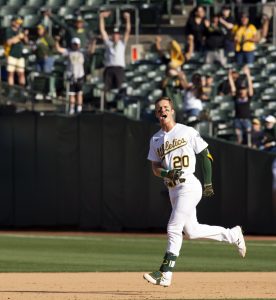
Canha becomes the second big addition of the day for the Mets, who also agreed to terms with infielder Eduardo Escobar on a two-year guarantee this afternoon. Canha will step into the club’s outfield mix, with the bulk of that time presumably coming in the corners. While he has experience in all three outfield spots, he’s never rated highly as a center fielder and has logged the plurality of his career innings in left field.
Public metrics like Statcast’s Outs Above Average and Defensive Runs Saved have been mixed on Canha’s corner outfield work over the past few seasons. There’s little question about his bat, though, as Canha has been an above-average hitter in each of the past four years by measure of wRC+.
Since the start of the 2019 season, the Berkeley product owns a .249/.377/.438 line over 1365 plate appearances. While he doesn’t have an eye-catching batting average, the right-handed hitter has walked in a fantastic 13.3% of his trips to the dish. That’s the 14th-highest rate among the 159 players with 1000+ plate appearances in that time. As a result, Canha’s on-base percentage is nearly sixty points higher than the league-wide mark over that span.
That ability to reach base may be Canha’s only standout skill, but it’s a highly valuable one for a Mets’ club that ranked sixteenth with a .321 mark this past season (excluding pitchers). And while Canha may not be elite at anything else, he’s a generally solid all-around player. His strikeout rates over the past few years have typically been a bit lower than the league marks. He owns a .189 ISO (slugging percentage minus batting average) since the start of 2019, which is slightly above par. Canha has done all that in one of the game’s more pitcher-friendly home environments, and his overall offense over the past three seasons checks in 29 percentage points above league average after accounting for park effects.
Canha was off to an especially promising start in 2021. In 325 plate appearances through June 25, he hit .255/.375/.450 with 11 homers. He suffered a left hip strain that landed him on the injured list at that point, an injury from which he didn’t seem to fully recover. While Canha returned in mid-July, he slumped to a .206/.340/.319 line over his final 300 plate appearances. A glance at his batted ball metrics seems to support that narrative. Canha’s average exit velocity before his IL stint sat at a solid 89 MPH; over his final few months, that mark dropped to 85.5 MPH.
The Mets are clearly of the belief that Canha’s power and overall offensive output will return to peak levels after an offseason to recover. His reported $13.25MM average annual value comes in a touch higher than MLBTR’s two-year, $24MM projected guarantee. Still, it’s a reasonable price for a player of Canha’s caliber and the Mets aren’t taking on much long-term risk. Canha turns 33 years old in February, capping the length of offers teams were willing to put forth.
Canha joins Brandon Nimmo as locks for regular playing time in the New York outfield next season. The Mets have various others who could play their way into the mix. Jeff McNeil and J.D. Davis could get bumped from a crowded infield mix into outfield work, while Dominic Smith, Khalil Lee and recent big league signee Nick Plummer could also see action. Still, there are enough moving parts that new GM Billy Eppler and his staff could continue to look for upgrades. Jon Heyman of the MLB Network tweets that New York still isn’t ruling themselves out of the market for free agent center fielder Starling Marte, for instance.
The specific breakdown of Canha’s deal has yet to be reported, but it’s likely to be another fairly significant addition to the Mets’ 2022 books. If both the Escobar and Canha deals were paid out evenly over the next two seasons, New York’s 2022 payroll would be pushing $207MM in the estimation of Jason Martinez of Roster Resource. The Mets’ estimated luxury tax commitments, meanwhile, are now up around $210MM (both figures including projected salaries for arbitration-eligible players).
It’s not entirely clear how far owner Steve Cohen is willing to push payroll, but it seem very likely they’ll at least be above this past season’s $195MM mark. Both Cohen and Eppler have talked about having ample financial flexibility, and the Mets remain on the hunt for additions to a rotation that has already lost Noah Syndergaard and could see Marcus Stroman depart. It’s already been an active first few days for Eppler in Queens, and it seems likely the Mets will continue to be busy as they try to snap a five-year playoff drought.
As for Canha’s former club, the A’s never seemed especially likely to make a strong run at bringing him back. Oakland is expected to conduct a significant roster overhaul this winter, with ownership seemingly mandating a drastic reduction in payroll. The A’s didn’t make Canha an $18.4MM qualifying offer, and shelling out a multi-year deal at an eight-figure annual salary would’ve registered as a major surprise.
Jeff Passan of ESPN first reported the Mets and Canha were nearing an agreement. Joel Sherman of the New York Post reported a two-year, $26.5MM guarantee had been agreed upon. Sherman also reported the presence of a 2024 option, which Jon Heyman of the MLB Network specified was a club option. MLB.com’s Anthony DiComo reported the salary breakdown of Canha’s contract.
Image courtesy of USA Today Sports.
Free Agent Notes: Marte, Castellanos, Lorenzen, Canha
Starling Marte is the clear top option in this winter’s free agent center field class. Unsurprisingly, early interest seems to be robust, as Jon Heyman of the MLB Network reports (Twitter links) that both the Marlins and Mets have expressed interest in the 33-year-old. Those NL East clubs join the Yankees and division-rival Phillies as known entrants in his market. There are no doubt other clubs who have or will express interest in Marte, who’s coming off a stellar .308/.381/.456 showing between Miami and the A’s.
Miami’s early interest is eyebrow-raising, since he and the Marlins couldn’t agree to terms during midseason extension negotiations this summer. Reports suggested the Fish balked at offering a fourth guaranteed year a few months back, and going to that length again figures to be necessary to land Marte’s services now that he can field offers from all 30 clubs. It’s not as if his stock tanked after the deal, as Marte continued to be an offensive force (.312/.355/.462 with 25 stolen bases in just 56 games) for Oakland down the stretch. MLBTR projects he’ll ultimately land a four-year deal worth $80MM, a figure that would come in quite a bit higher than the money Marte reportedly targeted in original extension talks.
The Mets, meanwhile, are still trying to finalize the structure of their front office. That could pose a challenge for them in making any impactful moves early in the winter, but whomever the Mets hire to lead baseball operations is expected to look for some form of outfield help. Michael Conforto has already rejected New York’s qualifying offer, and his potential departure would leave a vacancy in the grass in Flushing. A Marte pursuit would be one way to replace Conforto, with current center fielder Brandon Nimmo probably sliding over to right field were a deal to get done.
Some news on a few more free agents:
- Nick Castellanos has already rejected the Reds’ qualifying offer, little more than a formality after he opted out of the remaining two years on his contract. The 29-year-old wouldn’t close the door on a return to Cincinnati, though, telling reporters (including Adam Baum of the Cincinnati Enquirer) he’d listen to any offers from the Reds. “Of course I would. Why wouldn’t I,” Castellanos asked rhetorically. “I feel like there’s still a lot of valuable pieces that are very good to win with. Jonathan India … Jesse Winker is coming into his own, figuring out who he is, figuring out what kind of father he wants to be, he’s doing a great job at that. Joey Votto just reinvented himself. We still have pitching. We have pieces. Why wouldn’t I entertain it?” Regardless of Castellanos’ amenability, a Reds’ return seems highly unlikely. Cincinnati has kicked off the offseason by parting ways with two veteran contributors (Tucker Barnhart and Wade Miley) for little more than financial relief, and general manager Nick Krall has spoken of “(aligning) our payroll to our resources.” It’d be nothing short of shocking if Cincinnati then pivoted to make a serious run at Castellanos, whom MLBTR projects to sign for $115MM over five years.
- California natives Michael Lorenzen and Mark Canha are both drawing interest from teams on the West Coast, reports Robert Murray of FanSided (Twitter link). Interestingly, Murray hears that at least some teams are willing to consider Lorenzen as a starting pitcher, aligning with the 29-year-old’s hopes for a rotation job. Lorenzen broke into the majors as a starter, but he’s started just five of his 268 appearances with the Reds since the beginning of the 2016 campaign. He’s had success in a multi-inning relief capacity, though, and Lorenz’s five-pitch repertoire could help him navigate an order multiple times. Canha, who has spent his entire major league career with his hometown A’s, hits the open market on the heels of four straight above-average offensive seasons, by measure of wRC+. Entering his age-33 season, the productive outfielder will probably be limited to short-term deals, which could make him a target of low and high payroll clubs alike.
A’s Loaded Arbitration Class Will Lead To Some Tough Decisions
The Athletics are squarely in the mix for the second American League Wild Card and, with six remaining games against the first-place Astros still on the schedule, are still alive in the division chase in the American League West as well. Oakland currently trails Houston by four and a half games, so with 28 games left to play, there’s time for a surge to overtake the current leaders.
Oakland’s proximity to a division title and their (at the time) status as a team in possession of the second Wild Card spot surely emboldened the team to go for it at this year’s trade deadline. The acquisition of Andrew Chafin was a solid addition to an already-sound bullpen, but it was the team’s trade for Starling Marte that really grabbed headlines. That’s in part due to Marte’s status as one of the more prominent names on the summer trade market but also due to the fact that Oakland parted with longtime top prospect Jesus Luzardo — five years of control over him to be exact — in exchange for a rental player who’ll be a free agent at season’s end.
At the time of the trade, I touched on this a bit, but it’s a concept that bears a bit more detail. The Athletics have every reason to act aggressively on the trade deadline this summer, because barring a major uptick in the team’s typically thrifty payroll, this could be something of a last hurrah for the current Oakland core.
The A’s don’t have much on the payroll next season — just Elvis Andrus $14MM salary (of which the Rangers are paying $7.25MM) and Stephen Piscotty‘s $7.25MM salary. The A’s have a $4MM club option on Jake Diekman that comes with a $750K buyout as well. Most clubs would probably pick that up given his strong season, but it’s at least feasible that given the forthcoming payroll crunch that will be laid out here shortly, the A’s could pass on it.
Those minimal contractual guarantees look nice at first glance, but the Athletics have an enormous arbitration class on the horizon — and it’s not just large in terms of volume. It’s a talented and experienced group of players featuring the majority of Oakland’s most recognizable names: Matt Olson, Matt Chapman, Sean Manaea, Chris Bassitt, Ramon Laureano, Frankie Montas, Lou Trivino, Chad Pinder, Tony Kemp, Deolis Guerra, Burch Smith and (depending on his final service time numbers) perhaps Adam Kolarek. Of that bunch, Manaea and Bassitt are up for their final arbitration raises — the former as a Super Two player. Chapman, Olson, Montas and Trivino are getting their second raises.
I wanted to better ascertain just how expensive a class this is going to be for the Athletics, so I reached out to MLBTR contributor Matt Swartz for some help. Matt created MLBTR’s Arbitration Projection model, and I asked if he’d be able to put together some projections for the Athletics’ class based on the seasons they’ve had to date. Matt did just that, tacking on each player’s rest-of-season projections from the Steamer projection system to their actual production to date, coming up with the following projections:
- Matt Olson: $11.8MM
- Sean Manaea: $10.1MM
- Matt Chapman: $9.8MM
- Chris Bassitt: $8.9MM
- Frankie Montas: $4.8MM
- Lou Trivino: $3.0MM
- Ramon Laureano: $2.8MM
- Chad Pinder: $2.7MM
- Tony Kemp: $1.8MM
- Burch Smith: $1MM
- Deolis Guerra: $900K
- Adam Kolarek: $800K
(One caveat on the projections themselves: these raises are determined using the 2021 model and standard inflation for the 2022 season. Major League Baseball and the MLBPA agreed not to use 2021 arbitration raises as precedent-setters because of the anomalous nature of last year’s short-season data.)
In all, it’s a projected total of $58.4MM. Add that to the combined salaries of Andrus and Piscotty, and the A’s are up to $72.4MM — $76.4MM if they exercise the option on Diekman. That’s what they’d owe to just 15 players. There are some possible non-tenders in there (Smith and Kolarek, certainly), but for the most part, all of the major names should be expected to be tendered. We don’t know precisely what next year’s minimum salary will be due to the expiring collective bargaining agreement, but even filling out the roster with players earning this year’s minimum would take them up to nearly $80MM — about $6MM shy of their current payroll.
Of course, we know that you can’t simply supplement this group with pre-arbitration players, because the rest of the current roster isn’t made up of pre-arb players. The A’s currently stand to lose not only Marte but also Mark Canha, Yan Gomes, Yusmeiro Petit, Sergio Romo, Jed Lowrie, Mitch Moreland, Josh Harrison, Mike Fiers and Khris Davis to free agency. Replace that group with readily available, in-house options and you’re probably not looking at a playoff team — certainly not with the Mariners, Angels and Rangers both looking to improve their rosters this winter, making for even tougher competition within the division.
The A’s have never carried an Opening Day payroll greater than $92MM, per Cot’s Contracts — their prorated 2020 payroll may have gotten there — so an arbitration class worth more than $55MM is an immensely expensive group for ownership. Some of this crunch could be alleviated by trying to find a taker for Andrus and/or Piscotty, though moving either player might necessitate the A’s paying some of the freight (or taking a lesser contract in return). As previously mentioned, some non-tenders could get the bottom-line number down as well.
It’s always possible, too, that ownership simply bites the bullet and pays up for a franchise-record payroll. We haven’t seen that level of spending in the past, though, and this is the same A’s team that only agreed to pay its minor leaguers a $400 weekly stipend after considerable public relations backlash during last summer’s pandemic — a move that only cost them about a million dollars. The A’s also had the Marlins foot the bill for all of Marte’s remaining salary. Perhaps that was in preparation for a payroll hike this winter, but that’d be a rather charitable interpretation when history and precedent tell us this is a team that is already pushing the upper levels of its comfort from a payroll standpoint.
All of this is to say: the Athletics certainly have the look of a team that is going to have to make some tough decisions this winter. They can either take payroll to new heights, look to move Andrus and/or Piscotty (which would likely mean attaching a prospect and further depleting a thin farm), or listen to offers on some names who’ve become staples on the roster.
Parting with a starter such as Manaea or Bassitt would be difficult, but both are slated to become free agents following the 2022 season. Both Chapman and Olson have two arbitration raises left, which means both are going to be owed a raise on top of that already sizable arbitration projection following the ’22 campaign. Both are on a path toward $15MM-plus salaries in 2023 — especially if Chapman is able to maintain his recent surge at the plate and return to his pre-hip surgery levels of offensive output.
Whatever route the Athletics ultimately decide to take, the organization and its fans are in for a good bit of change this winter. That could mean changes to the payroll or changes to the composition of a core group of players who’ve been quite successful since coming together a few years back. Regardless of which path they choose, it’s understandable that the A’s opted to be aggressive at this year’s deadline; with Canha, Marte and several relievers set for free agency and a huge arbitration class that could force some financially-motivated trades, this looks like the current group’s best and perhaps final chance to make a deep playoff run together.
A’s Place Seth Brown On COVID-Related Injured List, Recall Daulton Jefferies
The Athletics placed Seth Brown on the injured list after a positive COVID-19 test, per Matt Kawahara of the San Francisco Chronicle (via Twitter). Daulton Jefferies was recalled from the taxi squad to claim his roster spot.
Brown has been part of the fix in right field after the club lost Ramon Laureano and Stephen Piscotty to a suspension and wrist surgery, respectively. Brown’s walk rate is a little low (8.2 percent) and his strikeout rate is a little high (29.2 percent), but he brings power to the position with a .254 ISO. With 254 plate appearances, the 29-year-old has not been an insubstantial contributor for these A’s, despite just a .219 BABIP that, along with the metrics above, paint Brown as a boom-or-bust type of role player.
Of course, the greater part of the story for Brown is that he’s been strictly a platoon player, with 233 plate appearances coming against right-handers. For that kind of limited usage player, you’d like to see even stronger splits, however, as Brown’s 100 wRC+ against righties suggests he’s holding the line as an average bat — but not much more than that.
Without him (and maybe even when he returns), the A’s piece together their final outfielder with infielders Tony Kemp, Josh Harrison, and Chad Pinder, depending on match-ups. Mark Canha also plays a role in Frankenstein-ing this roster spot, as he slides from left to right field depending on who else is in the lineup. The A’s seem more comfortable with Pinder in right, while Kemp and Harrison have taken their turns in left.
As for Jefferies, he’s most likely just an insurance arm in this short interval without Brown. The 26-year-old has served as a starter in all 16 of his outings this year, of which only one took place in the bigs. His arm should be fresh, however, as he hasn’t started a game since August 20th in Triple-A.
2021-22 Qualifying Offer Candidates
With the trade deadline in the rearview mirror and a little more than six weeks remaining in the regular season, plenty of front offices are turning their attention towards the upcoming offseason. The first notable decision for many clubs will be to decide whether to tag one or more of their top impending free agents with a qualifying offer.
As a reminder, the qualifying offer is a one-year contract offer teams can make to certain impending free agents. The precise value of the QO has yet to be calculated, but it’s determined as the average salary of the game’s 125 highest-paid players. Last season, the QO value was set at $18.9MM. If the player accepts the offer, he returns to his current team on that one-year deal. If he rejects, his previous team would receive draft pick compensation should he sign elsewhere.
Last season, six players (George Springer, Trevor Bauer, J.T. Realmuto, DJ LeMahieu, Kevin Gausman and Marcus Stroman) received qualifying offers. Gausman and Stroman accepted the QO, while Realmuto and LeMahieu re-signed with their current clubs as free agents. The Reds and Astros received compensatory picks (used on Jay Allen and Chayce McDermott, respectively) when Bauer and Springer departed.
The collective bargaining agreement prohibits a player from being tagged with a qualifying offer multiple times in his career. (A list of every active big leaguer who has previously received a QO is available here). Similarly, in order to be eligible, the player must have spent the entire preceding season on the same team. Players traded midseason cannot be tagged with a QO.
With the majority of the 2021 season in the books, we can take a look at the upcoming free agent class to predict which players might wind up receiving qualifying offer this winter.
Locks
- Carlos Correa, Freddie Freeman, Clayton Kershaw, Robbie Ray, Carlos Rodón, Corey Seager, Marcus Semien, Trevor Story
This group is fairly straightforward, as there’s very little chance any of these players would accept a qualifying offer. Correa, Seager and Freeman all have MVP-caliber upside and are locks to pull in long-term deals this winter. Semien didn’t receive a QO from the A’s after a down year in 2020, took a pillow contract with the Jays for almost the value of the QO ($18MM), and has essentially replicated his 2019 form that earned him a third place finish in AL MVP voting. He should find a big multi-year deal this time around.
Story is having a bit of a down year, but there’s no doubt the Rockies will make him a qualifying offer after not trading him at the deadline. Nick Groke of the Athletic wrote this week that Colorado hasn’t given up hope of convincing him to sign a long-term extension, but that seems unlikely given Story’s own bewilderment he wasn’t moved to a contender this summer. Whether Story is willing to return to Denver or not, he’ll receive a QO.
Kershaw, Ray and Rodón will be among the top pitchers on the market. Kershaw has spent the past couple months on the injured list due to forearm soreness, but he’s expected back in September and is in the midst of another fantastic season. So long as he’s healthy, he’s a lock for a QO. Ray and Rodón both had to settle for one-year deals after poor 2020 seasons, but they’ve each been among the best pitchers in the American League this year.
Likely
- Michael Conforto, Jon Gray, Yusei Kikuchi, Eduardo Rodríguez, Noah Syndergaard, Chris Taylor, Justin Verlander
Over the past two seasons, Taylor has somewhat quietly been one of the game’s top 25 qualified hitters by measure of wRC+ and he’s versatile enough to cover any non-catcher position on the diamond. He’s not a true everyday player at any one spot and he’s making contact at a career-worst rate this season, so he falls just short of being an absolute lock for a QO. But the Dodgers would be as willing as any team to shoulder a significant one-year salary were Taylor to accept, and his body of work should be sufficient to warrant a multi-year deal regardless.
The Mets’ players in this group are two of the more interesting free agents in the class. Conforto entered the season looking like a lock for a QO and seemingly having a chance at landing nine figures with a strong platform year. He missed a month with injury, though, and hasn’t made anywhere near his typical level of impact at the plate. He’s shown some life over the past few weeks, and between his track record and age (28), Conforto still seems a good bet to land a long-term deal.
Syndergaard was a top-of-the-rotation starter at his peak, but he hasn’t pitched since 2019 because of Tommy John surgery. He’s eyeing a September return — likely in relief, given his dwindling time to build up arm strength — and his late-season form will obviously be critical to his market. The Mets should run one of the higher payrolls in the league, and Syndergaard has the upside to be an ace if healthy, so New York still seems more likely than not to make the offer.
Similarly, Verlander has essentially missed two full seasons because of his own Tommy John procedure. That’s a scary development for a pitcher who’ll be 39 on Opening Day 2022, but he was still every bit an ace when we last saw him in 2018-19. The Astros are a win-now club that runs high payrolls, so Verlander accepting a QO wouldn’t be the worst thing in the world. If he declines and signs elsewhere, Houston would recoup some much-needed draft compensation after losing their past two first-round picks as punishment for the sign-stealing scandal.
Colorado reportedly showed even less interest in trading Gray than they did with Story at the deadline. There’s apparently mutual interest about working out a multi-year extension, and the QO could serve as a temporary measure to keep Gray in Denver while the Rockies and Gray’s representatives work on a long-term deal.
Rodríguez has bounced back to take the ball every fifth day this year after a scary bout with myocarditis cost him all of 2020. His ERA’s pushing 5.00, but his peripherals are far better than that bottom line run prevention and the southpaw has an established track record of mid-rotation production.
The Mariners are facing a difficult decision regarding Kikuchi, as MLBTR’s Steve Adams explored last month. Seattle must decide whether to exercise a package deal of four successive club options at $16.5MM apiece (essentially a four-year, $66MM extension) this winter. If the Mariners don’t exercise their four-year option, Kikuchi has a $13MM player option to return to Seattle for 2022. If both parties decline their ends, the 30-year-old would hit free agency this offseason, although the M’s could then tag Kikuchi with a qualifying offer.
Given that Kikuchi will only be a free agent if he passes on a $13MM player option, the Mariners would likely make him a QO worth a few million dollars more if it comes to that — either with the expectation he’ll decline in search of a longer-term deal, or with the hope he accepts and Seattle can keep him in the fold next season without committing themselves to the additional three years of guaranteed money.
Possible
The Giants have plenty of payroll space this offseason and seem likely to try to keep most of this season’s core together. Belt has been one of the sport’s most productive offensive players on a rate basis over the past two years. But he’s also 33 years old, has a long injury history and is striking out at the highest rate of his career.
San Francisco bought low on DeSclafani over the winter after he had a tough 2020 season with the Reds. He’s bounced back to post a very strong 3.26 ERA, although his peripherals are closer to average and he’s benefitted from opponents’ .257 batting average on balls in play. The Giants will likely see 4/5 of their starting rotation hit free agency this winter, so they could be eager to bring DeSclafani back, even if that comes via a lofty 2022 salary.
Morton has had another productive season in his first year as a Brave, but his previous two teams (the Astros in 2018 and the Rays in 2020) let him reach free agency without making a qualifying offer despite his consistently strong track record. That’s presumably due to concerns about his past injury history and age. He’ll turn 38 this winter and might check his potential earning power by limiting himself to teams in the Southeastern part of the country — as he reportedly did last offseason. That could inspire the Braves to pass on a QO, but Morton continually reels off above-average performances, and this is an Atlanta front office that has been eager to dole out hefty single-year salaries for key veteran upgrades in recent years.
Iglesias looks like the top impending free agent reliever (assuming the White Sox exercise their option over Craig Kimbrel). He’s sporting an ERA under 3.00 for the fifth time in his six seasons since moving to the bullpen, and he’s never had a single-season SIERA above 3.55. Home runs have been an issue, but Iglesias gets above-average results year in and year out and has some of the best strikeout and walk numbers in the game in 2021.
Long Shots
The Giants hold a $22MM club option (with a $3MM buyout) over Posey’s services for next season. If the front office is willing to commit him a significant salary, they’ll just exercise the option rather than going the QO route. Indeed, they’re reportedly planning to do exactly that (or to potentially pursue a multi-year extension with the franchise icon). Either way, there’s no real reason to involve the qualifying offer here.
Canha would be a very plausible qualifying offer candidate on many teams. He’s been a well above-average hitter and overall performer three years running and is generally one of the game’s more underrated players. The A’s, though, didn’t make a QO to either of Semien or Liam Hendriks last season. Canha’s a Bay Area native, and his age (33 in February) will cap the length of offers he receives from other clubs. Given that, it’s not hard to envision him accepting a QO if offered. The A’s, who perennially run low payrolls and will have a loaded class of arbitration-eligible players this winter, don’t seem likely to take that risk.
Wainwright has had a fantastic 2021 season, and the Cardinals figure to be motivated to keep the franchise icon in St. Louis in some capacity. But that also looked to be true after his strong 2020 campaign, and Wainwright only wound up landing a one-year, $8MM deal. He’d be well-deserved in demanding a raise over that sum to return next season, but it remains to be seen if the Cardinals would be willing to chance more than doubling his salary — particularly if they feel Wainwright’s motivated to remain in St. Louis rather than pursue the highest possible offers in free agency.
Kluber signed an $11MM deal with the Yankees last offseason after back-to-back seasons wrecked by injury. He pitched well through ten starts but has been out since late May with a shoulder strain. Kluber’s nearing a return to action, but his missing nearly three months only adds to prior concerns about his ability to handle a significant workload at this stage of his career.
Kim, García and Wood are all having strong 2021 seasons and could plausibly land solid multi-year deals this winter. Each has enough question marks that their teams don’t seem especially likely to offer a salary in the range of the qualifying offer, though. Kim doesn’t miss many bats; García has had extreme highs and lows throughout his career; Wood has a checkered injury history. García’s contract contains a $12MM club option that vests into a mutual option if he reaches 492 plate appearances this season. If that option doesn’t vest, the Brewers would obviously have no incentive to decline the option only to make a qualifying offer at a higher price point.
Opt-Out Clauses
Each of Arenado (six years, $179MM), Castellanos (two years, $34MM) and Martinez (one year, $19.35MM) has significant guaranteed money remaining on their contracts but can opt out of those deals this winter. Arenado and Castellanos would be locks to reject qualifying offers if they trigger their opt-out provisions, since they’d be foregoing bigger guarantees to test the market.
Martinez’s player option is of similar enough value to the projected value of the qualifying offer that he could plausibly trigger the opt-out but then accept a QO. Even if that proved to be the case, the Red Sox would probably be happy to keep him in the middle of the lineup for another season.
Ineligible
- Javier Báez (midseason trade), Kris Bryant (midseason trade), Alex Cobb (previous QO), Nelson Cruz (previous QO/midseason trade), Danny Duffy (midseason trade), Eduardo Escobar (midseason trade), Kevin Gausman (previous QO), Kendall Graveman (midseason trade), Zack Greinke (previous QO), Kenley Jansen (previous QO), Starling Marte (midseason trade), Anthony Rizzo (midseason trade), Max Scherzer (previous QO/midseason trade), Kyle Schwarber (midseason trade), Marcus Stroman (previous QO)
A’s Reinstate Mark Canha, Option Skye Bolt
The A’s reinstated Mark Canha from the injured list, optioning Skye Bolt to Triple-A to make room on the roster, per the team.
Canha has been tremendous this season, slashing .255/.375/.450 in 325 plate appearances while knocking 11 home runs. Canha was on-pace for a career year before a hip strain sent him to the injured list on June 20th. He’s been out for 20 days, but with a career-high of 126 games, Canha still has the potential to post career-best marks this season, should his good health hold.
Bolt, 27, has stepped in as an injury replacement on multiple occasions for the A’s, slashing just .109/.109/.196 in 48 plate appearances. Though defense is his calling card, Bolt’s -23 wRC+ suggests he has fallen on particularly hard times at the plate. With the A’s starting outfield back together, Bolt heads back to Triple-A to try to get his bat back on track.
Health Notes: Bader, Calhoun, Canha, Peterson
The Cardinals activated center fielder Harrison Bader from the 10-day injured list today and optioned fellow outfielder Lars Nootbaar to Triple-A Memphis in his place. Bader missed a little more than a month with a right rib hairline fracture. Before the injury, the 27-year-old had slumped to a .219/.301/.411 mark over his first 83 plate appearances. Bader’s a quality baserunner and defender, through, and his return will allow the Cards to shift Dylan Carlson back into the corner outfield role for which he’s better suited.
In other health news:
- Kole Calhoun might have suffered a setback in his recovery from left hamstring surgery. The Diamondbacks outfielder’s minor league rehab assignment was recently halted, as he was sent back to Phoenix to undergo an MRI after feeling something in the hamstring while attempting to dodge a hit-by-pitch, writes Nick Piecoro of the Arizona Republic. It’s been something of a lost season for the veteran, who has been limited to 51 plate appearances by injuries. If healthy, Calhoun would be an obvious trade candidate for the last-place Diamondbacks. The 33-year-old hit a strong .292/.333/.479 in 2020 and is in the final guaranteed season of his two-year, $16MM contract with the organization. Calhoun’s deal comes with a $9MM club option (or a $2MM buyout) for 2022.
- Athletics outfielder Mark Canha is unlikely to return to the club before the All-Star Break, manager Bob Melvin tells reporters (including Matt Kawahara of the San Francisco Chronicle). Canha, who landed on the injured list with left hip tendinitis last week, recently underwent platelet-rich plasma injections in both hips. A somewhat prompt return from the 32-year-old would be a huge boon for the A’s, who trail the Astros by half a game in the AL West. An ever-underrated contributor, Canha is hitting .255/.375/.450 with 11 homers in 325 plate appearances this year.
- Mets left-hander David Peterson departed his start last night with discomfort in his right side. Manager Luis Rojas told reporters (including Laura Albanese of Newsday) that Peterson continued to experience side tightness today and will be sent for further evaluation. Rojas added the 25-year-old is unlikely to make his next scheduled start. Peterson has struggled to follow up on last year’s promising rookie campaign, pitching to a 5.40 ERA/4.23 SIERA through 66 2/3 innings this season.
Athletics Place Mark Canha on Injured List With Hip Strain
JUNE 26: Canha’s MRI revealed tendinitis in his left hip, Melvin told Rubin and other reporters. Fortunately, nothing seems wrong with the part of Canha’s hip that was addressed by his 2016 surgery.
JUNE 25: The A’s announced that Canha has been placed on the 10-day injured list with a left hip strain. Infielder Vimael Machin is up from Triple-A Las Vegas in his place.
JUNE 24: Athletics outfielder Mark Canha left today’s 5-1 Oakland victory over the Rangers after two innings due to a left hip strain, manager Bob Melvin told Shayna Rubin of the San Jose Mercury News and other reporters. Canha will receive an MRI to explore the problem, which Melvin indicated has been bothering the outfielder prior to today. This isn’t the first hip issue of Canha’s career, as he underwent hip surgery back in 2016.
One of the sport’s more underrated players, Canha would represent a big loss to the Oakland lineup if he had to miss any time on the injured list. Since the start of the 2018 season, only 22 qualified players in baseball have posted a higher wRC+ than Canha’s total of 133, as the outfielder has hit .258/.372/.466 with 59 home runs over the last four seasons. Canha’s ability to play all three outfield positions (and some first base, in a pinch) has made him even more valuable to the A’s roster.
Canha has mostly played as a left fielder this year, though he saw a lot of everyday center field duties when Ramon Laureano was on the IL. Laureano is now back but Stephen Piscotty was sidelined with a wrist sprain earlier this week, so the A’s will be rather shorthanded should Canha also require an IL placement. Tony Kemp, Seth Brown, Chad Pinder, and Skye Bolt are all candidates for corner outfield playing time, with Kemp in particular having a very strong year as both a part-time outfielder and a platoon partner with Jed Lowrie at second base.
Players Avoiding Arbitration: 1/15/21
The deadline to exchange arbitration figures is today at 1pm ET. As of this morning, there were 125 arbitration-eligible players who’d yet to agree to terms on their contract for the upcoming 2021 season. Arbitration is muddier than ever before thanks to the shortened 2020 schedule, which most believe will lead to record number of arb hearings this winter. Be that as it may, it’s still reasonable to expect dozens of contractual agreements to filter in over the next couple of hours.
We’ll highlight some of the more high-profile cases in separate posts with more in-depth breakdowns, but the majority of today’s dealings will be smaller-scale increases that don’t radically alter a team’s payroll or a player’s trade candidacy. As such, we’ll just run through most of today’s agreements in this post.
I’ve embedded MLBTR’s 2021 Arbitration Tracker in the post (those in the mobile app or viewing on mobile web will want to turn their phones sideways). Our tracker can be sorted by team, by service time and/or by Super Two status, allowing users to check the status on whichever groups of players they like. You can also check out Matt Swartz’s projected arbitration salaries for this year’s class, and we’ll do a quick sentence on each player’s agreement at the bottom of this post as well, with the most recent agreements sitting atop the list.
Today’s Agreements (chronologically, newest to oldest)
- Rockies outfielder Raimel Tapia avoided arbitration with a $1.95MM deal, Jon Heyman of MLB Network tweets. The team also reached an agreement for $805K with reliever Robert Stephenson, per Joel Sherman of the New York Post.
- The Tigers have deals with infielder Jeimer Candelario ($2.85MM), outfielder JaCoby Jones ($2.65MM) and righty Jose Cisnero ($970K), Chris McCosky of the Detroit News relays.
- The Yankees and reliever Chad Green settled for $2.15MM, Mark Feinsand of MLB.com reports.
- The Marlins and lefty Richard Bleier have a deal for $1.425MM, Mark Feinsand of MLB.com tweets.
- The Dodgers reached a $3.6MM settlement with lefty Julio Urias, Jorge Castillo of the Los Angeles Times reports.
- The Angels announced a deal with righty Dylan Bundy for $8.325MM.
- The Tigers and southpaw Matthew Boyd have settled for $6.5MM, Chris McCosky of the Detroit News tweets.
- The Yankees have deals with catcher Gary Sanchez ($6.35MM), first baseman Luke Voit ($4.7MM), third baseman Gio Urshela ($4.65MM), shortstop Gleyber Torres ($4MM) and outfielder Clint Frazier ($2.1MM), per Jon Heyman of MLB Network and Ken Davidoff of the New York Post.
- The Rays and outfielder Manuel Margot avoided arbitration with a $3.4MM agreement, per Marc Topkin of the Tampa Bay Times.
- The Padres and outfielder Tommy Pham have a deal for $8.9MM, according to Robert Murray of FanSided. Reliever Dan Altavilla settled for $850K, AJ Cassavell of MLB.com tweets.
- The Angels and righty Felix Pena have come to terms for $1.1MM, Maria Torres of the Los Angeles Times reports.
- The Red Sox and third baseman Rafael Devers have reached a $4.575MM agreement, per Jon Heyman of MLB Network.
- The Mets and outfielder Brandon Nimmo have come to a $4.7MM agreement, Anthony DiComo of MLB.com tweets.
- The Reds and righty Luis Castillo have settled for $4.2MM, Robert Murray of FanSided relays.
- The Rays reached a $2.25MM agreement with infielder Joey Wendle and a $1.175MM settlement with righty Yonny Chirinos, Marc Topkin of the Tampa Bay Times tweets.
- The Cardinals and flamethrowing reliever Jordan Hicks have an agreement for $862,500, according to Heyman.
- The White Sox and ace Lucas Giolito avoided arbitration with a $4.15MM agreement, James Fegan of The Athletic reports.
- The Pirates and righty Joe Musgrove have reached an agreement for $4.45MM, Jon Heyman of MLB Network tweets. They also made deals with second/baseman outfielder Adam Frazier ($4.3MM), third baseman Colin Moran ($2.8MM) righty Chad Kuhl ($2.13MM) and lefty Steven Brault ($2.05MM), per reports from Jason Mackey of the Pittsburgh Post-Gazette and Adam Berry of MLB.com.
- Hard-throwing right-hander Reyes Moronta agreed to a $695K deal with the Giants after missing the 2020 season due to shoulder surgery, tweets Robert Murray of Fansided.
- The Tigers agreed to a $2.1MM deal with infielder Niko Goodrum, tweets Robert Murray of Fansided. They also inked lefty Daniel Norris for a $3.475MM salary, tweets Evan Petzold of the Detroit Free Press.
- The Pirates agreed to a $1.3MM deal with catcher Jacob Stallings and a $1.1MM deal with righty Chris Stratton, per Robert Murray of Fansided (Twitter links).
- Athletics right-hander Lou Trivino agreed to a $912,500 salary for the 2021 season, tweets Robert Murray of Fansided.
- Right-hander Richard Rodriguez and the Pirates agreed to a $1.7MM deal, tweets Jason Mackey of the Pittsburgh Post-Gazette.
- Catcher Jorge Alfaro and the Marlins agreed to a $2.05MM deal, tweets Craig Mish of SportsGrid.
- The Reds agreed to a $2.2MM deal with right-hander Tyler Mahle, tweets Fansided’s Robert Murray. Cincinnati also signed lefty Amir Garrett for $1.5MM, tweets Mark Feinsand of MLB.com.
- The Indians agreed to a $2.4MM deal with newly acquired shortstop Amed Rosario and a $975K deal with righty Phil Maton, tweets Zack Meisel of The Athletic.
- The Tigers and righty Buck Farmer settled at $1.85MM, tweets Evan Petzold of the Detroit Free Press.
- The Marlins agreed to a $1.9MM deal with right-handed reliever Yimi Garcia, tweets MLB Network’s Jon Heyman.
What Should The A’s Do About Left Field?
The Oakland A’s may look to offset the potential loss of left fielder Robbie Grossman with organizational depth. According to MLB.com’s Martín Gallegos, the A’s suspect 28-year-old Seth Brown could play an important role – but it’s now or never for the Oregon native. Brown’s combination of power and patience is a skill set the A’s have shown a fondness for over the years, and he played well during a 2019 call-up: .293/.361/.453 in 83 plate appearances.
From 2017 to 2019, Brown made the progressive leaps an organization likes to see as he jumped from High-A to Double-A to Triple-A in successive seasons. He earned his time on the big-league roster in 2019 after an impressive .297/.352/.634 line with 37 home runs in just 112 games at the highest level of the minors.
Grossman himself was somewhat of a late bloomer, cutting his teeth on unfortunate Astros squads of 2013 and 2014. He would be released by the Astros and then the Indians before finding a home in Minnesota. After three seasons of part-time work that culminated in a solid 1.7 bWAR season in 2018, the Twinkies cut him loose, too.
Hello, Oakland. Grossman’s 2020 output was easily the most productive season of his career, but those considering him in free agency must gauge whether his power display during the shortened 2020 season is the final step of his development or a small-sample burst. His .240 ISO this season far outpaced his career mark of .127 ISO.
All in all, Grossman’s skill set isn’t flashy, but that hasn’t stopped him from posting an above-average wRC+ in four of the last five seasons. If a market doesn’t develop for Grossman, the A’s could seek a reunion. Grossman and Brown both hit from the left side, of course, making for a ham-handed timeshare between the two.
Enter Chad Pinder, who could be in line for more regular playing time. Pinder has long been a short-side platoon utility player for the A’s, but his bat played up in a major way during their playoff run. Pinder was often penciled into the number three spot in the order while standing in for the injured Matt Chapman at the hot corner. Pinder could easily line up with Ramon Laureano and Mark Canha against lefties, but Stephen Piscotty should also be back in the lineup. The A’s could be intrigued by the possibility of more face time for the soon-to-be 29-year-old Pinder, but much of that time may have to come at second base, where Tony Kemp currently tops the depth chart.
All of which is to say, expect the A’s to slow-play the market this offseason and see where the value play lies. They’d like to explore the possibility of bringing back Tommy La Stella, who would expect a majority of the timeshare at the keystone. A long-time part-time player who almost retired many years ago when the Cubs sent him to Triple-A, La Stella is not likely to cherish a return to diminished responsibilities.
Add to the outfield mix ML-ready prospects Luis Barrera and Greg Deichmann – the latter of whom, Gallegos notes, was just added to the 40-man roster – and the A’s could head into 2021 as currently constituted with plenty of options to throw at the wall.
The real issue for the A’s is building a bridge between Marcus Semien and prospect Nick Allen at short. Allen’s defensive prowess is considerable, but the 5’8″ 22-year-old glove last appeared in High-A with a slash line of .292/.363/.434. Normal circumstances would dictate another year in the minors for Allen, but these days the development curve is more blueprint than model.
If Allen is close, Pinder could hold the line at short, but he’s totaled just 34 innings as the infield captain since 2017. Assuming they’re not ready to simply hand the keys to the car over to Allen, the A’s will focus their free agent energy (aka, dollars) on finding a short-term fix to keep the spot warm.
The A’s, like the Rays, are comfortable fielding a dynamic offensive lineup that shape-shifts as needed throughout the regular season. They’ll dole out playing time piecemeal until settling on the right mix. That could mean an increased share for Brown, but the A’s are sure to have ways to flex the roster if he’s unable to claim it.