
MLB Daily Roster Roundup: Harvey, Buxton, Martinez, Odor, Stroman
ROSTER MOVES BY TEAM
(May 10th-May 11th)
NATIONAL LEAGUE
- ARIZONA DIAMONDBACKS | Depth Chart
- Promoted: RP Jake Barrett
- Optioned: RP Silvino Bracho
- CINCINNATI REDS | Depth Chart
- Added to roster: SP Matt Harvey
- Harvey made his 1st start with the Reds on Friday.
- Optioned: SP Brandon Finnegan
- Added to roster: SP Matt Harvey
- MIAMI MARLINS | Depth Chart
- Activated from 10-Day DL: RP Elieser Hernandez
- Optioned: RP Merandy Gonzalez
- MILWAUKEE BREWERS | Depth Chart
- Activated from 10-Day DL: RP Boone Logan
- Promoted: SP Brandon Woodruff
- Woodruff started Friday’s game.
- Optioned: OF Brett Phillips, RP Jorge Lopez
- NEW YORK METS | Depth Chart
- Placed on Paternity List: OF Jay Bruce
- Placed on 10-Day DL: RP Hansel Robles (sprained knee)
- Promoted: 1B Dominic Smith, RP Buddy Baumann
- PHILADELPHIA PHILLIES | Depth Chart
- Promoted: RP Jake Thompson
- Optioned: RP Zac Curtis
- Activated from 10-Day DL: SP Ben Lively
- Lively was optioned to Triple-A
- SAN FRANCISCO GIANTS | Depth Chart
- Promoted: RP Jose Valdez (contract purchased)
- Optioned: RP Derek Law
- Activated from 10-Day DL: RP Josh Osich
- Osich was optioned to Triple-A
- Transferred to 60-Day DL: SP Johnny Cueto
- ST. LOUIS CARDINALS | Depth Chart
- Placed on 10-Day DL: SP Carlos Martinez (strained lat), RP Tyler Lyons (strained mid-back)
- Activated from 10-Day DL: RP Brett Cecil
- Promoted: RP Mike Mayers
- WASHINGTON NATIONALS | Depth Chart
- Placed on 10-Day DL: C Matt Wieters (strained hamstring)
- Pedro Severino will be the starting catcher while Wieters is out.
- Promoted: C Spencer Kieboom (contract purchased)
- Transferred to 60-Day DL: OF Adam Eaton
- Eaton underwent arthroscopic ankle surgery on Thursday. There is no timetable for return.
- Placed on 10-Day DL: C Matt Wieters (strained hamstring)
—
AMERICAN LEAGUE
- BALTIMORE ORIOLES | Depth Chart
- Placed on 10-Day DL: SP Chris Tillman (strained lower back)
- Promoted: RP Jimmy Yacabonis
- CLEVELAND INDIANS | Depth Chart
- Activated from 10-Day DL: RP Andrew Miller
- Placed on Paternity List: RP Tyler Olson
- LOS ANGELES ANGELS | Depth Chart
- Activated from 10-Day DL: RP Keynan Middleton
- Optioned: OF Jabari Blash
- MINNESOTA TWINS | Depth Chart
- Activated from 10-Day DL: OF Byron Buxton
- Optioned: OF Ryan LaMarre
- OAKLAND ATHLETICS | Depth Chart
- Promoted: SP Kendall Graveman
- Placed on Bereavement List: OF Stephen Piscotty
- TEXAS RANGERS | Depth Chart
- Activated from 10-Day DL: 2B Rougned Odor
- Designated for assignment: INF/OF Renato Nunez
- TORONTO BLUE JAYS | Depth Chart
- Placed on 10-Day DL: SP Marcus Stroman (shoulder fatigue)
- Promoted: RP/SP Joe Biagini, RP/SP Sam Gaviglio
- Biagini and Gaviglio are candidates to start in Stroman’s place on Sunday.
- Optioned: RP Tim Mayza
—
FUTURE EXPECTED MOVES
- BAL: SP David Hess will be recalled from the minors on Saturday May 12th, according to Brittany Ghiroli of MLB.com. He’ll start Game 1 of the double-header. It will be his MLB debut.
- NYM: SP Jacob deGrom is expected to return from the 10-Day DL on Sunday May 13th, according to Anthony DiComo of MLB.com.
- STL: SP Adam Wainwright will be activated from the 10-Day DL on Sunday May 13th, according to Rob Rains of STLSportsPage.
- STL: SP Jack Flaherty will be recalled from the minors on Tuesday May 15th, also according to Rob Rains of STLSportsPage.
- TBR: SP Anthony Banda will be recalled from the minors on Saturday May 12th, according to Marc Topkin of the Tampa Bay Times. It has not been determined whether he’ll start in one of the two games of the double-header.
One-Year MLB Deals Paying Dividends: Pitchers
We looked in at the top-performing one-year MLB contracts for position players from the 2017-18 offseason just this morning. Now, we’ll perform the same exercise for the hurlers.
It’s still early, of course, but there’s a fairly short period of time for one-year deals to pay off or fizzle out. We’ll identify those hurlers who have posted strong bottom-line results to date. Of course, the picture could still change quite a bit in a few months’ time; as we’ll see, some of the players cited below may well fade, while there’s still ample opportunity for others to deliver value. The six pitchers are ordered from lowest to highest guarantee:
- Trevor Cahill, SP, Athletics ($1.5MM): Signed late as a replacement for the injured Jharel Cotton, Cahill has been a revelation. He carries 11.6 K/9 against 2.3 BB/9, with a hefty 59.6% groundball rate, through 24 innings of 2.25 ERA pitching. Cahill is getting swings and misses at a 16.0% rate — rare air for a starter. We’ll have to see to what extent he can keep it going once he’s back from a brief DL stint, but it’s a fascinating showing for the 30-year-old veteran.
- Seung-hwan Oh, RHP, Blue Jays ($2MM): Swinging strikes are worthy of considering with regard to Oh, as well. Unfortunately, he’s again sitting in the ~12% range rather than the 18% rate he showed in his first season in the majors. Oh has also lost some fastball velocity. All told, it seems unlikely he’ll keep up his current pace after carrying a 1.65 ERA through 16 1/3 innings. Still, he looks to be a solid value for the Jays.
- Bud Norris, RHP, Cardinals ($3MM): The brilliant start to the season from Norris seems rather more sustainable. He’s averaging about a dozen K’s and one free pass per nine innings, with a 15.5% swinging-strike rate and a first-strike rate (72.1%) that’s easily a career-high and near the top among all relievers. This one seems to be a bargain.
- Doug Fister, SP, Rangers ($4MM): To be sure, 31 1/3 innings of 4.02 ERA pitching is not exactly exciting. Fister is humming along with a solid ~50% groundball rate to go with a middling mix of 7.2 K/9 and 3.5 BB/9. But that’s a nice initial showing on a limited investment. Fister has, however, rather handily outperformed the contact he’s allowed. Statcast credits the hitters that have opposed him with a .352 wOBA that lands far shy of the corresponding .400 xwOBA, so the veteran righty could be in for some regression.
- Francisco Liriano, SP, Tigers ($4MM): Another veteran hurler who is sporting a yawning x/wOBA gap (.049 in this case), Liriano nevertheless carries a promising .313 xwOBA. Contact management helps explain how the southpaw has managed to throw 40 1/3 innings of 3.35 ERA ball to open the season despite a pedestrian combination of 6.5 K/9, 4.5 BB/9 and a 47.7% grounder rate. Still, it’d be a surprise if he’s able to keep up quite this rate of productivity.
- CC Sabathia, SP, Yankees ($10MM): It’s a bit unfair to include a player this costly here, but nevertheless it is notable that the Yanks got Sabathia to return for only a single-season commitment. He’s thriving through six starts, over which he has given 32 1/3 innings with a 1.39 ERA that’s the best of any hurler on this list. While a .211 BABIP screams good fortune, Sabathia has allowed a meager .238 wOBA (against a still-low .266 xwOBA) and has been quite stingy with the free passes (just 1.4 per nine). He’s not going to keep getting mid-prime results, but the 37-year-old is maintaining his arm speed and seems a good bet to continue providing quite a few quality frames over the 2018 season.
One-Year MLB Deals Paying Dividends: Position Players
We already looked at some minor-league contracts that have been winners for teams in the early stages of the 2018 season. (Starters; Relievers; Position Players.) Now, we’ll check in on some of the best low-cost, one-year MLB contracts that were handed out over the winter. We’ll start with the position players.
As with the minors deals, single-season MLB contracts leave teams free from worry about long-term entanglements. But the payout is measured in terms of months (at least, except in cases of players who are still eligible for arbitration). Now that we’re over a month into the season, a substantial portion of these contracts is already in the books.
Here are the one-year contracts signed by position players that have delivered the best value thus far, ordered from cheapest to most expensive:
- Adrian Gonzalez, 1B, Mets ($545K): Despite only a .254 BABIP, Gonzalez is producing at a useful .247/.324/.438 clip with five home runs over 102 plate appearances. That’s not eye-popping output by any means, but the Mets can’t have reasonably hoped for much more given the league-minimum commitment that they made. Statcast, too, suggests there’s likely more in the tank, as A-Gon is credited with a .397 xwOBA and only carries a .318 wOBA.
- Leonys Martin, OF, Tigers ($1.75MM): He’s now out with injury, but Martin has been one of the more interesting budget signings of the winter. The talented defender and baserunner doesn’t need to do much at the plate to justify a roster spot, so his .294/.355/.508 output has more than justified the expenditure. He’s also showing a promising x/wOBA deficit (.057) that suggests he’s more than earning the slash with good contact. If he can get back to health and show that he’s still in good form with the bat, Martin could draw the attention of some contenders at the trade deadline.
- Nick Hundley, C, Giants ($2.5MM): It’s not that surprising to see a Giants catcher with a 156 wRC+ at this stage of the season, but nobody expected it to be Hundley rather than the man he backs up, superstar Buster Posey. There’s no real reason to believe that Hundley will sustain anything like his current output, which has come over just 57 plate appearances. But he is absolutely stinging the ball at present. Indeed, Statcast feels he has been rather unfortunate, valuing his batted-ball output at a .443 xwOBA that far exceeds his actual .388 wOBA. The Giants are surely pleased with their decision to allocate some precious luxury tax space to bring him back.
- Rene Rivera, C, Angels ($2.8MM): Known as a glove-first backstop, Rivera has similarly raced out of the gates. He’s slashing a robust .283/.340/.478 through fifty trips to the plate. In this case, the good fortune is apparent on the face of the stat sheet, as Rivera carries a .407 BABIP and .308 xwOBA. He won’t keep it up, but the added offense has been a nice bonus thus far for the Halos.
- Matt Adams, 1B/OF, Nationals ($4MM): If there’s one player on this list whose performance to date has arguably changed his outlook, it may be Adams — though, to be fair, we already held this debate about him last year. The big difference? The 29-year-old is not only mashing taters at a Ruthian rate (ten in 95 plate appearances) with the batted-ball output to match (.464 xwOBA), but is drawing walks in 14.7% of his plate appearances — more than double his career rate. He has been one of the most productive hitters in the game to this point of the season.
- Curtis Granderson, OF, Blue Jays ($5MM): The veteran outfielder seemed to fade late in 2017, but he’s back strong to begin the current campaign. There’s likely some batted-ball fortune (.419 BABIP) at play, but Granderson is walking at a career-high 19.1% rate and still delivering plenty of pop (.216 ISO). That makes his soaring strikeout rate (29.8%) easier to stomach.
- Jonathan Lucroy, C, Athletics ($6.5MM): His framing numbers still lag his once-outstanding levels, and the power may never fully return, but Lucroy is providing good value to the A’s after signing late. Thus far he owns a .289/.355/.392 batting line, which is above league average despite the fact that Lucroy has not yet hit a home run. His days as a star may be over, but it seems that Lucroy has figured out a way to get on base enough to remain a regular presence behind the dish, where he remains respected even if he no longer steals strikes with the best of them.
- Mike Moustakas, 3B, Royals ($6.5MM): This deal includes a mutual option, but there’s little reason to believe it’ll function as more than a means of pushing back some of the salary. Moose has picked up right where he left off last year, with ten long balls and a .292/.325/.569 slash over 154 plate appearances. It seems reasonable to anticipate that K.C. will get a shot at cashing him in for some young talent at the deadline.
MLB Daily Roster Roundup: Fowler, Knebel, O’Day, Puig
ROSTER MOVES BY TEAM
(May 9th)
NATIONAL LEAGUE
- CHICAGO CUBS | Depth Chart
- Promoted: OF Mark Zagunis, RP Justin Hancock (contract purchased)
- Optioned: SP Jen-Ho Tseng, RP Rob Zastryzny
- LOS ANGELES DODGERS | Depth Chart
- Activated from 10-Day DL: OF Yasiel Puig
- Puig played RF and batted 7th on Wednesday.
- Placed on 10-Day DL: RP Tony Cingrani (shoulder inflammation)
- Promoted: RP Scott Alexander, RP Brock Stewart
- Optioned: OF Alex Verdugo, RP Yimi Garcia
- Activated from 10-Day DL: OF Yasiel Puig
- MILWAUKEE BREWERS | Depth Chart
- Activated from 10-Day DL: RP Corey Knebel
- Knebel pitched in the 7th inning with a 4-0 deficit. He allowed a solo HR.
- Placed on 10-Day DL: INF/OF Nick Franklin (strained quad), SP Wade Miley (strained oblique)
- Miley is expected to miss 4-6 weeks.
- Promoted: INF/OF Tyler Saladino
- Activated from 10-Day DL: RP Corey Knebel
- NEW YORK METS | Depth Chart
- Promoted: INF Luis Guillorme
- Optioned: C Tomas Nido
- PHILADELPHIA PHILLIES | Depth Chart
- Activated from 10-Day DL: SP Ben Lively
- Lively was optioned to Triple-A
- Activated from 10-Day DL: SP Ben Lively
—
AMERICAN LEAGUE
- BALTIMORE ORIOLES | Depth Chart
- Placed on 10-Day DL: RP Darren O’Day (hyperextended elbow)
- Brad Brach picked up the save in Wednesday’s win.
- Promoted: RP Tanner Scott
- Placed on 10-Day DL: RP Darren O’Day (hyperextended elbow)
- DETROIT TIGERS | Depth Chart
- Placed on 10-Day DL: OF Leonys Martin (strained hamstring)
- JaCoby Jones played CF and batted 1st on Wednesday.
- Promoted: OF Mikie Mahtook
- Mahtook played LF and batted 3rd on Wednesday.
- Role change: P Blaine Hardy is scheduled to make his first start of the season on Sunday.
- Placed on 10-Day DL: OF Leonys Martin (strained hamstring)
- OAKLAND ATHLETICS | Depth Chart
- Promoted: OF Dustin Fowler
- Fowler did not start on Wednesday. He lined out as a pinch hitter in his A’s debut.
- Placed on 10-Day DL: SP Trevor Cahill (elbow impingement)
- Promoted: OF Dustin Fowler
- TORONTO BLUE JAYS | Depth Chart
- Acquisition: INF Giovanny Urshela (acquired from the Indians for a PTNBL or cash)
- A corresponding 25-man roster move needs to be made before Urshela joins the team.
- Acquisition: INF Giovanny Urshela (acquired from the Indians for a PTNBL or cash)
—
FUTURE EXPECTED MOVES
- CLE: RP Andrew Miller will likely be activated from the 10-Day DL on Friday May 11th, according to Jordan Bastian of MLB.com.
- LAA: RP Keynan Middleton could be activated from the 10-Day DL as soon as Thursday May 10th, according to Jeff Fletcher of the Southern California News Group.
- MIL: RP Boone Logan will be activated from the 10-Day DL on Thursday May 10th or Friday May 11th, according to Adam McCalvy of MLB.com.
- NYM: SP Jacob deGrom is expected to return from the 10-Day DL on Sunday May 13th, according to Anthony DiComo of MLB.com.
- STL: Adam Wainwright is on track to be activated from the 10-Day DL on Saturday May 12th, according to Joe Trezza of MLB.com.
- TEX: 2B Rougned Odor will likely be activated from the 10-Day DL on Friday May 11th, according to T.R. Sullivan of MLB.com.
Trade Candidate: J.T. Realmuto
As the Marlins offloaded their fleet of talented outfielders over the winter, it began to feel inevitable that catcher J.T. Realmuto would be the next out the door. While there weren’t really any financial pressures at play — he’s earning just $2.9MM in his first year of arbitration eligibility — it stood to reason that the Miami organization might prefer to finish off a painful but necessary offseason and further build out its newly robust store of young talent.
Certainly, that seems to have been Realmuto’s hope. He asked for a trade even before Christian Yelich was moved and reiterated that stance thereafter. Given that stance, it seems unlikely that an extension will come together. The Marlins, likewise, are surely aware that the roster is unlikely to be competitive while they control Realmuto, who’s eligible for arbitration for two more seasons in the future.
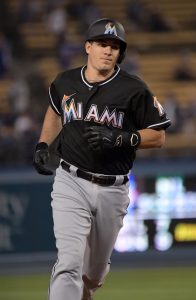
Under the circumstances, it still feels more a question of when than whether the Fish will part with Realmuto. The coming trade deadline surely isn’t a hard stopping point, but it would be foolish for the organization not to market him vigorously. Dealing Yelich proved that the Marlins were ready to embrace a rebuild. Holding Realmuto over the winter does not indicate otherwise; rather, it showed that the club was also willing to exercise patience in achieving value for its best remaining assets.
While the decision not to move starter Dan Straily has not looked promising to this point — he’s struggling to keep the ball in the zone after a DL stint to open the year — the Marlins may yet be paid out for waiting on Realmuto, who has looked much better since his own return from the DL. Through 77 plate appearances, the 27-year-old has shown career-best form in walk rate (7.8%), strikeout rate (13.0%), and power (.206 ISO) while producing at an excellent .309/.382/.515 rate with the bat.
To be sure, Realmuto has not yet proven he can sustain that kind of productivity over the course of a full season. But it has not been BABIP-driven, as he’s carrying a reasonable .315 mark thus far in 2018. If anything, the Statcast results suggest he has been a bit unlucky, as Realmuto is credited with a lofty .410 xwOBA based upon the quality of his contact, handily outpacing his already-impressive .383 wOBA.
Regardless, Realmuto is immensely valuable even if he goes back to being a slightly above-average hitter, as he was over the prior two seasons. He’s youthful. He steals bases. He’s the most athletic catcher in baseball. He has long been lauded for his handling of an ever-changing Miami pitching staff.
If there’s a question — beyond whether he’s a useful or a very good hitter — it’s probably in the framing department. StatCorner has rated Realmuto as one of the worst catchers in the game at winning strikes for his pitchers. Baseball Prospectus, meanwhile, has identified significant improvement over the years and graded Realmuto quite well in this area last year. Without a clear consensus in the metrics, it’s tough to say anything conclusively, though perhaps potential acquiring teams would at a minimum expect to be able to draw more out of Realmuto in the framing department given his underlying physical tools.
Just how much value Realmuto can return will likely depend upon how he hits over the next two-plus months. Barring a serious injury or total collapse at the plate, though, he has already established himself as one of only a few young, everyday backstops in the game.
In this case, then, the Marlins will be marketing Realmuto not only as a mid-season upgrade but also as a solution for clubs that have future needs behind the dish. A high-quality, mid-prime catcher often costs quite a lot more than he’s set to receive. The Pirates seemingly got an appealing price when they promised Francisco Cervelli $31MM over three years in an extension. Russell Martin took down $82MM over a five-year term on the open market.
Starting catchers may not necessarily represent a traditional deadline asset class, but they’ve been moved before. Most recently, one-and-a-half affordable seasons of Jonathan Lucroy — then one of the game’s best and most-established backstops — were swapped (along with quality reliever Jeremy Jeffress) for two high-end prospects.
Teams interested in immediate catching help may have a few other options. Wilson Ramos has been playing well and could be made available, though he’s more expensive now and will be a free agent after the season. Ditto, Lucroy. Perhaps the White Sox will dangle recent signee Welington Castillo, though he was evidently not strongly pursued by contenders over the offseason. The few poor-performing teams that possess established, controllable young catchers seem less likely to move them for a variety of reasons. With the Pirates and Braves contending to this point, some of the more appealing hypothetical rental targets (Cervelli, Kurt Suzuki, Tyler Flowers) may not be available.
In this setting, Realmuto could be in quite some demand. On paper, the Red Sox, Brewers, and Angels have the immediate and long-term need for improvement. The Nationals are getting useful work from behind the dish for the time being, but may well end up needing an upgrade this summer and still lack a long-term solution behind the dish. Though the Astros have been well-served by Brian McCann, they’d be a good fit for the present and future. While the Mets just added Devin Mesoraco, he doesn’t seem particularly likely to be the answer there. A few other teams — the Twins come to mind — could also conceivably emerge as suitors as well.
That’s just a preliminary glance, of course. Injuries and other developments can and surely will change the picture over the coming months. Generally, though, it seems reasonable to anticipate that the Marlins will have a good chance to secure a significant return for Realmuto this summer. While clubs that tried to structure a deal for him over the winter proved unwilling to meet the lofty asking price, the pressures of the trade deadline could help enhance the leverage available to the Miami front office.
Photo courtesy of USA Today Sports Images.
MLB Roster Roundup: Beltre, Darvish, LeMahieu, Schoop
ROSTER MOVES BY TEAM
(May 7th-May 8th)
NATIONAL LEAGUE
- ARIZONA DIAMONDBACKS | Depth Chart
- Placed on 10-Day DL: RP Braden Shipley (elbow inflammation)
- Promoted: RP Silvino Bracho
- ATLANTA BRAVES | Depth Chart
- Promoted: RP Luiz Gohara
- Outrighted: RP Luke Jackson
- CHICAGO CUBS | Depth Chart
- Placed on 10-Day DL: SP Yu Darvish (parainfluenza virus)
- Placed on 7-Day DL: OF Jason Heyward (concussion)
- Promoted: SP Jen-Ho Tseng, INF/OF David Bote, RP Cory Mazzoni, RP Rob Zastryzny
- Tseng started in Darvish’s spot on Tuesday.
- Optioned: RP Luke Farrell, RP Cory Mazzoni
- CINCINNATI REDS | Depth Chart
- Acquisition: SP Matt Harvey (acquired from Mets)
- Promoted: C Tony Cruz (contract purchased), RP Jackson Stephens
- Optioned: RP Kevin Shackelford
- COLORADO ROCKIES | Depth Chart
- Activated from 10-Day DL: 2B DJ LeMahieu
- LeMahieu played 2B and batted 1st on Tuesday.
- Optioned: INF Pat Valaika
- Activated from 10-Day DL: 2B DJ LeMahieu
- LOS ANGELES DODGERS | Depth Chart
- Activated from 10-Day DL: SP Rich Hill
- Optioned: RP Brock Stewart
- MILWAUKEE BREWERS | Depth Chart
- Promoted: INF/OF Nick Franklin (contract purchased)
- Franklin played 2B and batted 6th on Tuesday. He left the game with a strained quad.
- Optioned: INF Eric Sogard
- Transferred to 60-Day DL: C Stephen Vogt
- Promoted: INF/OF Nick Franklin (contract purchased)
- NEW YORK METS | Depth Chart
- Acquisition: C Devin Mesoraco (acquired from Reds)
- Mesoraco struck out as a pinch-hitter in his Mets debut on Tuesday.
- Placed on 10-Day DL: 3B Todd Frazier (strained hamstring)
- Jose Reyes played 3B on Tuesday.
- Promoted: RP Corey Oswalt
- Optioned: SP P.J. Conlon
- Transferred to 60-Day DL: RP Anthony Swarzak
- Acquisition: C Devin Mesoraco (acquired from Reds)
- PHILADELPHIA PHILLIES | Depth Chart
- Placed on 10-Day DL: RP Adam Morgan (strained back)
- Promoted: RP Seranthony Dominguez
- PITTSBURGH PIRATES | Depth Chart
- Promoted: 1B/OF Jose Osuna
- Osuna played 1B and batted 8th on Tuesday.
- Optioned: SP Nick Kingham
- Promoted: 1B/OF Jose Osuna
- SAN DIEGO PADRES | Depth Chart
- Activated from 10-Day DL: RP Matt Strahm
- Optioned: RP Kazuhisa Makita
- Role change: P Bryan Mitchell has been moved to the bullpen.
- Jordan Lyles will take Mitchell’s spot in the rotation on Thursday.
- SAN FRANCISCO GIANTS | Depth Chart
- Promoted: RP Derek Law
- Optioned: RP D.J. Snelten
- ST. LOUIS CARDINALS | Depth Chart
- Promoted: SP John Gant, RP John Brebbia
- Gant made a spot start on Monday.
- Optioned: RP Mike Mayers, RP Ryan Sherriff
- Promoted: SP John Gant, RP John Brebbia
- WASHINGTON NATIONALS | Depth Chart
- Activated from 10-Day DL: RP Shawn Kelley
- Optioned: OF Rafael Bautista
—
AMERICAN LEAGUE
- BALTIMORE ORIOLES | Depth Chart
- Activated from 10-Day DL: 2B Jonathan Schoop
- Schoop played 2B and batted 4th on Tuesday.
- Optioned: INF Engelb Vielma
- Activated from 10-Day DL: 2B Jonathan Schoop
- BOSTON RED SOX | Depth Chart
- Activated from 10-Day DL: INF/OF Brock Holt
- Optioned: INF Tzu-Wei Lin
- Injury: SP David Price was scratched from Wednesday’s start due to numbness in his left hand.
- Rick Porcello and Eduardo Rodriguez will move up to pitch on Wednesday and Thursday, respectively. Friday’s starter is TBD.
- CLEVELAND INDIANS | Depth Chart
- Added to 25-man roster: RP Oliver Drake
- Drake was acquired from the Brewers on Sunday.
- Optioned: RP Alexi Ogando
- Added to 25-man roster: RP Oliver Drake
- DETROIT TIGERS | Depth Chart
- Placed on 10-Day DL: SP Jordan Zimmermann (shoulder impingement), RP Alex Wilson (plantar fascia strain)
- Zimmermann expects to return when eligible.
- Promoted: INF Pete Kozma, RP Zac Reininger
- Transferred to 60-Day DL: P Daniel Norris
- Placed on 10-Day DL: SP Jordan Zimmermann (shoulder impingement), RP Alex Wilson (plantar fascia strain)
- LOS ANGELES ANGELS | Depth Chart
- Reinstated from Bereavement List: C Martin Maldonado
- Maldonado was the catcher and batted 8th on Tuesday.
- Optioned: C Juan Graterol
- Reinstated from Bereavement List: C Martin Maldonado
- TEXAS RANGERS | Depth Chart
- Activated from 10-Day DL: 3B Adrian Beltre
- Beltre played 3B and batted 4th on Tuesday.
- Placed on 10-Day DL: INF/OF Drew Robinson (hip soreness)
- Promoted: INF/OF Eliezer Alvarez
- Optioned: INF/OF Eliezer Alvarez
- Activated from 10-Day DL: 3B Adrian Beltre
- TORONTO BLUE JAYS | Depth Chart
- Placed on Administrative Leave: RP Roberto Osuna
- Osuna was arrested and charged with assault on Tuesday morning. He is under investigation by the Commissioner’s Office, and it’s not clear yet if any disciplinary measures will be imposed.
- Placed on 10-Day DL: INF Aledmys Diaz (sprained ankle)
- Lourdes Gurriel Jr. will be the team’s starting SS while Diaz is out.
- Promoted: INF Richard Urena, RP Jake Petricka
- Placed on Administrative Leave: RP Roberto Osuna
—
FUTURE EXPECTED MOVES
- CLE: RP Andrew Miller will likely be activated from the 10-Day DL on Friday May 11th, according to Jordan Bastian of MLB.com.
- DET: OF Leonys Martin (strained hamstring) will be placed on the 10-Day DL and OF Mikie Mahtook will be recalled from Triple-A, according to the team.
- LAD: OF Yasiel Puig will be activated from the 10-Day DL on Wednesday May 9th, according to Ken Gurnick of MLB.com.
- MIL: RP Corey Knebel will be activated from the 10-Day DL and SP Wade Miley (strained oblique) will be placed on the 10-Day DL on Wednesday May 9th, according to Adam McCalvy of MLB.com.
- NYM: INF Luis Guillorme will be recalled from Triple-A on Wednesday May 9th, according to Mark Feinsand of MLB.com.
- NYM: SP Jacob deGrom is expected to return from the 10-Day DL on Sunday May 13th, according to Anthony DiComo of MLB.com.
- STL: Adam Wainwright is on track to be activated from the 10-Day DL on Saturday May 12th, according to Joe Trezza of MLB.com.
The Orioles Need A Complete Overhaul
The Baltimore Orioles are not good. That’s hardly a bold proclamation or a nuanced piece of analysis, but it’s a fact — likely an understated one. The Orioles’ -72 run differential is the worst in Major League Baseball this season. The team has, somehow, scored the second-fewest runs in MLB this year (topping only the Marlins) while simultaneously yielding the second-most runs in the game (trailing only the Rangers). Orioles hitters, as a collective unit, have a .288 OBP. Their pitchers have a 4.95 ERA with metrics (4.61 FIP, 4.40 xFIP) that largely match. If this were a rebuilding club, perhaps that’d be acceptable or at the very least expected. The Orioles, though, spent $76MM in an effort to bolster their rotation in the offseason.
It’s rare to be able to say in early May that a club that planned on contending is effectively eliminated from the playoffs, but that’s the case for the Orioles. Both Fangraphs and Baseball Prospectus list Baltimore’s playoff odds at zero percent. They’re one of two teams, along with the Reds, to hold that distinction. Some fans don’t love postseason odds based on projection systems, though, so let’s present the uphill battle they’re facing in another manner.
In order even to reach the 85-win mark — that was enough for the Twins to sneak into the second Wild Card spot last season — the Orioles would need to go 77-51 through season’s end. (Realistically, it’ll likely take more than 85 wins, but I’ll stick with that for the purposes of this basic exercise.) That 77-51 record would represent a .601 winning percentage. Only three teams in baseball have played above a .600 clip so far in the year, and two of them — the Yankees and Red Sox — are in the Orioles’ division.
In these circumstances, Baltimore should sell off pieces this summer. That much is clear, and it’s seemed nearly inevitable since before the season even began that the O’s would go down that road. Adding Andrew Cashner and Alex Cobb to a poor rotation picture certainly should’ve improved the Orioles somewhat, but it never seemed likely to make them contenders.
As summer approaches, Manny Machado could be the most talked-about trade chip in the game. He’ll be joined by the likes of Zach Britton, Adam Jones and Brad Brach — each of whom is a free agent at season’s end. The O’s will probably also field interest in Darren O’Day. Ken Rosenthal of The Athletic suggested as much earlier today. But there’s little reason for the Orioles to stop there.
Realistically, the O’s aren’t going to get the haul for Machado that many fans would hope. He’s going to be a pure rental, and while he’s an elite hitter who can play two premium positions, he alone will not fetch a franchise-altering return. Machado is a younger player with far more defensive value than J.D. Martinez had last summer, but it’s worth reminding that the best bat on the market last year netted three mid-range prospects — none of whom were even considered to be among the D-backs’ best two or three prospects and none of whom received any top 100 fanfare. Machado will probably fetch one premium prospect and another second- or third-tier piece or two. The ship has sailed on Britton netting an Aroldis Chapman-esque return as well. He wasn’t especially good when he was healthy last season, and he’ll be coming off two major injuries that will have limited him to somewhere around 60 innings dating back to Opening Day 2017. He’s also earning $12MM in 2018.
If the Orioles want to dramatically remake their farm system — and they should want to do just that — then they need to be more willing to part with longer-term assets. Jonathan Schoop, Mychal Givens, Kevin Gausman and even Dylan Bundy should all be firmly in play for teams willing to part with considerable packages of talent.
Schoop is a free agent after the 2019 season, so it may be too late for Baltimore to secure an extension at this juncture. Gausman is controlled through 2020, but the chances of Baltimore competing with the Yankees and Red Sox in 2019-20 looks slim with much of their core departing and a bleak farm system. Givens has reportedly been deemed largely untouchable in trade talks, but three and a half years of a setup man with his penchant for missing bats would command serious interest. O’s fans undoubtedly bristle at the notion of dealing Bundy after years of anticipating his arrival and his signs of a potential breakout early this season, but three-plus years of him would be arguably the most coveted asset available in July if he can maintain a K-BB% in the 21 percent range.
Baltimore’s problems, though, extend beyond the roster at present. Both GM Dan Duquette and manager Buck Showalter are in the final seasons of their respective contracts. Rosenthal and others have reported on the shifting dynamic in the team’s front office, with vice president of baseball operations Brady Anderson said to be taking on greater responsibility and Duquette’s influence fading. Similarly, Lou and John Angelos, sons of owner Peter Angelos, are said to be increasingly involved in operations, with the Angelos sons and Anderson reportedly pushing hard to finalize the signing of Cobb.
Whoever is calling the shots for the O’s, there are multiple organizational philosophies that need an upheaval. Most glaring and baffling is Baltimore’s seeming refusal to spend any money international prospects. Each year, the Orioles routinely trade away their international bonus allotments for fringe prospects and fringe big leaguers. None of those moves have yielded a quality regular to this point, and a large reason that the team’s farm system is in such disrepair is a bizarre decision to sit out one of the primary avenues of amateur talent acquisition.
Beyond that, the Orioles would be wise to actually make use of the Competitive Balance draft selections they receive on an annual basis. In years past, the O’s have befuddled onlookers by using those picks to help them shed small-scale financial obligations to middle relievers. The Orioles effectively sold their pick in 2015 to the Dodgers in exchange for L.A.’s agreement to take the remaining year and $2.75M on Ryan Webb‘s contract. A year later, they “sold” their pick to the Braves in order to shed the remaining total of roughly $3MM on Brian Matusz‘s contract. In 2014, the O’s traded their Comp Balance pick to the Astros alongside Josh Hader and L.J. Hoes in order to acquire Bud Norris, although that trade at least netted some immediate big league talent.
Bottom line: the O’s have had Competitive Balance picks in each of the past five seasons but have only held onto those selections on two occasions. Norris gave them one strong season in 2014, but they’ve received nothing from the other trades involving picks.
Three years ago on the MLBTR Podcast, Jeff Todd and I discussed how the Reds were in position to rapidly rebuild their farm system by trading not only rental pieces (e.g. Johnny Cueto, Mike Leake) but also several players with additional control remaining. Doing so would’ve meant selling high on assets like Todd Frazier, Jay Bruce and Aroldis Chapman — a tough sell for the fanbase but one that likely would’ve been considerably more beneficial than the route the Reds ultimately took in holding onto those stars and watching their value diminish.
The Orioles find themselves in a similar spot — buried in a strong division with a weak farm system and little in the way of immediate hope for contending in 2019-20. They have several obvious rental pieces to market in July, but by opening themselves up to shipping off other assets with multiple years of control left on the books, they can stockpile a host of near-MLB assets and potentially avoid the style of lengthy, arduous rebuild that’s happening in Cincinnati at the moment. With an aggressive seller’s mentality this July and newfound commitments to both the international prospect market and the amateur draft, the Orioles should be able to establish the type of prospect pipeline they’ve lacked for years.
MLB Weekend Roster Roundup: deGrom, Kershaw, Molina, Rendon
ROSTER MOVES BY TEAM
(May 5th-May 6th)
NATIONAL LEAGUE
- ARIZONA DIAMONDBACKS | Depth Chart
- Promoted: RP Braden Shipley
- Optioned: SP Kris Medlen
- ATLANTA BRAVES | Depth Chart
- Promoted: RP Luke Jackson (contract purchased), RP Lucas Sims
- Optioned: RP Max Fried, RP Lucas Sims
- CINCINNATI REDS | Depth Chart
- Reinstated from Bereavement List: RP Amir Garrett
- Optioned: RP Tanner Rainey
- LOS ANGELES DODGERS | Depth Chart
- Placed on 10-Day DL: SP Clayton Kershaw (biceps tendinitis)
- Promoted: RP Brock Stewart
- Acquisition: INF Danny Espinosa (MiLB contract)
- NEW YORK METS | Depth Chart
- Placed on 10-Day DL: SP Jacob deGrom (hyperextended elbow)
- deGrom is only expected to miss one start and is expected to return on Sunday May 13th.
- Promoted: SP P.J. Conlon (contract purchased), RP Hansel Robles
- Conlon will make his MLB debut on Monday.
- Designated for assignment: SP/RP Matt Harvey
- Placed on 10-Day DL: SP Jacob deGrom (hyperextended elbow)
- ST. LOUIS CARDINALS | Depth Chart
- Placed on 10-Day DL: C Yadier Molina (pelvic injury with traumatic hematoma), RP Dominic Leone (upper arm nerve irritation)
- Molina underwent surgery on Saturday and is expected to miss at least one month.
- Promoted: C Carson Kelly, RP Mike Mayers
- Placed on 10-Day DL: C Yadier Molina (pelvic injury with traumatic hematoma), RP Dominic Leone (upper arm nerve irritation)
- WASHINGTON NATIONALS | Depth Chart
- Activated from 10-Day DL: 3B Anthony Rendon
- Rendon played 3B and batted 2nd on Friday and 3rd on Saturday.
- Optioned: INF Adrian Sanchez
- Activated from 10-Day DL: 3B Anthony Rendon
—
AMERICAN LEAGUE
- BOSTON RED SOX | Depth Chart
- Reinstated from Family Medical Leave list: SP Eduardo Rodriguez
- Optioned: RP Bobby Poyner
- CHICAGO WHITE SOX | Depth Chart
- Placed on 10-Day DL: 2B Yoan Moncada (strained hamstring)
- Leury Garcia played 2B and batted 1st on Saturday.
- Promoted: INF Jose Rondon
- Rondon played 2B and batted 7th on Sunday.
- Placed on 10-Day DL: 2B Yoan Moncada (strained hamstring)
- CLEVELAND INDIANS | Depth Chart
- Promoted: OF Greg Allen
- Allen played CF and batted 9th on Sunday.
- Optioned: RP Ben Taylor
- Acquisition: RP Oliver Drake (acquired from Brewers for cash considerations)
- No corresponding 25-man roster move has been made.
- Promoted: OF Greg Allen
- LOS ANGELES ANGELS | Depth Chart
- Promoted: OF Jabari Blash
- Blash played RF and batted 7th on Sunday.
- Optioned: RP Eduardo Paredes
- Promoted: OF Jabari Blash
- MINNESOTA TWINS | Depth Chart
- Placed on 10-Day DL: C Jason Castro (torn meniscus in knee)
- Promoted: C Bobby Wilson (contract purchased)
- Transferred to 60-Day DL: SP Ervin Santana
- TAMPA BAY RAYS | Depth Chart
- Promoted: RP Ryne Stanek
- Optioned: RP Chih-Wei Hu
- TORONTO BLUE JAYS | Depth Chart
-
- Reinstated from Paternity List: 1B Justin Smoak
- Promoted: OF Anthony Alford
- Alford played LF and batted 7th on Sunday.
- Optioned: INF Richard Urena, RP Jake Petricka
-
—
FUTURE EXPECTED MOVES
- CLE: RP Andrew Miller will likely be activated from the 10-Day DL on Friday May 11th, according to Jordan Bastian of MLB.com.
- LAD: OF Yasiel Puig will be activated from the 10-Day DL on Wednesday May 9th, according to Ken Gurnick of MLB.com. SP Rich Hill will be activated from the 10-Day DL on Tuesday May 8th, according to Andy McCullough of the Los Angeles Times.
- STL: SP John Gant will be recalled from the minors on Monday May 7th, according to Derrick Goold of the St. Louis Post-Dispatch. He’ll be making his first start of 2018.
Poll: Blake Swihart’s Future
The Red Sox entered Sunday with the majors’ best record (24-9) and second-ranked run differential (plus-62), feats that are all the more impressive when you consider they’ve received almost no offensive production from their catchers. Boston’s backstops, Christian Vazquez and Sandy Leon, have combined for a hideous .169/.226/.202 line with no home runs in 134 plate appearances. That amounts to a wRC+ of 15, which falls well short of 29th-place Baltimore’s mark (41).
Given the dreadful starts Vazquez and Leon have gotten off to at the plate, it stands to reason the Red Sox will give the catcher-capable Blake Swihart an opportunity to grab the reins at some point. There aren’t any signs that’s going to happen, however, as Evan Drellich of NBC Sports Boston wrote earlier this week.
Although Swihart was a first-round pick (26th overall) in 2011 and was once among the game’s most heralded catching prospects, he hasn’t been able to establish himself in Boston. The switch-hitter looked to be on his way when he amassed 309 PAs and batted a respectable .274/.319/.392 (93 wRC+) as a rookie in 2015, but he has only come to the plate 106 times since then. Of course, there were obvious causes for Swihart’s lack of MLB time from 2016-17, including nagging ankle problems, major questions about his defense and poor production at Triple-A Pawtucket last season. Meanwhile, at the big league level, Leon enjoyed a breakout year in 2016 to grab hold of the Red Sox’s catching job that season. And while Leon took sizable steps backward last year, Vazquez stepped up, thus earning himself a contract extension prior to the current campaign.
Despite the struggles Vazquez and Leon have endured this year, the Red Sox clearly trust those two more than Swihart, who has transitioned to a utility role. The 26-year-old has barely played in the field, though, and has only caught one inning (in a blowout loss to Texas this past Thursday). Although Swihart has been working on bettering his behind-the-plate skills with Red Sox catching coordinator Chad Epperson and retired catcher Jason Varitek, as Drellich details in his piece, pitching coach Dana LeVangie noted that the best way for him to improve is by actually seeing game action at the position.
“He needs to play through failure, he needs to play through success, he needs to get comfortable,” LeVangie told Drellich. “And the only way to do it is to play. And for him to figure it out behind the plate, the only way to get more comfortable is more reps. He can get better in every facet.”
If Boston’s not going to be the team that gives Swihart a shot at catcher this year, he may wind up on another roster soon, Drellich points out. When on-the-mend second baseman Dustin Pedroia returns from offseason knee surgery in the coming weeks, Swihart’s time with the Red Sox could end, given that he’s out of options. Boston has turned down opportunities to trade Swihart in the past, but it might have to either deal him or expose him to waivers soon. For his part, Swihart’s not asking for a trade.
“I don’t think that you do that,” he told Drellich. “That’s my agent’s job to call and do that, you know? Me personally, the player, this is all I know, is the Red Sox. I know there’s other teams that probably tried to call and there’s stuff moving. But I’m not the type of person that’s just going to walk in and say, ‘Hey, I’m not playing, so get rid of me.’ I mean, I want this team to win, and when I’m here, I want to be able to help contribute any way I can.”
Swihart perhaps has the ability to contribute not only at catcher, but in both the corner infield and outfield. The problem is that the Red Sox are set in all of those areas, with Hanley Ramirez and Mitch Moreland at first, Rafael Devers at third and an enviable group of corner outfielders (Mookie Betts, Andrew Benintendi and J.D. Martinez). The club’s embarrassment of riches at those spots has made it that much more difficult for Swihart to emerge as a factor in the majors – evidenced in part by his meager 25 PAs this year – though it’s possible he’ll soon have a chance to return to his natural position with another franchise.
Drellich names Texas as a possible fit for Swihart, which makes sense considering the Rangers have had interest in him the past. Further, they’ve clearly been in the market for a competent backup to Robinson Chirinos, having added Carlos Perez and Cameron Rupp in recent weeks. The Mets have also come up as speculative suitors for Swihart, thanks largely to starting catcher Travis d’Arnaud‘s season-ending elbow injury and the fractured left hand backup Kevin Plawecki suffered a few weeks ago. New York hasn’t found anything resembling a solution behind the plate in those players’ absences, as fill-ins Jose Lobaton and Tomas Nido have combined for a mere eight hits (two for extra bases) in 70 PAs.
Regardless of whether he ultimately hooks on with the Rangers, Mets or someone else, it does appear Swihart’s days with the Red Sox are on the verge of concluding. If so, it would bring an end to what has been a disappointing Boston tenure for a player who once looked as if he could be its first long-term answer at catcher since Varitek retired after the 2011 campaign.
(poll link for app users)
Will Blake Swihart stick with the Red Sox through the season?
-
No 74% (3,413)
-
Yes 26% (1,207)
Total votes: 4,620
MLB Daily Roster Roundup: Bautista, Cabrera, Harvey, Swanson
ROSTER MOVES BY TEAM
(May 4th)
NATIONAL LEAGUE
- ARIZONA DIAMONDBACKS | Depth Chart
- Promoted: SP Kris Medlen (contract purchased)
- Optioned: RP Silvino Bracho
- Transferred to 60-Day DL: SP Taijuan Walker
- Acquisition: SP Clay Buchholz (MiLB contract)
- ATLANTA BRAVES | Depth Chart
- Placed on 10-Day DL: SS Dansby Swanson (wrist inflammation)
- Johan Camargo will be the team’s regular SS while Swanson is out.
- Promoted: 3B/OF Jose Bautista (contract purchased)
- Bautista played 3B and batted 5th on Friday.
- Placed on 10-Day DL: SS Dansby Swanson (wrist inflammation)
- CINCINNATI REDS | Depth Chart
- Placed on Bereavement List: RP Amir Garrett
- Promoted: RP Tanner Rainey
- COLORADO ROCKIES | Depth Chart
- Activated from 10-Day DL: RP Chris Rusin
- Optioned: RP/SP Antonio Senzatela
- LOS ANGELES DODGERS | Depth Chart
- Promoted: SP Walker Buehler, INF/OF Breyvic Valera (26th man for Monterrey series)
- Optioned: RP Edward Paredes
- MILWAUKEE BREWERS | Depth Chart
- Placed on 10-Day DL: SP Zach Davies (rotator cuff inflammation)
- With two upcoming off days, Davies is expected to miss only one start.
- Promoted: RP Jorge Lopez
- Placed on 10-Day DL: SP Zach Davies (rotator cuff inflammation)
- NEW YORK METS | Depth Chart
- Designated for assignment: SP/RP Matt Harvey
- Corresponding move will be made on Saturday. The Mets will have seven days to trade Harvey or release him.
- Designated for assignment: SP/RP Matt Harvey
- SAN DIEGO PADRES | Depth Chart
- Promoted: INF Javy Guerra (26th man for Monterrey series)
- ST. LOUIS CARDINALS | Depth Chart
- Activated from 10-Day DL: RP Ryan Sherriff, RP Sam Tuivailala
- Optioned: 1B Luke Voit, RP Austin Gomber
—
AMERICAN LEAGUE
- BOSTON RED SOX | Depth Chart
- Promoted: RP Bobby Poyner
- Optioned: RP Marcus Walden
- CHICAGO WHITE SOX | Depth Chart
- Promoted: RP Jace Fry
- Optioned: RP Juan Minaya
- CLEVELAND INDIANS | Depth Chart
- Promoted: RP Alexi Ogando (contract purchased)
- Designated for assignment: INF Giovanny Urshela, RP Jeff Beliveau
- Urshela was activated from the 10-Day DL prior to being designated for assignment.
- DETROIT TIGERS | Depth Chart
- Placed on 10-Day DL: 1B Miguel Cabrera (strained hamstring)
- John Hicks will be the team’s regular 1B while Cabrera is out.
- Promoted: C Grayson Greiner, RP/SP Blaine Hardy (contract purchased)
- Optioned: RP Chad Bell
- Placed on 10-Day DL: 1B Miguel Cabrera (strained hamstring)
- KANSAS CITY ROYALS | Depth Chart
- Promoted: RP Jason Adam (contract purchased)
- Optioned: RP Scott Barlow
- LOS ANGELES ANGELS | Depth Chart
- Placed on Bereavement List: C Martin Maldonado
- Promoted: C Juan Graterol (contract purchased)
- Transferred to 60-Day DL: SP JC Ramirez
- TORONTO BLUE JAYS | Depth Chart
- Promoted: INF Richard Urena, OF Dalton Pompey, RP Jake Petricka (contract purchased)
- Neither Urena or Pompey were in Friday’s starting lineup.
- Optioned: OF Dwight Smith Jr., SP Joe Biagini, RP Carlos Ramirez
- Designated for assignment: RP Luis Santos
- Promoted: INF Richard Urena, OF Dalton Pompey, RP Jake Petricka (contract purchased)
—
FUTURE EXPECTED MOVES
- LAD: SP Rich Hill will be activated from the 10-Day DL on Sunday May 6th, also according to Hoornstra.
- STL: SP John Gant will be recalled from the minors on Monday May 7th, according to Derrick Goold of the St. Louis Post-Dispatch. He’ll be making his first start of 2018.
- WSH: 3B Anthony Rendon will likely be activated from the 10-Day DL on Saturday May 5th, according to Mark Zuckerman of MASN.