
Latest On Twins’ Offseason Plans
What once seemed to be a promising season for the Twins is coming to a devastating end, as the club was officially eliminated from postseason contention last night after a free fall in the standings spurred on by their brutal 9-16 record so far this September. While Minnesota entered the month with a 91.7% chance to make the postseason according to Fangraphs, they’ll sit on the sidelines this October just one year after breaking a 20-year drought without a victory in the postseason.
With that being said, Aaron Gleeman of The Athletic suggested in a report today that both president of baseball operations Derek Falvey and manager Rocco Baldelli (as well as team president Dave St. Peter, who handles business operations for the club) appear unlikely to be let go by the club as things stand. Falvey took the helm of baseball operations for the Twins prior to the 2017 season, and the team has generally been successful during his tenure with four postseason appearances and five seasons with an above .500 record during his eight years with the club’s front office. Meanwhile, Baldelli joined the club prior to the 2019 season and has led the club to three postseason appearances and four over .500 records in his six years in the Minnesota dugout.
That’s not to say no change is coming to the organization, however. According to Gleeman, it’s “expected” that changes will be made this winter that could impact high-ranking members of both the front office and coaching staff. Of note, Gleeman did not report on the status of GM Thad Levine. Levine has served as the #2 to Falvey throughout his tenure with the Twins and seemingly entered the year without a contract for the 2025 season. Speculatively speaking, it wouldn’t be a surprise to see Levine depart the club if the Twins were to shake up their front office, particularly given the fact that Levine was a finalist for the top job in Boston last winter before the Red Sox ultimately hired Craig Breslow and could once again look to pursue a top job elsewhere this offseason.
Disappointing as the 2024 season was for Twins fans, it’s fair to point out that the club’s struggles can’t be blamed entirely on the front office or coaching staff. After all, club ownership slashed payroll by $30MM coming off the club’s successful 2023 season, not only forcing the club to enter 2024 without replacing 2023 AL Cy Young finalist Sonny Gray but also leaving them unable to make moves of significance to improve the roster beyond adding veteran first baseman Carlos Santana, a move that needed to be paired with a deal to ship out longtime infielder Jorge Polanco.
Unfortunately for fans in Minnesota, Gleeman suggests there’s little reason to believe payroll will increase headed into 2025. Instead, he notes that the club’s revenue has landed below expectations this year and could prompt even more cuts. That could leave the club needing to trade away veterans on guaranteed contracts over the winter in order to improve other areas of the roster, and Gleeman suggests that right-hander Chris Paddack and catcher Christian Vazquez could be the club’s most expendable pieces if such a situation were to come to pass.
Paddack, 28, returned to the club after Tommy John surgery wiped out nearly all of his 2023 season. He made 17 starts for the Twins this year but struggled with lackluster results, posting a 4.99 ERA despite a solid enough 4.18 FIP. It’s easy to see how Paddack could be an attractive trade piece for pitching-hungry clubs this winter, particularly those with budget constraints of their own. After all, he’s set to make just $7.5MM in 2025. Even back-of-the-rotation arms have typically garnered guarantees north of $10MM on the open market in recent years, so $7.5MM for Paddack could be viewed as a bargain even in spite of injury concerns thanks to the tantalizing upside he flashed during his time with the Padres.
Vazquez, on the other hand, appears unlikely to bring back much outside of salary relief for Minnesota. The 34-year-old veteran entered free agency following the 2022 season with a strong defensive reputation and a solid 95 wRC+ in four years since taking over as the primary catcher in Boston. Unfortunately, things haven’t worked out well since he signed with the Twins on a three-year deal prior to the 2023 season. In Minnesota, Vazquez has hit just .224/.267/.324 (64 wRC+) over the past two years while ceding the regular duties behind the plate to breakout youngster Ryan Jeffers. He still remains a stalwart defender behind the plate, but his lackluster offense and hefty $10MM salary for next year would make him unattractive as a trade candidate unless the Twins were to sweeten the deal with either cash or additional talent.
The Twins’ Quietly Elite Catcher
For years in Minnesota, the catching position was the strongest on the roster. Hometown kid and former No. 1 overall pick Joe Mauer went from ballyhooed prospect to three-time batting champion and 2009 American League MVP. He solidified the spot for a decade, hitting .323/.405/.469 in more than 5000 plate appearances from 2004-13.
When concussions forced Mauer over to first base, the Twins turned things over to a series of veterans as they struggled to develop an in-house replacement. Kurt Suzuki and Jason Castro both inked multi-year deals to serve as the starting catcher in Minnesota. Those contracts actually panned out reasonably well; Suzuki hit .263/.316/.364 in three seasons and made the 2014 All-Star team. Castro hit .229/.325/.390 in his three seasons and provided elite defense. Along the way, the Twins succeeded in developing one high-end offensive catcher — Mitch Garver — but struggled to keep him healthy. Garver was eventually traded to the Rangers for Isiah Kiner-Falefa and Ronny Henriquez. Kiner-Falefa was then immediately flipped to the Yankees alongside Josh Donaldson in a swap that netted the Twins Gary Sanchez and Gio Urshela (while shedding the remainder of Donaldson’s $92MM contract).
Somewhat lost in the shuffle during that catching carousel was 2018 second-rounder Ryan Jeffers. The UNC-Wilmington product had a nice debut showing in the pandemic-shortened 2020 season, slashing .273/.355/.436 in a small sample of 62 plate appearances. Jeffers, however, fanned in more than 30% of his plate appearances that year and experienced even more pronounced contact issues in the two subsequent seasons.

From 2021-22, he hit just .203/.277/.384 with a 32.4% strikeout rate. The power was apparent (21 homers, .182 ISO in 529 plate appearances), but Jeffers’ contact issues rendered him a well below-average hitter. The Twins, in win-now mode after a strong 2022 campaign, signed veteran Christian Vazquez to a three-year, $30MM deal that generally aligned with market expectations.
Heading into the 2023 season, Jeffers wasn’t relegated to a traditional backup role, but there was a clear expectation that he and Vazquez would be in a timeshare behind the plate — likely with the defensively superior Vazquez handling a bit more of the workload. Through the season’s first few months, that’s precisely how things played out, too. Vazquez received 202 first-half plate appearances to Jeffers’ 157. Vazquez provided his typical brand of elite defense but hit just .210/.287/.265 in that time. Jeffers, on the other hand, hit .256/.357/.421 — numbers more in line with his intriguing rookie showing from 2020.
Following the All-Star break, the balance of playing time tilted in the other direction. It was Jeffers who found his name called more often, picking up 178 plate appearances to Vazquez’s 153. While Vazquez improved a bit offensively in the season’s second half, Jeffers saw his production soar to heights not seen by a Minnesota catcher in years. In the final two-plus months of the season, the 26-year-old mashed at a .294/.379/.549 clip and belted 10 homers. By measure of wRC+, that was 54% better than the league-average hitter. And considering catchers tend to be about 12% worse than the average hitter, Jeffers’ breakout was all the more eye-catching.
It didn’t appear to be simple small-sample noise, either. Jeffers made notable gains in his contact ability, fanning at a reduced (but still higher-than-average) 26.4% clip post-break last season. That includes a strikeout rate of just 17.1% in the season’s final month. While he didn’t suddenly reduce his chase rate on pitches off the plate, Jeffers took a noticeably more aggressive approach overall and seemed to benefit from it. His 50.3% overall swing rate in September was markedly higher than the 43.7% of pitches at which he’d offered in the five months prior. He’d previously made contact on 57.5% of his chases off the plate and 82.2% of his swings within the strike zone; those jumped to 71.4% and 87.8%, respectively, in the final month of play.
We’re now five weeks into the 2024 season, and Jeffers has picked up right where he left off last September. He’s hitting .300/.393/.556 on the season and has already popped five homers in his 107 plate appearances. His 16.8% strikeout rate is an easy career-low. The more aggressive approach he showed late last year remains in place, as he’s swinging at a 47.4% clip with better contact off the plate and within the zone that he’d shown prior to last September.
Jeffers has made himself veritably indispensable in the Twins’ lineup. He’s appeared in 27 of their 30 games: 14 at catcher and 11 at designated hitter. Manager Rocco Baldelli has begun to bat Jeffers in the top-third of his lineup with regularity. Seventy percent of his plate appearances have come while batting first, second or third this year. Jeffers has long pounded left-handed pitching (career .267/.362/.487), but he’s now hitting .285/.368/.489 against righties dating back to Opening Day 2023 — a wild improvement over the .185/.256/.361 slash he posted versus righties from 2020-22.
And, for all the talk about Vazquez’s defense earlier, it should be noted that Jeffers is hardly a slouch himself in that regard. Statcast was down on his ability to block balls in the dirt last season (five blocks below average), but Jeffers has routinely drawn positive overall grades from Defensive Runs Saved. He’s been better than average in that regard in each other season of his big league career, however, and Jeffers has been an average or better pitch framer in his career as a whole, per both FanGraphs and Statcast. He has a slightly below-average caught-stealing rate in his career, but much of that stems from an ugly 13% caught-stealing rate as a rookie. Jeffers nabbed 25% of thieves in 2023 (league-average was 21%) and is 1-for-5 in 2024 (23% is league-average).
Since last season, there are 75 big league catchers who’ve tallied at least 100 plate appearances. Jeffers’ 146 wRC+ leads the pack by a massive margin; the Contreras brothers check in at 133 (William Contreras) and 132 (Willson Contreras) and stand as the No. 2 and 3 entrants on that list. Yes, it’s still only a sample of 442 plate appearances for Jeffers, but he’s been far and away the best-hitting catcher in the majors going back to last year, quietly topping stars like Will Smith, Adley Rutschman, Sean Murphy and the Contreras brothers on a per-plate-appearance basis. Granted, Jeffers isn’t going to top WAR leaderboards because of his more even timeshare with Vazquez and lesser defensive skills to names like Murphy, Rutschman, Patrick Bailey and others — but he’s nevertheless stepped out as one the game’s premier hitters at his position.
Perhaps the Vazquez addition took some pressure off Jeffers, but the breakout at the plate and the Twins’ efforts to scale back payroll this past offseason do combine to make that signing look superfluous. Vazquez is a flat-out elite defender, but he’s hitting .222/.273/.309 in 421 plate appearances as a Twin. For a team that was up against some pretty noticeable payroll constraints from ownership in the offseason, that $10MM-per-year salary could certainly be allocated in a more efficient way.
That’s not to disparage Vazquez; had Twins ownership merely allowed the front office to maintain last year’s roughly $155MM payroll, his salary wouldn’t even be all that cumbersome to manage — and there’s surely intangible benefit to him working with Jeffers and with the team’s pitching staff. Still, the Twins spent relatively heavily to install a starting-caliber option behind the dish, only to see one of their young, in-house options emerge as the cornerstone backstop they’d been seeking all along.
Jeffers remains highly affordable for the Twins, earning just $2.425MM this season in his first trip through arbitration. He’s well on his way to earning a major raise on top of that salary if he can continue to hit as he has going back to Opening Day 2023. He’ll be arb-eligible twice more and is controllable through the 2026 season. As a Boras Corporation client, Jeffers doesn’t stand out as the likeliest candidate to sign a long-term deal, but it’s hard to imagine the Twins wouldn’t be interested in hammering out some kind of deal to keep him in Minneapolis longer than he’s currently slated to stay.
AL Central Notes: Vazquez, Malloy, Bubic
Now with more clarity on their broadcasting situation established for 2024, the Twins have started to make some significant offseason moves, including the Jorge Polanco trade and the signing of Carlos Santana. Since rumors about Polanco’s possible departure have swirled for months, it stands to reason that the Twins could also now finally move other trade candidates as Max Kepler or Christian Vazquez, though The Athletic’s Aaron Gleeman writes that there hasn’t been any real steam on a possible salary-shedding Vazquez trade.”
Minnesota was reportedly speaking with teams about potential Vazquez deals back in November, though Gleeman and Dan Hayes wrote at the time that a trade may not be too likely, both due to Vazquez’s $20MM in remaining salary and the catcher’s very disappointing 2023 campaign. In their most recent piece, Gleeman and Hayes agree that a Vazquez trade may still be something of a longshot, with the Twins’ desire to retain catching depth also acting as a factor. If Vazquez was dealt, Ryan Jeffers would step into the starting catching role and either rookie Jair Camargo or another veteran addition would be the backup, so Minnesota might prefer to stand pat.
More from the AL Central…
- After playing third base in college and at the start of his pro career in 2021, Justyn-Henry Malloy now looks to be on more or less a full-time path as a corner outfielder, and the Tigers prospect told Evan Petzold of the Detroit Free Press that he has spent the winter preparing for this role. “Every day, I’m out here shagging fly balls and making throws to bases,” Malloy said. “I want to be a player that my pitchers can trust….It’s something that I circle on my day, that we’re going to do some defense and get better. That’s been my mentality all offseason.” Baseball America ranked Malloy as the sixth-best prospect in Detroit’s system and also cited him as one of 15 players who just missed making their 2024 edition of the sport’s best prospects, noting that Malloy has a good throwing arm but struggled with accuracy in throwing from third to first base. While Malloy’s defensive future is still a question mark, his bat already seems big league-ready — Malloy hit .277/.417/.474 with 23 home runs over 611 plate appearances with Triple-A Toledo in 2023.
- Kris Bubic underwent Tommy John surgery last April, and the Royals southpaw told Jaylon Thompson of the Kansas City Star that he is now about 10 days away from his first bullpen session. Bubic expects to return around the middle of the season given the usual TJ recovery timeline, and he is taking the opportunity during his rehab to make some mechanical changes, as well as looking forward to continue work on developing a slider as a new pitch in his arsenal. Bubic was the 40th overall pick of the 2018 draft, and is one of several well-regarded Royals pitching prospects who have yet to really break out at the big league level, thus greatly hampering Kansas City’s rebuild efforts. The Tommy John procedure provided yet another obstacle for the 26-year-old Bubic, who has a 4.85 ERA over 325 career Major League innings.
AL Central Notes: Lugo, Royals, Twins, Vazquez, Kelly
Before Seth Lugo signed with the Padres last winter, the Royals were “reportedly” one of the other teams interested, the Kansas City Star’s Jaylon Thompson writes. That doesn’t necessarily mean that K.C. has continued that interest now that Lugo is a free agent again, yet given the Royals’ need for starting pitching and the apparent fact that the majority of the league has at least checked in on Lugo’s services, it stands to reason that the Royals still have the right-hander on their radar.
The price tag will be significantly higher for Lugo this time around. After inking a two-year, $15MM deal with San Diego last winter, Lugo re-established himself as a starting pitcher and posted a solid 3.57 ERA over 146 1/3 innings in 2023. This puts Lugo in line for at least the three years and $42MM that MLB Trade Rumors has projected, and it seems entirely possible that he’ll land an even bigger payday given the broad interest in his services. Kansas City might be hard pressed to land Lugo if it turns into a pure bidding war, yet as Thompson notes, the Royals already know they won’t be vying for the most expensive free agent pitchers. Some teams might see Lugo as a bit more of a backup plan if they can’t land a top-tier starter, whereas the Royals are theoretically more able to focus all their attention on the 34-year-old early.
More from around the AL Central…
- The Twins‘ roster is broken down by The Athletic’s Aaron Gleeman and Dan Hayes, including some talk of potential offseason moves and target areas. With Christian Vazquez‘s name recently surfacing in trade rumors, Gleeman and Hayes agree that a deal is possible, but Gleeman notes that Minnesota would likely have to eat a good portion of the $20MM remaining on Vazquez’s contract to facilitate a deal, and thus “trading him may not even save that much money, in which case there’s really no reason to do it.” Hayes thinks a Vazquez trade might be more likely to come closer to midseason, theoretically after Vazquez has rebuilt some of his value with a solid performance in the first few months of the 2024 campaign.
- Sticking with the Twins, their plan to cut payroll has been the big headline of the Minnesota offseason. In a mailbag piece with readers, Bobby Nightengale of the Minneapolis Star Tribune hears from a player agent that the Twins will be much more likely to pursue upgrades via trades before they “seriously” look at free agent signings. Offering backloaded contracts to free agents also doesn’t make much sense, either for the free agents themselves or for the Twins, as Nightengale notes that Minnesota will want to save future money for its own players (i.e. for arbitration raises or contractually-manded raises).
- It has been a tough few years for Carson Kelly, as injuries and a lack of performance have sidetracked the career of the former top prospect and seeming breakout catcher during his days with the Cardinals and Diamondbacks. Kelly signed with the Tigers after being released by the D’Backs in August, and the catcher will be staying in Motown as Jake Rogers‘ backup after the Tigers exercised their $3.5MM club option on his services for 2024. With his immediate future now secure, Kelly tells Evan Petzold of the Detroit Free Press that the next step is to spend the offseason fixing his swing mechanics, as well as working on catching from a one-knee stance as opposed to a traditional crouch. “It’s for stealing strikes at the bottom of the zone, and I’m already in a better position to block….It just puts me in a better position to react to wherever the ball is,” Kelly said.
Twins Have Discussed Christian Vázquez Trades
The Twins have been open about their plans to reduce payroll and that has reportedly led them to try to trade some players from their roster. In an appearance on Foul Territory, Robert Murray of FanSided listed catcher Christian Vázquez as one player that the club has been aggressively shopping.
Vázquez, now 33, signed a three-year, $30MM deal with the Twins almost a year ago. He got that deal after many years of solid work in the big leagues, generally pairing strong defense with offense around league average for a backstop. However, the first year in Minnesota didn’t go especially well. Vázquez was still good when donning the tools of ignorance but his work with the bat took a big step backwards. His strikeout rate jumped to a career high of 23.1% and his overall line of .223/.280/.318 translated to a wRC+ of just 65.
While Vázquez was going through that disappointing season, the Twins saw Ryan Jeffers take the opposite path. He had a tremendous breakout campaign in 2023, hitting 14 home runs in 96 games. His .276/.369/.490 batting line led to a wRC+ of 138. His glovework isn’t as heralded as that of Vázquez but he is still just 26 years old and could still make strides behind the plate. He’s only entering arbitration for the first time this winter with a projected salary of $2.3MM and isn’t slated for free agency until after 2026.
Vázquez still has two years and $20MM left on his deal, which isn’t terribly burdensome by baseball payroll standards. But for a club looking to cut costs due to its uncertainty around broadcast revenue, $10MM per year on a catcher who has been leapfrogged on the depth chart might be a luxury they can’t afford. Jair Camargo just had a strong season in Triple-A and got added to the 40-man roster, so perhaps he could step in as a backup to Jeffers, or the club could also look for a lower-cost veteran to replace Vázquez.
Though the Twins are looking to shed salary, they will likely have to eat at least a little bit of the deal in order to move it. Aaron Gleeman of The Athletic reported this week that several other clubs were willing to give Vázquez deals around two years and $20MM last year before the Twins got it done by adding a third year. But with Vázquez now a year older and coming off a rough season, the desire by other clubs to take on that contract is surely diminished.
But once the financials are worked out, there would likely be plenty of interest around the league. Murray mentions that the Padres had interest in Vázquez when he was a free agent, though they have their own payroll concerns and Luis Campusano had a strong finish to the 2023 season for them, perhaps reducing their need for help behind the plate. Murray also mentions the Marlins as a speculative fit, which is sensible since they are known to be looking for upgrades there. Some other clubs that could perhaps look for veteran to help with the workload behind the plate include the Red Sox, White Sox, Cubs, Rays, Diamondbacks and others.
Despite the rough 2023 campaign, Vázquez suitors might be interested in the .271/.318/.416 batting line he posted from 2019 to 2022. That translated to a 94 wRC+, below average overall but roughly par for a catcher, which paired nicely with his excellent glovework. What might help the Twins is that the free agent market doesn’t have many more exciting options. Mitch Garver and Tom Murphy have more offensive upside but both have significant injury histories and can’t match Vázquez in terms of defense. Gary Sánchez, Victor Caratini and Yasmani Grandal are some of the other top names available. What might work against the Twins, however, is that the Yankees are also looking to trade from their catching surplus.
It’s been suggested that the Twins could look to open 2024 with a payroll between $125MM and $140MM, a drop from last year’s $154MM mark. Roster Resource has them pegged at $125MM already, giving them little wiggle room for upgrading the pitching staff. They could give themselves a bit more breathing space with a trade of a player making a somewhat notable salary, such as Max Kepler, Jorge Polanco or Kyle Farmer, but Vázquez is apparently on the list as well.
AL Central Notes: Counsell, Twins, Rogers
The Guardians have secured permission to interview Brewers manager Craig Counsell, per Paul Hoynes of Cleveland.com. Cleveland had previously been reported as requesting permission from Milwaukee to interview Counsell earlier this week. While it was unclear if the Brewers would grant that permission, it’s hardly a surprise that they did so after recently offering the Mets the same courtesy. Counsell, 53, is among the most well-respected managers in the game after piloting the Brewers to a 707-625 record during his nine-year tenure that’s included five postseason appearances in the past six seasons.
Just as Counsell has other suitors beyond Cleveland in Milwaukee and Queens, the Guardians also have options outside of Counsell as they look to replace Terry Francona in the dugout. Cubs bench coach Andy Green recently interviewed for the position, and Dodgers first base coach Clayton McCullough, Yankees bench coach Carlos Mendoza, and Giants bullpen/catching coach Craig Albernaz have all also met with the Guardians regarding their managerial vacancy. Of that group, only Green has past experience as a big league manager aside from Counsell. While Counsell reportedly enters free agency hoping to move the ball forward for future managers around the game in terms of salary, that seems unlikely to preclude the Guardians from making a run at Counsell’s services, given Francona was the highest paid manager in the game this season, with Jon Heyman of the New York Post reporting that Francona made $4.5MM in 2023.
More from around the AL Central…
- Despite not being part of the club’s starting lineup during their postseason run, veteran catcher Christian Vazquez figures to remain a significant part of the Twins in 2024, per Bobby Nightengale of the Star Tribune. Per Nightengale, the team plans to offer roughly equal playing time to Vazquez and fellow catcher Ryan Jeffers behind the plate next year. Vazquez just wrapped up the first season of his three-year, $30MM deal with the club and suffered the worst offensive season of his career with a .223/.280/.318 slash line across 355 plate appearances. By contrast, Jeffers had a breakout season, slashing .276/.369/.490 in 335 trips to the plate. While Jeffers is clearly the stronger offensive option, Vazquez is regarded as an elite defensive catcher and Jeffers could feasibly see additional playing time at DH next year as a way to keep his bat in the lineup on days Vazquez is behind the plate.
- The Tigers had another difficult season in 2023, posting a 78-84 record and finishing 9 games out of a postseason spot. That being said, one significant bright spot for the club this year was catcher Jake Rogers, who Evan Petzold of the Detroit Free Press indicates has already secured his role as the club’s top option behind the plate for 2024. Rogers improved on defense in 2023 to post framing numbers in line with other quality regulars at the position like Adley Rutschman and Alejandro Kirk while also slashing a respectable .221/.286/.444 with 21 home runs in just 365 trips to the plate. Among catchers with at least 300 plate appearances in the majors this year, Rogers’s 97 wRC+ ties him with Mets rookie Francisco Alvarez for the 14th-best figure in the majors.
Best Deadline Rental Returns In Recent History: Honorable Mentions
The calendar has flipped to June, and more than one-third of the season is in the rearview mirror. While there’s still plenty of time for the standings to change in dramatic fashion — just ask the 2022 Phillies or 2019 Nationals — the “early” portion of the season is a bit behind us. As the weather heats up and playoff pictures begin to take a more definitive shape, the baseball world inherently turns its focus to a few things: the looming All-Star Game, the upcoming amateur draft and, of course, the annual trade deadline.
June trades of note are admittedly rare — particularly over the past ten years or so — but we’re fast approaching the portion of the season where trade needs, potential trade candidates and many other deadline-adjacent minutiae begin to crystallize. It’s common for fans of rebuilding and/or underperforming clubs to begin to wonder just what sort of returns their favorite team might be able to eke out for veteran players with dwindling club control.
Some of the most common questions we’re asked in chats at MLBTR these days center around what a team might be able to get for a certain player — rentals in particular. Names like Lucas Giolito, Cody Bellinger, Jordan Montgomery and Jeimer Candelario were just a few readers asked me about this past week. To be clear, it’s not a given that all or even any of those specific names will change hands in two months’ time (or sooner), but it’s obviously a hot topic that’s on people’s minds.
As such, it only seemed natural to take a look back through recent history and look at some high-profile trades of rental players and see which panned out the best for the team selling off the veteran player in question. Over the next couple weeks, we’ll roll out a look at the ten “best” returns for rental players in recent trade deadline history.
A few caveats of note! At times, it can take three, four, five years or even longer for a team to begin reaping the benefits from such a deal. An immediate return isn’t always apparent, particularly when you’re only selling two months of a player or players. As such, we’re not considering trades completed at last year’s deadline for our top ten, even though they could well prove excellent as soon as 2024 or 2025. It’s simply too soon to evaluate those swaps. Also, these rankings are subjective; they’re not based on a hard-and-fast WAR criteria or anything of the sort. If you think we should’ve ranked No. 7 higher and No. 4 lower, let us know. It’s all part of the fun.
While I said we’re omitting last year’s deadline from our top ten, that doesn’t mean we’ll completely ignore the results of the 2022 deadline. To kick off the series, here’s a quick look at three honorable mentions from 2017-21 as well as a handful of 2022 trades that will be worth keeping an eye on in the years to come. Present-day impact of these 2022 trades has either been minimal or nonexistent, but each brought the “selling” team some nearly MLB-ready help that could be impactful as soon as this season. These honorable mentions and 2022 swaps aren’t ranked — they’re just sorted alphabetically by the last name of the player who was traded.
Let’s begin!
Honorable Mentions
Orioles acquire RHPs Dillon Tate, Cody Carroll and LHP Josh Rogers from the Yankees in exchange for LHP Zack Britton (7/24/18)
Two-thirds of this return for Baltimore wound up making little to no impact, but the acquisition of Tate, a former No. 4 overall draft pick, wound up paying dividends. Though Tate isn’t the rotation piece the Rangers hoped for when drafting him or the Yankees envisioned when acquiring him for Carlos Beltran, he’s emerged as a quality setup man at Camden Yards. The O’s gave Tate just ten starts after the trade before moving him to the bullpen, and while his rookie effort in 2019 left plenty to be desired, he’s since pitched quite well.
Dating back to 2020, Tate has a 3.65 ERA in 158 innings of relief, adding 25 holds and eight saves along the way. Tate’s 19.1% strikeout rate is below-average, but his 6.8% walk rate is better than average and his 57.9% grounder rate is outstanding. In 2022, he pitched to a pristine 3.05 ERA through 73 2/3 frames, tallying five of those saves and 16 of those holds. A forearm strain has kept Tate out of action this year, however.
Tate isn’t peak Britton and likely never will be, but trading two months of an elite reliever and winding up with six years of club control over an above-average reliever isn’t a bad outcome for Baltimore. As for the Yankees, they got the tail end of Britton’s prime. He notched a 2.88 ERA in 25 innings down the stretch and re-signed on a three-year deal with a fourth year option (that had to be exercised after the contract’s second season to prevent a Britton opt-out). Britton posted a sub-2.00 ERA in both 2019 and 2020, but he pitched just 19 innings over his final two years in New York due to injuries.
Rays acquire LHP Jalen Beeks from the Red Sox in exchange for RHP Nathan Eovaldi (7/25/18)
Few could’ve predicted what an impactful trade this would end up being at the time it was made. At the time of the swap, Eovaldi was in his first season back from Tommy John surgery and had pitched 57 innings of 4.26 ERA ball for Tampa Bay. He’d long intrigued teams with his power arsenal but was inconsistent and carried a career ERA that more or less matched that season total.
Eovaldi took off in Boston, however, tossing 54 frames of 3.33 ERA ball as the Sox marched to the postseason, where he cemented his status in Red Sox lore. Eovaldi was a star that October, tossing 22 1/3 innings of 1.61 ERA ball with a 16-to-3 K/BB ratio. Those are impressive numbers on their own, but they only tell part of the tale. Eovaldi won his first two starts of the playoffs before moving to the bullpen and picking up a pair of holds. But it was Game 3 of the World Series, where Eovaldi gutted out six innings of relief in an 18-inning marathon and finished out the game, that many will remember. The Dodgers wound up winning when Eovaldi’s 97th (!) pitch out of the bullpen was deposited in the seats by Max Muncy, but he saved the Boston bullpen with six innings of one-run ball that night. The Sox went on to win the World Series in five games.
As for the Rays, they came away with a lefty who’d come up through Boston’s system as a starter but would be used in a jack-of-all-trades role in St. Petersburg. Beeks has served as a long reliever, a setup man and an opener in parts of five seasons with Tampa Bay, totaling 258 innings of 4.12 ERA ball along the way. He’s been the type of versatile arm whose value can’t be neatly encapsulated in what looks like an otherwise modest WAR total. Beeks has handled just about any role the Rays could ask, and he’s generally been effective in doing so. He’s not a star, but he’s been an important member of their pitching staff for a half decade now and is still under team control through the 2024 season.
Tigers acquire RHP Reese Olson from the Brewers in exchange for LHP Daniel Norris (7/30/21)
The 23-year-old Olson made his big league debut on Friday when he stepped into the Detroit rotation to take the spot of the injured Eduardo Rodriguez. As far as debuts go, it was nearly as good as a young pitcher could ask for. Olson carried a no-hitter into the sixth inning before being tagged for a pair of runs and departing five frames of two-run ball in the books.
Olson isn’t regarded among the sport’s top 100 prospects and isn’t even universally considered to be among the Tigers’ top 10 prospects, but he’s missed bats consistently in the upper minors and is regarded as a potential long-term rotation piece if he can improve upon the command of his fastball. Scouting reports at Baseball America, FanGraphs, The Athletic and MLB.com praise Olson’s secondary pitches, particularly his changeup, which he’s begun using effectively even in right-on-right situations.
Detroit has seen a lot of turnover in the baseball operations department since this trade, but former GM Al Avila, AGM David Chadd and others will be in line for some praise if the Tigers get a viable big leaguer in exchange for two months of the veteran Norris, who was sitting on a 5.38 ERA in 36 2/3 innings at the time of the deal. Norris had been tough on lefties, and the Brewers surely felt they could coax a higher level of performance out of him with some tweaks. That didn’t happen, however, as Norris was rocked for a 6.64 ERA in Milwaukee, walking 15 of the 63 batters he faced (23.8%) and serving up five homers in 20 1/3 frames (2.2 HR/9).
2022 Deadline Swaps to Watch
Pirates acquire RHP Johan Oviedo, INF Malcom Nunez from the Cardinals in exchange for LHP Jose Quintana, RHP Chris Stratton (8/2/22)
Yes, technically this isn’t a pure rental. Stratton had an additional year of club control, and that surely factored into the return. But he was also sitting on a 5.09 ERA at the time of the deal, and this was largely a trade centered around getting Quintana to land some much-needed rotation help in St. Louis.
The Cardinals got just what they wanted out of this deal — and then some. Quintana stepped into the rotation and not only solidified the staff but pitched to a brilliant 2.01 ERA in 62 2/3 frames down the stretch. The lefty was so excellent that St. Louis wound up tabbing him as the Game 1 starter in last year’s National League Division Series. Quintana had signed a one-year, $2MM deal in the offseason and was acquired as a back-end starter but pitched like an ace. The script doesn’t get much better for the acquiring team.
That said, this trade also has the makings of a winner for Pittsburgh. The 25-year-old Oviedo has been inconsistent but shown flashes of brilliance with the Bucs. He’s throwing fewer fastballs and more breaking pitches — particularly more curveballs, which has been an extremely effective offering for him through 11 starts. Oviedo’s 4.50 ERA in 58 innings looks pretty pedestrian, but he’s upped his ground-ball rate and improved his velocity even in a rotation role. He’s allowed one or zero runs in six of his 11 starts this year. The Pirates can control Oviedo for four more years beyond the current season, and if he’s a legitimate starter or even a multi-inning relief piece, that’ll be a fine return for their modest Quintana flier. Nunez, meanwhile, hit .286/.381/.476 in Double-A following the trade and is at .255/.338/.369 in 160 Triple-A plate appearances this year.
Cubs acquire RHP Ben Brown from the Phillies in exchange for RHP David Robertson (8/2/22)
Robertson was one of the most in-demand relievers — or trade candidates in general — at last year’s deadline, and the rebuilding/retooling Cubs needed to get their return right. So far, it looks like they’ve done just that. Brown is out to a sensational start in the upper minors this year, pitching to a combined 2.63 ERA with a 35.5% strikeout rate against a less-appealing 11.7% walk rate. Baseball America ranked him sixth among Cubs prospects heading into the season, and The Athletic’s Keith Law called him a “heck of a get for two months of a 37-year-old reliever.” FanGraphs currently has him ranked 87th on their top-100 prospect list, and MLB.com moved him into its top-100 just this morning.
Despite Brown’s wide-reaching acclaim, the Phillies might not even regret making the swap. Robertson struggled with his command following the trade but still posted 22 1/3 innings of 2.70 ERA ball and saved six games for Philadelphia down the stretch in a tight Wild Card race that saw them edge out the Brewers by exactly one win. The Phillies needed every single victory, and if they’d held onto Brown and targeted a different reliever(s), who knows whether they’d have reached the playoffs? Were it not for Robertson — who pitched 7 2/3 innings of one-run ball in the playoffs — the Phils may never have experienced J.T. Realmuto‘s NLDS inside-the-parker, Rhys Hoskins‘ four-homer NLCS, or Bryce Harper‘s iconic NLCS-clinching bomb.
Angels acquire OFs Mickey Moniak, Jadiel Sanchez from the Phillies in exchange for RHP Noah Syndergaard (8/2/22)
This trade might not have gone as well as the Phillies hoped. Syndergaard was decent down the stretch, pitching to a 4.12 ERA in 10 appearances, nine of them starts. He started just twice in the postseason and made one relief appearance. Syndergaard pitched like a fourth or fifth starter but saw his already diminished velocity and strikeout rate step even further back following the trade. Again, the Phils needed every last win to get to the playoffs, though, so it’s hard to say they’d definitively have done anything different. They won six of Syndergaard’s nine starts and also picked up the victory in the lone game they used him out of the bullpen, when he tossed two scoreless frames.
At least thus far, Angels fans can’t complain about the return. Moniak isn’t going to sustain a .429 batting average on balls in play, but he’s hitting .327/.340/.694 in 50 plate appearances. The BABIP and a 34% strikeout rate scream for regression, but the former 1-1 pick has already hit as many homers through 50 trips to the plate with the Halos (four) as he did in 167 with the Phillies. He’s played good defense, run well and given some hope that he can carve out a role moving forward.
Red Sox acquire INF Enmanuel Valdez, OF Wilyer Abreu from the Astros in exchange for C Christian Vazquez (8/1/22)
Trading Vazquez was part of a disjointed Red Sox trade deadline that saw Boston trade away their longtime catcher and lefty reliever Jake Diekman while also acquiring Eric Hosmer and Tommy Pham. It wasn’t clear that their 2023 roster was improved, and the decision to hold onto other trade targets while adding Pham’s salary left them just over the luxury tax line (thereby reducing their compensation for qualifying offers extended to Xander Bogaerts and Nathan Eovaldi).
Digression aside, the swap might prove beneficial to the Sox in the long run. Valdez has already made his big league debut, and although his bat faded after a hot start, he’s still sporting a passable .244/.292/.422 batting line (91 wRC+) in his first 97 big league plate appearances. He’s picked up four homers, four doubles and three steals (in four tries) while subbing in at second base in the wake of a slew of middle-infield injuries. Valdez posted absolutely massive numbers in 205 Double-A plate appearances last year (.357/.463/.649) before moving up to Triple-A and hitting .265/.327/.488.
Abreu, meanwhile, was added to the 40-man roster over the winter and is hitting .264/.379/.479 in 40 Triple-A games so far. He’s regarded as a potential plus outfield defender, and his success in Triple-A and status on the 40-man roster mean the Red Sox could possibly have two MLB contributors within a year or so of trading Vazquez.
It’s hard to say anything moves the 2022 Astros made “didn’t work out,” as the team won the World Series in the end. But Vazquez took a backseat to Martin Maldonado both in the regular season and the playoffs, hitting just .250/.278/.308 in 108 regular-season plate appearances following the swap (plus .235/.316/.235 in just 19 playoff plate appearances).
Each MLB Team’s Players On WBC Rosters
The World Baseball Classic is returning this year, the first time since 2017. The quadrennial event was supposed to take place in 2021 but was scuttled by the pandemic, now returning after a six-year absence. Rosters for the tournament were announced today and those can be found at this link. Here is a breakdown of which players from each MLB team are set to take participate. Quick caveat that this list is fluid and might be changed as more information becomes available.
Without further ado…
Angels
- Glenn Albanese Jr.
- Jaime Barria
- Gustavo Campero
- Alan Carter
- Jhonathan Diaz
- Carlos Estevez
- David Fletcher
- Jake Kalish
- D’Shawn Knowles
- Shohei Ohtani
- Jose Quijada
- Luis Rengifo
- Gerardo Reyes
- Patrick Sandoval
- Mike Trout
- Gio Urshela
- Cesar Valdez
- Zack Weiss
- Aaron Whitefield
Astros
- Bryan Abreu
- Jose Altuve
- Ronel Blanco
- Luis Garcia
- Colton Gordon
- Cristian Javier
- Martin Maldonado
- Rafael Montero
- Hector Neris
- Jeremy Pena
- Ryan Pressly
- Andre Scrubb
- Kyle Tucker
- Jose Urquidy
- Derek West
Athletics
Blue Jays
- Jose Berrios
- Jiorgeny Casimiri
- Yimi Garcia
- Vladimir Guerrero Jr.
- Spencer Horwitz
- Alejandro Kirk
- Otto Lopez
- Damiano Palmegiani
Braves
Brewers
- Willy Adames
- Sal Frelick
- Alex Hall
- Matt Hardy
- Joel Payamps
- Rowdy Tellez
- Abraham Toro
- Luis Urias
- Michele Vassalotti
- Devin Williams
Cardinals
- Nolan Arenado
- Genesis Cabrera
- Tommy Edman
- Giovanny Gallegos
- Paul Goldschmidt
- Ivan Herrera
- Matt Koperniak
- Noah Mendlinger
- Oscar Mercado
- Miles Mikolas
- Lars Nootbaar
- Tyler O’Neill
- JoJo Romero
- Adam Wainwright
- Guillermo Zuniga
Cubs
- Javier Assad
- Owen Caissie
- Danis Correa
- Ben DeLuzio
- Roenis Elias
- Miles Mastrobuoni
- Matt Mervis
- B.J. Murray Jr.
- Vinny Nittoli
- Fabian Pertuz
- Liam Spence
- Seiya Suzuki
- Marcus Stroman
- Pedro Strop
- Nelson Velazquez
- Jared Young
Diamondbacks
- Dominic Fletcher
- Jakob Goldfarb
- Gunnar Groen
- Merrill Kelly
- Ketel Marte
- Eric Mendez
- Dominic Miroglio
- Emmanuel Rivera
- Jacob Steinmetz
- Mitchell Stumpo
- Alek Thomas
Dodgers
- Austin Barnes
- Mookie Betts
- Freddie Freeman
- Clayton Kershaw
- Adam Kolarek
- Miguel Rojas
- Will Smith
- Trayce Thompson
- Julio Urias
Giants
Guardians
- Enyel De Los Santos
- Dayan Frias
- Andres Gimenez
- Bo Naylor
- Richie Palacios
- Cal Quantrill
- Cade Smith
- Meibrys Viloria
- Josh Wolf
Marlins
Mariners
- Matt Brash
- Diego Castillo
- Matt Festa
- Harry Ford
- Teoscar Hernandez
- Milkar Perez
- Julio Rodriguez
- Eugenio Suarez
- Blake Townsend
Mets
- Pete Alonso
- Jonathan Arauz
- Edwin Diaz
- Eduardo Escobar
- Dominic Hamel
- Elieser Hernandez
- Francisco Lindor
- Jeff McNeil
- Omar Narvaez
- Cam Opp
- Adam Ottavino
- Jose Quintana
- Brooks Raley
- Claudio Scotti
Nationals
Orioles
Padres
- Xander Bogaerts
- Nabil Crismatt
- Nelson Cruz
- Jarryd Dale
- Yu Darvish
- Jose Espada
- Ruben Galindo
- Luis Garcia
- Ha-Seong Kim
- Manny Machado
- Nick Martinez
- Evan Mendoza
- Juan Soto
- Brett Sullivan
- Julio Teheran
Phillies
- Jose Alvarado
- Erubiel Armenta
- Malik Binns
- Jaydenn Estanista
- Vito Friscia
- Brian Marconi
- J.T. Realmuto
- Kyle Schwarber
- Noah Skirrow
- Gregory Soto
- Garrett Stubbs
- Ranger Suarez
- Trea Turner
- Taijuan Walker
- Rixon Wingrove
Pirates
- David Bednar
- Tsung-Che Cheng
- Roansy Contreras
- Alessandro Ercolani
- Santiago Florez
- Jarlin Garcia
- Antwone Kelly
- Josh Palacios
- Jeffrey Passantino
- Tahnaj Thomas
- Duane Underwood Jr.
- Chavez Young
- Rob Zastryzny
Rangers
Rays
- Jason Adam
- Jonathan Aranda
- Randy Arozarena
- Christian Bethancourt
- Trevor Brigden
- Wander Franco
- Andrew Gross
- Joe LaSorsa
- Francisco Mejia
- Isaac Paredes
- Harold Ramirez
- Graham Spraker
Red Sox
- Jorge Alfaro
- Richard Bleier
- Rafael Devers
- Jarren Duran
- Ian Gibaut
- Rio Gomez
- Norwith Gudino
- Enrique Hernandez
- Nick Pivetta
- Henry Ramos
- Alex Verdugo
- Masataka Yoshida
Reds
- Donovan Benoit
- Silvino Bracho
- Luis Cessa
- Fernando Cruz
- Alexis Diaz
- Arij Fransen
- Kyle Glogoski
- Tayron Guerrero
- Evan Kravetz
- Nicolo Pinazzi
- Reiver Sanmartin
- Vin Timpanelli
Rockies
- Daniel Bard
- Jake Bird
- Yonathan Daza
- Elias Diaz
- Kyle Freeland
- Justin Lawrence
- German Marquez
- Michael Petersen
- Alan Trejo
Royals
- Max Castillo
- Robbie Glendinning
- Carlos Hernandez
- Nicky Lopez
- MJ Melendez
- Vinnie Pasquantino
- Salvador Perez
- Brady Singer
- Bobby Witt Jr.
- Angel Zerpa
Tigers
- Javier Baez
- Miguel Cabrera
- Chavez Fernander
- Andy Ibanez
- Jack O’Loughlin
- Jacob Robson
- Eduardo Rodriguez
- Jonathan Schoop
- John Valente
Twins
- Jose De Leon
- Edouard Julien
- Jorge Lopez
- Pablo Lopez
- Carlos Luna
- Jose Miranda
- Jovani Moran
- Emilio Pagan
- Christian Vazquez
White Sox
- Tim Anderson
- Kendall Graveman
- Eloy Jimenez
- Lance Lynn
- Yoan Moncada
- Nicholas Padilla
- Luis Robert
- Jose Ruiz
Yankees
Red Sox Notes: Vázquez, Yoshida, Rafaela
Despite a mid-season trade from the Red Sox to the Astros, catcher Christian Vazquez remained interested in a potential Boston reunion, even going so far as to reach out to the club before agreeing to his deal with the Twins, per Alex Speier of The Boston Globe. However, Speier adds that the “Sox never showed any interest in bringing back” the veteran backstop.
Vazquez, who is tied for the fifth-most games caught in franchise history, was reportedly offered a one-year extension before Boston picked up his $7MM option for the 2022 season, but the extra year was at a lower average salary than the 2022-23 option. Vazquez subsequently declined the offer, and the two parties never discussed a new deal. This decision to bet on himself worked well for the catcher, who would go on to sign a three-year, $30MM deal with the Twins. Nevertheless, during his introductory press conference, Vazquez noted the difficulty in his free agent decision, saying that the Sox will “be in my heart forever” and that it “was tough to leave Boston.”
Barring an offseason catcher addition, the Red Sox are projected to rely on Reese McGuire and Connor Wong behind the dish. While the duo doesn’t have as successful of an offensive history as Vazquez, McGuire is a career .256/.301/.381 hitter and Wong has a .213/.290/.361 slash line in 70 plate appearances, McGuire hit .337/.377/.500 following a trade to the Red Sox and Wong has hit .276/.327/.471 in two seasons at the Triple-A level.
In other Red Sox news:
- The Red Sox were quick to pounce on Masataka Yoshida, agreeing to a record-setting five-year, $90MM contract with the Japanese outfielder shortly after he was posted. However, the organization had been reportedly scouting Yoshida for years, per VP of professional scouting Gus Quattlebaum. Quattlebaum cites Pacific Rim coordinator Brett Ward for bringing Yoshida to the Red Sox’s attention long before the NPB star was posted this offseason, telling reporters that “Wardy recognized this bat a long time ago for us, and cited him as one of the better pure hitters that he’d seen since Ichiro.” While comparing Yoshida to Ichiro Suzuki is high praise, the two produced similar batting lines during their time in Japan’s NPB with Yoshida slashing .326/.419/.539 over seven seasons and Ichiro hitting .353/.421/.522 over nine seasons.
- With the majority of MLBTR’s top free agents inking contracts, general manager Chaim Bloom will be forced to turn to the trade market to improve his team this offseason. While Marcelo Mayer, Brayan Bello, and Triston Casas are considered untradeable, Tanner Houck, Ceddanne Rafaela, Bryan Mata, and Josh Winckowski have been floated as potential trade candidates. However, one National League team official believes that Rafaela is the least likely of the group to be moved, telling Speier that the Sox are “hugging him very tight.” Following a solid 2021 season at Single-A Salem, Rafaela broke out during the 2022 season. Across High-A and Double-A, the speedy utility man hit .299/.342/.539 with 21 home runs, 1o triples, and 32 doubles. The Red Sox’s No. 3 prospect, Rafaela is projected to make his debut during the 2023 season.
Twins, Christian Vazquez Agree To Three-Year Deal
The Twins have jumped into a fast-moving catching market, reportedly agreeing to terms with Christian Vázquez on a three-year contract. The deal, which is pending a physical, will guarantee him $30MM. Vázquez is represented by MDR Sports Management.
A longtime member of the Red Sox, Vázquez now changes uniforms for the second time in five months. Boston dealt him to the Astros at this past summer’s trade deadline, bringing back prospects Wilyer Abreu and Enmanuel Valdez for the final half-season before he hit free agency. That left Vázquez in an unfamiliar role splitting time with Martín Maldonado, but it positioned him to secure his second World Series title.
Vázquez, 32, is one of the better all-around catchers in the game. A light-hitting defensive specialist for his first few seasons, the Puerto Rico native has taken a step forward with the bat over the past four years. He hit .276/.320/.477 in 521 plate appearances in 2019, popping a career-best 23 home runs. Vázquez hasn’t replicated that kind of power outside a season with perhaps the liveliest ball the league has ever used, never reaching double digit longballs in another season. Still, he’s been an adequate hitter in two of the past three years. Vázquez stumbled to a .258/.308/.352 mark in 2021, but he was an above-average hitter during the abbreviated 2020 campaign and roughly league average this past season.
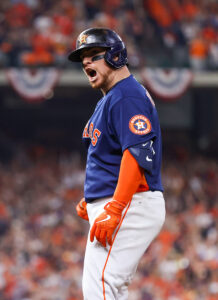
Going back to the start of 2019, he owns a .271/.318/.416 line in slightly more than 1600 plate appearances. That’s five percentage points below league average overall, by measure of wRC+, but it’s above par for a catcher. Backstops have a cumulative .232/.304/.390 mark over that stretch. Vázquez doesn’t draw many walks and, 2019 aside, rarely hits for power. His high-contact approach differentiates him from most of his positional peers, as he owns the fifth-lowest strikeout percentage among catchers (minimum 750 plate appearances) since the start of 2019.
The 2022 season was generally par for the course. Among 29 catchers with 300+ trips to the dish, he had the fourth-lowest strikeout rate (16.2%) and fourth-best rate of contact per swing (85.1%). Overall, Vázquez posted a .274/.315/.399 line in 119 games. He carried an impressive .282/.327/.432 mark with the Red Sox before the trade but stumbled to a .250/.278/.308 showing in 35 regular season games as an Astro. Vázquez also did very little offensively in his six-game playoff showing.
The Twins clearly aren’t deterred by that slow finish to the year. That came in an unfamiliar role dividing his reps with Maldonado, and Minnesota presumably anticipates he’ll more closely approximate his production from his time in Boston moving forward. Offense is only part of the story and Vázquez has an excellent reputation with the glove.
For his career, Vázquez has nabbed just under 34% of attempted basestealers. He had a more modest 27.1% mark this year, but that’s still narrowly above the roughly 25% league average. Statcast also credits him with a better than average arm, placing him 20th among 73 catchers with 10+ throws in pop time (average time to throw to second base). Vázquez consistently draws strong grades from public pitch framing metrics. Pair strong receiving with his ability to control the running game, he’s been rated as an above-average catcher by measure of Defensive Runs Saved in all but one season of his career. DRS pegged him 11 runs above par in 2022 and has rated him as 51 runs above average over his eight years in the majors.
That wealth of experience calling games certainly added to Vázquez’s appeal to the Minnesota front office. The Twins have young backstop Ryan Jeffers on hand already. The 25-year-old will continue to see a fair amount of run at Target Field, but president of baseball operations Derek Falvey and GM Thad Levine have each spoken of a desire to add another starting-caliber catcher to pair with Jeffers. They’ve done just that, leaving manager Rocco Baldelli to decide how to divvy up playing time.
Jeffers, a right-handed hitter, has been far better against lefty pitching (.263/.344/.450) than same-handed opponents (.185/.256/.361) through his first couple MLB campaigns. Vázquez also hits right-handed and is better against southpaws, but his career splits aren’t so drastic. He has a .257/.309/.422 line against lefty arms and a .263/.310/.372 mark against right-handers. Falvey has already suggested the Twins don’t plan to relegate Jeffers solely to the small side of a platoon, but the presence of a more balanced hitter in Vázquez gives Baldelli some more flexibility in matching up against opposing pitchers.
It’s the first meaningful dip into free agency for Minnesota this offseason. Vázquez’s contract lands right in line with MLBTR’s prediction of $27MM over three years. The specific financial breakdown hasn’t yet been reported, but an even distribution of $10MM annually would bring Minnesota’s 2023 payroll around $107MM, in the estimation of Roster Resource. There’s a fair amount of room before getting to this past season’s approximate $134MM mark, and the Twins surely aren’t finished. Addressing shortstop — where the organization awaits Carlos Correa’s decision — is the big question, but the Twins also could stand to upgrade both areas of the pitching staff (especially the bullpen) and potentially shake up their outfield.
Vázquez’s signing follows last week’s five-year agreement between the Cardinals and Willson Contreras and this afternoon’s blockbuster that sent Sean Murphy to Atlanta. As a result, the catching market is drying up quickly. The Blue Jays can still dangle one of their three backstops, with Danny Jansen seemingly the most likely to move. Free agency is without many obvious solutions at this point, with glove-first players like Austin Hedges, Tucker Barnhart, Roberto Pérez and Mike Zunino (the latter two of whom saw their 2022 seasons cut short by surgery) among the options.
Chris Cotillo of MassLive reported Vázquez was making progress on a deal with an unknown team. Jon Heyman of the New York Post first reported the backstop was in agreement with the Twins. Pete Abraham of the Boston Globe reported it was a three-year contract, while Ted Schwerzler of Twins Daily was first to report the $30MM guarantee.
Image courtesy of USA Today Sports.