
Talking Collective Bargaining With Labor Lawyer Eugene Freedman
Eugene Freedman serves as counsel to the president of the National Air Traffic Controllers Association, and also writes about baseball labor relations in his spare time. On January 19th, Eugene was kind enough to chat via phone with me and answer my collective bargaining questions. If you’re interested in baseball’s labor talks, I recommend following Eugene on Twitter.
Tim Dierkes: Can you explain your background a little bit?
Eugene Freedman: Sure. So I work for a national labor union, the National Air Traffic Controllers Association. I work in the office of the president and handle a lot of different things, including collective bargaining for the union. I’ve been involved over the course of my career in approximately nine term contract negotiations and not all of them with the air traffic controllers. When I was in law school, back in, I guess it was the fall of 98, I clerked at the National Labor Relations Board full-time. So I have some experience being on the side of the labor-neutral but the rest of my career has been on the union side.
Dierkes: Do you think it would be beneficial for the players to attempt to extend the current CBA by a year to allow teams to recover economically before hammering out a new CBA?
Freedman: I think it’s hard for me outside to say exactly whether they should extend it. I know that that’s something that has been put out there publicly. I don’t remember where I saw it originally. My guess is that it came from one of the sources that frequently puts things out there on behalf of management, and so I’d be wary just from the source of that original suggestion that it really came from Major League Baseball, not someone independently viewing the situation.
I do know that the Players Association has a lot of things that it wants to address in the next negotiations, some of them are very public, like service time manipulation. Some of them are probably less obvious, in terms of what the priorities are. I guess there’s a couple different ways to view the financial aspects of pay and there’s an idea that you can either spread the peanut butter thin or you can you can allow it to clump in certain areas. Right now, it’s very clumped and there is some thought to raising the league minimums, things like that, that would spread the peanut butter a little more thinly but allow for more players to see the benefits. And I think that that’s something in the next CBA negotiations that’s going to be a big deal in terms of how they share revenue not just among players and the league but also players among themselves.
There’s a big concern about loss of free agency benefits for players over the age of 30. I think the compensation system is something they want to get at quickly in terms of team-to-team free agent compensation, the draft pick compensation aspect of it. Delaying negotiations means one more year that players who are at the league minimum, players who are not premier free agents, may not see benefits and I don’t know that it’s in their interest for the Players Association to extend the current deal.
Dierkes: If we reach December 1 without a new CBA, what would you expect to happen then?
MLBTR Poll: Grading The Yankees’ Recent Deals
The Yankees agreed to deals with a pair of high-profile players on Friday. They started the day off by coming to terms with their own free agent, infielder DJ LeMahieu, on a six-year contract worth $90MM. In the evening, they went outside the organization to add right-hander Corey Kluber. Unsurprisingly, that was a much shorter deal, with Kluber headed to the Bronx for a single year at $11MM.
LeMahieu’s contract came in a bit above pre-offseason expectations. Entering the winter, MLBTR forecasted a four-year, $68MM figure for the reigning AL MVP finalist. LeMahieu eclipsed that mark by more than $20MM, albeit over an additional two years. The six-year term is no doubt a luxury tax workaround. (Teams’ luxury tax figures are calculated by taking a contract’s average annual value, so extending the deal an extra year reduces the Yankees’ per-season luxury tax hit).
Kluber, on the other hand, landed right in line with MLBTR’s prediction (one-year, $12MM). The two-time Cy Young winner is a bit of a wild card after pitching just 36.2 innings combined over the last two seasons. But he’d generally impressed teams at a showcase earlier this week and has an atypical level of upside for an addition at that price point.
How does the readership feel about the Yankees’ recent acquisitions?
(poll links for app users)
Grade The LeMahieu Signing From The Yankees' Perspective.
-
A 67% (14,185)
-
B 23% (4,917)
-
C 7% (1,410)
-
F 2% (358)
-
D 1% (305)
Total votes: 21,175
Grade The Kluber Signing From The Yankees' Perspective.
-
B 42% (8,313)
-
A 31% (6,162)
-
C 20% (3,974)
-
D 4% (796)
-
F 2% (457)
Total votes: 19,702
MLBTR Poll: Let’s Be The Braves’ Arbitration Panel
The Braves are heading to arbitration hearings with Dansby Swanson and Mike Soroka. That is, unless they sign multi-year deals beforehand, writes the Athletic’s David O’Brien. Otherwise, Atlanta will have a pair of interesting arbitration cases on their hands.
Swanson enjoyed a BABIP-driven spike in production over 2020’s 60-game season, logging a career-high 2.9 bWAR while appearing in all 60 games. That’s not an extrapolated career-high, that was Swanson arguably accomplishing more in his 264 plate appearances than he’d managed in 545, 533, or 551 plate appearances in 2019, 2018, or 2017, respectively. Not knowing how the arbitration panel is going to treat the truncated season makes evaluating Swanson’s season a tough task. Still, team and player aren’t that far apart, with the Braves submitting $6MM to Swanson’s $6.7MM, per O’Brien.
Soroka might be an even tougher case to decide, as the 23-year-old heads to arbitration for the first time. Soroka has been nothing short of spectacular thus far with a 2.86 career ERA/3.40 FIP, a 50.9 percent groundball rate, 19.6 percent strikeout rate, and 6.3 percent walk rate. Injuries have been the bugaboo for the Soroka, however, evidenced by a mere 214 innings across three seasons. Shoulder issues limited Soroka to just five starts in 2018, and he tore his Achilles just three starts into 2020.
In between, however, Soroka blossomed into one of the best pitchers in the National League. In 2019, he made 29 starts, logged 174 2/3 innings, and pitched to a 2.68 ERA/3.45 FIP with a 20.3 percent strikeout rate, 5.8 percent walk rate, and 51.2 percent groundball rate. While Soroka’s heavy sinker seems to gift him with the ability to depress launch angles and burn worms, not all of Soroka’s advanced metrics are sterling. Even in 2019 he gave up a fair amount of hard contact (37.5 percent hard hit rate) and enjoyed a sub-average .280 BABIP that may not be repeatable. He finished the year with a 4.12 expected ERA, per Statcast.
O’Brien seems to think a long-term deal is a definite possibility for Soroka, but it would be a risky move for the Braves given Soroka’s injury history. Assuming Soroka doesn’t sign an extension, he’ll head to arbitration having submitted a $2.8MM salary for 2021, with the Braves countering at $2.1MM.
Predicting what arbitration panels will do is a fool’s errand, so let’s leave them to their work and decide this for ourselves. (poll links for app users)
How much should Dansby Swanson make in 2021?
-
$6.0MM 43% (3,630)
-
$6.7MM 30% (2,547)
-
Doesn't matter because he's going to sign an extension. 26% (2,190)
Total votes: 8,367
How much should Mike Soroka make in 2021?
-
$2.8MM 45% (3,633)
-
$2.1MM 31% (2,513)
-
Doesn't matter, becuase he's going to sign an extension. 24% (1,908)
Total votes: 8,054
Deadline To Exchange Arbitration Figures Is Today
There’s a 1:00 ET deadline today for players and teams to exchange arbitration figures, meaning over the next few hours, there will be a landslide of settlements on one-year deals to avoid an arb hearing. Mookie Betts‘ $27MM agreement from last winter is the highest arb salary ever, and no one in this year’s class figures to topple that record. Kris Bryant and Francisco Lindor are this year’s two highest-profile cases. A few reminders:
- Players are typically arbitration-eligible three times. Three years of Major League service time is the standard entry point for the arbitration process; a player remains arbitration-eligible until he either signs a multi-year deal buying out his arbitration seasons or until he accrues six years of MLB service time, thus qualifying him for free agency. Typically, players are given raises based on their prior year’s work. The arbitration process tends to focus on fairly basic stats: e.g. plate appearances, batting average, home runs and RBIs for hitters, as well as innings pitched, wins, ERA, saves, holds and strikeouts for pitchers.
- In this year’s shortened schedule, service time was prorated in the same manner as salary. A full year is typically considered to be 172 days of a season’s 186 days on the Major League roster. Essentially, every day of service time in 2020 was equivalent to 2.77 days of actual Major League service.
- The top 22 percent of players (in terms of total service time) with between two and three years of service are also eligible as “Super Two” players. These players are eligible for arbitration four times. Brewers reliever Josh Hader, for instance, became arbitration-eligible in this manner last winter.
- Players who are non-tendered before reaching six years of service time can reenter the arbitration system. Last year, for example, the Dodgers non-tendered right-hander Yimi Garcia when he had four-plus years of service. He signed a one-year free-agent deal with the Marlins, accrued a full year of service in 2020, and is currently arb-eligible as a player with between five and six years of service.
- It’s become fairly standard for teams throughout the league to adopt a “file and trial” approach, meaning they’ll cease negotiating on one-year deals once salary figures are exchanged. Clubs that exchange figures with a player will sometimes continue working toward a multi-year deal, but it’s become increasingly rare for teams and players to negotiate one-year deals following the exchange deadline. Arbitration hearings typically begin in early February, although with so many hearings expected this year, the precise timeline could be subject to change. Negotiations can continue right up until the point of a hearing. It’s also unclear if some clubs will relax their file-and-trial approach in 2021 due to the expected deluge of hearings.
- Arbitration contracts, unless specifically negotiated otherwise, are non-guaranteed. Teams can cut any player who agrees to a standard arb deal and owe him only 30 days’ termination pay (roughly one-sixth the salary) up until halfway through Spring Training. Cutting him in the second half of Spring Training but before Opening Day entitles the player to 45 days of termination pay. Arbitration contracts are guaranteed come Opening Day. There are a few fully guaranteed arb deals every year, and because of the uncertainty associated with this offseason, we saw more of those than usual in the run-up to the non-tender deadline back in early December.
As is the case every offseason, MLBTR contributor Matt Swartz has projected arbitration salaries for all of the eligible players, but the unprecedented nature of the pandemic-shortened platform season for this year’s arbitration class has complicated the projection process even more so than usual. (Matt discussed that fact this week in an interview with The Athletic’s Chad Jennings.) As such, Matt provided three projection numbers based on various manners in which teams and agencies could argue based on the shortened season.
Broadly speaking, Matt’s projections are the result of a blanket, algorithm-based approach that doesn’t factor in context of unique or atypical cases. On the whole, the model has generally been an accurate barometer. For some higher-profile and/or atypical cases, Matt has gone into detail on why the model may or may not be at risk of missing; you can read these in his Arbitration Breakdown series.
Also, as we do every year, we’re providing an Arbitration Tracker to follow along with settlements and, for those that reach the point of exchange, proposed salary figures. You can bookmark MLBTR’s 2021 Arbitration Tracker as a means of keeping up, and we’ll also be tracking today’s arb agreements and filing figures in separate posts later today.
Check Out Our 2021 Arbitration Tracker
MLBTR’s 2021 arbitration tracker is available here. The tracker is regularly updated and allows for filtering by team, signing status, service time, and whether the player had a hearing.
This year, the date to exchange figures for unsigned arbitration eligible players is Friday, January 15th. Most teams, if they reach the point of exchanging figures, will not have further negotiations for a one-year deal and will go to a hearing. This has resulted in an increased number of hearings, about 13 per year on average since 2015. Over the past decade teams have won 46 hearings, while players have won 44.
With the 60-game season in 2020 and no agreement on how that affects arbitration, the players that have made it this far without a contract are in uncharted waters. At present, more than 120 arbitration eligible players are without contracts, including Francisco Lindor, Corey Seager, Cody Bellinger, Kris Bryant, Walker Buehler, Josh Hader, and Juan Soto. The record number of arbitration hearings was set in 1986, with 35.
Does Trevor Bauer Have A Case For Gerrit Cole’s AAV?
In an article yesterday, MLB.com’s Mark Feinsand made a statistical case that Trevor Bauer’s recent body of work justifies him matching or exceeding the record $36MM average annual value Gerrit Cole received in December 2019. While it may not be true that Cole and Bauer currently have beef, we can at least say the former UCLA teammates once had a rivalry. Beating Cole’s AAV record would be a major feat for Bauer and agent Rachel Luba. But as Homer Simpson once said, “Aw, people can come up with statistics to prove anything, Kent. Forfty percent of all people know that.” So I set out to see how Feinsand’s claims hold up.
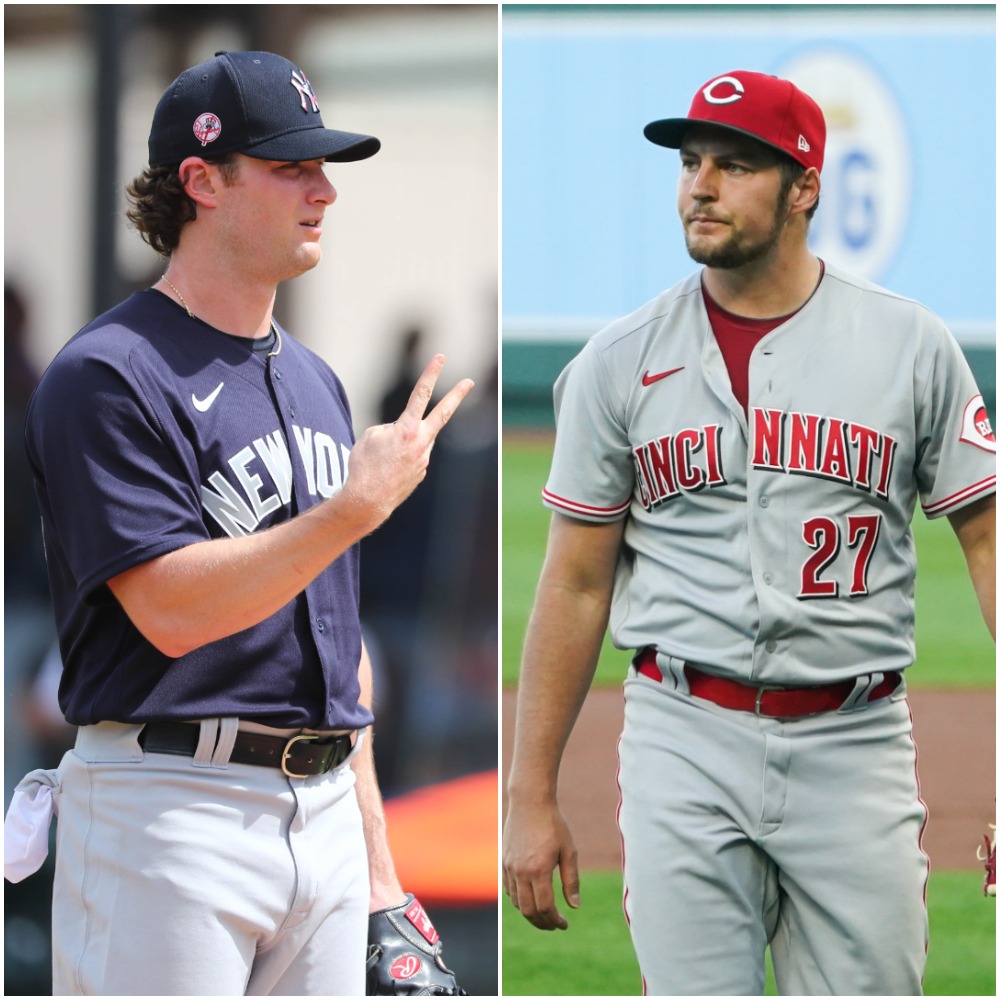
Bauer has had an up-and-down career. Since 2017, his season ERAs are 4.19, 2.21, 4.48, and 1.73. Feinsand, who also included Stephen Strasburg in his comparison, mainly focused on each pitcher’s final 90 starts heading into free agency. Why 90? Well, a three-season lookback is pretty standard. A 90-start lookback also happens to be quite convenient for Bauer, as it excludes his rough first half of 2017.
One thing I did not see in Feinsand’s article was any form of a strikeout rate, walk rate, or groundball rate. Those are the things pitchers do that actually correlate year-to-year. So here’s that look, with the additional info. We’ll remove Strasburg, since the question is whether Bauer is worthy of Cole’s AAV record. (App users can click here to see the 90-start comparison).

Cole had better strikeout and walk rates in his previous 90 starts, which is more important than the ERA difference. But I was also thinking it’s strange to do a comparison that includes 25 starts from Cole’s 2017 season, his last with the Pirates. Upon joining the Astros in a January 2018 trade, Cole famously changed his pitch mix and approach, to drastically improved results. So how would a Bauer-Cole comparison look over the previous 60 starts? (App users can click here to see the 60-start comparison).

Even though this window excludes Cole’s first five starts of 2018, which were dominant, it further accentuates the differences between the two hurlers. They’re both strikeout pitchers. But what Cole did in his walk year – a 39.9 K% – is literally the best in baseball history for a pitcher with at least 100 innings (Cole pitched 212 1/3). Bauer’s walk year strikeout rate of 36% was historic in its own right – seventh all-time for a qualified starter – but it was only 11 starts due to the 60-game season. That brings us to one last comparison, one that Feinsand made of each pitcher’s best 11 starts in their walk year (app users click here):

Both dominant stretches, yet Cole’s was clearly better. If we’re comparing post-2019 Cole to current Trevor Bauer, we can state the following:
- Cole averaged 97.2 miles per hour on his fastball in his walk year. Bauer averaged 93.5.
- On a related note, while both are strong strikeout pitchers, Cole was significantly better for longer.
- Cole had better control than Bauer.
- Cole was dominant in two full, consecutive seasons leading up to free agency. Bauer has never been dominant in two consecutive seasons.
- Bauer will be 234 days older on 4-1-21 than Cole was on 4-1-20.
On the merits of statistics, I don’t see how one can say that Bauer is better than Cole and therefore deserves a higher AAV. Feinsand makes a good point, though: if Bauer limits himself to an artificially shorter contract, his AAV should go up from where it would have been had he maxed out the years. But what is Bauer’s actual years maximum, assuming he won’t take an artificially low AAV like Bryce Harper did?
Given the current state of baseball economics, I’d suggest six. So to bring enhanced AAVs into play as a reward for an artificially short term, Bauer would probably have to sign for four or fewer years. Remember, the Dodgers reportedly offered Harper a $45MM AAV on a four-year term. Instead, he took a $25MM AAV on a 13-year term.
There are several reasons why the Bauer-Cole comparison actually doesn’t matter. The first is the state of the market in December 2019 compared to the current state of affairs. All 30 teams brought in significantly smaller amounts of revenue in 2020 than in 2019. Most of the best free agents remain unsigned, but the ones that did sign exceeded expectations. It’s an odd combination. But it’s fair to say market conditions are worse for Bauer than they were for Cole.
The second reason contract comps don’t matter is that free agency is a bidding war. The goal of every team targeting a free agent is to get that player for as little as possible. Agents don’t convince teams to spend more money by holding up other free agent contracts from years past. Generally speaking, teams run circles around agents in statistical chops, anyway. It’s certainly possible that Luba will be able to get a couple of teams to bid irrationally on Bauer, but it won’t be because of what Cole received.
The last point is that teams don’t pay free agents for what they have done; they pay for what they expect the player to do in the future over the life of the contract. Again, we have to defer to teams’ superior abilities to forecast what Bauer will do. They’ll use advanced stats, Statcast data, health history, and proprietary information we’ll never see. They won’t use ERA, which generally has a year-to-year correlation around 0.4. But that’s how a team’s GM will approach it. Signing Bauer is an ownership-level decision, and an owner is unlikely to analyze a potential signing with the same sophistication as the GM.
As Bauer once put it, he and Cole are “intertwined forever.” The UCLA teammates were drafted two picks apart in 2011 and made their way to MLB free agency coming off fantastic walk years. But as I see it, Bauer’s current position falls short of where Cole stood when he hit the market in 2019.
Top 10 Remaining Free Agents
The Major League Baseball offseason opened over two months ago, though free agency has moved at a snail’s pace to this point. MLBTR ranked the top 50 free agents in the game heading into the winter, and at least some of those names have come off the board. Based on our contract predictions, here’s a look at the top 10 players still sitting on the open market…
1.) Trevor Bauer, RHP (original prediction: four years, $128MM)
- As was the case when the offseason opened, it’s unclear what kind of deal Bauer is seeking. Yes, he’d probably love to break Gerrit Cole‘s annual average value of $36MM, but will it be for one year or over the long haul? Bauer, the reigning National League Cy Young winner, has continued to leave all options on the table. While Bauer recently met with the Blue Jays, there haven’t been many strong rumors connecting him to specific teams. Regardless, it seems likely Bauer will price himself out of Cincinnati, where he thrived in 2020.
2.) J.T. Realmuto, C (original prediction: five years, $125MM)
- Again, there doesn’t seem to be much happening with Realmuto. The Phillies, with whom he spent the previous two years and served as the game’s best catcher, certainly want him back. But are they willing to meet Realmuto’s demands? No dice so far. Otherwise, as MLBTR’s Anthony Franco wrote a couple weeks back, the Jays, Angels and Astros are just a few teams that could conceivably sign Realmuto.
3.) George Springer, OF (original prediction: five years, $125MM)
- Springer was among the sport’s best outfielders in Houston from 2014-19, but it doesn’t seem as if he’ll remain with the club. Springer reportedly has multiple offers worth upward of $100MM, though the Astros haven’t really been connected to him in the rumor mill this winter. The Jays and Mets have come off as Springer’s most ardent suitors to this point, though New York’s interest may have cooled off after it acquired shortstop Francisco Lindor and right-hander Carlos Carrasco from Cleveland last week. The Mets might rather duck the $210MM luxury tax in 2020, and adding Springer would make that a difficult goal to achieve.
4.) Marcell Ozuna, OF/DH (original prediction: four years, $72MM)
- Wouldn’t it be nice if MLB announced whether there will be a universal DH in 2021? The decision will be quite meaningful to someone like Ozuna, who was a DH more than an outfielder with Atlanta last season. Thanks in part to the lack of clarity on the DH position, Ozuna’s market has been quiet so far. However, anyone acquiring him will land a player who was an all-world hitter in 2020. The 30-year-old dominated in both bottom-line statistics and Statcast figures.
5.) DJ LeMahieu, INF (original prediction: four years, $68MM)
- Stop me if you’ve heard this before, but Toronto looks like a realistic possibility for another top free agent in LeMahieu. That said, the Yankees – with whom the second baseman was outstanding from 2019-20 – as well as the Dodgers, Red Sox, Braves, Cardinals and Mets may be in the mix. It’s a bit befuddling that the Yankees haven’t yet used their financial might to bring back LeMahieu, who apparently wants to re-sign after a batting title-winning, near-AL MVP season, but the two sides have been unable to close the gap in negotiations. In an ideal world for LeMahieu, he could collect around $100MM on his next deal. That’s a far cry from the two-year, $24MM contract he previously signed with the Yankees.
8.) Didi Gregorius, SS (original prediction: three years, $39MM)
- The Gregorius rumor mill has been surprisingly quiet to this point. Aside from 2019, when Sir Didi was coming back from Tommy John surgery, he has been consistently productive over the past few years. He rebounded last season in Philadelphia, perhaps his lone season with the team, though it may not be willing to re-sign him if it isn’t going to spend a large amount. Barring a re-signing in Philly, two of Gregorius’ other ex-teams – the Reds and Yankees – might be among those to make pushes for him.
10.) Masahiro Tanaka, RHP (original prediction: three years, $39MM)
- Beyond Bauer, the starting pitching market has dwindled rapidly in terms of both free agency and trades. A few examples: Marcus Stroman and Kevin Gausman, whom MLBTR initially ranked as top 10 free agents, accepted qualifying offers. Meanwhile, Yu Darvish and Blake Snell joined new teams in blockbuster deals, and Nippon Professional Baseball’s Tomoyuki Sugano decided to stay in Japan. Tanaka – who, like Darvish and Sugano, hails from Japan – is still available, and he might be the second-best starter left in free agency. Even though the 32-year-old generally got the job done as a Yankee from 2014-20, the team hasn’t made a big effort to sign him to this point. Neither has anyone else, it seems, and Tanaka hasn’t closed the door on a return to Japan.
11.) Jake Odorizzi, RHP (original prediction: three years, $39MM)
- Odorizzi went through an injury-limited 2020 in Minnesota, recording a mere 13 2/3 innings, but teams know what he’s capable of doing. As recently as 2019, Odorizzi was an All-Star with a 3.51 ERA in 159 frames. The Twins then gave Odorizzi a qualifying offer, which he accepted, though it wouldn’t be surprising to see him reel in a multiyear deal before next season. At least a few teams have shown interest in the soon-to-be 31-year-old this winter.
12.) Liam Hendriks, RHP (original prediction: three years, $30MM)
- Hendriks may have been the top reliever in baseball in the previous two years in Oakland, but he doesn’t seem to be in free agency at the preferred time. Also soon to turn 32, the Blue Jays (if you can believe it), Dodgers, Astros and White Sox have been connected to Hendriks over the past couple of months.
13.) Michael Brantley, OF/DH (original prediction: two years, $28MM)
- Considering the defensive questions surrounding him, Brantley is in a similar position to Ozuna at the moment. It would be beneficial to Brantley if MLB kept the universal DH around next season, as he’s a 33-year-old (34 in May) with an injury history who didn’t see much time in the field as an Astro in 2020. A few teams have shown interest in Brantley since then, though it doesn’t appear he’s all that close to signing anywhere.
MLBTR Poll: Grading The Francisco Lindor Trade
The Mets and Indians made perhaps the biggest trade of the offseason earlier this week. Star shortstop Francisco Lindor and right-hander Carlos Carrasco are now Mets. They represent the biggest pair of additions for a New York club that has been expected all offseason to pursue star-level talent.
Lindor, of course, was seen as a near-lock to be moved all winter. The Indians seemingly never came close to working out an extension with the four-time All-Star. With Lindor one season removed from hitting free agency, it looked apparent Cleveland would trade him away. Carrasco was less obviously going to be moved this winter, but it wasn’t a huge surprise the Indians parted with him, either. Carrasco’s two-year, $27MM deal (with a 2023 option) marked the biggest guaranteed contract on Cleveland’s books. Lindor’s projected arbitration range ($17.5MM — $21.5MM) would’ve easily been the Indians’ largest 2021 expense.
Each of Lindor and Carrasco remains a bargain at those rates relative to their on-field production. But Cleveland’s ownership has signaled a desire to cut payroll this winter; it wasn’t hard to foresee that coming via jettisoning the team’s highest-paid players. Cleveland’s estimated $40MM payroll, per Roster Resource, is now less than half the team’s 2020 season-opening outlay (prior to prorating).
While finances were an obvious element of the trade, it wasn’t a mere salary dump. The Indians brought in four young players, two of whom are immediate big leaguers. Amed Rosario is a former elite prospect who has been up and down over his first three-plus MLB seasons. Andrés Giménez was a highly-regarded farmhand himself and had a decent if unspectacular rookie year. The pair of prospects, right-hander Josh Wolf and Isaiah Greene, are recent high school draftees. They rank 25th and 28th, respectively, in the Indians’ farm system at FanGraphs.
Turning things over to the readership, how did each team fare in this week’s blockbuster?
(poll links for app users)
Grade The Lindor Trade For The Mets.
-
A 79% (22,641)
-
B 15% (4,346)
-
C 3% (889)
-
F 2% (432)
-
D 1% (298)
Total votes: 28,606
Grade The Lindor Trade For The Indians.
-
C 41% (10,729)
-
B 22% (5,777)
-
D 21% (5,437)
-
F 11% (2,915)
-
A 5% (1,288)
Total votes: 26,146
Trade Candidate: Jon Gray
Much has been written about the Rockies potentially trading stars Nolan Arenado and Trevor Story. There has been decidedly less chatter about starter Jon Gray. On the surface, though, the right-hander looks to be one of the more sensible trade candidates around the league.
That’s mostly a function of his contractual status. Gray has five years and sixty-two days of MLB service, meaning he’ll hit free agency at the end of next season. Meanwhile, contending in the NL West will be an uphill battle for the Rockies. The Dodgers are a perennial juggernaut, while the already-contending Padres made a trio of impact additions last month. The Giants also had a decent 2020 season; the Diamondbacks did not, but Arizona has largely the same roster that won 85 games and finished second in the division the year before. As Dan Szymborksi of FanGraphs examined this week, the Rockies look more likely to finish near the bottom of the division than the top.
Colorado projects as a longshot for the postseason, particularly if MLB returns to a five-team-per-league playoff structure in 2021. There’s a case to be made the Rockies should move short-term players for future value. The organization needn’t embark on a full rebuild, but a single year of production from Gray (or Story, for that matter) would probably be worth more to another team than it would to Colorado.
Admittedly, Gray is coming off a dismal season. He pitched just eight games with terrible results before being shut down with inflammation in his throwing shoulder. Gray’s velocity, strikeout and ground ball rates all dropped precipitously from past seasons. He ultimately posted an ERA just under 7.
Yet the former third overall pick looked like a capable mid-rotation starter entering 2020. Over the three prior seasons, Gray pitched to a 4.31 ERA (a deceptively solid mark in the hitters’ haven of Coors Field) across 432.2 innings. In that time, his strikeout (24.2%), walk (7.5%) and ground ball (48.8%) rates were each better than league average. As is, Gray was a productive starting pitcher. There remained some hope the former top prospect could yet emerge as a top-of-the-rotation arm. His fastball was in the mid 90’s and he flashed a pair of swing-and-miss breaking pitches.
After his disastrous 2020, Gray would be a reclamation project. But it’s easy to imagine plenty of contenders having interest in acquiring him. Eight poor starts don’t negate what Gray had achieved in the seasons before. His ending last season on the injured list is a red flag, but it’s notable the Rockies seemingly believe he can return to form this year. Otherwise, it wouldn’t have made sense for the Colorado front office to tender him an arbitration contract, projected in the not-insignificant $6MM range, as they did in November.
There has been no indication the Rockies are actually exploring trades involving Gray this offseason. On paper, though, Colorado looks a reasonable bet to subtract short-term pieces from the major league roster. Gray’s pre-2020 track record and past flashes of high-end raw stuff could entice some teams closer to contention to call the Rockies, particularly in a winter without many obvious rotation upgrades available in free agency.
MLBTR Poll: Will The Nationals Unlock Kyle Schwarber’s Potential?
In a sport known for its protracted regular season and voluminous historical records – playing for a franchise that had been without a championship crown for over a century – Kyle Schwarber established his legacy over a seven-game stretch of the 2016 playoffs. Though he only appeared in five games of the World Series, physical perseverance, inspired play and a confident batting eye turned Schwarber into a Chicago legend at the tender age of 23. His presence as a designated hitter for road contests at Progressive Field played no small part in turning the tide on a 3-1 series deficit (though starting Jon Lester, Jake Arrieta, and Kyle Hendricks in consecutive games didn’t hurt either). Schwarber reached base in half of his 20 plate appearances, and the Cubs won three of four games in Cleveland to take the crown.
While the baseball community largely recognizes that playoff performance is not predictive – nor repeatable – Schwarber is living proof that small samples, at times, do prove enduring. Schwarber will be memorialized for generations in Chicago for his appearance against the Cleveland Indians in 2016.
His myth-making return from season-ending injury is also a warning against our tendency to muddle the narrative of heroes. In that World Series, Schwarber did lengthen the lineup and provide a fear factor that was easier to see in real-time than in box scores after the fact, but it’s fair to wonder if his impact in Cleveland didn’t unwittingly get conflated with his status as a top prospect and his gargantuan output in the 2015 playoffs, when he hit .333/.419/.889 with five home runs in nine playoff games. The years since have only further complicated our ability to manufacture a compact narrative for Schwarber as a ballplayer. For starters, even a .136/.321/.273 line with just one home run, one RBI, two runs scored, and a negative championship win probability over 10 playoff games since 2016 hasn’t totally erased his reputation as a “championship proven” bat.
Further, his stat line in any given year is like an optical illusion (is he black and blue or white and gold?). His production hasn’t matched his reputation, and the advanced metrics don’t match the on-field production. In 2018, Schwarber hit a high-water mark by measure of 3.2 fWAR despite a .238 batting average and career-low 41.5 hard hit percentage. In 2019, he actualizes his “slugger” persona with a .531 slugging percentage, 29 doubles, and 38 home runs. He posted new highs with a 120 wRC+, .282 ISO, and 50.9 hard hit percentage – the third-highest mark in the Majors. The total package still amounted to just 2.1 bWAR/2.6 fWAR – solid numbers, but shy of the line for a presumed All-Star.
Then 2020 happened. His launch angle plummeted, and his .219 BABIP, .204 ISO, .188/.308/.393 line, and 90 wRC+ were all career-worst numbers. When the Cubs non-tendered him rather than pay the projected $7MM to $9MM in arbitration, few were surprised.
But the Nationals paid him $10MM for the 2021 season anyway – and that wasn’t shocking either. After all, Schwarber’s batted ball numbers have made him a popular bounce-back candidate among the Statcast crowd, and it’s not hard to see why: His resume includes finishing in the 95th percentile by exit velocity in 2019 and 2020, the 92nd percentile by barrel percentage in 2017, 2018, and 2019, and that 99th percentile mark by hard hit percentage in 2019.
At the same time, it’s worth considering how much of a role his subpar speed and 28 percent career strikeout rate play in his “under-performance.” He’s not the worst defender in the world, but negative three defensive runs saved in each of the last two seasons doesn’t inspire confidence that he’ll become a plus on that end of the field. Of course, with Victor Robles beside him in the outfield and Max Scherzer, Patrick Corbin, and Stephen Strasburg (hopefully) missing bats on a regular basis, the Nats seem to believe he doesn’t have to be a gold glove candidate. Besides, should the designated hitter make its way permanently to the National League, he may not have to spend every day in the grass.
The Nationals hope a reunion with Dave Martinez will provide Schwarber a comfortable environment to reset after a disappointing final season in Chicago. Beyond his relationship with Martinez – his bench coach for the first three years of his career – Schwarber will have a new social circle with whom to yuk it up about the ins-and-outs of hitting. That group will include hitting coach Kevin Long, his collegiate buddy Trea Turner, fellow new kid Josh Bell, and phenom Juan Soto. MLB.com’s Jessica Camerato provides video of Schwarber himself breaking down his new team (via Twitter).
Still very much in his prime entering his age-28 season, Schwarber may yet fulfill the legendary potential he established in the 2016 World Series. Given the new faces in the division and the now-rote proficiency of the three-time defending division champion Braves, the Nationals are counting on a big season from Schwarber to help the franchise rebound from a difficult 2020.
All that said, let’s keep this simple. Will Dave Martinez and the Nationals be able to unlock Schwarber’s potential and see him become a devastating middle-of-the-order presence? Or will Schwarber’s Statcast profile continue to betray him as he hits the ball hard but not often enough to truly classify as an elite bat?
Of course, there are many different ways to skin this cat, so let me offer this final framework as one way to simplify. Schwarber’s value proposition is his bat. By wRC+, which attempts to measure offensive contribution, adjusted for park and league, Schwarber has created 13 more runs than the average player over his career. As noted above, his career-high over a full season is 120 wRC+. But he also produced a 131 wRC+ over 273 plate appearances as a rookie in 2015. For context, 35 players posted a wRC+ higher than 130 in 2019, 24 managed that mark in 2018. Can Schwarber be one of those guys in 2021?
Will The Nationals Unlock Kyle Schwarber's Potential?
-
No 62% (5,781)
-
Yes 38% (3,493)
Total votes: 9,274
Schwarber's wRC+ in 2021 will be...
-
Between 100 wRC+ and 109 wRC+ 33% (2,307)
-
Between 110 wRC+ and 119 wRC+ 29% (2,017)
-
Under 100 wRC+ 18% (1,255)
-
Between 120 wRC+ and 130 wRC+ 13% (911)
-
Over 130 wRC+ 6% (435)
Total votes: 6,925