How They Were Acquired: Houston Astros ALDS Roster
Astros fans were subjected to three consecutive 100-loss seasons as the Jeff Luhnow-led front office aimed to build a young core by stockpiling talent in the draft. That approach led the Astros multiple top-five overall selections in the draft, and the team also leaned on creative means of utilizing its draft to nab highly touted prospects that slid down the board due to signability concerns. The finishing touches on this year’s 101-win team were made last offseason in trades (Brian McCann), free agency (Josh Reddick, Charlie Morton, Carlos Beltran) and of course, with this August’s last-minute Justin Verlander blockbuster.
Houston drew plenty of criticism from skeptics of their data-driven approach as they effectively tanked multiple seasons, but they now sport an imposing all-around roster the looks poised for a lengthy run of success. Here’s how they built the roster that now has the opportunity to make Sports Illustrated’s infamous 2014 prediction come true…
[Related: Houston Astros Depth Chart and Payroll Outlook]
- HOMEGROWN (8)
- Jose Altuve, 2B: International Free Agent (Venezuela) March ’07
- Dallas Keuchel, SP: Drafted 7th Rd ’09
- George Springer, OF: Drafted 1st Rd (11) ’11
- Carlos Correa, SS: Drafted 1st Rd (1) ’12
- Lance McCullers Jr., SP: Drafted 1st Rd (41) ’12
- Tyler White, INF: Drafted 33rd Rd ’13
- Derek Fisher, OF: Drafted 1st Rd (37) ’14
- Alex Bregman, 3B: Drafted 1st Rd (2) ’15
- ACQUIRED VIA FREE AGENCY (6)
- Luke Gregerson, RP: December ’14 (OAK) — Signed to a three-year, $18.5MM contract.
- Yulieski Gurriel, 1B: July ’16 (Cuba) — Signed to a five-year, $47.5MM contract.
- Josh Reddick, OF: November ’16 (LAD) — Signed to a four-year, $52MM contract.
- Charlie Morton, SP: November ’16 (PHI) — Signed to a two-year, $14MM contract.
- Juan Centeno, C: December ’16 (MIN) — Signed to a minor league contract.
- Carlos Beltran, OF: December ’16 (TEX) — Signed to a one-year, $16MM contract.
- ACQUIRED VIA TRADE (9)
- Marwin Gonzalez, INF/OF: December ’11 (BOS) — Acquired in the trade that sent Marco Duarte to the Red Sox. Gonzalez had just been drafted by the Red Sox in the Rule 5 draft.
- Joe Musgrove, RP: July ’12 (TOR) — Acquired in the trade that sent J.A. Happ, Brandon Lyon and David Carpenter to the Blue Jays.
- Chris Devenski, RP: August ’12 (CWS) — Acquired in the trade that sent Brett Myers to the White Sox.
- Brad Peacock, SP: February ’13 (OAK) — Acquired in the trade that sent Jed Lowrie and Fernando Rodriguez to the Athletics.
- Evan Gattis, C: November ’15 (ATL) — Acquired in the trade that sent Mike Foltynewicz, Rio Ruiz and Andrew Thurman to the Braves.
- Ken Giles, RP: December ’15 (PHI) — Acquired in the trade that sent Vince Velasquez, Brett Oberholtzer, Thomas Eshelman, Mark Appel, and Harold Arauz to the Phillies.
- Brian McCann, C: November ’16 (NYY) — Acquired in the trade that sent Albert Abreu and Jorge Guzman to the Yankees.
- Francisco Liriano, RP: July ’17 (TOR) — Acquired in the trade that sent Nori Aoki and Teoscar Hernandez to the Blue Jays.
- Justin Verlander, SP: August ’17 (DET) — Acquired in the trade that sent Franklin Perez, Daz Cameron, and Jake Rogers to the Tigers.
- ACQUIRED VIA WAIVERS (2)
Of the players on Houston’s 25-man ALDS roster, only Beltran, Gregerson, Maybin and Liriano will be free agents at the end of the season. In fact, nearly each of the Astros’ star-caliber players can be controlled through at least 2019, with the notable exception of Keuchel, who will hit the open market next winter. With few weaknesses and a wealth of young stars that are in their prime, the Astros look to be a perennial postseason contender for the foreseeable future.
How They Were Acquired: Boston Red Sox ALDS Roster
The Red Sox have now captured consecutive AL East titles with identical 93-69 records. Boston’s success continues to be spurred by the homegrown core of position-player talent compiled by prior front office administrations. But that’s not to say that president of baseball operations Dave Dombrowski hasn’t had an impact. In particular, many key members of the pitching staff have come from outside the organization, quite a few via recent trades.
Here’s how every member of the Red Sox’ 2017 ALDS roster was originally acquired:
[Related: Boston Red Sox Depth Chart and Payroll Outlook]
- HOMEGROWN (9)
- Dustin Pedroia, 2B: Drafted 2nd Rd ’04
- Christian Vazquez, C: Drafted 9th Rd ’08
- Xander Bogaerts, SS: International Free Agent (Aruba) August ’09
- Jackie Bradley Jr., CF: Drafted 1st Rd (40) ’11
- Mookie Betts, RF: Drafted 5th Rd ’11
- Deven Marrero, INF: Drafted 1st Rd (24) ’12
- Austin Maddox, RP: Drafted 3rd Rd ’12
- Rafael Devers, 3B: International Free Agent (D.R.) August ’13
- Andrew Benintendi, OF: Drafted 1st Rd (7) ’15
- ACQUIRED VIA FREE AGENCY (3)
- Hanley Ramirez, 1B: November ’14 (LAD) — Signed to a four-year, $88MM contract (includes $22MM vesting option in 2019).
- David Price, SP/RP: December ’15 (TOR) — Signed to a seven-year, $216MM contract.
- Mitch Moreland, 1B: December ’16 (TEX) — Signed to a one-year, $5.5MM contract.
- ACQUIRED VIA TRADE (12)
- Brock Holt, INF/OF: December ’12 (PIT) — Acquired in the trade that sent Mark Melancon, Jerry Sands, Ivan De Jesus Jr. and Stolmy Pimentel to the Pirates.
- Eduardo Rodriguez, SP: July ’14 (BAL) — Acquired in the trade that sent Andrew Miller to the Orioles.
- Joe Kelly, RP: July ’14 (STL) — Acquired in the trade that sent John Lackey and Corey Littrell to the Cardinals.
- Rick Porcello, SP: December ’14 (DET) — Acquired in the trade that sent Yoenis Cespedes, Alex Wilson and Gabe Speier to the Tigers.
- Sandy Leon, C: March ’15 (WSH) — Acquired in the trade that sent cash considerations to the Nationals.
- Craig Kimbrel, RP: November ’15 (SD) — Acquired in the trade that sent Manuel Margot, Carlos Asuaje, Javier Guerra and Logan Allen to the Padres.
- Carson Smith, RP: December ’15 (SEA) — Acquired in the trade that sent Wade Miley and Jonathan Aro to the Mariners.
- Drew Pomeranz, SP: July ’16 (SD) — Acquired in the trade that sent Anderson Espinoza to the Padres.
- Chris Sale, SP: December ’16 (CWS) — Acquired in the trade that sentYoan Moncada, Michael Kopech, Luis Alexander Basabe and Victor Diaz to the White Sox.
- Eduardo Nuñez, INF: July ’17 (SF) — Acquired in the trade that sent Shaun Anderson and Gregory Santos to the Giants.
- Addison Reed, RP: July ’17 (NYM) — Acquired in the trade that sent Gerson Bautista, Jamie Callahan, and Stephen Nogosek to the Mets.
- Rajai Davis, OF: August ’17 (OAK) — Acquired in the trade that sent Rafael Rincones to the Athletics.
- ACQUIRED VIA WAIVERS (1)
The bulk of Boston’s roster remains under control beyond the present season. Most of the team’s players that will head to the open market — Reed, Fister, Nunez, and Davis — were picked up during the current season. Moreland is the only other player to make this roster who’ll depart via free agency. He’ll be joined by outfielder Chris Young, who was perhaps the most notable omission from the postseason unit.
How They Were Acquired: Colorado Rockies Wild Card Roster
Entering the 2016-17 offseason, the Rockies were viewed by many as an organization that could position itself for contention with the right moves. While the club’s biggest splash (the signing of Ian Desmond) hasn’t really panned out thus far, the addition of closer Greg Holland surely did, helping lead the club to an 87-win regular season.
Of course, the bulk of the talent on hand in Colorado wasn’t just added last winter. The team’s two best players — Charlie Blackmon and Nolan Arenado — are homegrown stars. Most of the other regulars have been around for some time and the rotation has largely come through the farm system. More recently, the Rox took advantage of the summer trade market to add two important pieces in catcher Jonathan Lucroy and reliever Pat Neshek. Here’s how the Rockies’ Wild Card roster was compiled by the front office, which is currently led by GM Jeff Bridich …
[Related: Colorado Rockies Depth Chart and Payroll Outlook]
- HOMEGROWN (11)
- Charlie Blackmon, CF: Drafted 2nd Rd ’08
- Nolan Arenado, 3B: Drafted 2nd Rd ’09
- Raimel Tapia, OF: International Free Agent (D.R.) November ’10
- Tyler Anderson, SP: Drafted 1st Rd (20) ’11
- Trevor Story, SS: Drafted 1st Rd (45) ’11
- Antonio Senzatela, SP/RP: International Free Agent (Venezuela) July ’11
- Carlos Estevez, RP: International Free Agent (D.R.) May ’11
- Scott Oberg, RP: Drafted 15th Rd ’12
- Jon Gray, SP: Drafted 1st Rd (3) ’13
- Pat Valaika, INF/OF: Drafted 9th Rd ’13
- Mike Tauchman, OF: Drafted 10th Rd ’13
- ACQUIRED VIA FREE AGENCY (7)
- Mark Reynolds, 1B: December ’15 (STL) — Signed to a one-year, $2.6MM contract. Re-signed to MiLB contract in February ’17.
- Gerardo Parra, OF: January ’16 (BAL) — Signed to a three-year, $27.5MM contract (includes $12MM club option in 2019).
- Ian Desmond, INF/OF: December ’16 (TEX) — Signed to a five-year, $70MM contract (includes $15MM club option in 2022).
- Alexi Amarista, INF/OF: December ’16 (SD) — Signed to a one-year, $1.25MM contract (includes $2.5MM club option in 2018).
- Mike Dunn, RP: December ’16 (MIA) — Signed to a three-year, $19MM contract (includes $6MM club option in 2020).
- Greg Holland, RP: January ’17 (KC) — Signed to a one-year, $7MM contract (includes $15MM player option in 2018).
- Ryan Hanigan, C: March ’17 (PHI) — Signed to MiLB contract.
- ACQUIRED VIA TRADE (5)
- Carlos Gonzalez, OF: November ’08 (OAK) — Acquired in the trade that sent Matt Holliday to the Athletics.
- DJ LeMahieu, 2B: December ’11 (CHC) — Acquired in the trade that sent Ian Stewart and Casey Weathers to the Cubs.
- Jake McGee, RP: January ’16 (TB) — Acquired in the trade that sent Corey Dickerson to the Rays.
- Jonathan Lucroy, C: July ’17 (TEX) — Acquired in the trade that sent Pedro Gonzalez to the Rangers.
- Pat Neshek, RP: July ’17 (PHI) — Acquired in the trade that sent Jose Gomez, Alejandro Requena and J.D. Hammer to the Phillies.
- ACQUIRED VIA WAIVERS (2)
- Chris Rusin, RP: September ’14 (CHC)
- Tony Wolters, C: February ’16 (CLE)
The Rox will say goodbye to CarGo at the end of the year, along with Mark Reynolds, with Holland likely to decline his option and reenter the open market as well. But the team still has another year in which it can pair Blackmon and Arenado, retains most of its other key players, and can anticipate further strides from its youthful rotation. Plus, there are several intriguing prospects who may be ready to make full contributions at the game’s highest level as soon as 2018.
How They Were Acquired: Arizona Diamondbacks Wild Card Roster
Fresh off a 93-loss season, the Diamondbacks weren’t a popular pick to make a postseason run in 2017. However, a bounceback from the biggest free-agent signing in franchise history (Zack Greinke), better health from star center fielder A.J. Pollock and breakouts from Robbie Ray, Zack Godley and Jake Lamb (among others) helped propel the team to a 93-win season in 2017.
First-year Diamondbacks execs Mike Hazen (general manager), Amiel Sawdaye (assistant GM) and Jared Porter (assistant GM) as well as the rest of the D-backs’ front office made some changes to the roster’s composition in the offseason, most notably shipping Jean Segura and Mitch Haniger to the Mariners in the swap that netted them Taijuan Walker and Ketel Marte. They were again active at the non-waiver deadline, adding arguably the most impactful trade pickup of the summer in J.D. Martinez. But by and large this is a team that looks fairly similar to the unit that underachieved in 2016. Here’s how they all came together…
[Related: Arizona Diamondbacks Depth Chart and Payroll Outlook]
- HOMEGROWN (6)
- A.J. Pollock, CF: Drafted 1st Rd (17) ’09
- Paul Goldschmidt, 1B: Drafted 8th Rd ’09
- Archie Bradley, RP: Drafted 1st Rd (7) ’11
- Andrew Chafin, RP: Drafted 1st Rd (43) ’11
- Jake Lamb, 3B: Drafted 6th Rd ’12
- Jimmie Sherfy, RP: Drafted 10th Rd ’13
- ACQUIRED VIA FREE AGENCY (10)
- David Peralta, OF: July ’13 (Independent League) — Signed to minor league contract.
- Zack Greinke, SP: December ’15 (LAD) — Signed to a six-year, $206.5MM contract.
- Kristopher Negron, INF/OF: November ’16 (CHC) — Signed t0 minor league contract.
- Jeff Mathis, C: December ’16 (MIA) – Signed to a two-year, $4MM contract.
- Rey Fuentes, OF: December ’16 (KC) – Signed to minor league contract.
- Fernando Rodney, RP: December ’16 (MIA) – Signed to a one-year, $2.75MM contract.
- Chris Iannetta, C: January ’17 (SEA) – Signed to a one-year, $1.5MM contract.
- Gregor Blanco, OF: January ’17 (SF) – Signed to minor league contract.
- Daniel Descalso, INF/OF: February ’17 (COL): Signed to a one-year, $1.5MM contract (includes $2MM club option in 2018).
- Jorge De La Rosa, RP: February ’17 (COL): Signed to minor league contract.
- ACQUIRED VIA TRADE (9)
- Patrick Corbin, SP: July ’10 (LAA) — Acquired in the trade that sent Dan Haren to the Angels.
- Brandon Drury, INF: January ’13 (ATL) — Acquired in the trade that sent Justin Upton to the Braves.
- Robbie Ray, SP: December ’14 (DET) — Acquired in the three-team trade that sent Didi Gregorius to the Yankees and Shane Greene to the Tigers.
- Zack Godley, SP: December ’14 (CHC) — Acquired in the trade that sent Miguel Montero to the Cubs.
- Chris Herrmann, C/OF: November ’15 (MIN) — Acquired in the trade that sent Daniel Palka to the Twins.
- Ketel Marte, SS: November ’16 (SEA) — Acquired in the trade that sent Jean Segura, Mitch Haniger and Zac Curtis to the Mariners.
- Adam Rosales, INF/OF: July ’17 (OAK) — Acquired in the trade that sent Jeferson Mejia to the Athletics.
- J.D. Martinez, OF: July ’17 (DET) — Acquired in the trade that sent Dawel Lugo, Sergio Alcantara and Jose King to the Tigers.
- David Hernandez, RP: July ’17 (LAA) — Acquired in the trade that sent Luis Madero to the Angels.
The Diamondbacks likely feel more of a sense of urgency than some other clubs with younger cores. Martinez is set to hit free agency this winter, while Pollock will hit the open market next offseason. Greinke rebounded brilliantly in 2017 but still figures to decline over the final four years of his massive six-year deal, and Goldschmidt is presently controlled only through 2019.
That’s not to say that the D-backs don’t have a nice core of young talent, however. Lamb, Ray, Godley, Drury, Peralta and Bradley are among the quality young players that Arizona can control for a minimum of three more seasons, and the team’s payroll could have room to grow, as the massive television contract the D-backs signed in 2015 kicked in last season and will gradually provide increasingly larger revenues over its 15- to 20-year term.
How They Were Acquired: New York Yankees Wild Card Roster
After selling off pieces at the 2016 non-waiver trade deadline, the Yankees have successfully returned to the postseason with a stacked core of young talent that looks to have them positioned for long-term success in the AL East. The composition of their roster varies significantly from their opponent in tonight’s AL Wild Card game, the Minnesota Twins, who developed the bulk of their roster via the draft and international free agency.
The Yankees have their share of homegrown talent — including the likely Rookie of the Year and possible AL MVP Aaron Judge — but they’ve acquired nearly half of tonight’s active roster via trade. Just five of the Yankees’ current players came via free agency, only two of whom signed in the past calendar year, as the team has trended more and more toward stockpiling young talent to build a cost-controlled foundation and to serve as capital on the trade market. Here’s how general manager Brian Cashman and his staff assembled one of the most talented teams in the American League…
[Related: New York Yankees Depth Chart and Payroll Outlook]
- HOMEGROWN (8)
- Brett Gardner, OF: Drafted 3rd Rd ’05
- Dellin Betances, RP: Drafted 8th Rd ’06
- Austin Romine, C: Drafted 2nd Rd ’07
- Gary Sanchez, C: International Free Agent (D.R.) July ’09
- Greg Bird, 1B: Drafted 5th Rd ’11
- Luis Severino, SP: International Free Agent (D.R.) December ’11
- Aaron Judge, OF: Drafted 1st Rd (32) ’13
- Tyler Wade, INF/OF: Drafted 4th Rd ’13
- ACQUIRED VIA FREE AGENCY (5)
- CC Sabathia, SP: December ’08 (MIL) — Signed to an eight-year, $161MM contract (signed extension at point of opt-out decision in 2011)
- Jacoby Ellsbury, CF: December ’13 (BOS) – Signed to a seven-year, $153MM contract
- Chase Headley, 3B/1B: December ’15 (re-signed): Signed to a four-year, $52MM contract
- Matt Holliday, DH: December ’16 (STL) – Signed to a one-year, $13MM contract
- Aroldis Chapman, RP: December ’16 (CHC) — Signed to a five-year, $86MM contract
- ACQUIRED VIA TRADE (11)
- Didi Gregorius, SS: December ’14 (ARZ) — Acquired in the three-team deal that sent Shane Greene to the Tigers and Robbie Ray to the D-backs
- Aaron Hicks, OF: November ’14 (MIN) — Acquired in the trade that sent John Ryan Murphy to the Twins
- Chasen Shreve, RP: January ’15 (ATL) — Acquired in the trade that sent Manny Banuelos to the Braves
- Starlin Castro, 2B: December ’15 (CHC) — Acquired in the trade that sent Adam Warren to the Cubs
- Chad Green, RP: December ’15 (DET) — Acquired in the trade that sent Justin Wilson to the Tigers
- Clint Frazier, OF: July ’16 (CLE) — Acquired in the trade that sent Andrew Miller to the Indians
- Adam Warren, RP: July ’16 (CHC) — Re-acquired in the trade Aroldis Chapman to the Cubs
- Sonny Gray, SP: July ’17 (OAK) — Acquired in the trade that sent Dustin Fowler, Jorge Mateo and James Kaprielian to the A’s
- Todd Frazier, 3B/1B: July ’17 (CWS) — Acquired in the trade that sent Blake Rutherford, Ian Clarkin, Tito Polo and Tyler Clippard to the White Sox
- Tommy Kahnle, RP: July ’17 (CWS) — Acquired in the trade that sent Blake Rutherford, Ian Clarkin, Tito Polo and Tyler Clippard to the White Sox
- David Robertson, RP: July ’17 (CWS) — Acquired in the trade that sent Blake Rutherford, Ian Clarkin, Tito Polo and Tyler Clippard to the White Sox
- ACQUIRED VIA WAIVERS (1)
Of the players currently on the roster, the only Yankees that could leave via free agency either this offseason or next are Gardner, Sabathia, Headley, Holliday, Robertson, Warren and Todd Frazier. With talent like Gleyber Torres, Chance Adams, Justus Sheffield, Estevan Florial and many others still on the horizon and plenty of money to spend on established big leaguers, the Yankees look dangerous for years to come.
How They Were Acquired: Minnesota Twins Wild Card Roster
The Twins became the first team in MLB history to go from a 100-loss season to a playoff berth in 2017, and while that’s skewed somewhat by the fact that the postseason field of 10 teams is relatively new, it’s nonetheless an impressive feat. Newly minted chief baseball officer Derek Falvey, general manager Thad Levine and the rest of the Twins’ front office deserve credit for both the offseason additions they made last winter and for the restraint they showed in not blowing up a young roster that wholly underperformed reasonable expectations in 2016.
Former general managers Terry Ryan and Bill Smith and their lieutenants (including assistant GM Rob Antony, who still holds that title the new-look front office) also deserve credit, as a number of the players in question were acquired under their watch.
Here’s a look at how the Twins acquired the 25 players that will comprise their roster in tonight’s Wild Card playoff at Yankee Stadium…
[Related: Minnesota Twins Depth Chart and Payroll Outlook]
- HOMEGROWN (13)
- Joe Mauer, 1B: Drafted 1st Rd (1) ’01
- Brian Dozier, 2B: Drafted 8th Rd ’09
- Kennys Vargas, 1B: Non-Drafted Free Agent February ’09
- Jorge Polanco, SS: International Free Agent (D.R.) July ’09
- Max Kepler, RF: International Free Agent (Germany) July ’09
- Eddie Rosario, LF: Drafted 4th Rd ’10
- Byron Buxton, CF: Drafted 1st Rd (2) ’12
- Jose Berrios, SP: Drafted 1st Rd (32) ’12
- Tyler Duffey, RP: Drafted 5th Rd ’12
- Taylor Rogers, RP: Drafted 11th Rd ’13
- Mitch Garver, C/1B/OF: Drafted 9th Rd ’13
- Zack Granite, OF: Drafted 14th Rd ’13
- Trevor Hildenberger, RP: Drafted 22nd Rd ’14
- ACQUIRED VIA FREE AGENCY (7)
- Ervin Santana, SP: December ’14 (ATL) — Signed to a four-year, $55MM deal
- Buddy Boshers, RP: December ’15 (Indy) — Signed to a minor league deal
- Robbie Grossman, OF: May ’16 (CLE) — Signed to a minor league deal
- Jason Castro, C: November ’16 (HOU) — Signed to a three-year, $24.5MM deal
- Chris Gimenez, C: January ’17 (CLE) — Signed to a minor league deal
- Matt Belisle, RP: February ’17 (WSH) — Signed to a one-year, $2.05MM deal
- Dillon Gee, RP: June ’17 (TEX) — Signed to a minor league deal
- ACQUIRED VIA TRADE (3)
- Eduardo Escobar, INF: July ’12 (CWS) — Acquired in the trade that sent Francisco Liriano to the White Sox
- Adalberto Mejia, SP: July ’16 (SF) — Acquired in the trade that sent Eduardo Nunez to the Giants
- Alan Busenitz, RP: August ’16 (LAA) — Acquired in the trade that sent Ricky Nolasco and Alex Meyer to the Angels
- ACQUIRED VIA WAIVERS (1)
- Ehire Adrianza, INF/OF: February ’17 (MIL)
- ACQUIRED VIA RULE 5 DRAFT (1)
- Ryan Pressly, RP: December ’12 (BOS)
Notably, the Twins announced today that slugger Miguel Sano — a major factor in their postseason berth this season — will not be a part of the Wild Card roster due to ongoing discomfort in a stress reaction he suffered when fouling a ball into his shin in late August. He’d been activated for the final three games of the season, lending some optimism that he could potentially play in the divisional series should the team advance, but he was apparently too limited to carry on the roster for this all-hands-on-deck game.
Who Will Win The World Series?
Aside from Marlins right fielder Giancarlo Stanton‘s pursuit of 60 home runs, the final day of Major League Baseball’s regular season won’t bring much drama. Colorado on Saturday became the last team in the majors to clinch a playoff spot and will be one of 10 clubs vying for World Series glory over the next month-plus. Here’s a rundown of the participants by league and seeding:
National League
1.) Los Angeles Dodgers (record: 103-58; most recent title: 1988): The Dodgers are loaded with stars and depth, which explains how they easily exceeded the 100-win mark despite enduring a 1-15 stretch from Aug. 26 through Sept. 11. They recovered from that nightmarish 16-game showing over the season’s final couple weeks and once again look formidable entering the postseason. While the Dodgers have scored the second-fewest runs of this year’s playoff teams, they’ve still managed to pace all NL clubs in position player fWAR. Plus, with a Clayton Kershaw-fronted rotation and a Kenley Jansen-led bullpen, their staff is atop the NL in pitching fWAR.
2.) Washington Nationals (record: 97-64; most recent title: never): The Nationals cruised to an NL East crown this year despite losing center fielder Adam Eaton in April and having to go without arguably their best player, right fielder Bryce Harper, from mid-August until late September. Harper suffered a knee injury that looked like a season-ender when it happened, and while the missed time derailed his MVP chances, he’s back to lead a lineup that also includes other standouts in Anthony Rendon, Daniel Murphy, Trea Turner and Ryan Zimmerman. On the pitching side, it seems ace and Cy Young candidate Max Scherzer avoided a serious hamstring injury during his start on Saturday. If that’s the case, Scherzer, Stephen Strasburg and Gio Gonzalez could be the premier starting trio in the playoffs. They’ll hand off to a bullpen that has featured offered plenty of shaky performances in 2017, though midseason additions Sean Doolittle, Ryan Madson and Brandon Kintzler have helped stabilize the Nationals’ relief corps.
3.) Chicago Cubs (record: 92-69; most recent title: 2016): At this time a year ago, Chicago was putting the finishing touches on a 103-win regular season and preparing to enter the playoffs as the odds-on favorite. Ultimately, the Cubs lived up to the billing last fall and broke a 108-year title drought in an unforgettable World Series against the Indians. They haven’t been as sharp this year, owing in part to worse performances from their pitching and defense, but are still laden with talent. There’s no shortage of quality position players on hand, including reigning MVP Kris Bryant and Anthony Rizzo, but the Cubs will need more from their staff – particularly Jake Arrieta, who’s dealing with a hamstring issue right now, and Jon Lester.
4.) Arizona Diamondbacks (record: 92-69; most recent title: 2001): One of this year’s surprise teams, the Diamondbacks rode an underrated starting staff and a top 10 offense (by runs scored) to a playoff berth. Starters Zack Greinke, Robbie Ray, Zack Godley, Patrick Corbin and Taijuan Walker have all turned in good to great seasons, which is why the D-backs’ starters lead the NL in fWAR. They also have a pair of offensive superstars in first baseman Paul Goldschmidt, though he had a horrid September that likely ruined his MVP chances, and outfielder J.D. Martinez. The latter has been a revelation since coming over from the Tigers in a July trade, having smashed 29 home runs in 61 games and batted .304/.369/.746 in 255 plate appearances. If you’re looking for a potential Achilles’ heel, no playoff entrant has a worse wRC+ (84) against left-handed pitchers than Arizona. That doesn’t seem to bode well for a team that will face the Dodgers, whose southpaws include Kershaw, Rich Hill, Alex Wood, Tony Cingrani and Tony Watson, if it wins the NL wild-card game.
5.) Colorado Rockies (record: 87-74; most recent title: never): Primarily on account of NL MVP candidates Nolan Arenado and Charlie Blackmon, the Rockies are near the top of the league in runs scored, which is what you’d expect from a team that plays half its games at Coors Field. The Rockies managed to break a seven-year playoff skid this season largely because of an improved pitching staff that sits eighth in the majors in fWAR. Still, despite the presence of Jon Gray, their rotation doesn’t look particularly imposing relative to other playoff teams’ staffs. They do, however, feature a few highly capable relievers in Greg Holland, Chris Rusin, Pat Neshek and Jake McGee.
(Poll link for app users)
Who will win the NL?
-
Dodgers 35% (5,225)
-
Cubs 24% (3,648)
-
Nationals 24% (3,583)
-
Diamondbacks 14% (2,132)
-
Rockies 3% (515)
Total votes: 15,103
American League
1.) Cleveland Indians (record: 101-60; most recent title: 1948): At 48-45, the reigning AL champions were a mere three games above .500 on July 18. Since then, they’ve run roughshod over the rest of the league en route to a 53-15 mark, including a historic 22-game winning streak from Aug. 22 to Sept. 14. The Indians lost a meaningless game to the White Sox on Saturday, but that was just their fourth defeat in the past 35 contests. Needless to say, they’re heading into the playoffs on a roll. As you’d expect, Cleveland’s roster is chock-full of excellence. MVP hopeful Jose Ramirez and all-world shortstop Francisco Lindor are at the helm of a talent-rich offense, one that supports what could be an all-time great pitching staff from top to bottom. Ace/Cy Young candidate Corey Kluber, righty Carlos Carrasco and super reliever Andrew Miller, one of the faces of last year’s postseason, deservedly grab the most headlines, but good luck finding any weak links among the other pitchers the Tribe will use in the playoffs.
2.) Houston Astros (record: 100-61; most recent title: never): With a league-high 892 runs and a 121 wRC+, it’s a wonder how anyone gets the Astros out. Much of the damage has come from AL MVP front-runner Jose Altuve and Carlos Correa, the latter of whom missed significant time earlier this season, but ancillary pieces such as Marwin Gonzalez, Alex Bregman, Josh Reddick and Yuli Gurriel have all been no worse than very good at the plate. And then there’s the one-two pitching punch of recently acquired ace Justin Verlander and Dallas Keuchel, not to mention a deep starting staff/bullpen behind them. If there’s one big concern here, it’s that Houston may be the worst defensive team in the playoffs.
3.) Boston Red Sox (record: 93-68; most recent title: 2013): This year’s Red Sox have deviated from past Boston teams that used the likes of David Ortiz and Manny Ramirez to pound opponents into submission. In fact, this is the first playoff-bound Red Sox club since 1995 to qualify for the postseason without scoring at least 800 runs. Nevertheless, they have several especially well-rounded position players (Mookie Betts, Jackie Bradley Jr., Andrew Benintendi and the banged-up Dustin Pedroia, to name a few) who have done enough in the field to make Boston an elite defensive outfit. That defense supports the AL’s foremost southpaw, Chris Sale, and superstar closer Craig Kimbrel. Boston is entering the playoffs with some concerns in its rotation, though, including the recent struggles of Sale and the yearlong issues 2016 Cy Young winner Rick Porcello has had. Fortunately for the Sox, starter Drew Pomeranz quelled some late-season concerns with an encouraging start against the Astros on Saturday.
4.) New York Yankees (record: 90-71; most recent title: 2009): Baby Bombers Aaron Judge and Gary Sanchez have more than lived up to the hype this season, combining for 85 home runs and 11.7 fWAR in 1,203 PAs. Fifty-one of those long balls have come from Judge, an OPS machine and an AL Rookie of the Year shoo-in whose 8.2 fWAR leads the majors. The rest of the Yankees’ offense isn’t exactly subpar, either, as a laundry list of their other hitters have notched above-average seasons at the plate. And New York’s pitching staff could be built for October, with an incredibly strong bullpen and a rotation that features perhaps the AL’s third-best starter, Luis Severino. One of the major questions regarding the Yankees is which versions of Sonny Gray and Masahiro Tanaka will show up in the postseason – if the team gets by the wild-card game, that is. Gray allowed between four and six earned runs in three of five September starts, while Tanaka was a mixed bag throughout the regular season. He did conclude the slate with a seven-inning, 15-K shutout against the Blue Jays on Friday, though.
5.) Minnesota Twins (record: 84-77; most recent title: 1991): In terms of teams, there probably hasn’t been a better story during the regular season than the Twins, who were 103-game losers and owners of the majors’ worst record a year ago. Adding to the improbability of their Cinderella run to the playoffs, the Twins were sellers at this year’s trade deadline, when they dealt starter Jaime Garcia to their wild-card opponent, the Yankees, and Kintzler to the Nationals. However, Brian Dozier, Byron Buxton, Eddie Rosario, Joe Mauer & Co. were undeterred in the face of those deals and the late-summer absence of slugging third baseman Miguel Sano, who missed over a month with a left shin injury but just returned this week. Given its relatively underwhelming pitching staff, Minnesota is obviously a long shot to claim its first World Series in 26 years. For now, the Twins are focused on the Yankees, who have historically owned Minnesota in the playoffs. But New York’s past triumphs came during series. The wild-card round is a one-off, increasing the odds of an upset. The Twins’ No. 1 starter, Ervin Santana, allowed two or fewer runs in 20 of 33 starts during the regular season. If he’s that stingy against the Yankees on Tuesday – an admittedly tall order – an upset could be in the offing.
(Poll link for app users)
Who will win the AL?
-
Indians 47% (7,512)
-
Astros 24% (3,841)
-
Yankees 15% (2,428)
-
Red Sox 9% (1,391)
-
Twins 5% (762)
Total votes: 15,934
And now for the most important question (poll link for app users)…
Who will win the World Series?
-
Indians 35% (4,899)
-
Dodgers 15% (2,081)
-
Astros 12% (1,645)
-
Cubs 11% (1,611)
-
Yankees 10% (1,458)
-
Red Sox 5% (741)
-
Nationals 5% (658)
-
Twins 3% (403)
-
Diamondbacks 3% (401)
-
Rockies 1% (157)
Total votes: 14,054
MLBTR Originals
Recapping MLBTR’s original content from the past week:
- Bradley Woodrum returned with a must-read update to his excellent, painstakingly researched February piece 2016, “Predicting Tommy John Surgeries.” As Bradley explains, Rangers left-hander Martin Perez should probably check it out. On the other hand, Bradley notes that things continue to look up for dominant Yankees rookie Chad Green.
- Steve Adams sorted the starters and relievers of the upcoming free agent class by velocity, strikeouts, walks, groundball percentage and hard contact rate.
- Steve also answered a reader’s question on whether the Mets should tender a contract to free-falling right-hander Matt Harvey in the offseason. On the heels of a terrible 2017, the former ace will head to arbitration for the third and final time over the winter.
- MLBTR’s Three Needs series rolled along with entries on the Padres, Orioles and Angels.
Three Needs: San Diego Padres
Click here to read previous entries in MLBTR’s Three Needs series.
Despite another losing season, the rebuilding Padres have been better than most would’ve expected in 2017. At worst, they’ll lose 92 games — they sit at 70-89 heading into a weekend series against the last-place Giants — and they’re only four games under .500 since May 20th. The tone was set last offseason when the team signed four veteran pitchers — Trevor Cahill, Jhoulys Chacin, Clayton Richard and Craig Stammen — who went on to produce well beyond the $6.15MM it cost the team to sign each to a one-year contract.
Chacin and Richard have been positive clubhouse influences on a young team and combined for 63 starts. (Chacin is scheduled to make his 32nd start of the season on Saturday and will likely push the duo over 375 innings on the season) Cahill was on the disabled list twice, but he was very effective in his 11 starts as a Padre and ended up being part of a six-player pre-deadline trade with the Royals that netted San Diego a high-upside pitching prospect and one of the best hitters in the Arizona Rookie League. Stammen, who missed most of 2015 and all of 2016 due to injuries, came back strong with a 3.06 ERA in 59 appearances.
This offseason, expect the Padres to try this same strategy of adding inexpensive pitchers who can eat innings and possibly be flipped prior to the trade deadline. The club could have some money to spend after clearing most of their payroll during the rebuild and they also have plenty of trade chips, both in the farm system and with an abundance of second/third base and outfield candidates.
[Related: San Diego Padres Depth Chart and Payroll Outlook]
1. Add two starting pitchers—one who can be penciled into the top of the rotation.
Richard has already been re-signed to an extension that runs through the 2019 season. Dinelson Lamet and Luis Perdomo will come to camp with an edge over a long list of rotation candidates that will include Travis Wood, Matt Strahm, and several others who missed the 2017 season due to injury, including Robbie Erlin, Christian Friedrich and Colin Rea. Adding a few veterans to the mix should be a priority, with at least one that can be penciled into the front of the rotation.
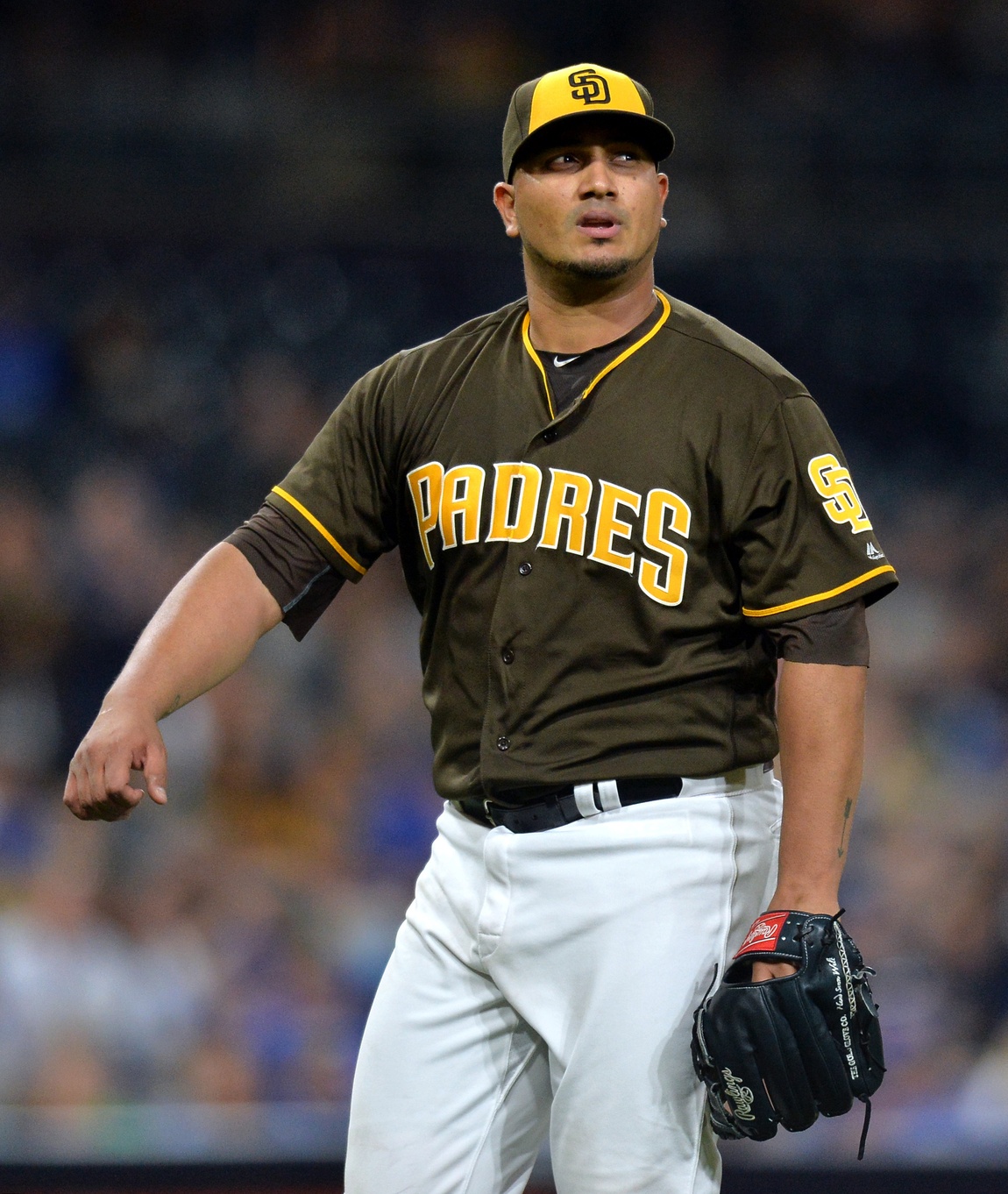
Re-signing Chacin (pictured) would make a lot of sense, considering that he has been one of the better pitchers at home in 2017 (9-3, 1.79 ERA, 5.4 H/9). The 29-year-old might have priced himself out of San Diego, however, and could command a deal that is well above what the Padres are willing to offer at this point. Cahill, considering how well he pitched with the Padres when healthy, would presumably welcome a return to his hometown Padres.
While Petco Park is no longer considered an extreme pitcher-friendly ballpark, pitchers who are looking for an opportunity to rebuild their value are still likely to place San Diego high on their list of potential destinations. Several hurlers have “figured things out” under Darren Balsley’s tutelage, which is why he’s been the team’s pitching coach for 15 seasons and counting. Clay Buchholz, Derek Holland, Ubaldo Jimenez and former Padres ace Tyson Ross could all be on the team’s radar as inexpensive bounce-back candidates.
2. Find a stop-gap shortstop who is better than Erick Aybar, Alexei Ramirez and Clint Barmes.
Filling the shortstop void has been a recurring offseason priority for this team since they traded away Khalil Greene following the 2008 season. Everth Cabrera was an NL All-Star in 2013, but he was never able to lock down the job because of inconsistency, injuries and off-the-field troubles. Thus, the team has continued to kick the can down the road in hopes that someone would eventually come along and solidify the position, which simply hasn’t happened. Short-term answers like Aybar, Ramirez and Barmes have not produced, and no prospects have emerged as the clear shortstop of the future…until now, which makes this offseason slightly different.
Whoever is written into the lineup card as the starting shortstop on Opening Day 2018 will be keeping the spot warm for highly-regarded 18-year-old prospect Fernando Tatis Jr., who some evaluators believe could reach the big leagues by 2019. Alcides Escobar, Danny Espinosa and J.J. Hardy, all coming off of bad offensive seasons, will likely be in the mix for one-year deals. The trade market for shortstops doesn’t appear to offer many options, but the Rays’ Adeiny Hechavarria, under contract through 2018, would be a possibility while the Rangers’ Jurickson Profar would fill the team’s need for at least the next two seasons—he does not appear to have accrued enough MLB service time in 2017 to reach four years—while Tatis continues to develop in the upper minors. (Though Profar, himself not far removed from being the game’s top prospect, could be seen as a long-term asset at another position.)
Corrections: Hechavarria is under contract through 2018. The article had initially stated that was under contract through 2019. Profar appears to have fallen short of 4.000 years of MLB service time, which keeps him under club control through 2020 instead of 2019.
3. Acquire a late-inning reliever who can step in as the closer if Brad Hand is traded.
With Stammen headed for free agency and Brandon Maurer and Ryan Buchter dealt to Kansas City at midseason, the Padres will likely be shopping around for late-inning bullpen help. They also have to plan around a potential trade of Hand, who received a lot of interest at the deadline.
General manager A.J. Preller held on to Hand since, presumably, teams were unwilling to meet his high asking price, and Preller isn’t likely to lower that price this offseason. If anything, Hand’s value increased after he posted a 2.22 ERA with 18 saves, six walks and 38 strikeouts in 28.1 IP after taking over as the closer in late July. With only two years of club control remaining, the 27-year-old lefty has more value with a playoff contender in 2018. In other words, there is still a high probability that Hand is traded this winter and the Padres will have a new closer heading into the season.
Kirby Yates and Phil Maton would be the top internal candidates to close if Hand is dealt. If San Diego was to add a third option with closing experience from the free agent market, Matt Belisle, Tyler Clippard, Bud Norris and Huston Street would fit the bill. Brandon Morrow, who pitched for the Padres in 2015 and 2016, would be an intriguing option to return. An impressive, injury-free season with the Dodgers, however, means that he’ll likely have plenty of interest around the league.
Photo courtesy of USA Today Sports Images
Predicting Tommy John Surgeries: The 2017 Update
Background
For 130 years, pitchers have thrown a baseball overhand, and for 130 years, doing so has hurt them. Starter or reliever, left-handed or right-handed, short or tall, skinny or fat, soft-tossing or hard-throwing, old or young—it matters not who you are, what color your skin is, what country you’re from. The ulnar collateral ligament (UCL), a stretchy, triangular band in the elbow that holds together the upper and lower arms, plays no favorites. If you throw a baseball, it can ruin you.
-Jeff Passan, The Arm: Inside the Billion-Dollar Mystery of the Most Valuable Commodity in Sports (Amazon link)
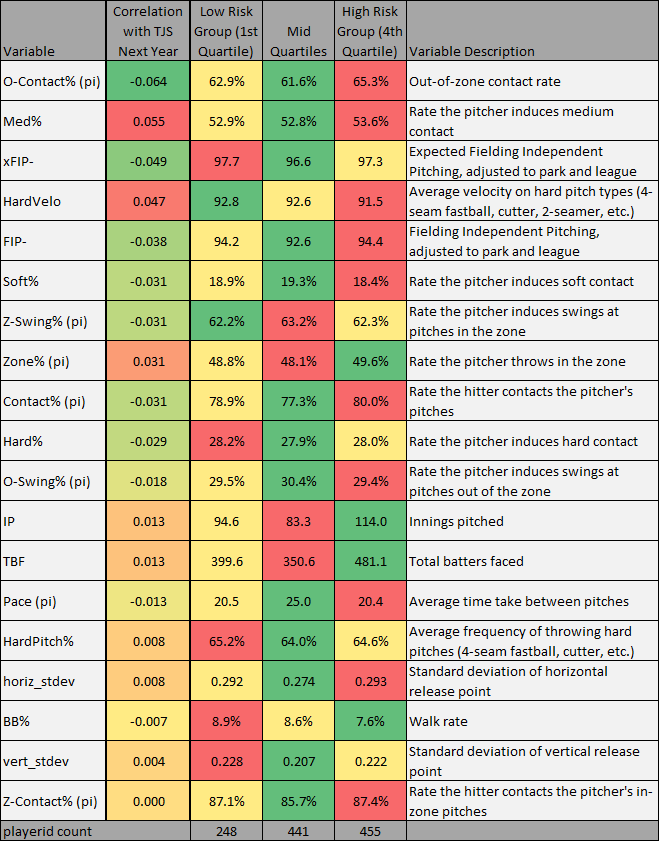
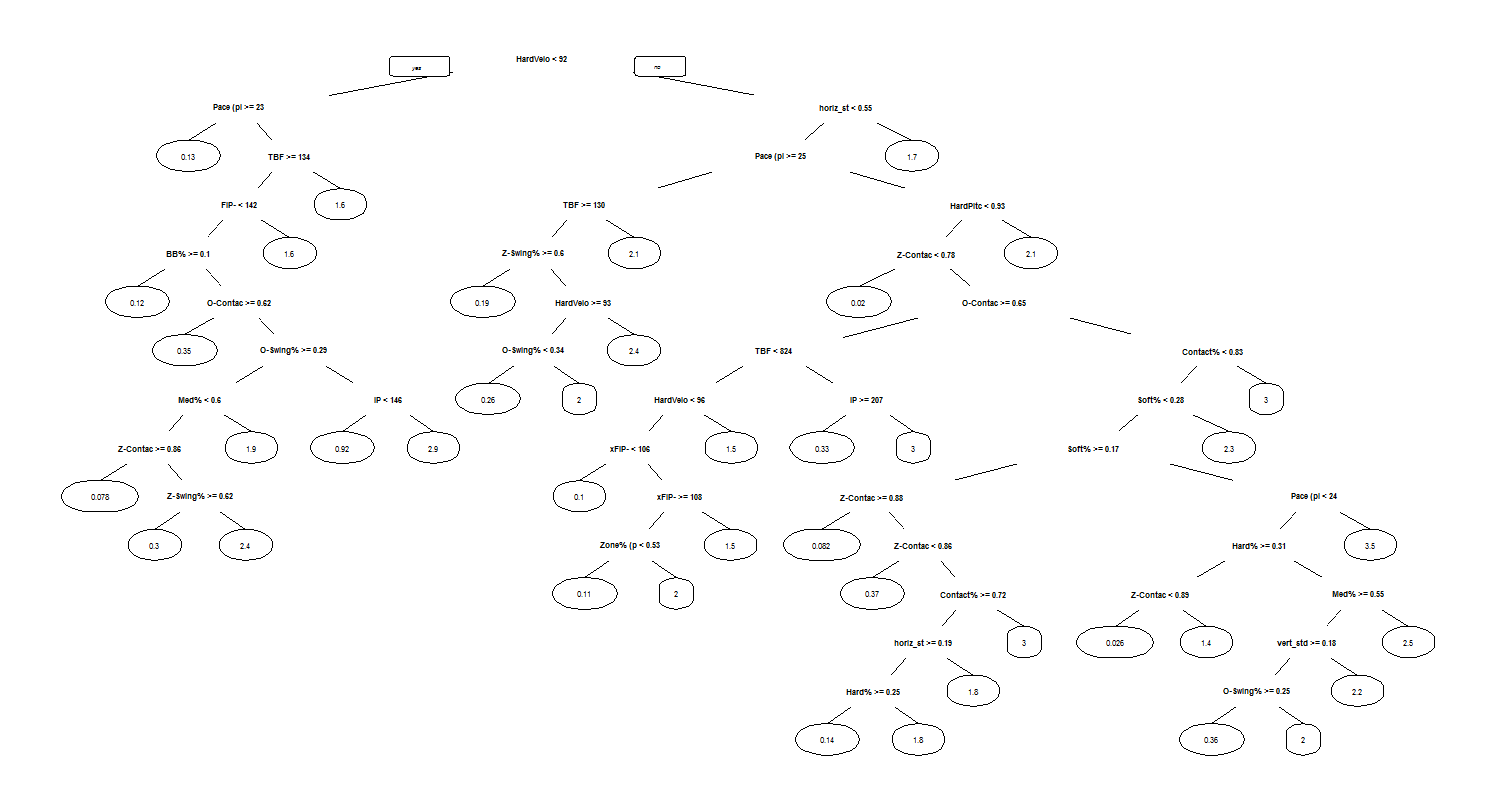
In February 2016, I presented my Tommy John surgery predictability findings from a half year of studying pitching, injury, geographic, and physiological data from thousands of Major League Baseball player-years. The results were simple and largely intuitive: Throwing really hard is dangerous for your elbow, doubly if you recently hurt your elbow.
After another year and a half of work, I’m proud to present an update to my injury research, and while the takeaway this year is perhaps more vague, the effectiveness of the model is more certain. Without further ado (the further ado section comes later), I present the results.
Results
The following table presents the Tommy John Surgery risk for MLB players entering the 2017 season, as well as the 2018 given 2016 through October 2017 data.
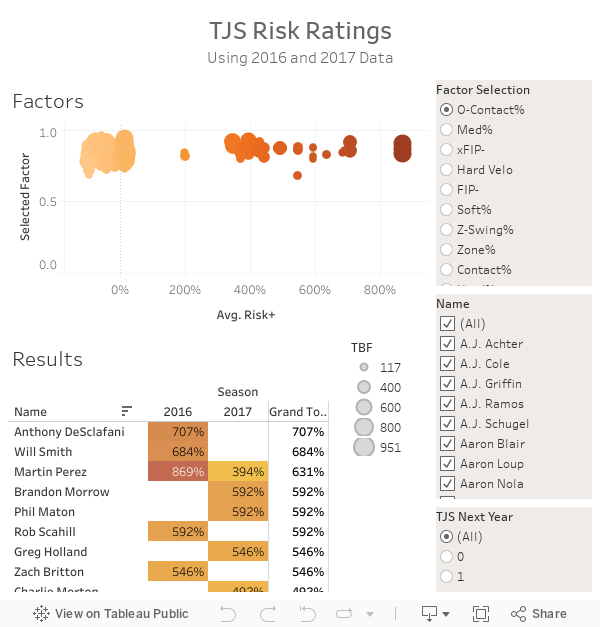
Risk+ is the player’s percentage above or below average the predicted TJS Power (explained below) score. The average TJS Power score is about 0.3, so a player with a 0.6 prediction would have a Risk+ of 100%. Link to standalone Tableau.
Because of playing time limits, some players will not appear in a 2016 or 2017 column even if they pitched in the given year. It is important to note that the 2016 column is estimating the pitcher’s TJS risk given his data from the 2016 season. So 2016 predicts a 2017 injury. The 2017 data predicts injury risk given the (partial) 2017 data, thus striving to predict a player’s injury risk heading into the 2017 playoffs and 2018 season.