
Latest On Marlins’ Rotation Trade Possibilities
As the free agent starting pitching market thins, there’s been some chatter about the Marlins as a team that might subtract a pitcher in trade. That attention has generally been centered on left-hander Jesús Luzardo and young righty Edward Cabrera. Last week, The Athletic’s Ken Rosenthal wrote that Cabrera had the better chance of that duo of changing hands, although it wasn’t clear how likely Miami was to move either player.
Barry Jackson of the Miami Herald added some context on the trade possibilities involving Miami’s starters this afternoon. Jackson writes that the Fish are willing to consider offers on each of Luzardo, Cabrera and left-hander Braxton Garrett, although he indicates there aren’t any proposals under “active consideration.”
A trade still seems a possibility but isn’t necessarily likely. The Fish haven’t done much under first-year president of baseball operations Peter Bendix. Miami is the only team that still hasn’t signed a free agent to a major league deal this offseason. Their biggest moves were trade pickups of catcher Christian Bethancourt, reliever Calvin Faucher and out-of-options infielder Vidal Bruján.
It’s an underwhelming offseason for a team coming off a surprising Wild Card berth. The Fish seem likely to lose a 36-homer hitter after Jorge Soler declined his player option. They’re looking to add at shortstop, but the free agent class at the position is dismal. They could use another bat in the corner outfield/designated hitter mix.
For all the lineup questions, their biggest loss in 2024 is one to injury. Sandy Alcantara underwent Tommy John surgery during last year’s postseason. With the 2022 NL Cy Young winner missing the entire season, the Fish project for a season-opening starting five of Eury Pérez, Luzardo, Garrett, Cabrera and Trevor Rogers.
That’s still a promising group, but their once vaunted rotation depth has thinned. In addition to the Alcantara injury, the Fish dealt Pablo López and prospect Jake Eder last year. Depth options beyond their front five include Ryan Weathers and Bryan Hoeing. Miami should get a boost from former #3 overall pick Max Meyer, who is 18 months removed from his own Tommy John procedure. Jackson writes that the new front office still considers Meyer a viable starting pitcher; prospect evaluators were divided on whether he was better suited for a high-leverage relief role before the injury.
Meyer only made two MLB starts before the unfortunate ligament tear. Rogers was limited to four starts, all in April, last year by biceps and lat injuries. Pérez, widely regarded as the sport’s top pitching prospect before an impressive rookie season, logged 128 innings between Triple-A and the majors last season. Miami could still be cautious about expanding the 20-year-old’s workload too far beyond 150 frames.
Luzardo and Garrett are Miami’s only healthy starters who topped 100 MLB innings a season ago. They both had strong seasons. The former posted a 3.58 ERA while punching out more than 28% of opposing hitters in 32 starts. With three years of arbitration control and a fastball approaching 97 MPH on average, he likely has more trade value than anyone in the Miami rotation aside from Pérez (who certainly isn’t getting moved).
Garrett has a more extended control window, as he won’t get to free agency for another five seasons. The former #7 overall pick allowed 3.66 earned runs per nine in just under 160 frames. Garrett doesn’t have the huge velocity of most of his rotation mates, sitting around 91 MPH with his heater. Yet his strong secondary offerings and plus command have translated into mid-rotation results for the last two seasons.
Cabrera is a more volatile young arm. The 25-year-old righty worked to a 4.24 ERA across 99 2/3 MLB frames. He generated an impressive 27.2% strikeout rate and 54.3% ground-ball percentage with a fastball that sits above 96 MPH. His control remains a significant question, however. Cabrera walked more than 15% of opposing hitters last season and has handed out free passes at a 14% rate over parts of three years in the big leagues. As with Garrett, he’s under club control for five more seasons.
Latest On Marlins’ Edward Cabrera, Jesus Luzardo
As with the past several offseasons, there’s been plenty of speculation and reporting about the Marlins’ willingness to deal from their starting rotation. Chatter surrounding the possibility of Miami dealing a starter didn’t bring about a high-profile trade two winters ago — Miami did deal Zach Thompson to the Pirates as part of the Jacob Stallings deal — but last offseason saw the Fish ship righty Pablo Lopez to Minnesota alongside prospects Jose Salas and Byron Chourio in a deal that brought Luis Arraez to Miami. Talk this offseason has centered primarily around lefty Jesus Luzardo and righty Edward Cabrera, but Ken Rosenthal of The Athletic writes that a trade involving Luzardo is “less likely” than a trade of the younger Cabrera. MLB.com’s Mark Feinsand wrote late last week that the Marlins have been open to discussing both in trades.
While Cabrera has more club control remaining — five years, compared to Luzardo’s three — he’s also the less-established arm of the two, so it makes sense that the Marlins would be a bit more reluctant to part with the more experienced Luzardo.
Cabrera, who’ll turn 26 in April, has already spent parts of three seasons in the big leagues. After getting roughed up as a rookie, the former top prospect has made strides in the past two seasons, logging a combined 3.73 ERA with a sharp 26.6% strikeout rate. He throws hard (96.2 mph average fastball), has generally been good at keeping the ball in the yard (1.10 HR/9) and boasts a strong 50.6% ground-ball rate. However, Cabrera has also walked far too many opponents, issuing free passes to 13.7% of batters faced.
That lack of command has at times prevented him from working deep into games. While some of his short starts have been attributable to the Marlins monitoring his workload as he’s worked through a shoulder impingement and elbow inflammation, Cabrera’s average of 4 2/3 innings per start to this point in his career is quite brief, even by today’s standards. Cabrera worked a career-high eight shutout innings against the A’s in August of 2022, but that was one of just two career outings where he’s recorded an out beyond the sixth inning (the other was in his MLB debut a year prior).
Clearly, there are still some final steps to take in Cabrera’s development, but his body of work over the past two years offers plenty of reason for optimism. Couple that with club control that stretches through the 2028 season — he’ll likely be arbitration-eligible four times as a Super Two player — and Cabrera should appeal to plenty of pitching-hungry clubs, even if he’s the less-established of Miami’s two “available” starters.
As for the Marlins’ goals in a trade, they’ll surely vary from prospective trade partner to prospective trade partner. The Fish entered the offseason looking for long-term help behind the plate and at shortstop. Rosenthal suggests that a viable long-term option at short, in particular, might pique the Marlins’ interest when it comes to moving a controllable pitcher. As things stand, utilityman Jon Berti, glove-first prospect Jacob Amaya and former top prospects Vidal Brujan and Xavier Edwards are among the organization’s options there.
That said, Miami also hasn’t done much to upgrade its long-term catching outlook this winter. Christian Bethancourt was acquired in a small trade with Cleveland, who’d acquired him from the Rays. He and Nick Fortes are the only catchers on Miami’s 40-man roster. None of the organization’s current top 10 prospects at Baseball America are catchers.
There’s no indication yet that a trade of Cabrera, Luzardo or any other Marlins starter should be considered especially likely. But the Marlins have sat out free agency entirely this offseason, and the market hasn’t exactly been deep in options at their foremost positions of need anyhow. They likely view the trade market as their best path to addressing those needs in the short- and long-term, as in addition to the thin free-agent market, the team’s projected $97MM payroll (via Roster Resource) is already about $5MM greater than last year’s Opening Day mark.
The Fish are still about $13MM shy of where they ended the 2023 season, but it’s fair to wonder just how much appetite ownership has for additional spending. Rosenthal writes, for instance, that Josh Bell‘s $16.5MM salary (which the club acquired in order to dump the majority of Jean Segura‘s contract on the Guardians) is one of the reasons that the Marlins have been reluctant to spend this winter. If that’s the case, it’s hard to envision owner Bruce Sherman greenlighting additional free-agent spending of note, which either sets the stage for some trade activity or a disappointing offseason on the player acquisition front (possibly both).
Yankees Interested In Jesus Luzardo, Shane Bieber
Earlier reports suggested that the Yankees were talking with the Marlins about their starting pitching, and USA Today’s Bob Nightengale adds some specifics by writing that New York is interested in left-hander Jesus Luzardo. In addition, the Yankees have also checked in the Guardians about righty Shane Bieber, Nightengale adds.
These two pitchers represent the wide range of options the Bronx Bombers are considering are they seek out rotation help. Luzardo would be a longer-term add, as the 26-year-old is arbitration-controlled through the 2026 season and is only arb-eligible (projected for a $5.9MM salary) for the first time this winter. Bieber is projected to earn $12.2MM in 2024, which is slated to be his final season before free agency. Though Bieber is reportedly open to signing an extension with his new team in the event of a trade, that probably won’t be an option with the Yankees in particular, since New York so rarely breaks its unofficial team rule about offering contract extensions.
Because Cleveland almost always moves its higher-paid players prior to free agency, Bieber has been rumored as a trade candidate for years, and that speculation has been peaking now that he is entering his final year of team control. The Guardians have already dealt one veteran pitcher in Cal Quantrill this offseason, and given the talented by generally inexperienced nature of the rest of Cleveland’s rotation, the Guards could potentially opt to hang onto Bieber to further bolster its own pitching staff. There’s also the fact that Bieber pitched only 128 innings in 2023 due to elbow inflammation, and his numbers were only good (3.80 ERA) rather than the elite form he showed earlier in his career.
As much as Bieber could help the Guardians, however, it seems likely that the team wouldn’t hesitate to move a pitcher who might not be a part of their future in exchange for a longer-term asset. Whether or not the Yankees might match up well with the Guardians is another matter, as New York already dealt away a good chunk of their younger pitching assets in the Juan Soto deal, and the Yankees’ young infield depth might not hold as much appeal to a Cleveland team that already has plenty of young infielders.
Naturally the Bombers aren’t going to have much interest in dealing top minor league talent for just a year of Bieber’s services, yet they could be willing to explore such a move for three years of Luzardo. The left-hander is coming off his first full and healthy season as a starting pitcher, and the results were impressive — Luzardo posted a 3.58 ERA over 178 2/3 innings, with solidly above-average strikeout and walk rates.
As noted by MLBTR’s Nick Deeds earlier today, Oswald Peraza might have a clear appeal to the shortstop-needy Marlins, but it would take more just Peraza to pry Luzardo away from South Florida. It’s fair to assume that any number of teams have at least floated the idea of a Luzardo trade with the Marlins, and a demand of multiple top-100 prospects seems like a reasonable ask for Miami given Luzardo’s age, ability, and three years of control.
Unlike with Bieber and the Guardians, there is no ticking clock on Luzardo’s time in Miami, so president of baseball operations Peter Bendix would probably have to be bowled over by an offer to move the left-hander. The Marlins might well look to move a starter for hitting help, yet any of Edward Cabrera, Trevor Rogers, or even Braxton Garrett could be likelier trade candidates than Luzardo. With Sandy Alcantara missing 2024 due to Tommy John surgery, Luzardo and Eury Perez are lined up as the cornerstones of the talented Miami rotation.
Jesús Luzardo Drawing Trade Interest
8:57pm: In a separate column, Rosenthal reports that Miami and the Royals discussed the framework of a trade that would’ve sent the southpaw to Kansas City and first baseman Vinnie Pasquantino to South Florida during the Winter Meetings. It doesn’t appear that those conversations are still going, as the Royals instead addressed their rotation with free agent adds of Seth Lugo and Michael Wacha.
Pasqunatino, who owns a .272/.355/.444 slash in 558 career plate appearances, saw his second big league season cut short by surgery to repair a labrum tear in his right shoulder. He remains under team control for five years.
12:28pm: Marlins left-hander Jesús Luzardo is drawing trade interest, per a report from Ken Rosenthal of The Athletic.
The Miami rotation has been a frequent nexus point of rumors in recent years, which has continued into this winter. Just last month, Rosenthal reported on the same concept, highlighting Edward Cabrera and Trevor Rogers as possible trade candidates. At that time, Rosenthal portrayed Luzardo as likely off-limits, but his report from today seems to suggest it may not be totally off the table after all.
Rosenthal suggests that Peter Bendix, the club’s new president of baseball operations, might have more willingness to consider a trade than now-former general manager Kim Ng. As Rosenthal points out, Bendix came to the Marlins from the Rays, a club that has generally been unafraid to trade players at peak value. For instance, in 2018, they traded Chris Archer to the Pirates for Tyler Glasnow, Austin Meadows and Shane Baz. They later sent Meadows to the Tigers for Isaac Paredes and are in the process of trading Glasnow to the Dodgers at this very moment.
If Bendix has any intention of bringing a similar operating style to Miami, then considering a Luzardo deal can become plausible in that light. He has three years of club control remaining, with MLBTR contributor Matt Swartz projecting a salary of $5.9MM in 2024. He will be due raises in the two following seasons before he’s slated to reach free agency after 2026. Since he’s going to get more expensive as his control dwindles, his trade value right now is likely as high as it will get.
Of course, beyond the contractual situation, there is the on-field stuff to consider. Luzardo posted a 3.32 earned run average in 18 starts last year, then a 3.58 ERA in 32 starts here in 2023. He struck out 28.7% of batters faced over those two years while walking just 7.9% and keeping 40.1% of balls in play on the ground. That kind of performance, along with his relatively modest salary and years of control, should combine to give him a tremendous amount of trade value.
But that also makes him incredibly valuable to the Marlins and it’s worth pointing out that their situation is more precarious than in past years. Sandy Alcántara underwent Tommy John surgery at the end of the most recent season and is slated to miss all of 2024. The club also subtracted Pablo López from the mix by flipping him to the Twins last offseason. If they were to trade Luzardo, they would be down to Eury Pérez, Braxton Garrett, Cabrera, Rogers and Max Meyer.
Pérez and Garrett make for a strong front two, but Pérez might be on a workload limit next year due to his youth and quick ascent. Cabrera has significant control problems while Rogers struggled in 2022 and then missed almost all of 2023 due to injury. Meyer has just two MLB starts and missed all of 2023 due to his own TJS. The club is reportedly planning to stretch out relievers A.J. Puk and George Soriano in the spring but there’s no guarantee that transition will work.
Given the uncertainty in the rotation, they may not want to subtract a talented pitcher like Luzardo, and there’s nothing to suggest they are actively shopping him. But if the right offer comes in, the club may have to consider it. Roster Resource currently projects the club’s 2024 payroll at $98MM. Bruce Sherman bought the team at the end of 2017 and, per the data from Cot’s Baseball Contracts, we can see the club’s Opening Day payroll dropped from $115MM that year to $100MM the year after. It hasn’t been higher than $93MM since.
The club could use some upgrades to its lineup, particularly in the middle infield, and may not have many resources available to do so. Even if they were willing to spend a bit more money, the best free agents available are guys like Whit Merrifield, Tim Anderson and Isiah Kiner-Falefa. While trading a pitcher would come with the risk of further weakening the rotation, it’s possible it could be their best path forward. Clubs like the Reds, Twins, Rays, Cardinals and Orioles are flush with position players and could use some pitching, perhaps allowing them to line up with the Marlins.
Marlins’ Edward Cabrera, Trevor Rogers Drawing Trade Interest
It wouldn’t be an offseason or trade deadline without the annual tradition of rumors regarding the Marlins’ collection of young starting pitchers. Ken Rosenthal of The Athletic writes this morning that Miami has received interest in right-hander Edward Cabrera and lefty Trevor Rogers this winter, though there’s no indication a deal involving either has been seriously discussed.
Miami’s wealth of starting pitching has been the focus of other clubs for several years now, although the extent of that depth is probably overstated now. The Fish traded Pablo Lopez as part of their Luis Arraez acquisition and will be without 2022 NL Cy Young winner Sandy Alcantara in 2024 due to Tommy John surgery. Pitching prospect Jake Eder was traded at the deadline to acquire Jake Burger from the White Sox. Fellow prospects Max Meyer (2022 TJS), Dax Fulton (2023 elbow surgery) and Sixto Sanchez (shoulder surgeries in 2021, 2022) have all seen injuries slow their trajectories as well — particularly in the case of Sanchez.
Currently, the Marlins project to trot out a rotation including Jesus Luzardo, Braxton Garrett, Cabrera, Rogers and ballyhooed young right-hander Eury Perez. There’s no way the Marlins would move Perez, who entered 2023 as arguably the top pitching prospect in the sport and debuted as a 20-year-old with 19 starts of 3.15 ERA ball. Similarly, Rosenthal suggests that Luzardo and Garrett are likely considered off limits. Beyond that top quintet, the Marlins’ top in-house options are 27-year-old Bryan Hoeing and lefty Ryan Weathers, whom they acquired in a buy-low deal from the Padres over the summer.
The extent to which Cabrera or Rogers is available will depend on the strength of offers made by other clubs, as there’s no urgency for Miami to move either pitcher. Rogers, the 2021 NL Rookie of the Year runner-up, has three years of team control remaining. Cabrera has five. Rogers has had a pair of disappointing years since a brilliant rookie campaign, pitching to a 5.26 ERA in his past 125 frames (just 18 of which came in an injury-ruined 2023 season). Cabrera has been better but inconsistent while showing worrying command; he’s logged a 3.73 ERA and fanned 26.6% of his opponents in his past 171 1/3 innings but has also issued walks at a 13.7% clip in that time.
Between the greater amount of club control and the better recent track record (both in terms of health and performance), Cabrera has the greater trade value of the pair. He’ll likely be eligible for Super Two status next winter and thus be arbitration-eligible four times rather than three, but Rogers is already into his arb years and projected to earn a modest $1.5MM this coming season, via MLBTR contributor Matt Swartz.
With their past trades and all of the injuries throughout the prospect ranks, the Marlins are no longer as deep as some may believe them to be. It’s still feasible that they could trade someone like Cabrera or Rogers in an effort to acquire help at another area of need like catcher, shortstop or center field (depending on the new front office’s plans for Jazz Chisholm Jr.‘s defensive home). It’s a thin free-agent market for bats, after all, and the Marlins likely don’t have extensive financial flexibility anyhow.
That said, if new president of baseball operations Peter Bendix does deal from the rotation to address another need, it’d likely just create a hole on the starting staff that would need to be filled via free agency or a subsequent trade. The Marlins tried this last year when dealing Lopez and signing Johnny Cueto, but the results weren’t at all what the team had hoped, as Cueto posted a 6.02 ERA in 52 1/3 innings.
Marlins Looking To Add Starting Pitcher
The Marlins pulled off one of the bigger moves of deadline season last night, acquiring back-end reliever David Robertson for a pair of promising low minors prospects. It’s the first of what is likely to be multiple additions for a Miami club that currently sits just outside the NL Wild Card picture.
Before the Robertson deal, Ken Rosenthal of the Athletic reported that adding both a starter and a reliever were Miami’s top priorities. They moved quickly on the latter front but figure to explore the rotation market over the coming days.
It’s surprising to see the Fish looking for rotation help at first glance. For a few seasons, Miami has skewed rotation-heavy and been light on offense. As a result, the Marlins dealt Pablo López to Minnesota for Luis Arraez in an effort to balance the roster.
That said, the Marlins’ rotation has been more good than exceptional in 2023. They rank 11th in starting pitching ERA, allowing 4.11 earned runs per nine innings. They’re third in strikeout rate (25.4%), 11th in walks (7.5%) and third in grounder percentage (45.9%). Starting pitching certainly hasn’t been a weakness, but it hasn’t been quite as effective as last year’s group — which ranked eighth in ERA behind a Cy Young performance from Sandy Alcantara.
Some amount of regression was probably inevitable. The López trade subtracted arguably Miami’s second-best starter. The Marlins rearranged their infield, installing Arraez at second base to push Jazz Chisholm to the outfield. They signed Jean Segura to move to third and dealt away Miguel Rojas while moving Joey Wendle to shortstop. All those transactions were designed to add offense — and the Arraez trade in particular has achieved that — but come with the expected effect of reducing the defensive efficiency behind a ground-ball heavy pitching staff.
That’s among the reasons for Alcantara’s step back, although there are myriad factors whenever a pitcher’s ERA jumps more than two runs (from 2.28 to 4.46). They’re obviously not going to displace Alcantara from the rotation, but his relative down season magnifies some of the other challenges Miami has faced.
Trevor Rogers has been on the injured list since the middle of April; a partial tear in his non-throwing shoulder leaves him with an uncertain return timetable. Free agent pickup Johnny Cueto lost a couple months to injury and was knocked around on his minor league rehab stint. Miami broke him in as a reliever before moving him back into the rotation last weekend.
Top prospect Eury Pérez has had a brilliant start to his MLB career, but he’s back in the minors temporarily as the club keeps an eye on his workload. The 20-year-old has already set a personal high with 86 2/3 innings between Double-A and the majors this season. Bryan Hoeing has gotten six starts but allowed a 6.66 ERA in 24 1/3 frames over that stretch. He’s been much better in a multi-inning relief role.
There have also been signs of promise, of course. Jesús Luzardo has taken another step forward and looks like a #2 caliber starter. Braxton Garrett, who opened the season in the minors, has stepped up with a 4.32 ERA and above-average peripherals through 100 innings. Edward Cabrera is missing plenty of bats and racking up grounders, though he’s walking over 14% of opponents and has an ERA approaching 5.00.
Miami has plenty of high-upside arms who are capable of starting a playoff game if they play into October. They don’t need to shop at the top of the rotation market. There’s some sense in adding a stable back-end starter to ease the workload on some of Miami’s younger arms — in effect playing the role the Marlins envisioned from Cueto when they signed him in January.
While rotation help now seems to be the front office’s priority, Ng and her group will also certainly remain on the lookout for ways to add to the lineup. They’ve been loosely linked to Jeimer Candelario and Tim Anderson within the past week. Rosenthal writes that Miami made a run at first baseman Carlos Santana before the Pirates dealt him to Milwaukee. The Marlins should have a few irons in the fire over the next few days as a somewhat surprising entrant into the rotation market.
Best Deadline Rental Returns In Recent History, No. 2: Marlins Cash In Marte
With the trade deadline now less than two months away, we at MLBTR are setting our sights backwards for a bit to highlight past trades of rental players to provide a loose guideline of what sort of returns fans can expect with their teams’ current rental players. With an arbitrary cutoff point of 2017-21, we’re counting down the top 10 returns that a team got when selling a rental player. We’ve already published some honorable mentions as well as entries No. 10, No. 9, No. 8, No. 7, No. 6, No. 5, No. 4 and No. 3. If you disagree with our rankings, let us know! It’s all part of the subjective fun! Onto No. 2…
The Marlins and Starling Marte at one point both hoped the dynamic outfielder would spend the final years of his career in Miami. Marte, whom the Fish acquired from the D-backs at the 2020 trade deadline when he had a season and a half of club control remaining, immediately took a liking to South Beach and voiced a desire to remain there long-term. A then-32-year-old Marte was willing to talk extension during the season in 2021, and the two parties headed into the All-Star break in the midst of extension negotiations.
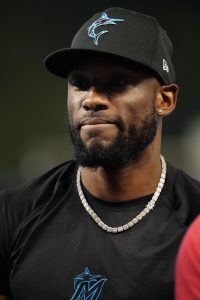 Reporting from Craig Mish, Jordan McPherson and Barry Jackson of the Miami Herald at the time indicated that Marte was seeking a four-year extension offer that would cover his age-33 through age-36 seasons — a reasonable request for a player of his caliber. Marte entered that year’s All-Star break with a strong .271/.382/.411 batting line, after all, and was a career .287/.341/.450 hitter entering that 2021 campaign.
The Marlins said all the right things publicly about wanting to keep Marte, but Mish and McPherson reported after the All-Star break that the team had topped out on a three-year offer worth less than $40MM. That type of offer was never going to get a deal done — Marte wound up signing a four-year, $78MM deal in free agency in the offseason, remember — and it was a bit surprising the Fish even put it out there. Regardless, the focus shifted to finding a trade partner for Marte, and in the end, things could hardly have worked out better for Miami.
Marte, as one would expect, quickly became a hot commodity on the trade market once it became clear that an extension in Miami wasn’t happening. The Giants, Yankees, Phillies and Astros were among the teams showing interest, and San Francisco in particular appeared to be a strong on-paper fit. There was never any talk about the Athletics harboring interest in Marte, and their outfield appeared largely set anyhow — at least from the outside looking in. Just days after the trade deadline, however, Ramon Laureano was hit with an 80-game PED ban. He’d almost certainly already gone through the appeals process by that point, so there’s a chance the A’s had a strong inkling they’d need some outfield help by the time they swung their July 28 deal for Marte.
Regardless of the circumstances that led to the trade, it was a legitimate shocker. There’d been virtually nothing to link the two teams prior to the deal, and a low-payroll club like the A’s taking on an expensive rental player didn’t seem plausible. Miami, however, kicked in $4MM to help cover the remainder of Marte’s salary. Owner Bruce Sherman was likely plenty OK with doing so, given the return.
Jesus Luzardo entered the 2020 season as the top left-handed pitching prospect in baseball. He had a decent but not elite rookie campaign during the pandemic-shortened 2020 sprint (4.12 ERA in 59 innings). Paired with a strong showing during his 12-inning cup of coffee as a 21-year-old late in the 2019 season, he looked ready for primetime and entered the ’21 season regarded as a breakout candidate who could soon front Oakland’s rotation.
Things didn’t pan out that way. Luzardo was rocked for a 5.79 ERA through his first six starts and was placed on the injured list after sustaining a hairline fracture in his left pinkie. The injury, one of the more bizarre IL trips in recent memory, occurred after Luzardo hit his hand on a desk while playing video games. The lefty apologized to the team and fans after the fact, calling the injury “stupid” and “immature.” Luzardo returned a month later, this time pitching out of the bullpen, and allowed 11 runs in 10 innings before being optioned to stretch back out as a starter.
Embarrassing injury aside, the future still seemed plenty bright for Luzardo, even with a poor 38 innings to begin his 2021 season. Perhaps the video game incident contributed to the forthcoming decision. Perhaps the A’s just didn’t feel Luzardo would live up to his prospect status. Or, more likely, perhaps vice president Billy Beane and general manager David Forst knew full-well what was coming in the offseason — massive payroll cuts from ownership and the inevitable teardown of a roster that won 97 games in both 2018 and 2019 — and simply felt they needed to push all-in for a ring in 2021.
The 56-46 Athletics traded Luzardo, who still had five years of club control remaining, to the Marlins in order to acquire the final two-plus months of Marte’s contract before he reached free agency.
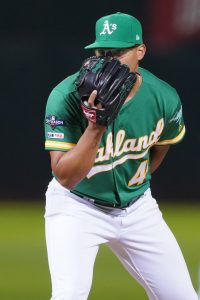 I used the term “deadline-season stunner” at the time of the trade and still feel that holds up. It’s simply rare for an MLB-ready pitcher with this much promise and this much club control to be moved at all — let alone for a two-month rental. That the acquiring team was a small-market, low-payroll club like the A’s and hadn’t been linked to Marte whatsoever only added to the surprise. In all likelihood, this trade coming together required a perfect storm: the looming PED ban for Laureano, the regrettable freak injury for Luzardo early in the season, and career years/breakouts from several A’s pitchers (Frankie Montas, Chris Bassitt, Cole Irvin, James Kaprielian) that all made Luzardo feel a bit more expendable.
In an all too common refrain for the tortured Oakland fanbase these days, the trade hasn’t worked out for the A’s. Granted, Marte was brilliant in green and gold, hitting .316/.359/.466 with five homers, 16 doubles, a pair of triples and a hefty 25 steals in just 56 games. The Athletics couldn’t have realistically asked for much more than that, but the rest of the team didn’t hold up well enough to even reach the postseason.
The A’s still finished 10 games over .500, but Oakland lost nine of its final 13 games, finishing third place in the AL West and winding up five games out in the AL Wild Card chase. Marte reached free agency and was ineligible for a qualifying offer by virtue of that midseason trade. Oakland received no compensation for his departure, and ownership gutted payroll as the front office embarked on yet another rebuild.
Down in Miami, things got out to a rocky start as well. Luzardo’s velocity was down a bit in a dozen post-trade starts, and he posted a 6.44 ERA with the Marlins overall in his first run with the club. It wasn’t a great start.
Things took a sharp turn in Miami’s favor the following season. Luzardo, born in Peru but raised in Florida, looked far more comfortable in the first full season of his homecoming. A forearm injury limited him to 100 1/3 innings, but he broke out with a 3.32 ERA, a 30% strikeout rate and an 8.8% walk rate — all while displaying a career-best 96.4 mph average on his heater. His swinging-strike and opponent chase rates were the highest of his career, and he gave up less hard contact than he had during his ugly 2021 campaign.
The Marlins received trade interest in Luzardo over the winter and surely could’ve moved him for a haul of young talent if they’d preferred, but the Fish held onto the still just 25-year-old lefty and now find themselves in the running for a postseason berth. Miami has won eight of ten games and is just three and a half games behind the division-leading Braves in the NL East. If the season ended today, the Fish would land the National League’s second Wild Card spot.
Luzardo has been a key part of that, although his recent six-run clunker did mark his third start of five or more runs allowed this year. Even with that trio of rough outings, Luzardo has a 4.17 ERA. His 27.3% strikeout rate and 6.4% walk rate are much more encouraging, however. Like many pitchers on a Marlins club that is playing multiple players out of position, Luzardo’s been hampered by his defense (.335 BABIP). Fielding-independent metrics like FIP and SIERA both peg him at 3.58 so far this season.
Dating back to Opening Day 2021, Luzardo has given the Marlins 32 starts and 178 innings of 3.69 ERA ball with a 28.8% strikeout rate and 7.7% walk rate. He’s not only regained any velocity that dipped in 2021 but is now averaging a career-high 96.8 mph on his heater. Luzardo’s swinging-strike and chase rates both suggest there’s the potential for even more strikeouts. Even if his results never catch up to the strong marks he’s receiving from fielding-independent numbers, the 2021-22 version of Luzardo is already a playoff-caliber starting pitcher. He may not be an “ace,” and fans can debate whether he’s more of a “No. 2” or “No. 3” type starter, but he’s solidified himself as an above-average starter with upside for more.
The Marlins control Luzardo for three more years beyond the current season. He reached arbitration as a Super Two player this past winter and is already earning $2.45MM. As a Scott Boras client, an extension isn’t likely, so expect Luzardo’s name to pop up in trade rumors again as he inches closer to free agency. Even by Miami payroll standards, he’s a bargain in 2023 and will be again in 2024, so a trade in the short-term doesn’t seem likely. For now, he’ll continue slotting into the rotation of a surprisingly competitive Miami club that could enter the deadline as a buyer if it can maintain any semblance of its current pace.
As for the A’s, they’re on the opposite end of the spectrum, with their primary 2023 goal at this point being to avoid the worst record in big league history. It’s hard to blame the Oakland front office for going all in and trading Luzardo, knowing the fire sale was coming, but the A’s would be a lot less futile with him in the rotation. Or, at the very least, the farm system would likely be stronger with the influx of young talent they could’ve acquired by putting him on the market as part of the rebuild this past offseason.
Images courtesy of USA Today Sports.
Each MLB Team’s Players On WBC Rosters
The World Baseball Classic is returning this year, the first time since 2017. The quadrennial event was supposed to take place in 2021 but was scuttled by the pandemic, now returning after a six-year absence. Rosters for the tournament were announced today and those can be found at this link. Here is a breakdown of which players from each MLB team are set to take participate. Quick caveat that this list is fluid and might be changed as more information becomes available.
Without further ado…
Angels
- Glenn Albanese Jr.
- Jaime Barria
- Gustavo Campero
- Alan Carter
- Jhonathan Diaz
- Carlos Estevez
- David Fletcher
- Jake Kalish
- D’Shawn Knowles
- Shohei Ohtani
- Jose Quijada
- Luis Rengifo
- Gerardo Reyes
- Patrick Sandoval
- Mike Trout
- Gio Urshela
- Cesar Valdez
- Zack Weiss
- Aaron Whitefield
Astros
- Bryan Abreu
- Jose Altuve
- Ronel Blanco
- Luis Garcia
- Colton Gordon
- Cristian Javier
- Martin Maldonado
- Rafael Montero
- Hector Neris
- Jeremy Pena
- Ryan Pressly
- Andre Scrubb
- Kyle Tucker
- Jose Urquidy
- Derek West
Athletics
Blue Jays
- Jose Berrios
- Jiorgeny Casimiri
- Yimi Garcia
- Vladimir Guerrero Jr.
- Spencer Horwitz
- Alejandro Kirk
- Otto Lopez
- Damiano Palmegiani
Braves
Brewers
- Willy Adames
- Sal Frelick
- Alex Hall
- Matt Hardy
- Joel Payamps
- Rowdy Tellez
- Abraham Toro
- Luis Urias
- Michele Vassalotti
- Devin Williams
Cardinals
- Nolan Arenado
- Genesis Cabrera
- Tommy Edman
- Giovanny Gallegos
- Paul Goldschmidt
- Ivan Herrera
- Matt Koperniak
- Noah Mendlinger
- Oscar Mercado
- Miles Mikolas
- Lars Nootbaar
- Tyler O’Neill
- JoJo Romero
- Adam Wainwright
- Guillermo Zuniga
Cubs
- Javier Assad
- Owen Caissie
- Danis Correa
- Ben DeLuzio
- Roenis Elias
- Miles Mastrobuoni
- Matt Mervis
- B.J. Murray Jr.
- Vinny Nittoli
- Fabian Pertuz
- Liam Spence
- Seiya Suzuki
- Marcus Stroman
- Pedro Strop
- Nelson Velazquez
- Jared Young
Diamondbacks
- Dominic Fletcher
- Jakob Goldfarb
- Gunnar Groen
- Merrill Kelly
- Ketel Marte
- Eric Mendez
- Dominic Miroglio
- Emmanuel Rivera
- Jacob Steinmetz
- Mitchell Stumpo
- Alek Thomas
Dodgers
- Austin Barnes
- Mookie Betts
- Freddie Freeman
- Clayton Kershaw
- Adam Kolarek
- Miguel Rojas
- Will Smith
- Trayce Thompson
- Julio Urias
Giants
Guardians
- Enyel De Los Santos
- Dayan Frias
- Andres Gimenez
- Bo Naylor
- Richie Palacios
- Cal Quantrill
- Cade Smith
- Meibrys Viloria
- Josh Wolf
Marlins
Mariners
- Matt Brash
- Diego Castillo
- Matt Festa
- Harry Ford
- Teoscar Hernandez
- Milkar Perez
- Julio Rodriguez
- Eugenio Suarez
- Blake Townsend
Mets
- Pete Alonso
- Jonathan Arauz
- Edwin Diaz
- Eduardo Escobar
- Dominic Hamel
- Elieser Hernandez
- Francisco Lindor
- Jeff McNeil
- Omar Narvaez
- Cam Opp
- Adam Ottavino
- Jose Quintana
- Brooks Raley
- Claudio Scotti
Nationals
Orioles
Padres
- Xander Bogaerts
- Nabil Crismatt
- Nelson Cruz
- Jarryd Dale
- Yu Darvish
- Jose Espada
- Ruben Galindo
- Luis Garcia
- Ha-Seong Kim
- Manny Machado
- Nick Martinez
- Evan Mendoza
- Juan Soto
- Brett Sullivan
- Julio Teheran
Phillies
- Jose Alvarado
- Erubiel Armenta
- Malik Binns
- Jaydenn Estanista
- Vito Friscia
- Brian Marconi
- J.T. Realmuto
- Kyle Schwarber
- Noah Skirrow
- Gregory Soto
- Garrett Stubbs
- Ranger Suarez
- Trea Turner
- Taijuan Walker
- Rixon Wingrove
Pirates
- David Bednar
- Tsung-Che Cheng
- Roansy Contreras
- Alessandro Ercolani
- Santiago Florez
- Jarlin Garcia
- Antwone Kelly
- Josh Palacios
- Jeffrey Passantino
- Tahnaj Thomas
- Duane Underwood Jr.
- Chavez Young
- Rob Zastryzny
Rangers
Rays
- Jason Adam
- Jonathan Aranda
- Randy Arozarena
- Christian Bethancourt
- Trevor Brigden
- Wander Franco
- Andrew Gross
- Joe LaSorsa
- Francisco Mejia
- Isaac Paredes
- Harold Ramirez
- Graham Spraker
Red Sox
- Jorge Alfaro
- Richard Bleier
- Rafael Devers
- Jarren Duran
- Ian Gibaut
- Rio Gomez
- Norwith Gudino
- Enrique Hernandez
- Nick Pivetta
- Henry Ramos
- Alex Verdugo
- Masataka Yoshida
Reds
- Donovan Benoit
- Silvino Bracho
- Luis Cessa
- Fernando Cruz
- Alexis Diaz
- Arij Fransen
- Kyle Glogoski
- Tayron Guerrero
- Evan Kravetz
- Nicolo Pinazzi
- Reiver Sanmartin
- Vin Timpanelli
Rockies
- Daniel Bard
- Jake Bird
- Yonathan Daza
- Elias Diaz
- Kyle Freeland
- Justin Lawrence
- German Marquez
- Michael Petersen
- Alan Trejo
Royals
- Max Castillo
- Robbie Glendinning
- Carlos Hernandez
- Nicky Lopez
- MJ Melendez
- Vinnie Pasquantino
- Salvador Perez
- Brady Singer
- Bobby Witt Jr.
- Angel Zerpa
Tigers
- Javier Baez
- Miguel Cabrera
- Chavez Fernander
- Andy Ibanez
- Jack O’Loughlin
- Jacob Robson
- Eduardo Rodriguez
- Jonathan Schoop
- John Valente
Twins
- Jose De Leon
- Edouard Julien
- Jorge Lopez
- Pablo Lopez
- Carlos Luna
- Jose Miranda
- Jovani Moran
- Emilio Pagan
- Christian Vazquez
White Sox
- Tim Anderson
- Kendall Graveman
- Eloy Jimenez
- Lance Lynn
- Yoan Moncada
- Nicholas Padilla
- Luis Robert
- Jose Ruiz
Yankees
Jesus Luzardo Wins Arbitration Hearing Against Marlins
Left-hander Jesus Luzardo has won his arbitration hearing against the Marlins, MLB.com’s Mark Feinsand reports (Twitter link). The arbiter’s ruling means that Luzardo will earn his desired $2.45MM salary in 2023, rather than the Marlins’ submitted figure of $2.1MM.
Luzardo becomes the second Miami player (and the second MVP Sports Group client) to win an arb hearing in as many days, after Luis Arraez was victorious Thursday in his bid to earn a larger salary. Jon Berti is also slated for a hearing in the coming days, unless he and the Marlins agree ahead of time on a contract to avoid arbitration.
This is the first of four trips through the arb process for Luzardo, as a Super Two player. The extra year of arbitration eligibility makes this hearing decision a particularly nice result for Luzardo, since the $2.45MM provides a higher starting platform for his future earnings. Both figures from Luzardo and the Marlins were above the $2MM projection of Matt Swartz’s arbitration model.
One of baseball’s best pitching prospects during his time in the Athletics’ farm system, Luzardo made his MLB debut in 2019, and then finished eighth in AL Rookie Of The Year voting in 2020 when he posted a 4.12 ERA over 59 innings in the shortened season. Just when it seemed like Luzardo was going to be Oakland’s next building block, however, he struggled badly at both the Major League and Triple-A levels in 2021, and also missed time with a fractured pinkie finger.
With the A’s vying for a playoff berth (and facing an imminent fire sale that offseason), Luzardo was dealt to the Marlins in a one-for-one trade for Starling Marte at the deadline. As well as Marte played in his brief time in Oakland, it wasn’t enough to get the Athletics into the postseason, while the Marlins picked up a controllable and talented arm who already looks to have benefited from the change of scenery.
Luzardo didn’t pitch well for Miami during the remainder of the 2021 campaign, but then posted a 3.32 ERA and a strong 30% strikeout rate over 100 1/3 innings in his first full season as a Marlin. The southpaw’s 2022 performance wasn’t without some hiccups, however, as his 8.8% walk rate was below average and he spent over two months on the 60-day injured list due to a forearm strain. Fortunately, Luzardo returned from that worrisome injury in good form, posting a 3.03 ERA over his final 12 starts and 71 1/3 innings of the season.
Some more trade rumors swirled around Luzardo this winter, as the Marlins were openly looking to move one of their starters (except Sandy Alcantara or top prospect Eury Perez) in exchange for a hitting upgrade. Luzardo was reportedly floated to the Mets in a possible offer involving Brett Baty, though ultimately, Pablo Lopez ended up being the starter on the move, as Miami sent Lopez to the Twins as part of the four-player trade that brought Arraez onto the roster. With Lopez now gone, the Marlins are counting on Luzardo to take another step forward, and perhaps even establish himself as the rotation’s number two pitcher.
Marlins Explored Trades For Mets’ Brett Baty
The Marlins spent much of the season looking for ways to convert their surplus of starting pitchers into some help at the plate, and that quest might have ended this week when the Fish dealt Pablo Lopez to the Twins as part of a four-player swap that sent Luis Arraez to Miami. Before that move, however, Mets third base prospect Brett Baty was one of the other names on Miami’s radar, and the New York Post’s Jon Heyman reports that the Marlins were willing to offer either Jesus Luzardo or Edward Cabrera in return.
Reports earlier this month indicated that the Marlins had also talked to the Mets about Eduardo Escobar, when New York seemingly had an agreement in place with Carlos Correa. Had the Correa contract been finalized, an Escobar deal to the Marlins might’ve been been more viable, but the Mets naturally opted to hang onto Escobar once the club had some issues with Correa’s physical. Heyman writes that the Marlins’ interest in Baty existed “both before and after the Mets’ Carlos Correa deal fell through,” and it is probably safe to assume that the Mets’ willingness to move Baty also diminished in the aftermath of the Correa situation.
While there seems to be no financial limit on the Mets’ desire to upgrade their roster, Steve Cohen’s splashy dives into free agency have been related to the club’s desire to hang onto its minor league depth. While New York has moved some top young players in trades during Cohen’s two-plus years as owner, the Mets haven’t been willing to entirely clean out the farm system for proven veterans. As such, players like Baty, Francisco Alvarez, Mark Vientos, Ronny Mauricio, and prospects further away from the majors have remained in New York’s organization.
Since Correa is no longer in the picture and the 34-year-old Escobar is entering his last year under contract, Baty may once again be the Amazins’ third baseman of the future, or even present if he starts to take on a larger role in 2023. Baty made his MLB debut last season and could potentially be deployed in a platoon with Escobar this year, or might see some action in left field. As Baty recently told MLB.com’s Anthony DiComo, he would’ve been happy to switch positions in the event of a Correa signing, saying “I just want to be in the big leagues helping a team win.” Baty also said he feels “stronger than ever” in the wake of the thumb surgery that prematurely ended his 2022 season, and though he has been fully healed since November, Baty will be heading to Spring Training early to make up for lost prep time.
With Baty looking like a key figure in the Mets’ future plans, it would’ve taken quite a trade haul to get the team to change its mind about trading the third baseman….a haul akin to, say, a controllable and talented young pitcher like Luzardo or Cabrera. Such a trade may no longer be on the table in the wake of the Arraez move, but it would’ve been a fascinating swap of young talents, especially with the added wrinkle of the Mets and Marlins being division rivals. Either Luzardo or Cabrera would’ve added youth and long-term control to a veteran Mets rotation that currently has only one pitcher (Kodai Senga) locked up beyond the 2024 season. Carlos Carrasco is entering the last year of his contract, while Max Scherzer, Justin Verlander, and Jose Quintana are all only guaranteed through the 2024 campaign (though Verlander has a vesting option for 2025).
Had the Marlins successfully landed Baty, their roster moves of the last few weeks would’ve naturally been quite different, and the Arraez trade likely doesn’t happen. In this scenario, Baty likely becomes the new everyday third baseman, while Jean Segura would’ve played second base rather than the hot corner. This would’ve still opened the door for Jazz Chisholm Jr. to be moved to center field, as the Marlins are seeing if the All-Star second baseman’s speed and arm can translate to success as an outfielder.