
MLB’s 5 Most-Traded Players
Trades are the life blood of this website. This is the longest we’ve ever gone without one! We’re all pining for the good old days … which got me thinking about the players who have been constant fodder for MLBTR posts.
Plenty of other names have appeared on the site more often in rumors. And there are lots of players who’ve ended up moving around more often by other mechanisms. (See, e.g., Oliver Drake, the reigning king of the waiver claim.) But among those players that appeared in the majors in 2019, no man (so far as my research revealed) has matched or exceeded these five-time-traded players when it comes to being dealt …
5 (tie). Mark Melancon (5)
- Yankees to Astros (7/10)
- Astros to Red Sox (12/11)
- Red Sox to Pirates (12/12)
- Pirates to Nationals (7/16)
- Giants to Braves (7/19)
5 (tie). Drew Butera (5)
- Mets to Twins (7/07)
- Twins to Dodgers (7/13)
- Dodgers to Angels (12/14)
- Angels to Royals (5/15)
- Royals to Rockies (8/18)
5 (tie). J.A. Happ (5)
- Phillies to Astros (7/10)
- Astros to Blue Jays (7/12)
- Blue Jays to Mariners (12/14)
- Mariners to Pirates (7/15)
- Blue Jays to Yankees (7/18)
4. Tyler Clippard (6)
- Yankees to Nationals (12/07)
- Nationals to Athletics (1/15)
- Athletics to Mets (7/15)
- Diamondbacks to Yankees (7/16)
- Yankees to White Sox (7/17)
- White Sox to Astros (8/17)
2 (tie). Cameron Maybin (7)
- Tigers to Marlins (12/07)
- Marlins to Padres (11/10)
- Padres to Braves (4/15)
- Braves to Tigers (11/15)
- Tigers to Angels (11/16)
- Marlins to Mariners (7/18)
- Indians to Yankees (4/19)
2 (tie). Edwin Jackson (7)
- Dodgers to Rays (1/06)
- Rays to Tigers (12/08)
- Tigers to Diamondbacks (12/09)
- Diamondbacks to White Sox (7/10)
- White Sox to Blue Jays (7/11)
- Blue Jays to Cardinals (7/11)
- Athletics to Blue Jays (5/19)
1. Jesse Chavez (8)
- Rangers to Pirates (7/06)
- Pirates to Rays (11/09)
- Rays to Braves (12/09)
- Braves to Royals (7/10)
- Blue Jays to Athletics (8/12)
- Athletics to Blue Jays (11/15)
- Blue Jays to Dodgers (8/16)
- Rangers to Cubs (7/18)
12 Years Later, This Trade’s Still Paying Off For Yankees
It has been a dozen years since the Yankees swung a trade for outfielder Nick Swisher, who paid immediate dividends as part of the franchise and whose acquisition continues to benefit the organization to this day. On Nov. 13, 2008, the Yankees sent two minor league pitchers – Jeff Marquez and Jhonny Nunez – as well as veteran infielder Wilson Betemit to the White Sox for Swisher and young hurler Kanekoa Texeira. Most of the pieces in the swap – Marquez, Nunez and Texeira – failed to pan out in the majors, but the move revived the switch-hitting Swisher’s career and helped him land a sizable payday in free agency down the road.
If we go back to the start, Swisher opened his career as a rather effective member of the Athletics, who chose him 16th overall in the 2002 draft. As a member of the big club from 2004-07, Swisher batted .251/.361/.464 (118 wRC+) with 80 home runs and 10.0 fWAR over 1,924 plate appearances, aiding Oakland in three plus-.500 seasons and a playoff berth. However, almost six years after spending a high pick on him, the A’s sold the affable Swisher, dealing him to the White Sox in January 2008 for a package led by left-hander Gio Gonzalez. That worked out fine for Oakland, which received a couple terrific years from Gonzalez before trading him to the Nationals in December 2011 in yet another notable transaction.
While the A’s profited from Gonzalez’s presence, his career took a bad turn in his first year out of Oakland. The 2008 campaign was one of the worst of Swisher’s time in the game, and he was unable to win the favor of then-White Sox manager Ozzie Guillen as a result. While Swisher was seemingly a solid clubhouse presence in the majors, Guillen thought the opposite. He said in November 2008, a little while after the White Sox parted with Swisher: “To be honest with you, I was not happy with the way he was reacting at the end of the season. He wasn’t helping me either.” Maybe the relationship would have been better had Swisher produced, though he instead struggled to a .219/.332/.410 line (93 wRC+) in 588 PA. But Swisher did pop 24 home runs, his third of nine straight seasons with 20-plus, and Yankees general manager Brian Cashman decided to buy low on him.
To this day, the Swisher pickup looks like one of the most brilliant decisions of Cashman’s lengthy tenure atop New York’s front office. Swisher was a quality contributor throughout his time as a Yankee, including in a 2009 campaign that saw the team win its most recent World Series championship. From that season through 2012, Swisher’s last as a Yankee, he hit .268/.367/.483 (128 wRC+) with 105 HRs and 14.4 fWAR across 2,501 PA, also earning his lone All-Star berth in the process. But the Yankees were not willing to commit to Swisher once he became a free agent before 2013, which, for multiple reasons, was a wise call in hindsight.
In January 2013, the Ohio-born Swisher returned to his native state on a four-year, $56MM contract with the Indians. Unfortunately for Cleveland, it didn’t get anything close to the Yankees’ version of Swisher. Owing in part to knee problems, Swisher slashed a below-average .228/.311/.377 (92 wRC+) with 32 homers and minus-0.5 fWAR in 1,146 PA in an Indians uniform. They dealt Swisher and fellow outfielder Michael Bourn to the Braves for infielder Chris Johnson in August 2015. That proved to be Swisher’s final season in MLB, though he did return to the Yankees on a minor league contract in 2016 before his career came to an end later that year.
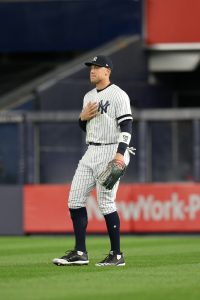
The season after Swisher said goodbye to pro baseball, another star was born in New York. Towering right fielder Aaron Judge, a top 100 prospect in his younger days, exploded on the scene in 2017, batting .284/.422/.627 (174 wRC+), smacking 52 homers and racking up 8.3 fWAR. Judge fell short of AL MVP honors then, but he won Rookie of the Year in his league and was part of a club that took the eventual title-winning Astros to a seven-game LCS.
While injuries have somewhat limited Judge’s availability since his initial season, you can’t argue with the production he has managed when he has been able to take the field. Since his second year, Judge has recorded a line of .278/.392/.528 (good for a 146 wRC+) and amassed 54 dingers with 9.7 fWAR.
Judge is now 28 years old, a two-time All-Star and perhaps the face of the Bronx-based franchise, but he may have never gotten there if not for Swisher. Allowing Swisher to depart in free agency entitled the Yankees to a compensatory selection in the ensuing draft. They used that pick, No. 32 in 2013, on Judge – a former Fresno State Bulldog. So, not only did the Yankees benefit from Swisher’s best seasons as a pro, but stealing him from the White Sox 12 years ago is still paying off for them in a big way.
Photo courtesy of USA Today Sports Images.
Andrus & Odor Occupy Top Spots On Rangers’ Future Payroll
2020 salary terms are set to be hammered out in the coming days. But what about what’s owed to players beyond that point? The near-term economic picture remains questionable at best. That’ll make teams all the more cautious with guaranteed future salaries.
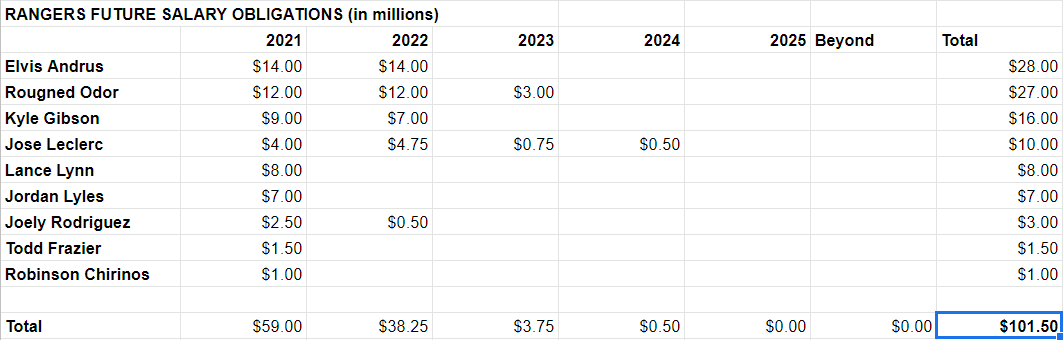
Every organization has some amount of future cash committed to players, all of it done before the coronavirus pandemic swept the globe. There are several different ways to look at salaries; for instance, for purposes of calculating the luxury tax, the average annual value is the touchstone, with up-front bonuses spread over the life of the deal. For this exercise, we’ll focus on actual cash outlays that still have yet to be paid.
We’ll run through every team, with a big assist from the Cot’s Baseball Contracts database. Next up is the Rangers:
(click to expand/view detail list)
Rangers Total Future Cash Obligation: $101.5MM
*includes buyouts on club options
*2023 club option ($15MM) over Elvis Andrus vests with 550 plate appearances in 2022 and/or 1,110 plate appearances in 2021-22
Which 15 Players Should The Rangers Protect In An Expansion Draft?
In a few weeks, we’ll be running a two-team mock expansion draft here at MLBTR. Currently, we’re creating 15-player protected lists for each of the existing 30 teams. You can catch up on the rules for player eligibility here.
So far, we’ve covered the Mariners, Athletics, Angels, Astros, Twins, Royals, Tigers, Indians, White Sox, Rays, Yankees, Red Sox, Blue Jays and Orioles. The Rangers are up next.
We’ll start by removing free agents Jeff Mathis, Shin-Soo Choo, Jesse Chavez, and Mike Minor from consideration. We’ll also remove Todd Frazier and Robinson Chirinos, who have club options for 2021 but probably aren’t worth protected spots.
Corey Kluber has an $18MM club option for 2021, and the Rangers’ decision on that will be dependent on how he performs in a possible 2020 season. I’ve decided to make the guess that the Rangers would use a protected spot on Kluber. We’ll also lock down Elvis Andrus due to his no-trade protection. I’ve decided to lock down starting pitchers Kyle Gibson and Jordan Lyles as well, who signed with the Rangers as free agents last December. That’s debatable, but some judgment calls are made in this process. Here’s the entire initial protected group of nine players:
Corey Kluber
Elvis Andrus
Lance Lynn
Danny Santana
Joey Gallo
Willie Calhoun
Nick Solak
Kyle Gibson
Jordan Lyles
That leaves six spots for the following 18 players:
Kolby Allard
Brock Burke
Luke Farrell
Nick Goody
Ronald Guzman
Taylor Hearn
Scott Heineman
Jonathan Hernandez
Ariel Jurado
Isiah Kiner-Falefa
Jose Leclerc
Brett Martin
Yohander Mendez
Rafael Montero
Joely Rodriguez
Rougned Odor
Joe Palumbo
Jose Trevino
With that, we turn it over to the MLBTR readership! In the poll below (direct link here), select exactly six players you think the Rangers should protect in our upcoming mock expansion draft. Click here to view the results.
Former No. 3 Pick’s Path To MLB Would Be Accelerated With Universal DH
We’ve already sorted through the rest of the NL East (Braves, Nationals, Mets, Marlins) when looking at how the likely addition of a universal DH might impact the teams within. How might the Phillies react to the change? The Phils have a reasonably experienced lineup, with only presumptive center fielder Adam Haseley checking in at under a year of big league service time. The group was a middle-of-the-pack unit in the NL last year, ranking eighth in runs scored (774), tenth in wRC+ (91) and 11th in home runs (215).
Among in-house veterans, Jay Bruce leads the pack of DH candidates. Acquired last year shortly before Andrew McCutchen tore his ACL, Bruce continued to show off huge power but posted bottom-of-the-barrel OBP numbers: a .261 OBP and a career-low 5.7 percent walk rate. If his days an even passable OBP threat are behind him, perhaps he’s no longer suited for this role, but he’ll probably get some opportunities to bounce back. He’ll likely need a right-handed platoon partner. The Phils have no shortage of non-roster veterans who could factor into the mix, including Logan Forsythe, Josh Harrison and Neil Walker (although Walker is a much better left-handed hitter than he is right-handed).
The bigger question in Philly, though, is whether the advent of the NL DH and the likely expansion of rosters will push top prospect Alec Bohm to the big league level. Bohm hasn’t appeared above Double-A yet, but the former No. 3 overall draft pick clobbered High-A and Double-A pitching last year, hitting at a combined .305/.378/.518 clip in 540 plate appearances. Bohm walked in 10.6 percent of his plate appearances against a mere 13.5 percent strikeout rate. There’s no guarantee that any minor league games will be played in 2020, and he was widely expected to debut at some point in 2020 anyhow. Given Bohm’s status as a consensus top 60 prospect, the Phillies can’t be keen on him missing a year’s worth of games.
If Bohm holds his own in the Majors, the benefits to the Phillies are substantial. Jean Segura could move from third base to second base, freeing Scott Kingery up to embrace a super-utility role or simply allowing him to supplant Haseley as the everyday center fielder. Kingery rated well at virtually every position he played in 2019, and his bat is an upgrade over that of Haseley. With a DH spot added, there’s room for each of Bohm, Segura and Kingery to regularly factor into the lineup.
It’s true that Haseley’s glove graded out excellently last year, so perhaps the Phils would prefer to keep him in there as often as possible — particularly against righties. In that case, both Haseley and Kingery could log outfield reps on days when McCutchen is the DH, allowing his surgically repaired knee the occasional rest. Bohm could play third base on those days with Segura at second. At the very least, a productive debut from Bohm would give incoming skipper Joe Girardi the “good” types of problems/questions that every manager hopes to have.
There could be other options in the organization. Expanded rosters surely give Nick Williams a greater chance of making the club, though he’s rather buried on the outfield depth chart. The right-handed-hitting Kyle Garlick could see some increased opportunities, and while Nick Martini isn’t on the 40-man roster at present, he’s an OBP machine who would make for a nice bench bat or occasional DH versus righties. With Matt Szczur, Ronald Torreyes, Phil Gosselin, Mikie Mahtook and T.J. Rivera all in camp on minor league deals as well, the Phillies aren’t short on recognizable names. It’s doubtful any of that bunch would factor prominently into DH duties, but they give the Phillies plenty of options for a deepened bench.
Which 15 Players Should The Mariners Protect In An Expansion Draft?
In a few weeks, we’ll be running a two-team mock expansion draft here at MLBTR. Currently, we’re creating 15-player protected lists for each of the existing 30 teams. You can catch up on the rules for player eligibility here.
So far, we’ve done the Athletics, Angels, Astros, Twins, Royals, Tigers, Indians, White Sox, Rays, Yankees, Red Sox, Blue Jays, and Orioles. The Mariners are next.
First, we’ll remove free agents Dee Gordon, Taijuan Walker, and Yoshihisa Hirano from consideration. I’ve decided to lock down these 11 players out of the gate:
Mitch Haniger
Marco Gonzales
Evan White
Logan Gilbert
Justus Sheffield
Justin Dunn
Kyle Lewis
J.P. Crawford
Shed Long
Jake Fraley
Tom Murphy
That leaves four spots for the following 25 players:
Austin Adams
Dan Altavilla
Gerson Bautista
Braden Bishop
Brandon Brennan
Nestor Cortes
Carl Edwards Jr.
Kendall Graveman
Zac Grotz
Taylor Guilbeau
Sam Haggerty
Yusei Kikuchi
Tim Lopes
Matt Magill
Nick Margevicius
Dylan Moore
Austin Nola
Kyle Seager
Mallex Smith
Erik Swanson
Daniel Vogelbach
Donovan Walton
Art Warren
Taylor Williams
Patrick Wisdom
With that, we turn it over to the MLBTR readership! In the poll below (direct link here), select exactly four players you think the Mariners should protect in our upcoming mock expansion draft. Click here to view the results.
How Seattle Acquired One Of Its Best Players
While last season was an injury-shortened wreck for the Mariners’ Mitch Haniger, you can’t dispute that he’s a highly valuable outfielder when he’s able to take the field. Haniger came into his own during his first extensive action in 2017, and he was a deserving All-Star during the next season, in which he hit .285/.366/.493 (137 wRC+) with 26 home runs and 4.5 fWAR. With three years of control left, Haniger could either continue to serve as a key Mariner or re-emerge as a desirable trade chip, leaving the M’s in a good spot in both cases.
As for how Haniger became a Mariner, we can start by revisiting the 2011-12 offseason. Prolific slugger Prince Fielder, a Brewer from 2005-11, reached the open market after the last of those seasons. He was a Type A free agent, which is a concept that’s now extinct in the majors, but losing Fielder entitled the Brewers to a compensatory pick in the 2012 draft. They did indeed see Fielder depart, as he went to the Tigers on a nine-year, $214MM contract. That left the Brewers with the 38th overall pick, which they used on Haniger.
While Haniger was a decent minor league hitter at the lower levels in the Milwaukee organization, he never played in the majors with the Brewers. They instead traded Haniger and left-hander Anthony Banda (now a Ray) to the Diamondbacks at the July 2014 deadline for outfielder Gerardo Parra. The Brewers didn’t make the playoffs that year or the next one – Parra was on their roster both seasons – and they traded him to the Orioles for righty Zach Davies at the 2015 deadline. Davies was effective as a Brewer from 2015-19, though they dealt him to the Padres in a four-player swap that delivered infielder Luis Urias and lefty Eric Lauer to Milwaukee over the offseason.
So, in the wake of the Parra trade, how did Haniger end up in Seattle? Let’s go back to November 2016, when the D-backs sent him, infielder Jean Segura and righty Zac Curtis to the Mariners in a blockbuster trade for infielder/outfielder Ketel Marte and righty Taijuan Walker. Segura’s now a member of the Phillies, who acquired him from the M’s in a December 2018 that brought shortstop J.P. Crawford and some guy named Carlos Santana to Seattle (though Santana never played for the club). Marte has turned into a superstar in Arizona, meanwhile, Walker’s now back in Seattle after a couple injury-ruined years in the desert, and Curtis is out of baseball.
This goes to show how much one team’s decision – in this case, the Brewers letting Fielder go in free agency – can affect the league. Had the Brewers simply re-signed Fielder, which was out of the question for the low-budget team, you never know what would have happened to any of the aforementioned clubs or players. Milwaukee’s inability to keep Fielder did lead Haniger to Seattle, which is no doubt pleased to have him in the fold for at least the next few seasons, but it did lose Marte when it acquired him.
The First Five No. 1 Picks
The Major League Baseball amateur draft first came about in 1965. Since then, plenty of first overall picks have made a mark in the bigs, while many others have disappointed. Having already looked at the top selections from 2010-19, 2000-09, the 1990s, the 1980s and the 1970s, we’ll now turn our focus to the first five players who went No. 1 overall…
1965 – Rick Monday, OF, Kansas City Athletics:
You know you’re going back in time when you’re talking about the Kansas City Athletics, who moved to Oakland prior to the 1968 season. In any event, the KC version of the franchise made Monday the first No. 1 overall pick ever. Monday wound up as a very productive big leaguer with the A’s, Cubs and Dodgers from ’66 through 1984, during which he made two All-Star teams and batted .264/.361/.443 with 243 home runs and 31.1 fWAR. However, Monday may be best known for saving the American flag from being burnt by a couple of miscreants in LA in 1976. Take it away, Vin Scully.
1966 – Steve Chilcott, C, Mets:
- Chilcott’s one of the few No. 1s to never appear in the majors, thanks in part to injuries. He played in the minors with the Mets and Yankees from 1966-72, but could only muster a .569 OPS during that stretch. Speaking of the Yankees, you know who went one pick after Chilcott? Mr. October, Reginald Martinez Jackson. That should still sting for the Mets.
1967 – Ron Blomberg, 1B, Yankees:
- A fun bit of trivia: Blomberg was the first-ever DH, in 1973. In regards to the position, he told Bill Ladson of MLB.com in 2017: “I love the DH. I hate to watch the pitchers hit. It’s the most boring thing in the world, even in batting practice. The DH is like the three-point [shot] in the NBA and college basketball. It brought a lot of excitement to the game.” It’s a polarizing topic, but I totally agree with Blomberg, who had a wonderful career as a hitter when he was healthy enough to play. Although injuries limited Blomberg to 461 games and 1,493 plate appearances with the Yankees and White Sox from 1969-78, he hit .293/.360/.473 with more unintentional walks (140) than strikeouts (134).
1968 – Tim Foli, SS, Mets:
- Statistically, Foli – taken three picks before Thurman Munson – didn’t have a great impact. The defense-first infielder was a .251/.283/.309 hitter who hit 25 homers in almost 6,600 trips to the plate as part of a half-dozen different teams from 1970-85. Nevertheless, Foli made quite a mark on the game in transactions. The Mets traded him, Mike Jorgensen and Ken Singleton (arguably a Hall of Famer) to the Expos in 1972 for outfielder Rusty Staub, who became a Mets icon. Twelve years later, Foli was part of a Yankees-Pirates deal that brought Jay Buhner to New York. Buhner didn’t last long as a Yankee, to Frank Costanza’s chagrin.
1969 – Jeff Burroughs, OF, Washington Senators:
- We’re going so far back that Ted Williams was the Senators’ manager when they chose Burroughs, who debuted the next season. Burroughs ended up as a good major leaguer from 1970-85 with the Senators, Rangers, Braves, Mariners, A’s and Blue Jays, with whom he combined for a .261/.355/.439 line with 240 HRs and 18.3 fWAR. That said, the Senators may have been wiser to choose righty J.R. Richard, the No. 2 pick and someone who had a better career than Burroughs.
A One-Year Deal That Could Pay Off For A Decade
It’s been more than six years since the Braves inked righty Ervin Santana to a one-year, $14.1MM deal after Spring Training was already underway. Santana, then 31, was a free agent for the first time and entered the market as one of the more appealing starters available to teams in need of a rotation upgrade. He’d just wrapped up a strong season with the Royals that saw him rack up 211 frames with a 3.24 ERA and a 3.16 K/BB ratio.
But Santana hit the market aiming quite high, reportedly seeking a contract worth more than $100MM. A big payday wasn’t exactly far-fetched — we predicted a five-year deal at a more reasonable $75MM term that winter — but teams clearly balked at a nine-figure guarantee for a pitcher who struggled with year-to-year consistency. Kansas City, after all, had only acquired Santana in a salary dump from the Angels after the righty posted an ERA north of 5.00 in a sub-replacement-level 2013 effort.
By the time Santana’s asking price dropped into the four-year, $50-60MM range as Spring Training approached, it was too late. He reportedly received three-year offers from the Twins (who’d sign him a year later) and Orioles that spring but preferred a one-year deal to reenter free agency next winter. The Braves obliged, signing Santana at the exact $14.1MM value of the qualifying offer he’d rejected four months prior.
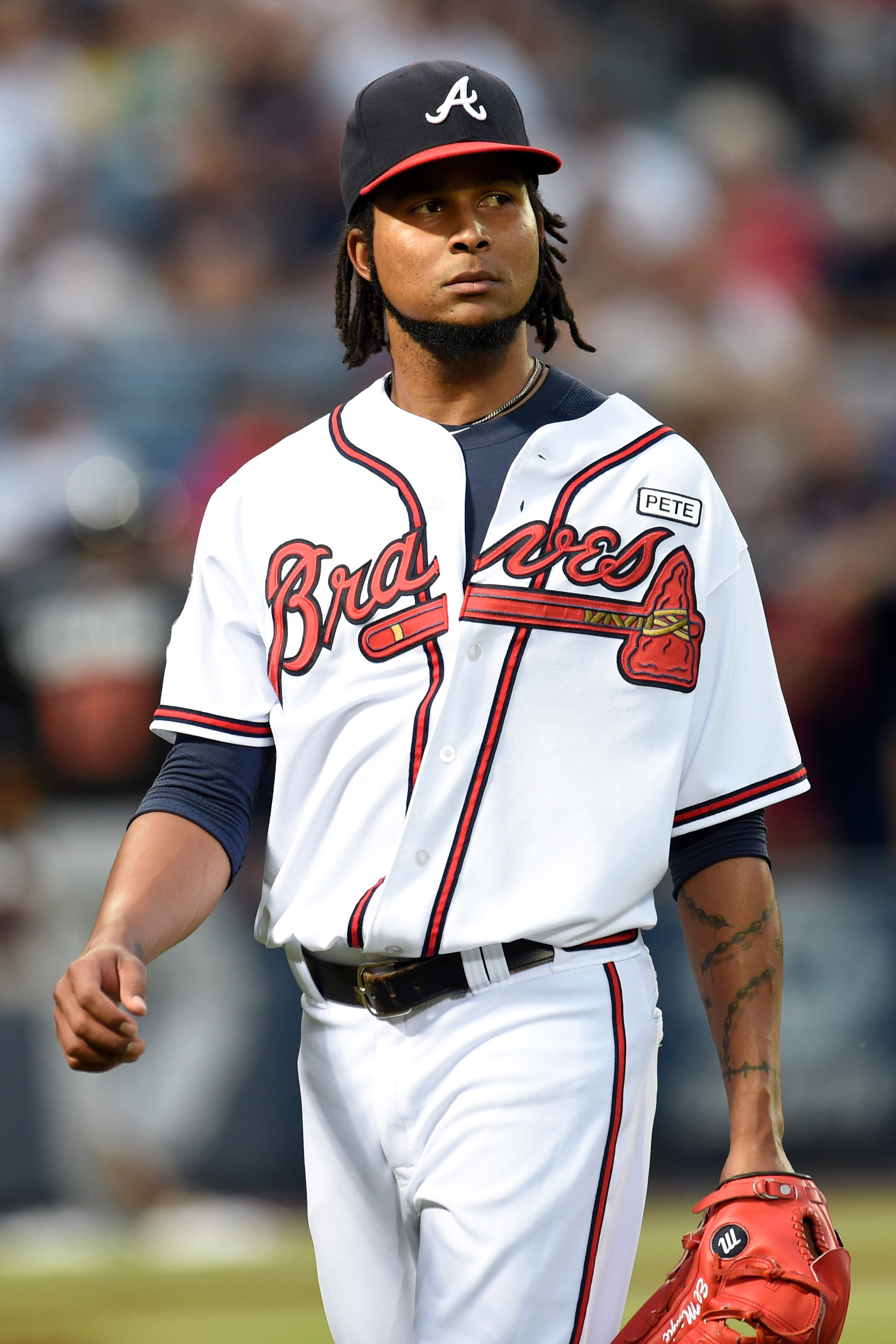
The signing worked out swimmingly for Atlanta. Santana made 31 starts, totaled 196 innings and logged a 3.95 ERA (3.39 FIP) with 8.2 K/9, 2.9 BB/9, 0.73 HR/9 and a 42.9 percent ground-ball rate. The Braves finished second in the NL East that year, but their playoff miss couldn’t be pinned on Santana, who largely held up his end of the bargain. At season’s end, Santana entered the open market a second time.
Unlike the 2016-21 collective bargaining agreement, the previous arrangement allowed players to receive multiple qualifying offers in their career. As such, the Braves issued a second qualifying offer, which Santana again rejected. This time around, his expectations were set a bit lower, and by the end of the Winter Meetings he’d landed a four-year deal with the Twins that guaranteed him $55MM. The Twins lost their second-round pick to sign Santana. The Braves received a compensatory pick at the end of the first round.
As readers have likely gleaned by now, that’s where the Atlanta organization struck gold. The Braves’ organic pick that year, No. 14 overall, saw them select lefty Kolby Allard, whom they traded to Texas last July to rent reliever Chris Martin. The compensatory pick they landed in exchange for Santana turned into Mike Soroka.
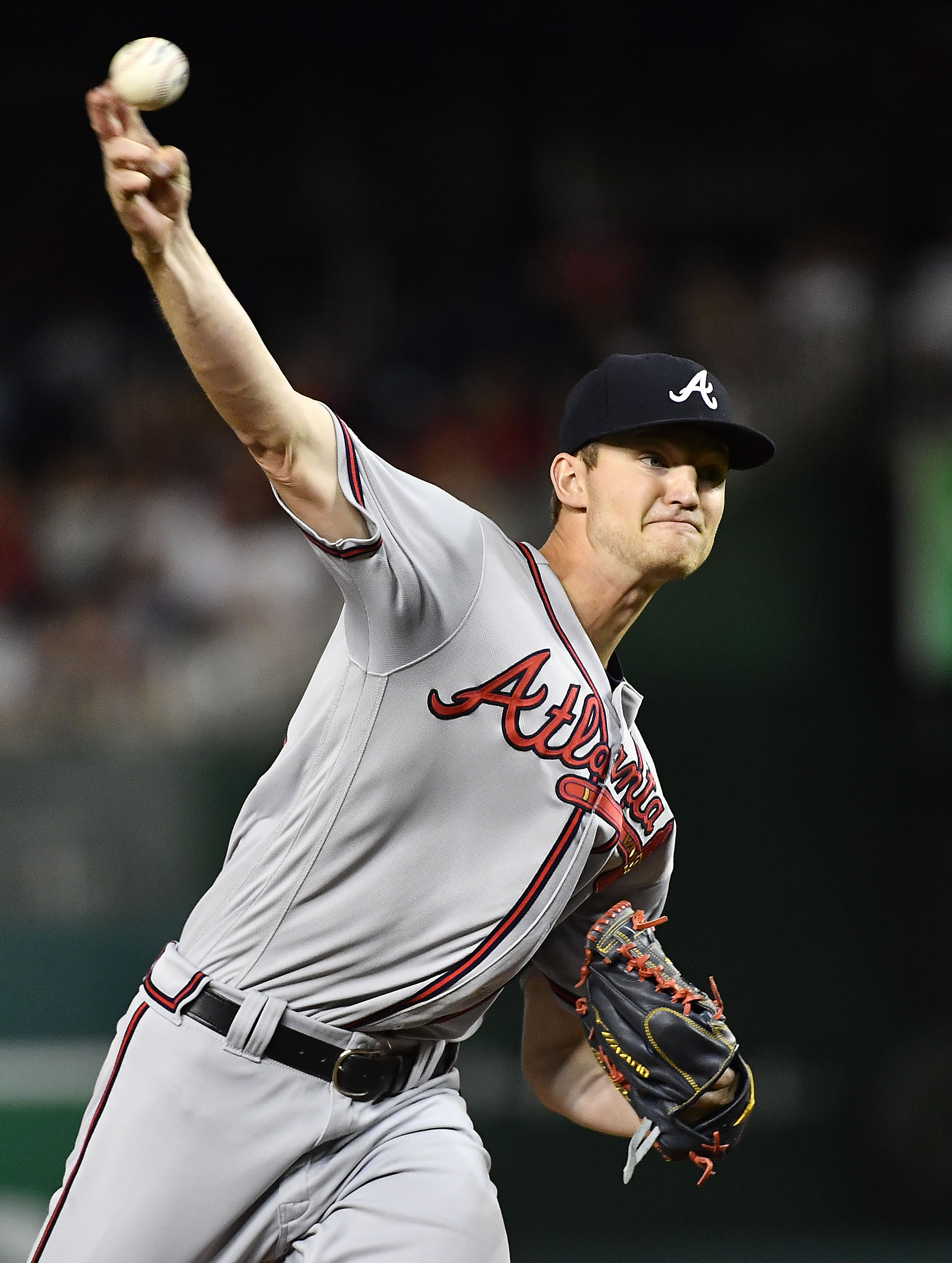
At the time of the selection, Soroka was an aggressive selection. Pre-draft rankings from MLB.com, Baseball America, FanGraphs and ESPN all had Soroka ranked in the 60 to 90 range among draft prospects. He was one of the youngest players in the draft and generally pegged as more of a second- or third-round pick. In their scouting report heading into the draft, Baseball America wrote: “There hasn’t been a player out of Alberta selected in the top 100 picks since the Red Sox picked Chris Reitsma 34th overall in 1996, and while Soroka probably won’t go that high, he should end up off the board in the first few rounds in June.”
Just 17 when he was selected, Soroka nonetheless rose quickly through the Braves’ system and steadily improved his prospect stock along the way. Soroka was at least three years younger than the average age of his competition at every minor league level he competed, and before he’d reached his 21st birthday he was suiting up for the Braves at SunTrust (now Truist) Park. Shoulder troubles in that debut campaign in 2018 limited Soroka to just 25 2/3 innings in the Majors another 30 2/3 frames in the minors.
This past season, of course, unfolded quite differently. Were it not for the outrageous power display put on by division rival Pete Alonso, Soroka might well have locked up Rookie of the Year honors. The 2019 NL runner-up pitched to a pristine 2.68 ERA with 7.3 K/9, 2.1 BB/9, 0.72 HR/9 and a 51.2 percent grounder rate. Soroka was worth 4.0 fWAR and 5.6 bWAR, and he ranked well above average in terms of Statcast metrics such as opponents’ barrel rate, average exit velocity, expected ERA and expected wOBA. Considering he was 21 for most of the 2019 season, optimism regarding Soroka abounds.
With Ronald Acuna Jr. and Ozzie Albies already locked up long term, Soroka stands out as an obvious candidate for a long-term deal of his own. At the very least, the Braves can enjoy Soroka for four full years beyond whatever semblance of a 2020 season we get, all the way through the 2024 season. So long as Soroka’s shoulder holds up, it seems the Atlanta organization will still be reaping the benefits of that Santana signing more than a decade after the ink on his contract dried.
How The 2000-09 NL Rookies Of The Year Turned Out
This is the start of a series in which we’ll examine how Rookie of the Year winners panned out from various decades. Let’s begin with the National League from 2000-09…
2000 – Rafael Furcal, SS, Braves:
- Furcal won the award with ease that year, when he batted .295/.394/.382 with 3.3 fWAR, almost as many walks (73) as strikeouts (80), and 40 stolen bases. But was he a one-shot wonder? Nope. Furcal, whose final season came in 2014, wrapped things up as a .281/.346/.402 hitter with 113 homers, 314 steals, three All-Star bids and 33.1 fWAR. Aside from the Braves, he spent MLB time with the Dodgers, Cardinals and Marlins, winning a World Series championship with St. Louis in 2011.
2001 – Albert Pujols, 1B/3B/OF, Cardinals:
- The birth of a legend. Pujols totaled 7.2 fWAR that year on the strength of a .329/.403/.610 line with 37 home runs, and he missed just one game in the process. Now a member of the Angels, he can be counted as one of the greatest players ever – a 10-time All-Star, a three-time NL MVP, a two-time World Series winner and a 656-home run man.
2002 – Jason Jennings, RHP, Rockies:
- It’s tough to win any kind of award as a pitcher in hitter-friendly Colorado, but Jennings pulled it off in his first full season, in which he amassed 185 1/3 innings of 4.52 ERA pitching with 2.1 fWAR. Jennings had a couple more solid seasons, but his career didn’t last nearly as long as of those of Furcal and Pujols. From 2001-09 as a member of the Rox, Astros and Rangers, Jennings posted a 4.95 ERA with 12.2 fWAR over 1,128 1/3 frames.
2003 – Dontrelle Willis, LHP, Marlins:
- The D-Train will always be one of the most recognizable hurlers in Marlins history. During a 2003 rookie campaign, he piled up 160 2/3 innings of 3.30 ERA ball to help the Marlins to their most recent playoff berth. Willis had some rough outings that postseason, but he made up for those performances with 3 2/3 scoreless innings versus the Yankees in a World Series that the Marlins won in six. Before that, Willis – a very good offensive player for his position – collected three hits, including a triple, in as many at-bats against the Giants in the NLDS. Willis’ star faded after a few terrific years, but he exited following 2011 as a two-time All-Star and the owner of a 4.17 ERA across 1,221 2/3 innings as a Marlin, Tiger, Diamondback and Red. He was also part of the earth-shattering trade that sent Miguel Cabrera from Florida to Detroit in 2007.
2004 – Jason Bay, OF, Pirates:
- Bay was a formidable offensive player that season, when he batted .282/.358/.550 with 26 homers in 472 plate appearances. That proved to be the first of many standout campaigns at the plate for Bay, a lifetime .266/.360/.481 hitter who accumulated 222 HRs with the Padres, Pirates, Red Sox, Mets and Mariners through 2012. Bay was a three-time All-Star whom the Mets inked to a four-year, $66MM contract before 2009, though his production nosedived after he earned that payday.
2005 – Ryan Howard, 1B, Phillies:
- Howard smacked 22 dingers in just 88 games as a rookie, and he wound up a 382-HR hitter who batted .258/.343/.515 from 2004-16 – all of which he spent with the Phillies. Howard picked up three All-Star nods, won a World Series and took home an NL MVP along the way.
2006 – Hanley Ramirez, SS, Marlins:
- This was the start of an eventful career for Ramirez, who slashed .292/.353/.480 with 17 HRs and a whopping 51 steals as a rookie. Ramirez mostly continued to thrive in Miami until the team dealt him to the Dodgers in 2012. After a successful stint in LA, Ramirez signed a four-year, $88MM pact with the Red Sox before 2015. That marriage didn’t work out, though, nor did Ramirez’s short run with the Indians in 2019. It’s possible we haven’t seen the last of the 36-year-old, but if we have, he had an excellent career. Also a former first baseman, third baseman and outfielder, HanRam’s a .289/.360/.484 hitter with 271 homers, 281 steals and 41.5 fWAR.
2007 – Ryan Braun, 3B, Brewers:
- Then a third baseman and now an outfielder, Braun batted an eye-popping .324/.370/.634 with 34 homers and 15 steals as a rookie. That was the first of many highly productive seasons for Braun, a six-time All-Star and a one-tme NL MVP who has registered a career line of .298/.360/.533 with 344 HRs, 215 stolen bases and 43.7 fWAR. While he’s now 36 and on the downside of his career, Braun’s still a solid member of the Brewers’ offense.
2008 – Geovany Soto, C, Cubs:
- Soto starred at the plate in 2008, when he batted .285/.364/.504 and smacked 23 homers to get the NL ROY and his lone All-Star nod. But Soto’s career, some of which he also spent with the Rangers, A’s, White Sox and Angels, was pretty up and down into his final season in 2017. Soto was better than most who have set foot in the majors, however, as he hit .245/.330/.435 with 108 HRs and 16.4 fWAR.
2009 – Chris Coghlan, OF, Marlins:
- The third former Marlin on this list, Coghlan was a .321/.390/.460 hitter during his initial year, though he rarely reached those heights again. Coghlan became a utilityman and ended up playing for four other teams (the Cubs, Phillies, A’s and Blue Jays) through 2017. He batted a respectable .258/.334/.398 with 53 HRs and 47 SBs in the bigs.