
The Rangers’ New-Look Rotation Has Big-Time Upside
Historically, pitching has not been a strength of the Texas Rangers. The franchise has consistently found itself sorely lacking true aces; outside of Nolan Ryan, there aren’t really any iconic pitchers that come to mind when you think of the Rangers. Kenny Rogers, anyone?
That trend held true once again last year, with the Rangers posting an overall 5.09 ERA that ranked seventh-worst in baseball. That said, Lance Lynn and Mike Minor anchored the top of the rotation admirably, each garnering Cy Young consideration and holding the staff intact during the hot Texas summer.
But when the 2020 season boots up, Lynn and Minor will have some help, and starting pitching may indeed be a strength for this year’s iteration of the team. GM Jon Daniels and company made a concerted effort in the winter to acquire starting pitchers—and they did so at relatively little cost, meaning that a bit of short-term ambition likely won’t impeach on the franchise’s future plans.
Corey Kluber is the big-name addition, and the two-time Cy Young winner should do plenty to bolster the Rangers’ staff. Even so, the team didn’t mortgage the future to bring him aboard: Kluber is only guaranteed a contract for this year, with a vesting option that could keep him in Texas through 2021. Coming off a season in which he could pitch in just seven games, he was acquired in exchange for Delino DeShields and Emmanuel Clase, a move that was widely praised at the time and looks even worse for Cleveland in light of Clase’s PED suspension.
But the smaller-scale signings of Kyle Gibson and Jordan Lyles, while not deserving of the same attention as the acquisition of a decade-defining pitcher like Kluber, could together have just as great an impact on the Rangers’ success as Kluber. In the offseason, Lyles signed on with a two-year, $16MM deal, while Gibson earned himself a three-year contract worth $28MM. Together, they’ll make $19MM in 2020, just a hair more than Kluber’s salary.
Lyles has been around forever, it seems, breaking in as a young arm with the Astros and Rockies, but it took until his age-28 season for him to put it all together as a starter. After a slow start with the Pirates earned him a trade to Milwaukee, he put up career-best numbers, striking out 146 batters in 141 innings, an unprecedented rate for Lyles.
How come? The simple version is that Lyles began relying less and less on his sinker, a staple in his repertoire throughout the early stages of his career. His sinker usage dropped to a minuscule 1.7% last year while he threw four-seam fastballs 50.2% of the time, more than he ever had before. The curveball also became a more important weapon in his pitch mix.
That isn’t too unlike the formula that Lance Lynn rode to his career-best 2019 season. Just like Lyles, Lynn’s sinker usage hit a career low last year, replaced almost entirely by four-seam fastballs—largely in the upper part of the strike zone. This isn’t unique to the Rangers—the Astros’ unparalleled pitching brilliance hinges on this philosophy—and it’s a trend that has redefined the way we look at pitching in MLB.
It’s an approach that worked for the Rangers last year, Lynn’s first in Texas, and perhaps Daniels is confident that his staff can use it to produce similar results with Lyles and Gibson this year. Sure enough, the sinker has been Gibson’s most-used pitch through his first five years as a big-leaguer. Sound familiar? Granted, Gibson’s four-seamer hasn’t been a great pitch for him, but throwing fewer sinkers could in turn lead to a jump in his slider usage, a high-spin pitch that may be a hidden gem.
Still, pitching at the MLB level is not as simple as flipping a switch and saying, “sinker bad, four-seam good.” That approach can’t be uniformly applied to every pitcher in baseball with the same results; there’s a reason careers have been forged around the sinker. And yet, the proliferation of the high fastball in MLB lends credence to its value, and the Rangers may have pursued the likes of Gibson and Lyles with that style in mind.
But that’s only half the battle; the burden then falls on the coaching staff and players themselves to accept and implement adjustments. It’s why we still play the games when there’s such a wealth of knowledge out there. So we’ll anxiously await the 2020 season to see whether the on-field results look as good as the ideas that underpin them.
The Rays Left An Asset Unprotected And A Division Rival Noticed
It’s no secret that the Baltimore Orioles need pitching. While GM Mike Elias and company work on building a development pipeline, the O’s are spending a lot of time scouring other organizations for excess talent to skim off the top.
Take 30-year-old right-hander Cole Sulser. Baltimore’s waiver claim in early October doesn’t jump out as an impact move, but there’s potential beneath the surface for Sulser and the birds. Before digging into Sulser’s prospects, let’s cover the backstory.
In December of 2018, the Indians, Mariners, and Rays engaged in a three-way deal that shuffled around first baseman candidates. In this rare three-way challenge trade, each team came away with a major-league first baseman. The Rays chose Yandy Diaz, the Mariners Edwin Encarnacion, and the Indians actually snagged two first basemen in the deal: Jake Bauers and Carlos Santana. Tagging along, Sulser went from the Indians to the Rays, for whom he made 7 scoreless appearances last season. But the Rays are no longer in line to be the beneficiaries of a potential Sulser breakout.
Granted, it’s suspect that the Indians and Rays – two organizations with strong reputations for identifying and developing pitching – both passed up on the opportunity to roster Sulser. Sulser isn’t locked into a roster spot with the Orioles either, but he should have an easier time carving out a role with the pitching-needy Orioles than he did with either of his previous organizations. The short season very well may expand rosters, too, giving Sulser a greater opportunity to toe the rubber in Baltimore.
So where does the optimism for Sulser come from? Last year Sulser made 49 appearances (4 starts), spanning a robust 66 innings with a 3.29 ERA. His peripherals look good with a 12.1 K/9 to 3.3 BB/9. He put together similar numbers the year prior while in the Indians system (3.86 ERA over 60 ⅔ innings with 14.1 K/9 to 2.5 BB/9). Those numbers were helped by including a 9-inning scoreless stint in Double-A, without which a 4.53 ERA in Triple-A doesn’t look quite as impressive.
It is, however, a positive sign to see Sulser improve year-over-year when repeating the level. The Dartmouth grad doesn’t have overwhelming stuff, but he’s made himself into a double-digit strikeout-per-nine guy over the last couple of seasons. Sulser could yet turn himself into a late-blooming bullpen piece. He’s probably not Nick Anderson, but there’s value to unearth from an arm like Sulser. Breakouts for players on the wrong side of thirty aren’t exactly commonplace, of course, but late bloomers often emerge in the bullpen. Sulser doesn’t have to become the next Kirby Yates to add value to the O’s organization. With 5 appearances in spring training with a 1.53 ERA and 8 strikeouts in 4 ⅔ innings, he was off to a good start.
The Orioles may not have a lot of crucial innings to lockdown, but if they can help Sulser establish himself as a reliable arm, he could become the type of cost-controlled asset teams in contention ask after. For the Orioles these days, that’s more-or-less the goal.
1990 AL Rookies Of The Year: How Many Hall Of Famers?
After reviewing the careers of 1990s National League Rookies of the Year, let’s move over to the AL…
1990 – Sandy Alomar Jr., C, Indians:
- Kevin Appier, John Olerud and Robin Ventura were among the rookies Alomar beat out for the award that year. While those players had better careers than Alomar, he did turn in a few solid seasons, including in 1990. He was a .290/.326/.418 hitter with 2.4 fWAR then. He wound up playing through 2007 and totaling 13.2 fWAR in almost 5,000 plate appearances.
1991 – Chuck Knoblauch, 2B, Twins:
- The rookie version of Knoblauch was a capable contributor on a Twins team that won the World Series in 1991, when he batted .281/.351/.350 with 2.2 fWAR and 25 steals during the regular season and put up even better offensive numbers in the playoffs. Knoblauch made his first of four All-Star trips the next season, but he really came into his own from 1995-97. During that three-year span, Knoblauch trailed only Barry Bonds, Ken Griffey Jr. and Mike Piazza in position player fWAR (20.6). Nevertheless, after the last of those seasons, the Twins traded him to the Yankees for Eric Milton, Danny Mota and Brian Buchanan. Knoblauch was a member of three World Series winners and four straight AL pennant teams as a Yankee, though his overall production fell and he developed an awful case of the yips as a second baseman. His defensive troubles forced him to move to the outfield for the tail end of his career – which came to a close with the Royals in 2002. Still, Knoblauch was quite successful in the bigs, where he slashed .289/.378/.406 with 39.8 fWAR.
1992 – Pat Listach, SS, Brewers:
Listach beat out fellow speedster Kenny Lofton for this award, hitting .290/.352/.349 with one homer, 54 steals and 3.4 fWAR. But Lofton ended up a far superior big leaguer to Listach, who only played through 1997. Also an ex-Astro, Listach batted .251/.316/.309 with 1.5 fWAR.
1993 – Tim Salmon, OF, Angels:
- This was the first of five 30-home run seasons for Salmon, who put up 31 en route to 4.7 fWAR. For the most part, Salmon was an excellent offensive player during his career – all of which he spent with the Angels from 1992-2006 – evidenced by his .282/.385/.491 line and 299 HRs. He put up 35.4 fWAR along the way and is considered one of the top players in franchise history. However, with Mike Trout now in the fold, Salmon’s no longer the best Angel with a fish for a last name.
1994 – Bob Hamelin, 1B, Royals:
- Hamelin upended eventual greats Manny Ramirez and Jim Edmonds in the voting that season, but it was hardly the start of a storied career. While Hamelin hit .282/.388/.599 with 24 homers and 2.4 fWAR as a rookie, he never reached the 20 mark again through his last season in 1998, and he was a replacement-level player (0.0. fWAR) after his first year. But he’ll always have this, arguably the worst baseball card ever.
1995 – Marty Cordova, OF, Twins:
- Cordova had a few productive campaigns from 1995-2003, but Year 1 was his best. He debuted with a .277/.352/.486 line, 24 homers, 20 steals and 3.6 fWAR. He ultimately finished his career a .274/.344/.448 hitter with 122 dingers, 57 stolen bases and 6.5 fWAR.
1996 – Derek Jeter, SS, Yankees:
- Never heard of him. Seriously, though, 24 years after winning AL ROY, Jeter can be considered one of the most recognizable athletes in history. He went on to a Hall of Fame career, all of which he spent from 1995-2014 with the Yankees (who retired his number), with 14 All-Star nods and five titles. The Captain was a .310/.377/.440 hitter with 260 homers, 358 steals and 73.0 fWAR. As a first-year man, Jeter batted .314/.370/.430, totaling 10 HRs, 14 SBs and 2.2 fWAR.
1997 – Nomar Garciaparra, SS, Red Sox:
- A year after the Red Sox saw an archrival Yankee win the award, they found a shortstop capable of going to to toe with Jeter. Garciappara’s greatest four-year stretch spanned from his rookie season through 2000, during which Jeff Bagwell and Barry Bonds were the only position players to outdo his 27.5 fWAR. A good portion of that (6.4) came during Garciaparra’s first year, when he slashed .306/.342/.534 with 30 homers and 22 steals. Unfortunately, peak Garciaparra didn’t last nearly as long as he should have because of injuries. But he did still manage extremely effective overall production (.313/.361/.521; 229 HRs, 95 SBs; 41.5 fWAR; six All-Star appearances) before his career ended in 2009.
1998 – Ben Grieve, OF, Athletics:
- Grieve was a good hitter throughout his career, which ended in 2005, though never more productive than he was a rookie. He hit .288/.386/.458 with 18 HRs that season. Four years later, the A’s sent Grieve to the then-Devil Rays as part of a trade for Johnny Damon. However, Grieve didn’t provide a ton of value in Tampa Bay. He left the game as a .269/.367/.442 hitter with 118 homers and 6.7 fWAR.
1999 – Carlos Beltran, OF, Royals:
- The start of a Hall of Fame career? Depends on how you view Beltran in light of his sign-stealing issues with the Astros and his fleeting stint as the Mets’ manager. In terms of production, though, he has a strong case, and it all began during a ’99 campaign in which he slashed .293/.337/.454, went 20/20 (22 HRs, 27 SBs) and accrued 4.3 fWAR. Beltran went on to account for 67.9 fWAR as a member of several different teams through 2017, bat .279/.350/.486 with 435 homers and 312 steals, and earn nine All-Star trips.
10-Year-Old A’s Trade Paying Dividends
If you followed Major League Baseball for most of the this century, you probably remember David DeJesus. The now-retired outfielder posted a solid career as part of a few different teams from 2003-15, during which he amassed 25.5 fWAR. DeJesus spent one of his seasons in Oakland, and though he didn’t have a banner year then, the franchise is still benefiting from his acquisition – one that could pay dividends for at least a few more years.
Back in November 2010, DeJesus was coming off one of the most productive seasons of his career. Although he only played in 91 games that year with the Royals, DeJesus batted .318/.384/.443 (127 wRC+) with 2.5 fWAR. However, after spending the first eight seasons of his career in Kansas City, the non-contenders traded him and his $6MM salary to Oakland for pitchers Vin Mazzaro and Justin Marks. The Royals received little to no value from either of those players, though. Mazzaro threw 72 1/3 innings of 6.72 ERA ball in their uniform, and the Royals dealt him to the Pirates after that. Marks tossed just two frames in KC (both in 2014) and was out of the organization after that.
Oakland made out far better, though it took some time for that to become the case. Both the team and DeJesus underwhelmed in 2011, in which the A’s went 74-88 and DeJesus saw his line plummet to .240/.323/.376 (96 wRC+) with 1.7 fWAR over 506 trips to the plate. DeJesus became a free agent after that, and the A’s let him leave for the Cubs on a two-year, $10MM contract (fun fact: He was president of baseball operations Theo Epstein’s first free-agent signing in Chicago). So the trade was close to a wash for the A’s, right? Not quite.
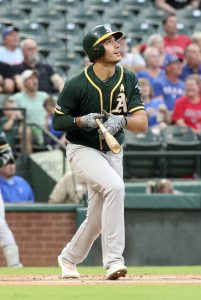
As MLBTR’s Tim Dierkes wrote when DeJesus joined the Cubs, “DeJesus was offered arbitration by the A’s last week, so they’ll receive a supplemental draft pick in 2012 for their loss.”
This is where it gets good for the Athletics. With selection No. 47, the one the club received for DeJesus, it chose a Georgia-born high school first baseman named Matt Olson.
“The A’s see Olson as a future middle-of-the-order hitter,” Baseball America wrote at the time. And though Olson was long a well-regarded part of the A’s system, he was never a premium prospect across the league. Now, though, he’s one of the most valuable players on the A’s and among the most well-rounded first basemen in the sport.
After a run as a productive minor leaguer, Olson made it to Oakland in 2016, though he struggled over a mere 26 plate appearances. The next season, however, Olson turned into a monster at the MLB level. The lefty swinger racked up 216 PA and slashed .259/.352/.651 (164 wRC+) with 24 home runs. To this point, that has been Olson’s lone elite showing as a hitter, but that’s not to say he hasn’t been easily above average since then. Dating back to 2018, Olson has slashed .256/.342/.495 (126 wRC+) with 65 homers over 1,207 PA. Those numbers, not to mention his all-world defense, helped him post 7.3 fWAR during the previous two seasons.
Among all major leaguers dating back to 2018, Olson ranks seventh in Ultimate Zone Rating (18.1) and eighth in Defensive Runs Saved (31). One of the few better defenders than Olson has been teammate and third baseman Matt Chapman. He and Olson comprise one of the premier corner infield tandems in the game, and they’ve done it at affordable prices for low-budget Oakland. That’s going to start changing soon – b0th players will enter arbitration for the first of three potential trips next winter. Whether the A’s will be able to keep either around beyond their arb years remains to be seen, but there’s no denying they’ve already gotten excellent value from the two. In Olson’s case, it all began with a trade that didn’t bring potentially strong returns in the beginning.
Photo courtesy of USA Today Sports Images.
Altuve & Bregman Dominate Astros’ Long-Term Payroll
2020 salary terms are set to be hammered out in the coming days. But what about what’s owed to players beyond that point? The near-term economic picture remains questionable at best. That’ll make teams all the more cautious with guaranteed future salaries.
Every organization has some amount of future cash committed to players, all of it done before the coronavirus pandemic swept the globe. There are several different ways to look at salaries; for instance, for purposes of calculating the luxury tax, the average annual value is the touchstone, with up-front bonuses spread over the life of the deal. For this exercise, we’ll focus on actual cash outlays that still have yet to be paid.
We’ll run through every team, with a big assist from the Cot’s Baseball Contracts database. Next up is the Astros:
(click to expand/view detail list)
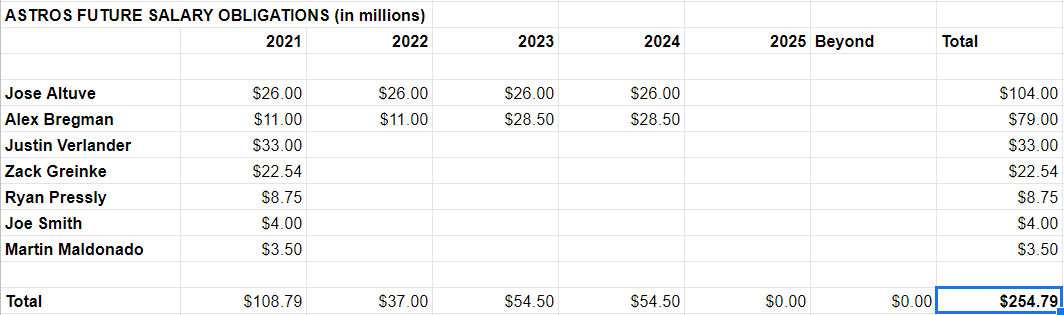
Astros Total Future Cash Obligation: $254.79MM
*includes buyouts of club options
*excludes remaining obligation to Zack Greinke retained by Diamondbacks
Remembering 1990s NL Rookies Of The Year
Having already revisited the careers of Rookie of the Year winners from 2000-09 (American League, National League), let’s go back a decade to the 1990s. We’ll open with the NL’s 10 winners…
1990 – David Justice, OF, Braves:
- This marked the beginning of a decorated career for Justice, who slashed .282/.373/.535 with 28 home runs in 504 plate appearances as a rookie. The Braves were only a 65-win team that season, but thanks in part to Justice, they became a powerhouse after that. The club made three World Series appearance, winning one Fall Classic (in 1995), with Justice on its roster. But the Braves traded Justice and Marquis Grissom to the team they knocked off, the Indians, prior to the ’97 campaign for Kenny Lofton and Alan Embree. Justice continued to succeed as an Indian, though they dealt him to the Yankees during the 2000 season. He went on to win his second title then. Although Justice’s numbers dipped as a Yankee and Athletic from 2001-02, he finished his career as a .279/.378/.500 hitter with 305 homers, 40.4 fWAR and three All-Star bids.
1991 – Jeff Bagwell, 1B, Astros:
- Acquired from Boston a year earlier in a trade the Red Sox would still like back, Bagwell got off to a terrific start – he hit .294/.387/437 with 4.3 fWAR as a rookie – and only improved from there. He’s now an Astros legend, a Baseball Hall of Famer and someone who put up a .297/.408/.540 line with 449 homers, 202 steals, 80.2 fWAR, four All-Star nods and an MVP through 2005.
1992 – Eric Karros, 1B, Dodgers:
- Compared to the first couple players on this list, Karros had a modest impact in his first year, when he batted .257/.304/.426 with 20 homers and 1.0 fWAR. But Karros still enjoyed a better career than most, as he swatted 284 HRs and hit .266/.325/.454 with 17.8 fWAR as a Dodger, Cub and Athletic through 2004.
1993 – Mike Piazza, C, Dodgers:
- The second straight Dodger to win and the second eventual Hall of Famer on this list, Piazza made an incredible impact from the get-go. He slashed .318/.370/.561 with 35 dingers and 7.4 fWAR in Year 1 – the first of 12 All-Star seasons. Also a former Marlin, Met (they retired his No. 31), Athletic and Padre, Piazza hung it up in 2007 as a .308/.377/.545 batter who smacked 427 homers and accounted for 63.7 fWAR.
1994 – Raul Mondesi, OF, Dodgers:
- Make that three consecutive Dodgers. Mondesi hit .306/.333/.516 with 16 homers and 11 steals in his first year, which proved to be the first of several above-average offensive efforts for him. Overall, he was a two-time 30/30 man who racked up 271 homers, 229 steals, recorded a .273/.331/.485 line, and collected 26.5 fWAR as a Dodger, Blue Jay, Yankee, Diamondback, Pirate, Angel and Brave from 1993-2004. Mondesi later became the mayor of San Cristobal, Dominican Republic, but that ended with a prison sentence for corruption. In better news, his son Adalberto Mondesi looks as if he could be a long-term cornerstone for the Royals.
1995 – Hideo Nomo, SP, Dodgers:
- Hey, another Dodger, and the first NL pitcher of the decade to win the award. Nomo, a Japanese import who was the first player born there to play in the majors since 1965, was a sensation early in his MLB career. He spun 191 1/3 innings of 2.54 ERA ball with over 11 strikeouts per nine as a rookie. That proved to be Nomo’s best season, but he did put together a few more quality ones through 2008, and he tossed two no-hitters along the way. The former Dodger, Met, Brewer, Tiger, Red Sox, Ray and Royal logged a 4.24 ERA with 8.73 K/9 and 4.13 BB/9 in 1,976 1/3 innings in the bigs.
1996 – Todd Hollandsworth, OF, Dodgers:
- In order to win this award, it was apparently a requirement to play for the Dodgers. Hollandsworth hit .291/.348/.437 with 12 homers and 21 steals in his debut season, though his impact in the league wasn’t that great otherwise. He totaled 5.2 fWAR (1.2 as a rookie) with a handful of teams from 1995-2006.
1997 – Scott Rolen, 3B, Phillies:
- Rolen put an end to the Dodgers’ ROY reign Hall of Famer with a stellar first season, in which he was a .283/.377/.469 hitter with 21 homers and 4.3 fWAR. Rolen was largely an outstanding offensive player with the Phils, Cardinals, Blue Jays and Reds through 2012 – he batted a lifetime .281/.364/.490 with 316 HRs and 118 steals – and also a defensive maven. He wound up an eight-time Gold Glover and a seven-time All-Star who accrued 69.9 fWAR. Hall of Famer? He has a legit case.
1998 – Kerry Wood, SP, Cubs:
- Wood’s shining moment came in his fifth-ever start, May 6, 1998, when he struck out 20 Astros in a complete game shutout. Those 20 punchouts helped Wood to a whopping 12.58 K/9 that year, during which he registered a 3.40 ERA over 166 2/3 innings. But Wood missed the next season because of Tommy John surgery, and injuries regularly slowed him down throughout a career that ran through 2012 with the Cubs, Yankees and Indians. While Wood was a full-time starter in his first six seasons, he shifted to a relief role in 2005. He left the game with a 3.67 ERA, 10.32 K/9 and 23.9 fWAR across 1,380 frames. Not the Hall of Fame career it perhaps could have been had Wood stayed healthy, but still an impressive one.
1999 – Scott Williamson, RP, Reds:
- Williamson was a relief workhorse who peaked in his first season, when he fired 93 1/3 innings of 2.41 ERA pitching with 10.32 K/9 and 19 saves. Like Wood, however, injuries had a negative effect on his career. Williamson pitched for several other teams through 2007, and despite walking five batters per nine, he still put up a highly respectable 3.36 ERA with 10.45 K/9 in 439 1/3 lifetime innings.
The Mariners’ Future Payroll Promises
2020 salary terms are set to be hammered out in the coming days. But what about what’s owed to players beyond that point? The near-term economic picture remains questionable at best. That’ll make teams all the more cautious with guaranteed future salaries.
Every organization has some amount of future cash committed to players, all of it done before the coronavirus pandemic swept the globe. There are several different ways to look at salaries; for instance, for purposes of calculating the luxury tax, the average annual value is the touchstone, with up-front bonuses spread over the life of the deal. For this exercise, we’ll focus on actual cash outlays that still have yet to be paid.
We’ll run through every team, with a big assist from the Cot’s Baseball Contracts database. Next up is the Mariners:
(click to expand/view detail list)
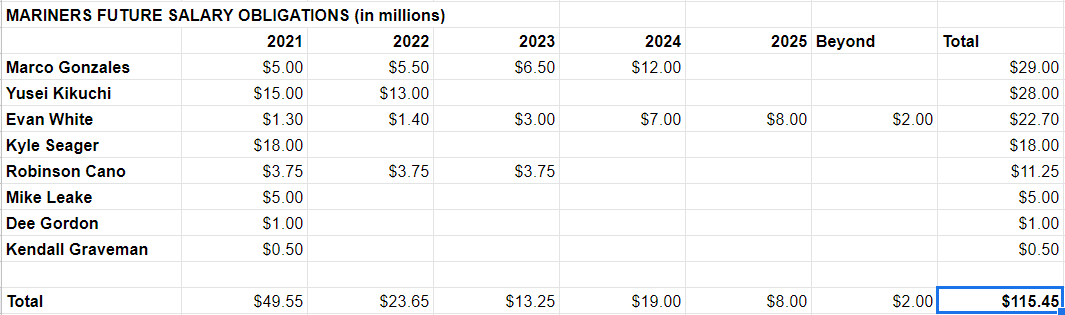
Mariners Total Future Cash Obligation: $115.45MM
*includes Yusei Kikuchi 2022 player option
*includes buyouts of club options
Which 15 Players Should The Giants Protect In An Expansion Draft?
In a few weeks, we’ll be running a two-team mock expansion draft here at MLBTR. Currently, we’re creating 15-player protected lists for each of the existing 30 teams. You can catch up on the rules for player eligibility here.
So far, we’ve covered the Rangers, Mariners, Athletics, Angels, Astros, Twins, Royals, Tigers, Indians, White Sox, Rays, Yankees, Red Sox, Blue Jays and Orioles. The Giants are up next.
We’ll start by removing free agents Hunter Pence, Jeff Samardzija, Tony Watson, Drew Smyly, and Kevin Gausman.
Buster Posey, Brandon Belt, and Brandon Crawford will make the protected list by virtue of their no-trade clauses. I’ll also protect Mike Yastrzemski, Alex Dickerson, Mauricio Dubon, and Logan Webb out of the gate. So these seven players will be protected:
Buster Posey
Brandon Belt
Brandon Crawford
Mike Yastrzemski
Alex Dickerson
Mauricio Dubon
Logan Webb
That leaves eight spots for these 26 players:
Shaun Anderson
Tyler Anderson
Abiatal Avelino
Tyler Beede
Sam Coonrod
Johnny Cueto
Jaylin Davis
Steven Duggar
Wilmer Flores
Enderson Franco
Aramis Garcia
Jarlin Garcia
Trevor Gott
Jandel Gustave
Evan Longoria
Conner Menez
Reyes Moronta
Wandy Peralta
Dereck Rodriguez
Tyler Rogers
Sam Selman
Chris Shaw
Austin Slater
Donovan Solano
Andrew Suarez
Kean Wong
With that, we turn it over to the MLBTR readership! In the poll below (direct link here), select exactly eight players you think the Giants should protect in our upcoming mock expansion draft. Click here to view the results.
Ranking The All-Time No. 1 Picks
In case you missed it, we just recapped the careers of every No. 1 pick from the first amateur draft in 1965 through last year (1960s, 1970s, 1980s, 1990s, 2000s, 2010s). So now let’s round up how those players fared or, in the cases of those who are still active, have fared since hearing their names called at the top of their respective classes. For simplicity’s sake, we’ll use fWAR as the defining stat. Granted, it’s not the end-all, be all, and it doesn’t account for the postseason, but it does give you a pretty good idea of a player’s performance. Of course, not every first selection has played in the majors. Recent choices like Mickey Moniak (2016), Royce Lewis (2017), Casey Mize (2018) and Adley Rutschman (2019) are trying to work their way up. Meanwhile, Steve Chilcott (1966), Brien Taylor (1991), Mark Appel (2013) and Brady Aiken (2014) never reached the majors.
- Alex Rodriguez, 3B/SS (1993) – 113.7 fWAR
- Chipper Jones, 3B/OF (1990) – 84.6 fWAR
- Ken Griffey Jr., OF (1987) – 77.7 fWAR
- Joe Mauer, C/1B (2001) – 52.5 fWAR
- David Price, SP (2007) – 41.7 fWAR
- Darryl Strawberry, OF (1980) – 41.5 fWAR
- Harold Baines, OF (1977) – 38.4 fWAR
- Justin Upton, OF (2005) – 36.8 fWAR
- Stephen Strasburg, SP (2009) – 36.7 fWAR
- Adrian Gonzalez, 1B (2000) – 36.4 fWAR
- Andy Benes, SP (1988) – 36.2 fWAR
- Bryce Harper, OF (2010) – 35.1 fWAR
- Mike Moore, RHP (1981) – 34.7 fWAR
- B.J. Surhoff, C/INF/OF (1985) – 31.4 fWAR
- Rick Monday, OF (1965) – 31.1 fWAR
- Floyd Bannister, SP (1976) – 30.8 fWAR
- Tim Belcher, RHP (1983) – 30.3 fWAR
- Gerrit Cole, SP (2011) – 28.8 fWAR
- Darin Erstad, 1B/OF (1995) – 28.5 fWAR
- Josh Hamilton, OF (1999) – 27.9 fWAR
- Ben McDonald, SP (1989) – 20.5 fWAR
- Bob Horner, 3B/1B (1978) – 19.5 fWAR
- Pat Burrell, OF (1998) – 19.0 fWAR
- Carlos Correa, SS (2012) – 18.5 fWAR
- Jeff Burroughs, OF (1969) – 18.3 fWAR
- Jeff King, INF (1986) – 17.0 fWAR
- Phil Nevin, C/1B/3B/OF (1992) – 15.2 fWAR
- Kris Benson, SP (1996) – 14.8 fWAR
- Luke Hochevar, SP/RP (2006) – 9.0 fWAR
- Paul Wilson, SP (1984) – 8.7 fWAR
- Ron Blomberg, 1B (1967) – 8.3 fWAR
- Mike Ivie, C/INF/OF (1970) – 7.5 fWAR
- Shawon Dunston, SS (1982) – 7.4 fWAR
- Tim Foli, SS (1968) – 6.1 fWAR
- Tim Beckham, INF/OF (2008) – 4.3 fWAR
- David Clyde, SP (1973) – 4.1 fWAR
- Dansby Swanson, SS (2015) – 3.9 fWAR
- Bill Almon, INF/OF (1974) – 2.5 fWAR
- Matt Bush, SS/RP (2004) – 2.2 fWAR
- Dave Roberts, INF (1972) – 0.6 fWAR
- Matt Anderson, SP (1997) – 0.5 fWAR
- Bryan Bullington, SP (2002) – minus-0.2 fWAR
- Al Chambers, OF (1979) – minus-0.5 fWAR
- Danny Goodwin, 1B (1975) – minus-1.2 fWAR
- Shawn Abner, OF (1984) – minus-1.2 fWAR
- Delmon Young, OF (2003) – minus-1.3 fWAR
2000-09 AL Rookies Of The Year: At Least 2 Future Hall Of Famers
We just began a series that examines how the Rookies of the Year from each decade panned out. Naturally, after going from 2000-09 in the National League, we’ll stay in that decade and turn our attention to the AL…
2000 – Kazuhiro Sasaki, RP, Mariners:
- Sasaki was a star in his homeland of Japan before immigrating to the majors and signing with Seattle, where he continued to keep runs off the board at an impressive rate. The right-hander put up 62 2/3 innings of 3.16 ERA ball with 37 saves as a rookie. While Sasaki only played through 2003, he enjoyed a nice major league career in which he posted a 3.14 ERA with 9.75 K/9, 3.1 BB/9, 129 saves and two All-Star appearances over 223 1/3 frames.
2001 – Ichiro Suzuki, OF, Mariners:
- Back-to-back Mariners, both from Japan. Ichiro, who beat out then-Indian C.C. Sabathia for ROY honors, was among the driving forces on an incredible M’s team that won 116 regular-season games. Not only was he the top rookie in his first season, but the exhilarating Ichiro took home the MVP, won his first of two batting titles and made his first of 10 All-Star teams with a .350/.381/.457 line, 56 stolen bases and 6.0 fWAR. Ichiro didn’t spend his entire career in Seattle – he also was a Yankee and Marlin – but things came full-circle when he wrapped up his playing days as a Mariner in 2019. He should be a first-ballot Hall of Famer when the time comes.
2002 – Eric Hinske, 3B, Blue Jays:
- Hinske peaked in Year 1 with a .279/.365/.481 showing, 24 homers and 4.8 fWAR. He did play through 2013 with a few other teams, but he didn’t register especially valuable production after his first season. However, Hinske did end up as a .249/.332/.430 hitter with 137 HRs and 11.2 fWAR, so he had a better MLB career than most.
2003 – Angel Berroa, SS, Royals:
- Hideki Matsui, Rocco Baldelli and Mark Teixeira were also among the AL’s top rookies that year, but they all lost out to Berroa. Those three ultimately had far better overall careers than Berroa, though. While Berroa was a .287/.338/.451 batter who totaled 17 HRs, 21 steals and 2.7 fWAR in his rookie season, he never came close to matching that output again. Berroa, also a Dodger, Met and Yankee through 2009, was a minus-0.1 fWAR player for the rest of his career, and he said goodbye as a .258/.303/.374/ hitter.
2004 – Bobby Crosby, SS, Athletics:
- Another sign that ROY voting isn’t an indicator of long-term success: Zack Greinke finished fourth in that year’s balloting. Crosby was productive that season and the next, during which he combined for 6.4 fWAR, but was nowhere near as valuable thereafter. He posted a combined 0.1 fWAR with the A’s, Pirates and Diamondbacks into 2010, the last season he appeared in the majors.
2005 – Huston Street, RP, Athletics:
- The second consecutive winner for Oakland, Street beat out runner-up Robinson Cano by logging a sterling 1.72 ERA and converting 23 of 27 save opportunities. It was the beginning of a strong career for Street, who managed a 2.95 ERA with 324 saves from 2005-17 as an Athletic, Rockie, Padre and Angel. Notably, Street was part of the 2008 blockbuster that saw him, Carlos Gonzalez and Greg Smith go to Colorado in exchange for Matt Holliday.
2006 – Justin Verlander, SP, Tigers:
- Future Hall of Famer No. 2 on this list. The fireballing Verlander pitched to a 3.63 ERA across 186 innings in 2006, when the Tigers lost to the Cardinals in the World Series, yet his production has trended way upward since then. Now a member of the Astros, with whom he has won two pennants and a World Series, the 37-year-old is the owner of a 3.33 ERA with 9.07 K/9 and 2.57 BB/9 in 453 starts and just under 3,000 innings. Verlander’s an eight-time All-Star, someone who has pitched three no-hitters, won two AL Cy Youngs (including last season) and taken home an MVP. He’s also 27th all-time in pitcher fWAR (72.0).
2007 – Dustin Pedroia, 2B, Red Sox:
- Pedroia may also have a Hall of Fame case, though injuries have ruined a tremendous career over the past few seasons and could prevent the 36-year-old from making his way back to a major league diamond. Nevertheless, Pedroia will go down as one of the most accomplished Red Sox players ever. It all began in Year 1 with a .317/.380/.442 line and 3.7 fWAR. Pedroia was on his first of three World Series-winnings teams then. He’s also now a four-time All-Star, a four-time Gold Glover and a one-time MVP who has slashed .299/.365./439 with 140 homers, 138 steals and 46.6 fWAR in the bigs.
2008 – Evan Longoria, 3B, Rays:
- We’re on a good run now. Longoria batted .272/.343/.531 with 27 homers and 5.6 fWAR as a rookie to help the Rays to their only AL pennant. He’s now a franchise icon who largely thrived in Tampa Bay through 2017, though the team traded him to San Francisco after that. Longoria’s production has dropped off lately, but there’s no denying he has had a wonderful career. The 34-year-old is a three-time All-Star and a three-time Gold Glove winner who has batted .267/.335/.474 with 297 HRs and 51.1 fWAR.
2009 – Andrew Bailey, RP, Athletics:
- The decade concluded with three A’s winning this award. Bailey earned it with 83 1/3 innings of 1.84 ERA ball and 26 saves, and he continued to hold his own over the next couple years. However, injuries took their toll after that, and Oakland traded Bailey to Boston in 2011 in a deal that delivered Josh Reddick to the A’s. That worked out for the A’s, but Bailey wasn’t often healthy or effective as part of the Red Sox from 2012-13. He went on to pitch for Yankees, Angels and Phillies from 2015-17, though he also couldn’t revisit his A’s form with any of those teams. That said, Bailey had a more-than-respectable career, in which he logged a 3.12 ERA with 9.05, 2.99 BB/9 and 95 saves, and earned two All-Star nods.